Log in


I offer all my news, investigations and analysis for free. But your support is necessary and appreciated. Please like, share, comment and subscribe, paid if you’re able. You may also leave a one-time or recurring tip in any amount. Just four $25 tips per day keep me writing full time. Thank you!
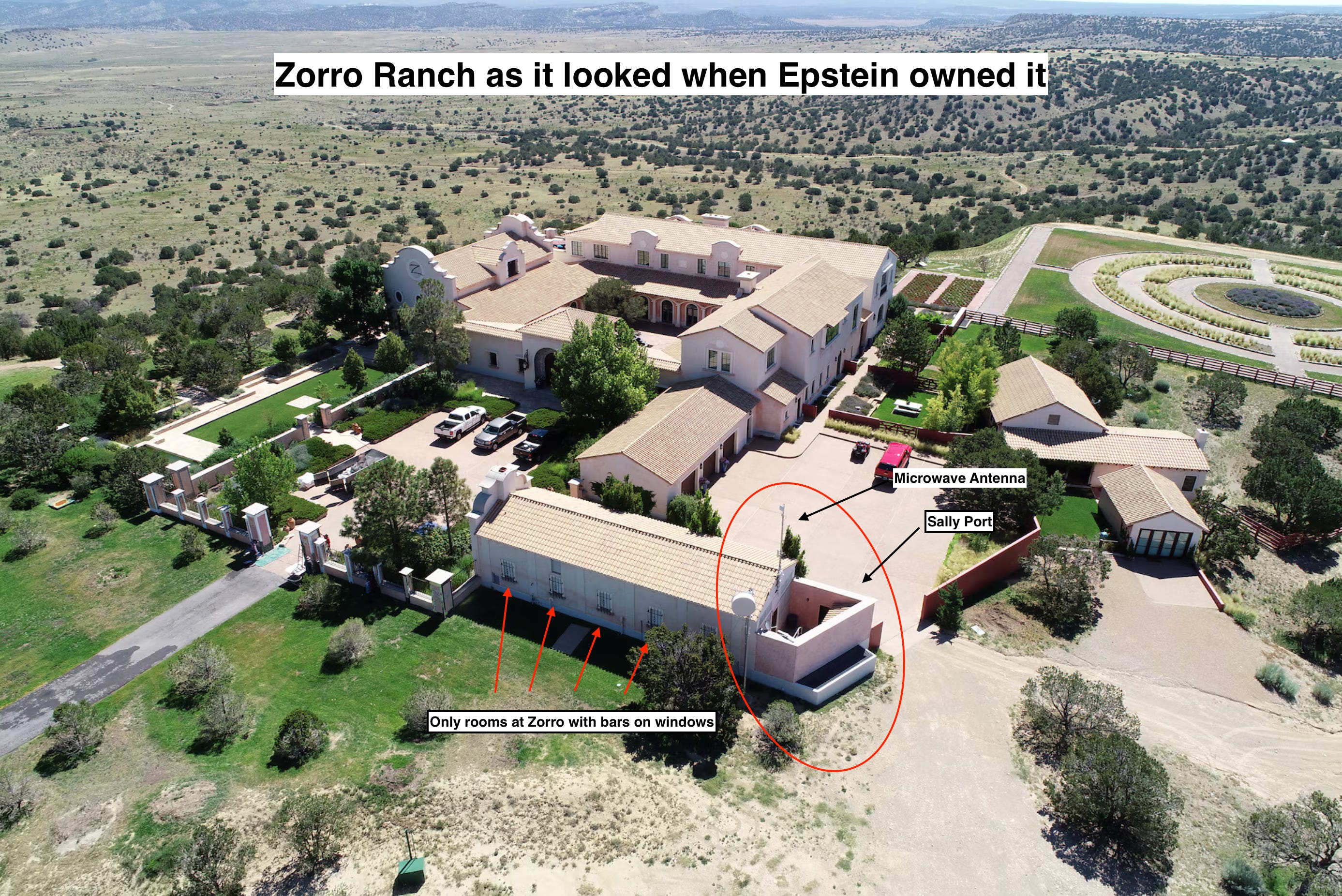
In emails contained within the 3+ million publicly available documents in the Dept. of Justice Epstein files, we see that in 2014, notorious child sex trafficker, child rapist and likely intelligence operative Jeffrey Epstein started asking about upgrading the modest communications network at Zorro Ranch to something far more substantial.
Then he waited.
By 2016, he had stopped waiting.
Over those two years, the project drew in his inner circle: his ranch manager Brice Gordon, his accountant Richard Kahn in New York, his lawyer Darren Indyke, his New York IT consultant and “personal genius” James Ce, and Jermaine Ruan, the man he called “the lsj guy,” his communications contact in the U.S. Virgin Islands. They emailed one another and called others too. Local contractors like Richard Boltz of Advanced Communications an Technology in Albuquerque. The list also included a man described only as “Vito,” the manager of the San Cristobal Ranch next door to Zorro, owned by the family of former OSS officer Henry Singleton, who founded Teledyne, one of the most successful defense contractors in the world.
But why? Why was Epstein suddenly and anxiously demanding a new and extremely robust private network at the ranch? And why did Epstein want a communications network that a local contractor would later describe as military and industrial grade, at a place Epstein treated as a vacation property, and where, by the state’s own recent (and likely wrong) estimate, he supposedly spent only two to five weeks a year? (NM Truth Commission interim report)
The answer is hidden in plain sight.
Epstein commands his team to simply recreate at his New Mexico ranch the same private communications system had at Little St. James, his private island.
Little St. James was the first Epstein property to have a powerful microwave communications setup, far more than a remote vacation compound would need, be it an island or a massive ranch.
People have long speculated that Epstein used that Little St. James system to send secret communications in his various unsavory dealings there and in his other properties. Survivors have repeatedly said their rapes were video recorded and used by Epstein and Maxwell to blackmail powerful people, claims backed up by photo evidence in the DOJ files that show hidden spy cameras in clocks and other items in rooms owned by Epstein.
One can safely assume that if kompromat were being collected by them, Epstein and Maxwell would need a powerful closed private communications network for the transmission of such materials to whomever they worked for who needed powerful men blackmailed for them.
So, who were Epstein and Maxwell working for? That’s still a subject of debate and speculation. While there seems to be a concerted effort by certain “independent” journalists, such as Zev Shalev, to point the finger at Russia as the likely recipient of such blackmail materials from Epstein and Maxwell, this appears to possibly be deliberate misdirection, likely paid for by what The Pugilist considers to be the most likely true power behind the operation: Israel.
Ghislaine Maxwell’s father was an Israeli spy, as documented in the book Robert Maxwell, Israel’s Superspy by Gordon Thomas and Martin Dillon. Ari Ben-Menashe, a former Israeli intelligence operative and the author of the book Profits of War: Inside the Secret U.S.-Israeli Arms Network, has said he was tasked with “running” Epstein, and was the man to introduce him to the Maxwells. Perhaps most damning of all is that the voting, legislative and financial records of those men in Epstein’s potential blackmail orbit always ended up shifting after their association with him, to become strongly supportive, in one way or another, of the goals of the Zionist Israeli government. In New Mexico, those goals appear to have been connected to a task begun by Robert Maxwell in the 1980s, when he infiltrated the state’s nuclear weapons labs with software that had been bugged by Israeli military intelligence.
For many years, Epstein’s operation seemed to run smoothly and without interference out of the U.S. Virgin Islands. But by 2014, something there was making Epstein nervous about keeping the nexus of that massive private communications system at Little St. James.
For a while, he waited it out. Maybe hoping things would not get as bad as they could.
Then something happened, and he, seemingly spooked, stopped waiting. He started demanding. The new system in New Mexico, at Zorro Ranch, had to be built, and quickly.
There’s a reason for that. And the reason is this: As the walls started closing in around Epstein in the U.S. Virgin Islands, Florida and New York City, there was only one place left where he held a vast property, where had complete privacy, and where its leadership had been so easy to blackmail, bribe, or otherwise buy off that Epstein trusted no one in power there would ever betray him.
And that place, dear readers, was New Mexico.
The island, and the people who once covered for him
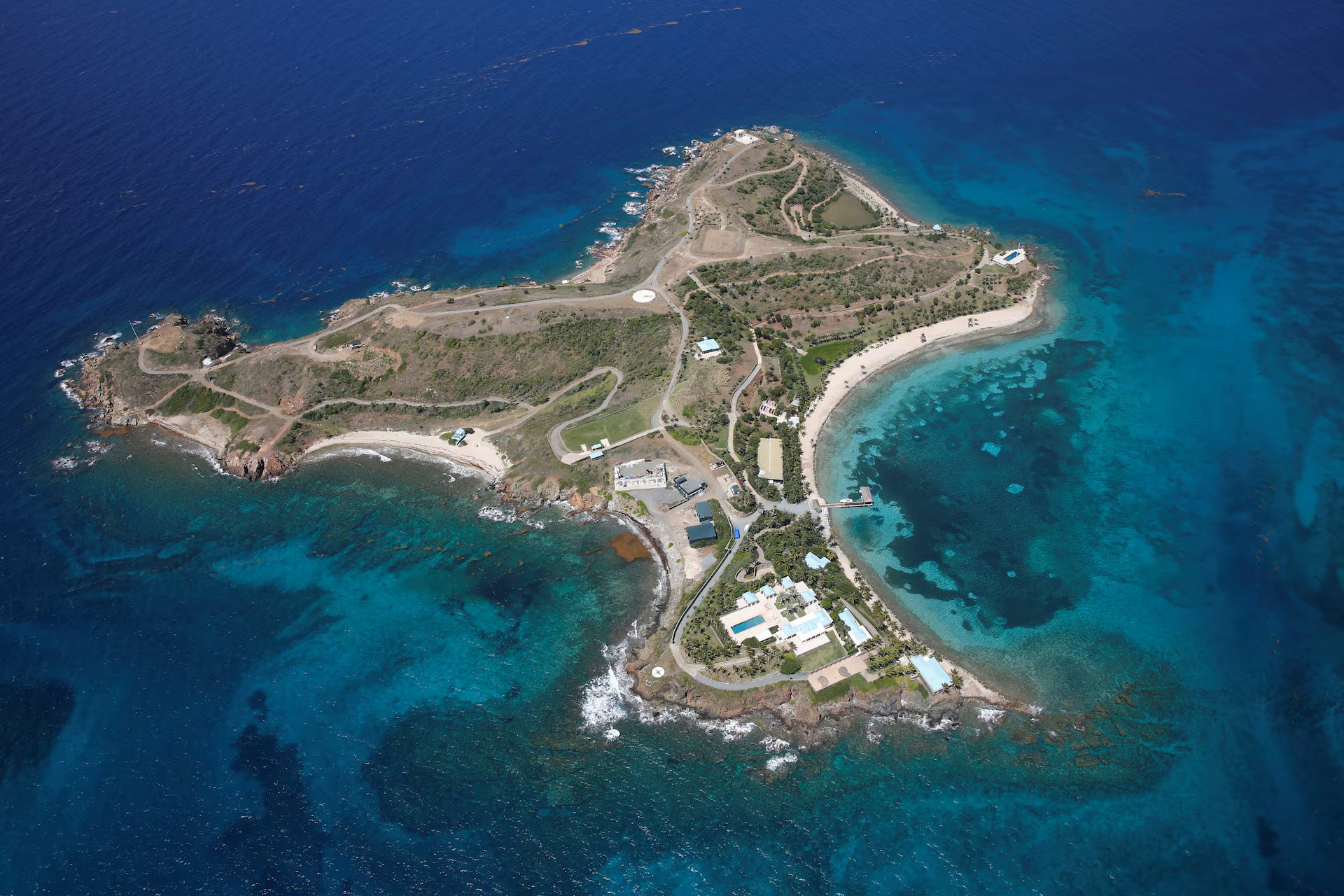
Little St. James was Epstein’s primary residence and, according to the Virgin Islands’ own attorney general, the center of his child (and adult) sex trafficking operation. She alleged that he lured girls and young women to the island, kept a computerized database to track those he could traffic there, and later bought neighboring Great St. James in part to keep anyone from watching. When sex-offender registry officials came to verify his address, they could go no farther than the dock unless Epstein or his staff invited them.
Epstein had been wiring the island for years. Steve Scully, who owned a telecommunications business on St. Thomas, told ABC News in 2019 that Epstein hired him in 1999 to build a communications network on Little St. James, and that over six years he visited the island more than 100 times. Epstein wanted phone or internet service almost everywhere on the 72-acre island, Scully said, including a secluded cove he called “the grotto.” He “never wanted a call to drop.” Scully said he walked away over what he saw there: groups of girls who appeared to be unsupervised and who “couldn’t have been more than 15 or 16 years old.”
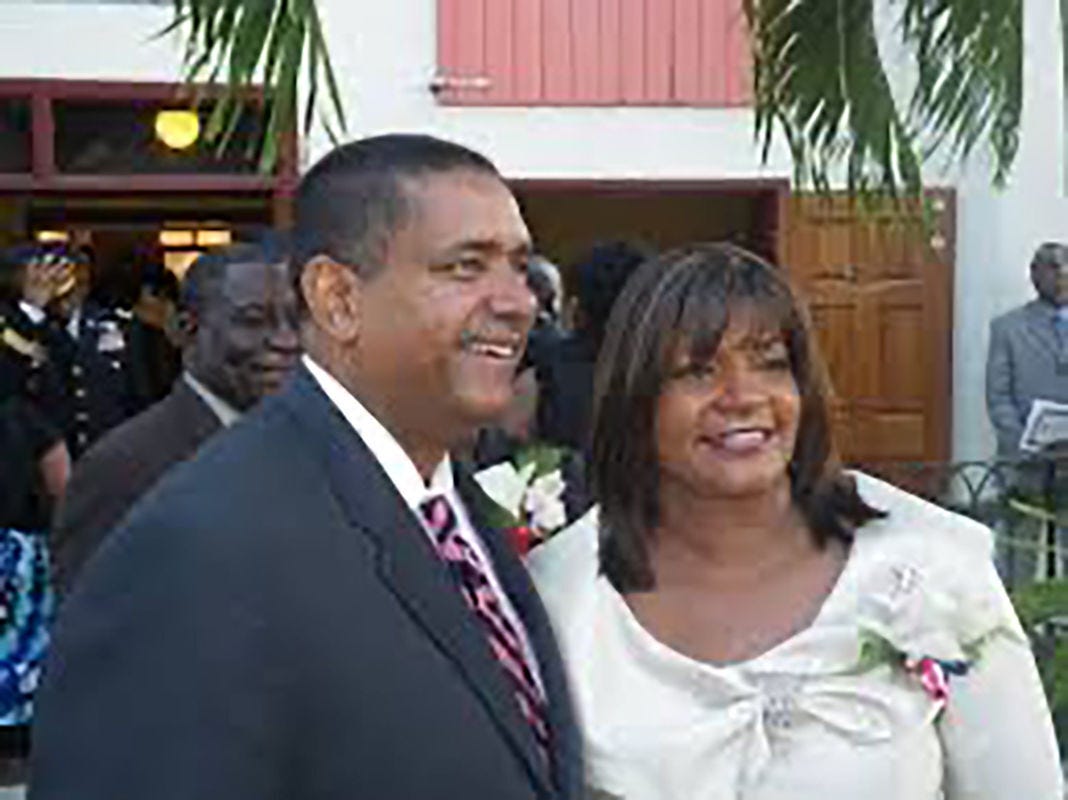
Epstein could operate that way because the territory’s government let him. From 2007 to January 2015, the Virgin Islands was governed by John de Jongh Jr. For that entire stretch, according to JPMorgan Chase, the governor’s wife, Cecile de Jongh, worked for Epstein as office manager of his St. Thomas companies. JPMorgan alleged she was paid as much as $200,000 a year, that Epstein paid the couple’s children’s tuition, and that in 2009 she certified Epstein was a “bona fide resident” while he was serving his Florida sentence. In 2011, according to the bank, she sent Epstein draft language for the territory’s sex-offender monitoring law and asked whether it would work for him. The de Jonghs have contested the claims against them in court.
In 2014, Epstein was about to lose that protection. De Jongh was finishing his second term and could not run again. Epstein courted his successor, Kenneth Mapp, from the start: Mapp later acknowledged a $10,000 Epstein contribution to his inaugural committee, and he had lunch on the island, probably in 2016. But Mapp was a different kind of governor. In text messages released by the Justice Department, he repeatedly scolded Epstein for building on his islands without permits and told him environmental matters could not be settled informally. By 2018, Epstein’s own lawyer is seen in the DOJ files strategizing about how to unseat Mapp.
The pressure was building outside the islands too. On December 30, 2014, Virginia Roberts asked to join a federal lawsuit in Florida that challenged Epstein’s 2008 plea deal, and her filing named Prince Andrew and Alan Dershowitz, both of whom denied her allegations. In 2015, now Virginia Giuffre, she sued Ghislaine Maxwell in federal court in New York. These were civil cases brought by victims, not criminal investigations; those would come later. But their discovery reached into Epstein’s and Maxwell’s records, and the Florida case threatened to tear up the deal that had kept him out of federal prison.
The Virgin Islands, long his safe haven, was suddenly not looking so safe. But another of his properties was. Florida had prosecuted him. New York would. The Virgin Islands would sue his estate and collect more than $105 million. New Mexico, where he owned 10,000 acres, never charged him, never made him register as a sex offender, and never searched his ranch until 2026, seven years after his death. More than any other place Epstein kept a home, New Mexico had done the least to hold him accountable, and he could wagered he could count on that continuing. (Spoiler alert: He was right.)
I believe that whatever Epstein was sending and receiving through his network at Little St. James, he began moving to New Mexico in those years. He started planning the twin in 2014 and then hesitated. He pushed it through in 2016, after his protector had left office and his name was back in headlines beside Prince Andrew’s. It was finished in September 2016.
When the reckoning finally came, it proved him right about New Mexico. The Miami Herald’s 2018 series “Perversion of Justice” blew open the Florida case, and the Virgin Islands sued his estate after his death.
Zorro Ranch went unsearched until this year, seven years after his death. It is only now, too, that the state’s attorney general is finally investigating Epstein’s crimes here. Both of these things might never have happened if the release of the DOJ files earlier this year had not been so deeply, pathetically embarrassing for the state and its leaders, and many of them named in the files as taking money from Epstein are still in positions of power today. There is some indication that the state’s sudden creation of a “truth commission” made of four state legislators, one of whom has since resigned from office after a conflict of interest was made public, and another of whom has a similar conflict but is refusing to resign, was created mostly as damage control and public relations.
Without the world finally having known about the New Mexico power structure’s deep ties to Epstein, I rather suspect no one here would have done a goddamned thing at all.
The build, document by document
Until 2014, Zorro ran on two leased T-1 lines and an unlicensed radio hop to Sandia Crest, about a megabit and a half of data. (EFTA01124584) The emails released under the Epstein Files Transparency Act show what happened next.
June 2014. Epstein approves a bid from Richard Boltz of Advanced Communications for a licensed microwave link, and a $30,000 deposit goes out on a $48,984 job. (EFTA00991033, EFTA01206652) That month, Richard Kahn reports that the ranch’s data lines keep getting hammered with traffic “even when no one is using any computer equipment.” (EFTA00706953)
2014. Epstein asks for the Zorro system to duplicate what he has at Little St. James.
October 6, 2014. The FCC grants Zorro Development Corp. its first two microwave licenses, WQUT488 and WQUT489.
December 1, 2014. The project stalls; Kahn tells the vendor they will wait for Epstein’s next visit before deciding whether to cancel. (EFTA01206652) The 2014 licenses lapse unbuilt in April 2016.
March 22, 2016. Ranch manager Brice Gordon forwards Epstein a memo laying out three options. The cheapest is to share a fiber site on the neighboring San Cristobal Ranch; the most expensive is a 27-mile shot to Sandia Crest that the memo says would require industrial or military grade equipment. Epstein picks Sandia Crest. (THE PUGILIST)
March 23, 2016. Epstein refuses a gigabit link and points to the DragonWave radios he already uses: “we shoot dragon wave further.” (EFTA00830845)
March 25, 2016. Epstein tells Gordon that if problems come up, they should bring in “the lsj guy.” (THE PUGILIST)
April 15, 2016. The contractor runs the engineering numbers: 27.53 miles from Sandia Crest straight to the main residence. (EFTA00702637)
May 2016. A crew confirms line of sight by flashing a signal mirror toward the peak. (EFTA01738251)
July 12, 2016. The FCC grants WQXY316 and WQXY300, a two-way link between the ranch house and Sandia Crest.
September 26, 2016. Gordon confirms the link is finished. (EFTA02450493)
November 2016. Gordon writes that he and his wife are returning to their “new home” on Little St. James. They keep managing Zorro until Epstein’s death.
The people on the emails
The documents name the people Epstein relied on to build and run the network. Each played a documented role. Kahn, as co-executor of Epstein’s estate, has been sued by government plaintiffs over the estate; the others have not been accused of any wrongdoing.
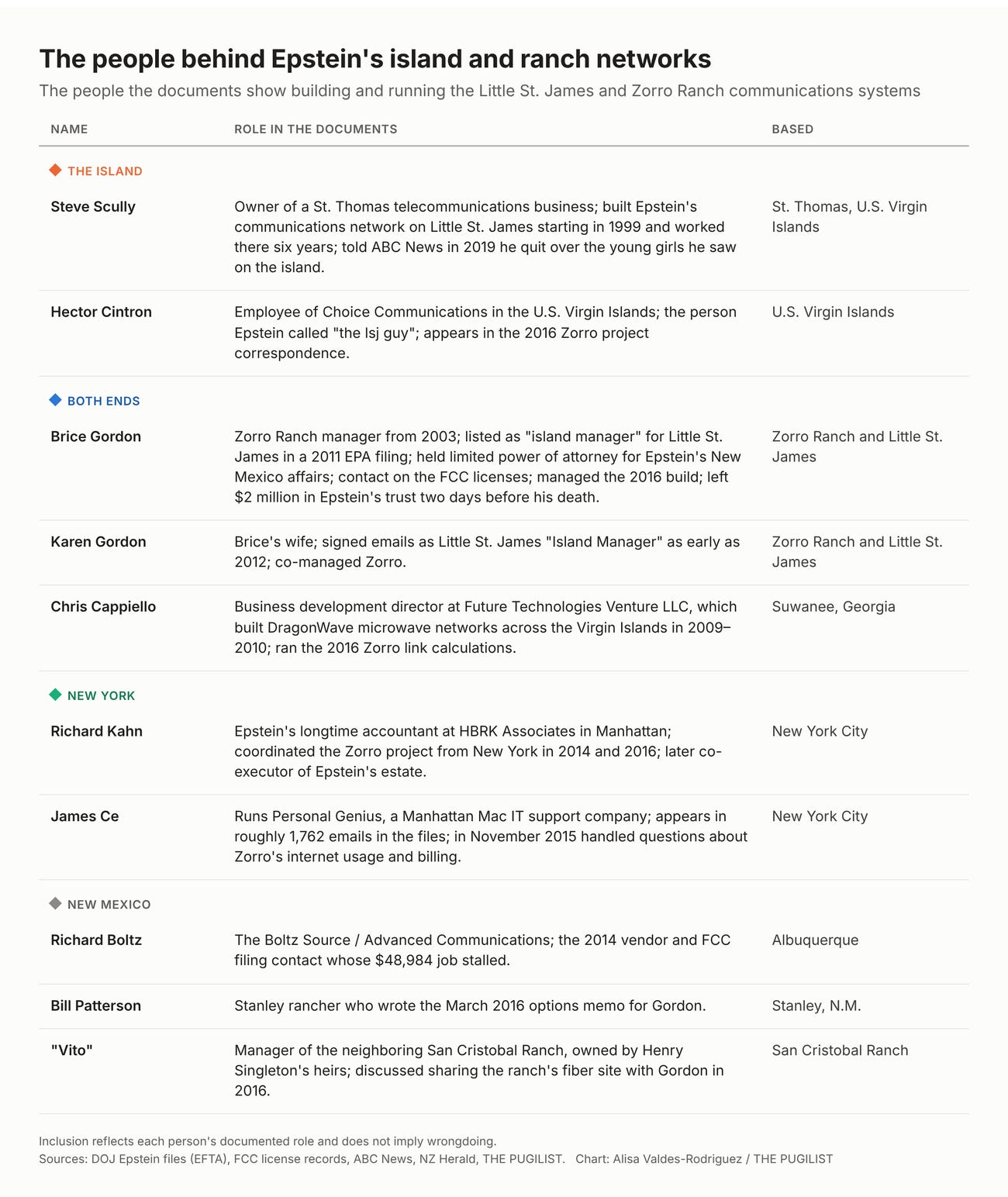
The pattern matters more than any one name. The vendor who built the islands’ microwave backbone designed Zorro’s. The island’s communications man was on call for the ranch. And the couple who had managed Little St. James since at least 2011 built the New Mexico link, then went back to the island while still running Zorro. The same small team ran both ends of a twin system.
The documents show what the network was built to do and who built it. They do not show what it carried. That is the question only these people, or a subpoena, can answer.
The case against everything I’ve written about the communications system at Zorro Ranch, answered point by point
The most detailed rebuttal to my reporting on this comes from self-described researcher on Substack, named Rye Howard-Stone. He went through the same emails and concluded that the Zorro network was nothing but a troubled rural broadband project. His argument, published in his own newsletter, deserves a full hearing, and an answer, point by point. But before we get to that, we should also make it clear that Howard-Stone is associated with another group of “journalists” in Zionist Cliff Schechter’s “Blue Amp Media” universe. This cabal, which serves the Zionist wing of the United States Democratic Party (and has a strong interest in hiding the truth about Zorro Ranch and the powerful NM Democrats in Epstein’s orbit) includes people like Ellie Leonard (on Blue Amp’s payroll), mega-grifter Lev Parnas and a few other less significant “influencers” who joined forces in an attempted smear campaign against me in the wake of my having published articles that pointed towards Israel’s possible involvement with Epstein’s child sex trafficking ring.
Ahem. Here we go:
The license. Howard-Stone notes that the license Epstein used, Microwave Industrial/Business Pool, is one of the most common the FCC issues: more than 55,000 are active, about 1,500 of them held by Union Pacific Railroad alone. That’s true, and it’s the wrong comparison. These licenses belong to railroads, electric utilities, pipelines, internet providers and governments. So I downloaded the FCC’s complete license file, dated October 18, 2026, and went through it. Of 55,487 active licenses, about two dozen connect to a private house, cabin, lodge or ranch, roughly one in 2,400. That means only 0.04% of these “common” licenses were issued to private homes. It also means that among private homes in the USA with internet service, the chance that the service is provided by the kind of operation Epstein had at both LSJ and Zorro is 0.000022429906542056075%. In other words: For a private home, this type of license is close to unheard of. Howard-Stone has a fucked-up view of what the word “common” means.
The hardware. He’s right that the DragonWave radios are standard equipment rural internet providers use every day. I’ll grant it. The question this piece asks was never whether the radios were exotic. It’s why a man with a vacation ranch built a private, point-to-point link he owned end to end, with the same brand of radio, designed by the company that built the Virgin Islands’ microwave backbone, with his island’s communications man on call. Ordinary parts can build an extraordinary system.
The speed. Howard-Stone reads Epstein’s refusal of a gigabit connection as proof that this was only about getting decent internet. The March 2016 options memo points the other way. Plan A was to tap fiber at the neighboring San Cristobal Ranch, where gigabit service was available, and talks with the ranch’s manager were already under way. Plan B was the memo writer’s recommended fallback: lease any nearby property with gigabit fiber and build a short microwave hop, as he had done on his own ranch. Plan C, the 27-mile shot to Sandia Crest, was his least favorite: hard to reach, expensive, and expected to carry about 30 percent of the bandwidth. Within 48 hours of receiving the memo, with the neighbor’s fiber still in negotiation and Plan B untried, Epstein chose Plan C. A man shopping for internet takes the fast, cheap option down the road. A man who wants a path that runs through nobody else’s equipment pays more for less. Epstein was never after speed. He was after privacy.
The antenna. Howard-Stone cites Epstein’s objection to seeing the antenna as the fussiness of a rich homeowner. Maybe. It’s also what you would expect from someone who didn’t want the link noticed, and the emails show the contractor flagging for “Jeffrey’s attention” whether the dish would be visible from the back parking area.
The heating and cooling. When the link failed in a March 2017 storm, the ranch manager shut down the main house’s climate system. Howard-Stone ties that to a 2015 Honeywell contract that made the climate controls depend on an internet connection. That may be right, and it proves only that the link carried ordinary traffic too, which this piece never disputes. A thermostat’s data and any other data travel the same path. And as Howard-Stone himself acknowledges, Gordon’s email never says why he shut the system down.
The route. He suggests the completion email, which describes a link “from Sandia to Ranch and MH to Lodge,” may mean the 27-mile path was never built as a single jump. The FCC’s own record settles it: license WQXY316 runs directly from a site labeled “MAIN RESIDENCE” to one labeled “SANDIA CREST TOWER.”
The licenses. He reports that WQXY316 and WQXY300 expired on July 12, 2026. FCC records confirm it. The licenses were active when THE PUGILIST first reported on them in March; they lapsed four months later, at the end of their ten-year term. The more telling fact is how long they lasted: the licenses stayed active in the name of Epstein’s company, Zorro Development Corp., for three years after the ranch was sold in 2023.
The silence in the files. Finally, Howard-Stone notes that the released documents never mention Sandia Labs, Los Alamos or any intelligence agency in connection with this network. No shit. He says this as if all the truth of Epstein is only contained in the files. As if reporting were limited only to things a robot can find on the internet (Howard-Stone’s specialty.)
First off, we do not know what the full Epstein files contain. Most of them have never been released, and the ones that have been are heavily redacted.
Secondly, the only reason a man with associations such as Howard-Stone’s would stand up, point a scrawny finger at my work and say, “That’s not true” without evidence is because someone paid (or merely flattered and misled?) him to do that. I think we all know who that might be.
The questions New Mexico hasn’t asked
I cannot tell you what traveled over that 27-mile path between 2016 and 2019. As far as I can find in the public record, nobody with subpoena power has tried to find out.
New Mexico has two bodies that could. The Department of Justice reopened its criminal investigation in February. The Truth Commission has subpoena power and a list of witnesses. I am putting these questions to both, and will report their answers:
Do you plan to subpoena or interview the people who built and ran these networks — Brice and Karen Gordon, Richard Kahn, James Ce, Hector Cintron, Chris Cappiello and Future Technologies, Richard Boltz, and the operator of the Sandia Crest tower — about what the Zorro and Little St. James systems carried?
Have you subpoenaed the companies’ records: invoices, network configurations, access logs, and any record of who could reach the system remotely?
During the March 2026 search, did investigators examine the ranch’s communications equipment, or ask the current owners for its logs, configurations or storage devices?
Have you asked the U.S. Virgin Islands, or Choice Communications, for records of the Little St. James network Zorro was modeled on?
The Truth Commission’s counsel said the Gordons are on its list to depose. When?
Epstein spent two years and tens of thousands of dollars making sure his ranch could talk privately with his island and the rest of the world. Seven years after his death, New Mexico still hasn’t asked what it said.
Looking beyond New Mexico
My coverage of the Epstein saga has so far been provincial by design, focused almost exclusively on what happened here in my home state of New Mexico, and on what did not happen but should have. Now I have started looking beyond our borders, at the ways Epstein’s other properties and connections shaped what he did, and did not do, here.
In 2014, as the rest of Epstein’s secretive world was slowly being uncovered at his other estates, he figured that here in New Mexico no one would bother him.
And he was right.
I offer all my news, investigations and analysis for free. But your support is necessary and appreciated. Please like, share, comment and subscribe, paid if you’re able. You may also leave a one-time or recurring tip in any amount. Just four $25 tips per day keep me writing full time. Thank you!
 reply
reply