1122 stories
·
0 followers

A Looking Glass Half Empty, Part 2: A Series of Unfortunate Events

1 Share

This article tells part of the story of Looking Glass Studios.

Coming out of 1998, the folks at Looking Glass Studios believed they had pretty good reason to feel optimistic about their future. With Thief, they had delivered not just their first profitable original game since 1995’s Flight Unlimited but their biggest single commercial success ever. They had no fewer than four more games slated for release within the next fifteen months, a positively blistering pace for them. Yes, all of said games were sequels and iterations on existing brands, but that was just the nature of the industry by now, wasn’t it? As long-running franchises like Ultima had first begun to demonstrate fifteen years ago, there was no reason you couldn’t continue to innovate under a well-known and -loved banner headline. Looking Glass closed their Austin office that had done so much to pay the bills in the past by taking on porting contracts. In the wake of Thief, they felt ready to concentrate entirely on their own games.

Then, just as they thought they had finally found their footing, the ground started to shift beneath Looking Glass once again. Less than a year and a half after the high point of Thief’s strong reviews and almost equally strong sales, Paul Neurath would be forced to shutter his studio forever.

We can date the beginning of the cascading series of difficulties that ultimately undid Looking Glass to March of 1999, when their current corporate parent decided to divest from games, which in turn meant divesting from them. Intermetrics had been on a roller-coaster ride of its own since being purchased by Michael Alexander in 1995. In 1998, the former television executive belatedly recognized the truth of what Mike Dornbrook had tried to tell him some time ago: that his dreams and schemes for turning Intermetrics into a games or multimedia studio made no sense whatsoever. He deigned to allow the company to return to its core competencies — indeed, to double-down on them. Late in the year, Intermetrics merged with Pacer InfoTec, another perennial recipient of government and military contracts. The new entity took the name of AverStar. When one looked through its collection of active endeavors — making an “Enterprise Information Portal” for the Army Chief of Staff; developing drainage-modeling software for the U.S. Geological Survey; providing “testing and quality-support services” for the Administrative Office of the U.S. Courts; writing and maintaining software for the Space Shuttle and other NASA vehicles — the games of Looking Glass stood out as decidedly unlike the others. Michael Alexander and his reconstituted team of managers, most of them grizzled veterans of the Beltway military-industrial complex, saw no point in continuing to dabble in games. In the words of Looking Glass programmer Mark LeBlanc, “AverStar threw us back into the sea.”

Just as is the case with Intermetrics’s acquisition of Looking Glass barely a year and a half earlier, the precise terms under which Alexander threw his once-prized catch back have never surfaced to my knowledge. It’s clear enough, however, that Looking Glass’s immediate financial position at this juncture was not quite so dire as it had been, thanks to the success of Thief if nothing else. Still, none of the systemic problems of being a small fish in the big pond of the games industry had been solved. Their recent success notwithstanding, without a deeper-pocketed parent or partner to negotiate for them, Looking Glass was destined to have a harder time getting their games into stores and selling them on their own terms.

The next unfortunate event — unfortunate for Looking Glass, but deeply tragic for some others — came about a month later. On April 20, 1999, two deeply troubled, DOOM-loving teenagers walked into their high school in the town of Columbine, Colorado, carrying multiple firearms each, and proceeded to kill thirteen of their fellow students and teachers and wound or terrorize hundreds more before turning their guns on themselves. This act of mass murder, occurring as it did before the American public had been somewhat desensitized to such massacres by the sheer numbing power of repetition, placed the subject of violence in videogames under the mass-media spotlight in a way it hadn’t been since Joseph Lieberman’s Senate hearings of 1993. Now Lieberman, a politician with mounting presidential ambitions, was back to point the finger more accusingly than ever.

This is not the place to attempt to address the fraught subject of what actual links there might be between violence in games and violence in the real world, links which hundreds of sociological and psychological studies have never managed to conclusively prove or disprove. Suffice to say that attributing direct causality to any human behavior outside the controlled setting of a laboratory is really, really hard, even before one factors in the distortions that can arise from motivated reasoning when the subject being studied is as charged as this one. Setting all of that aside, however, this was not a form of attention to which your average gaming executive of 1999 had any wish to expose himself. First-person action games that looked even vaguely like DOOM — such as most of the games of Looking Glass — were cancelled, delayed, or de-prioritized in an effort to avoid seeming completely insensitive to tragedy. De-prioritization rather than something worse was the fate of Looking Glass’s System Shock 2, but that would prove plenty bad enough for a studio with little margin for error.
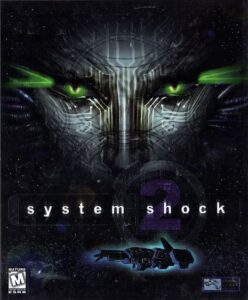
The story of System Shock 2′s creation is yet another of those “only at Looking Glass” tales. In 1994, a 27-year-old Boston-area computer consultant named Ken Levine played System Shock 1 and was bowled over by the experience. A year or so later, he saw a want ad from the maker of his favorite game in a magazine. He applied and was hired. He contributed a great deal to Thief during that project’s formative period of groping in the dark — he is credited in the finished game for “initial design and story concepts” — and then was given a plum role indeed. Looking Glass had just won a contract to make an adventure game based on the popular new television series Star Trek: Voyager, and Levine was placed in charge of it.

Alas, that project fell apart within a year or so, when Viacom, the media conglomerate that owned the property, took note of the lackluster commercial performance of another recent Star Trek adventure game — and of recent adventure games in general — and pulled the plug. Understandably enough, Levine was devastated at having thus wasted a year of his life. Somewhat less understandably, he blamed the management of Looking Glass as much as Viacom for the fiasco. He left to start his own studio, taking with him two other Looking Glass employees, by the names of Jon Chey and Rob Fermier.

This is where the story gets weird, in an oh, so Looking Glass sort of way. Once they were out on their own, trading under the name of Irrational Games, the trio found that contracts and capital were not as easy to come by as they had believed they would be. At his wit’s end, facing the prospect of a return to his former life as an ordinary computer consultant, Levine came crawling back to his old boss Paul Neurath. But rather than ask for his old job back, he asked that Irrational be allowed to make a game in partnership with Looking Glass, using the same Dark Engine that was to power Thief. Most bosses would have laughed in the face of someone who had poached two of their people in a bid to show them up and show them how it was done, only to get his comeuppance in such deserving fashion. But not Neurath. He agreed to help Levine and his friends make a game in the spirit of System Shock, Levine’s whole reason for joining the industry in the first place. In fact, he even let them move back into Looking Glass’s offices for a while in order to do it. Neurath soon succeeded in capturing the interest of Electronic Arts, the corporate parent of Origin Systems and thus the owner of the System Shock brand. Just like that, Levine’s homage became a direct sequel, an officially anointed System Shock 2.

The ironic capstone to this tale is that Warren Spector had recently left Looking Glass because he had been unable to secure permission to do exactly what the unproven and questionably loyal young Ken Levine was now going to get to do: to make a spiritual heir to System Shock. Spector ended up at Ion Storm, a new studio founded by John Romero of DOOM fame, where he set to work on what would become Deus Ex.

In the course of making System Shock 2, the Irrational staff grew to about fifteen people, who did eventually move into their own office. Nonetheless, the line separating their contributions from those of Looking Glass proper remained murky at best. As a postmortem written by Jon Chey would later put it, “the project was a collaborative effort between two companies based on a contract that only loosely defined the responsibilities of each organization.” It’s for this reason that I’ll be talking about System Shock 2 from here on like I might any other Looking Glass game.

The sequel isn’t shy about embracing its heritage. Once again, it casts you into an outer-space complex gone badly, horrifyingly haywire; this time you find yourself in humanity’s first faster-than-light starship instead of a mere space station. Once again, the game begins with you waking up disoriented, not knowing how you got here, forced to rely on narrations of the backstory that may or may not be reliable. Once again, your first and most obvious antagonists are the zombified corpses of the people who used to crew the ship. Once again, you slowly learn what really went down here through the emails and logbooks you stumble across. Once again, you have a variety of cybernetic hardware to help you stay alive, presented via a relentlessly diegetic interface. Once again, you meet SHODAN, the disembodied, deliciously evil artificial intelligence who was arguably the most memorable single aspect of the very memorable first game. And once again, she is brought to iconic life by the voice of Terri Brosius. In these ways and countless others, this apple doesn’t fall far from the tree.
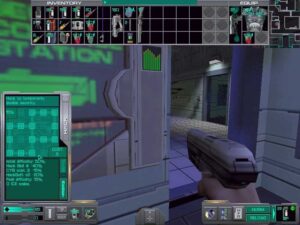
But even as it embraces its heritage in the broad strokes, System Shock 2 isn’t averse to tinkering with the formula, through both subtraction and addition. The most significant edit is the elimination of a separate, embodied cyberspace, which was already beginning to feel dated in 1994, having been parachuted in straight out of William Gibson’s 1984-vintage Neuromancer. Cyberspace has its charms in System Shock 1, but few would deny that it’s the roughest part of the game in terms of implementation; it was probably a wise choice for Ken Levine and company to focus their efforts elsewhere. More debatable are their decisions to simplify the hacking mini-games that you sometimes need to play to open locked doors and the like, and to eliminate the unique multi-variant difficulty settings of the first game, which let you turn it into whatever kind of experience you desire, from a walking simulator to an exercise in non-stop carnage to a cerebral pseudo-adventure game. System Shock 2 settles for letting you choose a single setting of “Easy,” “Normal,” “Hard,” or “Impossible,” like any standard-issue shooter of the era.
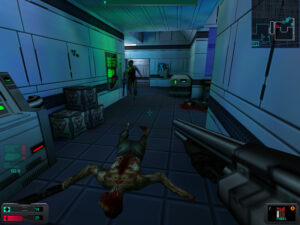
In fact, at first glance this game looks very much like a standard shooter. If you try to play it as one, however, you’ll be quickly disabused of that notion when you die… and die and die and die. This isn’t a stealth game to the same extent as Thief, but it does demand that you proceed with caution, looking for ways to outwit enemies whom you can’t overcome through firepower. If you can’t see your way to noticing and disabling the security cameras that lurk in many a corner, for example, you’re going to find yourself overwhelmed, no matter how fast and accurate a trigger finger you happen to possess.

By way of a partial replacement for the multi-variant difficulty settings of its predecessor, Irrational chose to graft onto System Shock 2 more CRPG elements. Theoretically at least, these give you almost as much control over what kind of game you end up playing. You can go for a combat-oriented build if you want more of a shooter experience — within reason, that is! — or you can become a hardcore tech-head or even a sort of Jedi who makes use of “psi” powers. Or you can judiciously mix and match your abilities, as most players doubtless wind up doing. After choosing an initial slate of skills at the outset, you are given the opportunity to learn more — or to improve the ones you already have — at certain milestones in the plot.
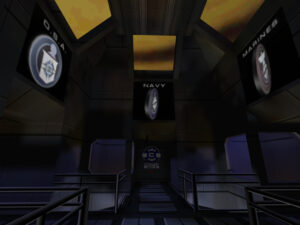
You create your character in System Shock 2 in a similar way to the old Traveller tabletop RPG, by sending him off on three tours of duty with different service branches — or the same one, if you prefer. (I fancy I can see some traces of the Star Trek: Voyager game which Ken Levine once set out to make in the vibe and the iconography here.) This is an example of how System Shock 2 can sometimes feel like it has a few too many ideas for its own good. It seems like an awful lot of effort to go through to establish a character who is about to get his memories erased anyway.

System Shock 2 is an almost universally acclaimed game today, perhaps even more so than its uglier low-res predecessor. There are good reasons for this. The atmosphere of dread builds and builds as you explore the starship, thanks not least to masterful environmental sound design; if anything, this game is more memorable for its soundscape than for its visuals. Although its emergent qualities are certainly nothing to sneeze at, in my opinion the peak moment of the game is actually pre-scripted. A jaw-dropping plot twist arrives about halfway through, one of the most shocking I’ve ever encountered in a game. I hesitate to say much more here, but will just reveal that nothing and no one turn out to be what you thought they were, and that SHODAN is involved. Because of course she is…

For all its increased resolution and equal mastery of atmosphere, however, System Shock 2 doesn’t strike me as quite so fully realized as the first System Shock. It also suffers by comparison with Warren Spector’s own System Shock successor Deus Ex, which was released about nine months later. System Shock 2 never seems entirely sure how to balance its CRPG elements, which are dependent on character skill, with its action elements, which are dependent on player skill. Increasing your character’s skill in gunnery, for example, somehow makes your guns do more damage when you shoot someone with them; this is not exactly intuitive or realistic. Deus Ex just does so much of this sort of thing so much better. In that game, a higher skill level lets your character hold the gun steadier when you’re trying to shoot with it; this makes a lot more sense.
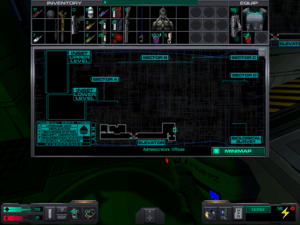
Unusually for Looking Glass, who seldom released a game before its time, System Shock 2 shows all the signs of having been yanked out of its creators’ hands a few months too early. The level design declines dramatically during the final third of the game, becoming downright sketchy by the time you get to the underwhelming finale. The overall balance of the gameplay systems is somewhat out of whack as well. It’s really, really hard to gain traction as a psi-focused character in particular, and dismayingly easy to end up with a character that isn’t tenable by choosing the wrong skills early on. I found a lot of the design choices in System Shock 2 to be tedious and annoying, such that I wished for a way to just turn them off: the scarcity of ammunition (another way to find yourself in an unwinnable cul de sac), the way that weapons degrade at an absurd pace and constantly need to be repaired, the endlessly respawning enemies that make hard-won firefights feel kind of pointless, the decision to arbitrarily deprive you of your trusty auto-map just at the point when you need it most.

Granted, some of this was also in System Shock 1, but it irritated me much more here. In the end, the two games provide very similar subjective experiences. Perchance this was just a ride I was only interested in going on once; perchance I would have a very different reaction to System Shock 2 if I had met it before its older sibling. Or maybe I’m just getting more protective of my time as I get older and have less and less of it left. (Ach… hold that morbid thought!)

Whatever its ratio of strengths to weaknesses, System Shock 2 didn’t do very well at all upon its release in August of 1999. Many folks from both Looking Glass and Irrational attribute this disappointment entirely to the tragic occurrence of four months earlier in Columbine, Colorado. Although the full picture is surely more nuanced — it always is, isn’t it? — we have no reason to doubt that the fallout from the massacre was a major factor in the game’s commercial failure. According to Paul Neurath, Electronic Arts pondered for a while whether it was wise to put System Shock 2 out at all. He remembers EA’s CEO Larry Probst telling him that “we may just want to walk away from doing shooters because there’s talk of these shooters causing these kinds of events.” “We convinced them to release the game,” says Neurath, “but they did almost zero marketing and they put it in the bargain discount $9.95 bin 45 days after the game launched. It never stood a chance to make any money. That really hurt us financially.”

If System Shock 2 was to some extent a victim of circumstances, Looking Glass’s next game was a more foreseeable failure. For some reason, they just couldn’t stop beating the dead horse of flight simulation, even though it had long since become clear that this wasn’t what their primary audience wanted from them at all. Flight Unlimited III wasn’t a bad flight simulator, but the changes it introduced to the formula were nowhere near as dramatic as those that marked Flight Unlimited II. The most notable new development was a shift from the San Francisco Bay to Washington State, a much larger geographical area depicted in even greater detail. (Owners of the second game were given the privilege of loading their old scenery into the new engine as well.) Innovation or the lack thereof aside, the same old problem remained, in the form of Microsoft’s 800-pound-gorilla of a flight-simulation franchise, which was ready with its own “2000” update at the same time. Published by Electronic Arts in late 1999, Flight Unlimited III stiffed even more abjectly than had System Shock 2.

On the left, we see Seattle-Tacoma International Airport as depicted in Microsoft’s Flight Simulator 2000. On the right, we see the same airport in Flight Unlimited III. The former modeled the whole world, including more than 20,000 airports; the latter tried to compete by modeling a comparatively small area better. Regardless of the intrinsic merits of the two approaches, Looking Glass’s did not prove a formula for marketplace success.

A comparatively bright spot that holiday season was Thief Gold, which added three new missions to the original’s twelve and tweaked and polished the existing ones. It did decently well as a mid-tier product with a street price of about $25, plus a $10 rebate for owners of the previous version of Thief and the promise of a $10 discount off the upcoming Thief II. But a product like this was never going to offset Looking Glass’s two big failures of 1999.

In truth, the Looking Glass goose was probably already more or less cooked as Y2K began. The only thing that might have saved them was Thief II: The Metal Age turning into a massive hit right out of the gate. Sadly, there was little likelihood of that happening; the best that Looking Glass could realistically hope for was another solid half-million seller. There was already a sense in the studio as the final touches were being put on Thief II that, barring a miracle, this game was likely to be their swansong.
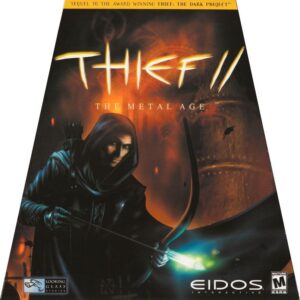
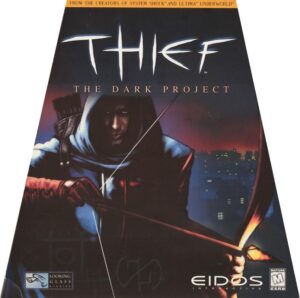
As swansongs go, Thief II acquits itself pretty darn well. It comes off as far more self-assured than its predecessor, being focused almost exclusively on stealth rather than monster-slaying through its fifteen cunningly crafted levels. Some of these spaces — a huge central bank, a sprawling warehouse complex, a rich art collector’s country estate — are intricate and beautiful enough that you almost wish there was an option to just wander around and admire them, without having to worry about guards and traps and all the rest. There’s a greater willingness here to use gameplay to advance the larger story: plot twists sometimes arrive in the midst of a mission, and you can often learn more about what’s really going on, if you’re interested, by listening carefully to the conversations that drift around the outskirts of the darkness in which you cloak yourself. Indeed, Thief II is positively bursting with little Easter eggs for the observant. Some of them are even funny, such as a sad-sack pair of guards who have by now been victimized by Garrett several times in other places, who complain to one another, Laurel and Hardy style, about their lot in life of constantly being outsmarted.

The subtitle pays tribute to the fact that the milieu of Thief has now taken on a distinct steampunk edge, with clanking iron robots and gun turrets for Garrett to contend with in addition to the ever-present human guards. Garrett now has a mechanical eye which he can use to zoom in on things, or even to receive the visual signal from a “scouting orb” that he’s tossed out into an exposed space to get a better picture of his surroundings. I must confess that I’m somewhat of two minds about this stuff: it’s certainly more interesting than zombies, but I do still kind of long for the purist neo-Renaissance milieu I thought I was getting when I played the first level of Thief I.
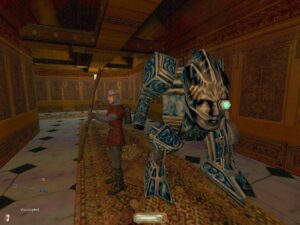
The “faces” on the robots look a bit like SHODAN, don’t they? Some of the code governing their behavior was also lifted directly from that game. But unlike your mechanical enemies in System Shock 2, these robots have steam boilers on their posteriors which you can douse with water arrows to disable them.

Beyond this highly debatable point, though, there’s very little to complain about here, unless it be that Thief II, for all its manifest strengths, doesn’t quite manage to stand on its own. Oddly in light of what a make-or-break title this was for them, Looking Glass seems not to have given much thought to easing new players into this very different way of approaching a first-person action game; they didn’t even bother to rehash the rudimentary tutorial that kicks off Thief I. As a result, and as a number of otherwise positively disposed contemporary reviewers noted, Thief II has more the flavor of an expansion pack — a really, really well-done one, mind you — than a full-fledged sequel. It probably isn’t the best place to start, but anyone who enjoyed the first game will definitely enjoy this one.

Looking Glass’s problem, of course, was that none of what I’ve just written sounds like a ticket to id- or Blizzard-level success, which was what they needed by this point to save the company. As Computer Gaming World wrote in its review, Thief II “is a ’boutique’ game: a gamer’s game. It pays its dividends in persistent tension rather than in bursts of fear. It still pumps as much adrenaline, but it works on a subtler level. It’s the difference between Strangers on a Train and Armageddon, between the intimated and the explicit.”

Having thus delivered another cult classic rather than a blockbuster, Looking Glass’s fate was sealed. By March of 2000, when Eidos published Thief II, Paul Neurath had been trying to sell the studio for a second time for the better part of a year. Sony was seriously interested for a while, until a management shakeup there killed the deal. Then Eidos was on the verge of pulling the trigger, only to have its bankers refuse to loan the necessary funds after a rather disappointing year for the company, in which the Tomb Raider train seemed to finally be running out of steam and John Romero’s would-be magnum opus Daikatana, which Eidos was funding and publishing for Ion Storm, ran way over time and budget. Not wanting to risk depriving his employees of their last paychecks, Neurath decided to shut the studio down with dignity. On May 24, 2000, he called everyone together to thank them for their efforts and to tell them that Thief II had been Looking Glass’s last game. “We’re closing,” he said. What else was there to say?

Plenty, as it turned out. The news of the shuttering prompted paroxysms of grief throughout gaming’s burgeoning online ecosystem, frequently accompanied by a full measure of self-loathing. Looking Glass had been just too smart for a public that wasn’t worthy of them, so the story went. Many a gamer who had always meant to pick up this or that subtly subversive Looking Glass masterstroke, but had kept delaying in favor of easier, more straightforward fare, blamed himself for being a part of the problem. But no amount of hand-wringing or self-flagellation could change the fact that Looking Glass was no more. The most it could do was to turn having worked for the studio into a badge of honor and one hell of a line item on anyone’s CV, as a Looking Glass diaspora spread out across the industry to influence its future.

To wit: the tearful tributes were still pouring in when Ion Storm’s Warren Spector-led Deus Ex reached store shelves in June of 2000. Cruel irony of ironies: Deus Ex became a hit on a scale that Thief, Looking Glass’s biggest game ever, could scarcely have dreamed of approaching. Right to the end, Looking Glass was always the bridesmaid, never the bride.


Looking Glass was a cool group, and a lot of us put a lot of time and energy and a large part of our lives into it, and it’s sad when that doesn’t work out. So there’s some part of me that says, oh, that sucks, that’s not fair, but it’s the real world and it had a pretty good run.

— Doug Church

Without consciously intending to, I’ve found myself writing quite a lot of obituaries of gaming icons recently: TSR, Sierra On-Line, MicroProse, Bullfrog, the adventure-making arm of Legend Entertainment. Call it a sign of the millennial times, a period of constant, churning acquisition and consolidation in which it began to seem that just half a dozen or so many-tendriled conglomerates were destined to divide the entirety of digital gaming among themselves. Now, we can add Looking Glass to our list of victims of this dubious idea of progress.

A lot of hyperbole has been thrown around about Looking Glass over the past quarter-century. A goodly portion of it is amply justified. That said, I do think there is some room for additional nuance. (There always is, isn’t there?) At the risk of coming off like the soulless curmudgeon in the room, I’m not going to write about Looking Glass here as if they were a bunch of tortured artists starving in a garret somewhere. Instead I’m going to put on my pragmatist’s hat and go off on in search of some more concrete reasons why these remarkable games didn’t resonate as much as they may have deserved to back in the day.

It shouldn’t be overlooked that Paul Neurath and Ned Lerner made some fairly baffling business decisions over the years. Their disastrous choice to try to make a go of it as an independent publisher against gale-force headwinds in 1995 can be all too easily seen as the precipitating event that sent Looking Glass down the road to closure five years later. Then, too, Neurath’s later insistence on persisting with the Flight Unlimited series must stand high on the list of mistakes. Incredibly, at the time Looking Glass was shut down, they were still at the flight-simulation thing, having spent a reported $3 million already on a fourth one, which was finally to add guns and enemy aircraft to the mix; this was half a million more than they had spent to make Thief II, a game with a far more secure customer base. [1]After the closure, some Looking Glass staffers migrated to the nearby Mad Doc Software, where they incorporated much of their flight-simulation code into Jane’s Combat Simulations: Attack Squadron. Released in 2002, it was not positively reviewed.

Then again, this isn’t a Harvard Business School case study. What final words are there to say about the games themselves, the real legacy of this company that failed rather spectacularly at its business-school ambition of making a lot of — okay, any — money? How should we understand them in their full historical context?

As you probably know, historical context is kind of my jam. Writing for this site is for me a form of time travel. I don’t play modern games for lack of hours in the day, and I’ve long since settled into a more or less one-to-one correspondence between present time and historical time; that’s to say, it takes me about one year worth of articles on this site to fully cover one year of gaming history and matters adjacent. We’ve by now moved out of the era when I was playing a lot of games in my previous life, so most of what I encounter is new to me. I think this puts me in a privileged position. I can come pretty close to experiencing and appreciating games — and the evolution of the medium as a whole — as a contemporary player might have done. When I read in the year 2025 that Looking Glass was poorly rewarded for their uncompromising spirit of innovation, I can understand and even to a large extent agree. And yet, in my role as a time traveler, I can also kind of understand why a lot of gamers ended up voting with their wallets for something else.

The decade after Looking Glass’s demise saw the rise of what gaming scholar Jesper Juul has dubbed the Casual Revolution; this was the heyday of BejeweledZumaDiner Dash, and the Big Fish portal, which brought gaming to whole new, previously untapped demographics who dwarfed the hardcore old guard in numbers. In 2010, when this revolution was at its peak, Juul put forth five characteristics that define casual gaming: “emotionally positive fictions”; “little presupposed knowledge” on the player’s part; a tolerance for being played in “short bursts”; “lenient punishments for failing”; and “positive feedback for every successful action the player performs.” The games of Looking Glass are the polar opposite of this list. At times, they seem almost defiantly so; witness the lack of an “easy” setting in Thief, as if to emphasize that anyone who might wish for such a thing is not welcome here. Looking Glass’s games are the ultimate “gamer’s games,” as Computer Gaming World put it, unabashedly demanding a serious commitment of time, focus, energy, and effort from their players. But daily life demands plenty of those things from most of us already, doesn’t it? In this light, it doesn’t really surprise me that a lot of people decided to just go play something more welcoming and less demanding. This didn’t make them ingrates; it just made them people who weren’t quite sure that there was enough space in their life to work that hard for their entertainment. I sympathize because I often felt the same in the course of my time-traveling; when I saw a new Looking Glass game on the syllabus, it was always a little bit harder than it ought to have been for me to muster the motivation to take the plunge. And this is part of what I do for a living!

Now, there’s certainly nothing wrong with gamer’s games. But they are by definition niche pursuits. The tragedy of Looking Glass (if I can presume to frame it in those terms in an article which has previously mentioned the real tragedy that took place at Columbine High School) is that they were making niche games at a time when the economics of the industry were militating against the long tail, pushing everyone toward a handful of tried-and-true mainstream gameplay formulas. After the millennium, the rise of digital distribution would give studios the luxury of being loudly and proudly niche, if that was where their hearts were. (Ironically, this happened at the same instant that ultra-mainstream casual gaming took off, and was enabled by the same transformative technology of broadband in the home.) But digital distribution of games as asset-heavy as those of Looking Glass was a non-starter throughout the 1990s. C’est la vie.

This situation being what it was, I do feel that Looking Glass could have made a bit more of an effort to be accessible, to provide those real or metaphorical easy modes, if only in the hope and expectation that their customers would eventually want to lose the training wheels and play the games as they were meant to be played. On-ramping is a vital part of the game designer’s craft, one at which Looking Glass, for all their strengths in other areas, wasn’t all that accomplished.

Another thing that Looking Glass was not at all good at, or seemingly even all that interested in, was multiplayer, which became a bigger and bigger part of gaming culture as the 1990s wore on. (They did add a co-operative multiplayer mode to System Shock 2 via a patch, but it always felt like the afterthought it was.) This was a problem in itself. Just to compound it, Looking Glass’s games were in some ways the most single-player games of them all. “Immersion” was their watchword: they played best in a darkened room with headphones on, almost requiring of their players that they deliberately isolate themselves from the real world and its inhabitants. Again, this is a perfectly valid design choice, but it’s an inherently niche one.

Speaking only for myself now, I think this is another reason that the games of Looking Glass proved a struggle for me at times. At this point in my life at least, I’m just not that excited about isolating myself inside hermetically sealed digital spaces. If I want total immersion, I take a walk and immerse myself in nature. Games I prefer to play on the sofa next to my wife. My favorite Looking Glass game, for what it’s worth, is System Shock 1, which I played at an earlier time in my life when immersion was perhaps more of a draw than it is today. Historical context is one thing, personal context another: it’s damnably difficult to separate our judgments of games from the circumstances in which we played them.

Of course, this is one of the reasons that I always encourage you not to take my judgments as the final word on anything, to check out the games I write about for yourself if they sound remotely interesting. It’s actually not that hard to get a handle on Looking Glass’s legacy for yourself. Considering the aura of near-divinity that cloaks the studio today, the canon of widely remembered Looking Glass classics is surprisingly small. They seem to have had a thing for duologies: their place in history boils down to the two Ultima Underworld games, the two System Shock games, and the two Thief games. The rest of their output has been pretty much forgotten, with the partial exception of Terra Nova on the part of the really dedicated.

Still, three bold and groundbreaking concepts that each found ways to advance the medium on multiple fronts is more than enough of a legacy for any studio, isn’t it? So, let us wave a fondly respectful farewell to Looking Glass, satisfied as we do so that we will be meeting many of their innovations and approaches, sometimes presented in more accessible packages, again and again as we continue to travel through time.


Did you enjoy this article? If so, please think about pitching in to help me make many more like it. You can pledge any amount you like.


SourcesThe books Game Design Theory & Practice (2nd. ed.) by Richard Rouse III, A Casual Revolution: Reinventing Video Games and Their Players by Jesper Juul, and the Prima strategy guide to Thief II by Howard A. Jones; Computer Gaming World of January 1999, November 1999, January 2000, February 2000, and June 2000;  Retro Gamer 60, 177, and 260; Game Developer of November 1999; Boston Globe of May 26 2000; Boston Magazine of December 2013.

Online sources include “Ahead of Its Time: A History of Looking Glass” and “Without Looking Glass, There was No Irrational Games” by Mike Mahardy at Polygon, James Sterrett’s “Reasons for the Fall: A Post-Mortem on Looking Glass Studios,” GameSpy featurette by John “Warrior” Keefer, Christian Nutt’s interview with Ken Levine on the old Gamasutra site, and AverStar’s millennial-era corporate site.

My special thanks to Ethan Johnson, a fellow gaming historian who knows a lot more about Looking Glass than I do, and set me straight on some important points after the first edition of this article was published.

Where to Get Them: System Shock 2: 25th Anniversary Remaster (which includes the original version of the game as a bonus) and Thief II: The Metal Age are available as digital purchases on GOG.com.

Footnotes

Footnotes
1 After the closure, some Looking Glass staffers migrated to the nearby Mad Doc Software, where they incorporated much of their flight-simulation code into Jane’s Combat Simulations: Attack Squadron. Released in 2002, it was not positively reviewed.
Read the whole story
mikemariano
4 hours ago
reply
Share this story
Delete

A Looking Glass Half Empty, Part 1: Just Lookin’ for a Hit

1 Share

This article tells part of the story of Looking Glass Studios.

There was some discussion about it: “Wow, gosh, it’d sure be nice if we were making more money and selling more copies so we could do crazy games of the type we want, as opposed to having to worry about how we’re going to sell more.” Hey, I’d love it if the public was more into what I like to do and a little less into slightly more straightforward things. But I totally get that they’re into straightforward things. I don’t have any divine right to have someone hand me millions of dollars to make a game of whatever I want to do. At some fundamental level, everyone has a wallet, and they vote with it.

— Doug Church, Looking Glass Studios

Late in 1994, after their rather brilliant game System Shock had debuted to a reception most kindly described as constrained, the Cambridge, Massachusetts-based studio Looking Glass Technologies sent their star producer Warren Spector down to Austin, Texas. There he was to visit the offices of Looking Glass’s publisher Origin Systems, whose lack of promotional enthusiasm they largely blamed for their latest game’s lukewarm commercial performance. Until recently, Spector had been directly employed by Origin. The thinking, then, was that he might still be able to pull some strings in Austin to move the games of Looking Glass a little higher up in the priority rankings. The upshot of his visit was not encouraging. “What do I have to do to get a hit around here?” Spector remembers pleading to his old colleagues. The answer was “very quiet, very calm: ‘Sign Mark Hamill to star in your game.‘ That was the thinking at the time.” But interactive movies were not at all what Looking Glass wanted to be doing, nor where they felt the long-term future of the games industry lay.

So, founders Paul Neurath and Ned Lerner decided to make some major changes in their business model in the hope of raising their studio’s profile. They accepted $3.8 million in venture capital and cut ties with Origin, announcing that henceforward Looking Glass would publish as well as create their games for themselves. Jerry Wolosenko, a new executive vice president whom they hired to help steer the company into its future of abundance, told The Boston Globe in May of 1995 that “we expect to do six original titles per year. We are just beginning.” This was an ambitious goal indeed for a studio that, in its five and a half years of existence to date, had managed to turn out just three original games alongside a handful of porting jobs.

Even more ambitious, if not brazen, was the product that Looking Glass thought would provide them with their entrée into the ranks of the big-time publishers. They intended to mount a head-on challenge to that noted tech monopolist Microsoft, whose venerable, archetypally entitled Flight Simulator was the last word — in fact, very nearly the only word — in civilian flight simulation. David-versus-Goliath contests in the business of media didn’t come much more pronounced than this one, but Looking Glass thought they had a strategy that might allow them to break at least this particular Microsoft monopoly.

Flight Unlimited was the brainchild of a high-energy physicist, glider pilot, and amateur jazz pianist named Seamus Blackley, who had arrived at Looking Glass by way of the legendary Fermi Laboratory. His guiding principle was that Microsoft’s Flight Simulator as it had evolved over the last decade and a half had become less a simulation of flight itself than a simulation of the humdrum routine of civil aviation — of takeoff permissions and holding patterns, of navigational transponders and instrument landing systems. He wanted to return the focus to the simple joy of soaring through the air in a flying machine, something that, for all the technological progress that had been made since the Wright brothers took off from Kitty Hawk, could still seem closer to magic than science. The emphasis would be on free-form aerobatics rather than getting from Airport A to Airport B. “I want people to see that flying is beautiful, exciting, and see the thrill you can get from six degrees of freedom when you control an airplane,” Blackley said. “That’s why we’ve focused on the experience of flying. There is no fuel gauge.”

The result really was oddly beautiful, being arguably as close to interactive art as a product that bills itself as a vehicular simulation can possibility get. Its only real concession to structure took the form of a 33-lesson flying course, which brought you from just being able to hold the airplane straight and level to executing gravity-denying Immelman rolls, Cuban eights, hammerheads, and inverted spins. Any time that your coursework became too intense, you always had the option to just bin the lesson plans and, you know, go out and fly, maybe to try some improvisational skywriting.

In one sense, Flight Unlimited was a dramatic departure from the two Ultima Underworld games and System Shock, all of which were embodied first-person, narrative-oriented designs that relied on 3D graphics of a very different stripe. In another sense, though, it was business as usual, another example of Looking Glass not only pushing boundaries of technology in a purist sense — the flight model of Flight Unlimited really was second to none — but using it in the service of a game that was equally aesthetically innovative, and just a little bit more thoughtful all the way around than was the norm.

Upon its release in May of 1995, Flight Unlimited garnered a rare five-stars-out-of-five review from Computer Gaming World magazine:

It’s just you, the sky, and a plane that does just about anything you ask it to. Anything aerobatic, that is. Flight Unlimited is missing many of the staple elements of flight simulations. There are no missiles, guns, or enemy aircraft. You can’t learn IFR navigation or practice for your cross-country solo. You can’t even land at a different airport than the one you took off from. But unless you’re just never happy without something to shoot at, you won’t care. You’ll be too busy choreographing aerial ballets, pulling off death-defying aerobatic stunts, or just enjoying a quiet soar down the ridge line to miss that stuff.

Flight Unlimited sold far better than System Shock: a third of a million copies, more even than Looking Glass’s previous best-seller Ultima Underworld, enough to put itself solidly in the black and justify a sequel. Still, it seems safe to say that it didn’t cause any sleepless nights for anyone at Microsoft. Over the years, Flight Simulator had become less a game than a whole cottage industry unto itself, filled with armchair pilots who often weren’t quite gamers in the conventional sense, who often played nothing else. It wasn’t all that easy to make inroads with a crowd such as that. Like a lot of Looking Glass’s games, Flight Unlimited was a fundamentally niche product to which was attached the burden of mainstream sales expectations.

That said, the fact remained that Flight Unlimited had made money for Looking Glass, which allowed them to continue to live the dream for a while longer. Neurath and Lerner sent a homesick Warren Spector back down to Austin to open a second branch there, to take advantage of an abundance of talent surrounding the University of Texas that the Wing Commander-addled Origin Systems was believed to be neglecting.

Then Looking Glass hit a wall. Its name was Terra Nova.

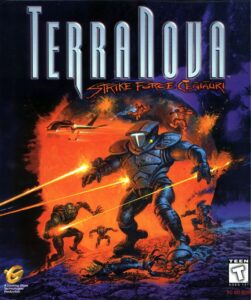
Terra Nova: Strike Force Centauri had had the most protracted development cycle of any Looking Glass game, dating almost all the way back to the very beginning of the company and passing through dozens of hands before it finally came to fruition in the spring of 1996. At its heart, it was an ultra-tactical first-person shooter vaguely inspired by the old Robert Heinlein novel Starship Troopers, tasking you with leading teams of fellow soldiers through a series of missions, clad in your high-tech combat gear that turned you more than halfway into a sentient robot. But it was also as close as Looking Glass would ever come to their own stab at a Wing Commander: the story was advanced via filmed cutscenes featuring real human actors, and a lot of attention was paid to the goings-on back at the ranch when you weren’t dressed up in your robot suit. This sort of thing worked in Wing Commander, to whatever extent it did, because the gameplay that took place between the movie segments was fairly quick and simple. Terra Nova was not like that, which could make it feel like an even more awkward mélange of chocolate and peanut butter. It’s difficult to say whether Activision’s Mechwarrior 2, the biggest computer game of 1995, helped it or hurt it in the marketplace: on the one hand, that game showed that there was a strong appetite for tactical combat involving robots, but, on the other, said demand was already being fed by a glut of copycats. Terra Nova got lost in the shuffle. A game that had been expected to sell at least half a million copies didn’t reach one-fifth of that total.

Looking Glass’s next game didn’t do any better. Like Flight Unlimited, British Open Championship Golf cut against the dark, gritty, and violent stereotype that tended to hold sway when people thought of Looking Glass, or for that matter of the games industry writ large. It was another direct challenge to an established behemoth: in this case, Access Software’s Links franchise, which, like Flight Simulator, had its own unique customer base, being the only line of boxed computer games that sold better to middle-aged corporate executives than they did to high-school and university students. Looking Glass’s golf project was led by one Rex Bradford, whose own history with simulating the sport went all the way back to Mean 18, a hit for Accolade in 1986. This time around, though, the upstart challenger to the status quo never even got a sniff. By way of damning with faint praise, Computer Gaming World called British Open Championship Golf “solid,” but “somewhat unspectacular.” Looking Glass could only wish that its sales could have been described in the same way.

With the benefit of hindsight, we can see all too clearly that Neurath and Lerner crossed the line that separates ambition from hubris when they decided to try to set Looking Glass up as a publisher. At the very time they were doing so, many another boutique publisher was doing the opposite, looking for a larger partner or purchaser to serve as shelter from the gale-force winds that were beginning to blow through the industry. More games were being made than ever, even as shelf space at retail wasn’t growing at anything like the same pace, and digital distribution for most types of games remained a nonstarter in an era in which almost everyone was still accessing the Internet via a slow, unstable dial-up connection. This turned the fight over retail space into a free-for-all worthy of the most ultra-violent beat-em-up. Sharp elbows alone weren’t enough to win at this game; you had to have deep pockets as well, had to either be a big publisher yourself or have one of them on your side. In deciding to strike out on their own, Neurath and Lerner may have been inspired by the story of Interplay Productions, a development studio which in 1988 had broken free of the grasp of Electronic Arts — now Origin System’s corporate parent, as it happened — and gone on to itself become one of the aforementioned big publishers who were increasingly dominating at retail. But 1988 had been a very different time in gaming.

In short, Neurath and Lerner had chosen just about the worst possible instant to try to seize full control of their own destiny. “Game distribution isn’t always based on quality,” noted Warren Spector at the end of 1996. Having thus stated the obvious, he elaborated:

The business has changed radically in the last year, and it’s depressing. The competition for shelf space is ridiculous and puts retailers in charge. If you don’t buy an end-cap from retailers for, say, $50,000 a month, they won’t buy many copies.

Products once had three to six months. The average life is now 30 days. If you’re not a hit in 30 days, you’re gone. This is predicated on your association with a publisher who gets your title on shelves. It’s a nightmare.

With just three games shipped in the last two and a half years — a long way off their projected pace of “six original titles per year” — and with the last two of them having flopped like a wet tuna on a gymnastics court, Looking Glass was now in dire straits. The only thing that had allowed them to keep the doors open this long had been a series of workaday porting jobs that Warren Spector had been relegated to supervising down in Austin, while he waited for the company to establish itself on a sound enough financial footing to support game development from whole cloth in both locations. Ten years on, after Looking Glass had been enshrined in gaming lore as one of the most forward-thinking studios of all time and Spector as the ultimate creative producer, the idea of them wasting their collective talents on anonymous console ports would seem surreal. But such was the reality circa 1997, when Looking Glass, having burnt through all of their venture capital, was left holding on by a thread. “I remember people walking into the office to take back the [rented] plants which the studio was no longer able to pay for,” says programmer and designer Randy Smith.

Ned Lerner abandoned what seemed to be a sinking ship, leaving Looking Glass to co-found a new studio called Multitude, whose focus was to be Internet-enabled multiplayer gaming. Meanwhile Neurath swallowed the hubris of 1995 and did what the managers of all independent games studios do when they find themselves unable to pay the bills anymore: looking for a buyer who would be able to pay them instead. But because Looking Glass could never seem to do anything in the conventional way even when they tried to, the buyer Neurath found was one of the strangest ever.

The Cambridge firm known as Intermetrics, Inc., was far from a household name, but it had a proud history that long predated the personal-computer era. Intermetrics had grown out of the fecund soil of Project Apollo, having been founded in March of 1969 by some of the engineers and programmers behind the Apollo Guidance Computer that would soon help to place astronauts on the Moon. After that epochal achievement, Intermetrics continued to do a lot of work for NASA, providing much of the software that was used to control the Space Shuttle. Other government and aerospace-industry contracts filled out most of the balance of its order sheets.

In August of 1995, however, a group of investors led by a television executive bought the firm for $28 million, with the intention of turning it into something altogether different. Michael Alexander came from the media conglomerate MCA, where he had been credited with turning around the fortunes of the cable-television channel USA. Witnessing the transformation that high-resolution graphics, high-quality sound, and the enormous storage capacity of CD-ROM were wreaking on personal computing, he had joined dozens of his peers in deciding that the future of mass-market entertainment and infotainment lay with interactive multimedia. Deeming most of the companies who were already in that space to be “overvalued,” and apparently assuming that one type of computer programming was more or less the same as any other, he bought Intermetrics, whose uniform of white shirts, ties, and crew cuts had changed little since the heyday of the Space Race, to ride the hottest wave in 1990s consumer electronics.

“This is a company that has the skills and expertise to be in the multimedia business, but is not perceived as being in that business,” he told a reporter from The Los Angeles Times. (It was not a question of perception; Intermetrics was not in the multimedia business prior to the acquisition.) “And that is its strength.” (He failed to elaborate on exactly why this should be the case.) Even the journalist to whom he spoke seemed skeptical. “Ponytailed, black-clad, twenty-something multimedia developers beware,” she wrote, almost palpably smirking between the lines. “Graying engineers with pocket protectors and a dozen years of experience are starting to compete.” Likewise, it is hard not to suspect Brian Fargo of Interplay of trolling the poor rube when he said that “I think it’s great that the defense guys are doing this. It’s where the job security is now. It used to be in defense. Now it’s in the videogame business.” (Through good times and bad, one thing the videogame business has never, ever been noted for is its job security.)

Alas, Michael Alexander was not just a bandwagon jumper; he was a late bandwagon jumper. By the time he bought Intermetrics, the multimedia bubble was already close to popping under the pressure of a more sustained Internet bubble that would end the era of the non-game multimedia CD-ROM almost before it had begun. As this harsh reality became clear in the months that followed, Alexander had no choice but to push Intermetrics more and more in the direction of games, the only kind of CD-ROM product that was making anyone any money. The culture clash that resulted was intractable, as pretty much anyone who knew anything about the various cultures of computing could have predicted. Among these someones was Mike Dornbrook, a games-industry stalwart who had gotten his start with Infocom in the early 1980s. Seeking his next gig after Boffo Games, a studio he had founded with his old Infocom colleague Steve Meretzky, went down in flames, Dornbrook briefly kicked the tires at Intermetrics, but quickly concluded that what he saw “made no sense whatsoever”: “They were mostly COBOL programmers in their fifties and sixties. I remember looking around and saying, ‘You’re going to turn these guys into game programmers? What in the world are you thinking?'” [1]Dornbrook wound up signing on with a tiny startup called Harmonix Music Systems, which in 2005, after years of diligent experimentation with the possibilities for combining music and games, altered the landscape of gaming forever with Guitar Hero.

Belatedly realizing that all types of programming were perhaps not quite so interchangeable as he had believed, Michael Alexander set out in search of youngsters to teach his old dogs some new tricks. The Intermetrics rank and file must have shuddered at the advertisements he started to run in gaming magazines. “We are rocket scientists!” the ads trumpeted. “Even our games are mission-critical!” When these efforts failed to surface a critical mass of game-development talent, Alexander reluctantly moved on to doing what he should have done back in 1995: looking for an extant studio that already knew how to make games. It so happened that Looking Glass was right there in Cambridge, and, thanks to its troubled circumstances, was not as “overvalued” as most of its peers. Any port in a storm, as they say.

On August 14, 1997, a joint press release was issued: “Intermetrics, Inc., a 28-year-old leading software developer, and Looking Glass Studios, one of the computer gaming industry’s foremost developers, today announce the merger of the two companies’ gaming operations to form Intermetrics/Looking Glass Studios, LLC. Through the shared strengths of the two entities, the new company is strategically positioned to be a major force in the computer-game, console and online-gaming industries.” Evidently on a quest to find out how much meaningless corporate-speak he could shoehorn into one document, Michael Alexander went on to add that “Looking Glass Studios immediately catapults Intermetrics into a leading position in the gaming industry by giving us additional credentials and assets to compete in the market. Our business plan is to maintain and grow our core contract-services business while at the same time leveraging our expertise and financial resources to be a major player in the booming interactive-entertainment industry.” The price paid by the rocket scientists for their second-stage booster has to my knowledge never been publicly revealed.

The acquiring party may have been weird as all get-out, but it could have worked out far worse for Looking Glass, all things considered. In addition to the obvious benefit of being able to keep the doors open, at least a couple of other really good things came directly out of the acquisition. One was a change in name, from Looking Glass Technologies to Looking Glass Studios, emphasizing the creative dimension of their work. Another was a distribution deal with Eidos, a British publisher that had serious retail clout in both North America and Europe. Riding high on the back of the massive international hit Tomb Raider, Eidos could ensure that Looking Glass’s games got prominent placement in stores. Meanwhile this idea of the Looking Glass people serving as mentors to those who were struggling to make games at Intermetrics proper — an excruciating proposition for both parties — would prove to mostly be a polite, face-saving fiction for Michael Alexander; in practice, the new parent company would prove largely content to leave its subsidiary alone to do its own thing. Now the folks at Looking Glass just needed to deliver a hit to firmly establish themselves in their new situation. That was always the sticky wicket for them.

The first game that Looking Glass released under their new ownership was Flight Unlimited II, which appeared just a few months after the big announcement. Created without the input of Seamus Blackley, who had left the company, Flight Unlimited II sought simultaneously to capitalize on the relative success of Looking Glass’s first flight simulator and to adjust that game’s priorities to better coincide with the real or perceived desires of the market. Looking Glass paired the extant flight model with an impressively detailed depiction of the geography of the San Francisco Bay Area. Then they added a lot more structure to the whole affair, in the form of a set of missions to fly after you finished your training. The biggest innovation, a first for any civilian flight simulator, was the addition of other aircraft, turning San Francisco International Airport into the same tangle of congested flight lanes it was in the real world. These changes moved the game away from being such a purist simulation of flight as an end unto itself. Still, there was a logic to the additions; one can easily imagine them making Flight Unlimited II more appealing to the sorts of gamers who don’t tend to thrive in goal-less sandboxes. Be that as it may, though, it didn’t show up in the sales figures. Flight Unlimited II sold better than Terra Nova or British Open Championship Golf, but not as well as its series predecessor, just barely managing to break even.

This disappointment put that much more pressure on Looking Glass’s next game to please the new boss and show that the studio could deliver a solid, unqualified hit. In a triumph of hope over experience, everyone had high expectations for The Dark Project, which had been described in the press release announcing the acquisition as “a next-generation fantasy role-playing game.” Such a description might have left gamers wondering if Looking Glass was returning to the territory of Ultima Underworld. As things worked out, the game that they would come to know as simply Thief would not be that at all, but would instead break new ground in a completely different way. It stands today alongside Ultima Underworld in another sense: as one of the three principal legs — the last one being System Shock, of course — that hold up Looking Glass’s towering modern-day reputation for relentless, high-concept innovation.

The off-kilter masterstroke that is Thief started with a new first-person 3D engine known as The Dark Engine. It could have powered a “low-brain shooter,” as the Looking Glass folks called the likes of the mega-hit Quake, with perfect equanimity. But they just couldn’t bring themselves to make one.

It took a goodly while for them to decide what they did want to do with The Dark Engine. Doug Church, the iconoclastic programmer and designer who had taken the leading role on System Shock, didn’t want to be out-front to the same extent on this project. The initial result of this lack of a strong authority figure was an awful lot of creative churn. There was talk of making a game called Better Red than Undead, mixing a Cold War-era spy caper with a zombie invasion. Almost as bizarre was Dark Camelot, an inverted Arthurian tale in which you played the Black Knight against King Arthur and his cronies, who were depicted as a bunch of insufferable holier-than-thou prigs. “Our marketing department wasn’t really into that one,” laughs Church.

Yet the core sensibility of that concept — of an amoral protagonist set against the corrupt establishment and all of its pretensions — is all over the game that did finally get made. Doug Church:

The missions [in Dark Camelot] that we had the best definition on and the best detail on were all breaking into Camelot, meeting up with someone, getting a clue, stealing something, whatever. As we did more work in that direction, and those continued to be the missions that we could explain best to other people, it just started going that way. Paul [Neurath] had been pushing for a while that the thief side of it was the really interesting part, and why not just do a thief game?

And as things got more chaotic and more stuff was going on and we were having more issues with how to market stuff, we just kept focusing on the thief part. We went through a bunch of different phases of reorganizing the project structure and a bunch of us got sucked into doing some other project work on Flight [Unlimited] and stuff, and there was all this chaos. We said, “Okay, well, we’ve got to get this going and really focus and make a plan.” So we put Greg [LoPiccolo] in charge of the project and we agreed we were going to call it Thief and we were going to focus much more. That’s when we went from lots of playing around and exploring to “let’s make this Thief game.”

It surely comes as no revelation to anyone reading this article that most game stories are power fantasies at bottom, in which you get to take on the identity of a larger-than-life protagonist who just keeps on growing stronger as you progress. Games which took a different approach were, although by no means unknown by the late 1990s, in the decided minority even outside of the testosterone-drenched ghetto of the first-person shooter. The most obvious exponents of the ordinary-mortal protagonist were to be found in the budding survival-horror genre, as pioneered by Alone in the Dark and its sequels on computers and Resident Evil on the consoles. But these games cast you as nearly powerless prey, being stalked through dark corridors by zombies and other things that go bump in the night. Thief makes you a stealthy predator, the unwanted visitor rifling through cupboards and striking without warning out of the darkness, yet most definitely not in any condition to mow down dozens of his enemies in full-frontal combat, Quake-style. If you’re indiscreet in your predations, you can become the cornered prey with head-snapping speed. This was something new at the time.

Or almost so. Coincidentally, two Japanese stealthy-predator games hit the Sony PlayStation in 1998, the same year as Thief’s release. Tenchu: Stealth Assassins cast you as a ninja, while Metal Gear Solid cast you as an agent of the American government on a top-secret commando mission. The latter in particular caused quite a stir, by combining its unusual gameplay style with the sort of operatically melodramatic storytelling that was more commonly associated with the JRPG genre. That said, Thief is a far more sophisticated affair than either of these games, in terms of both its gameplay and its fiction.

The titular thief and protagonist is a man known only as Garrett, who learned his trade on the streets of The City, a mixture of urban squalor and splendor that is best described as Renaissance Florence with magic — a welcome alternative to more typical fantasy settings. Over the course of a twelve-act campaign, Garrett is given a succession of increasingly daunting assignments, during which a larger plot that involves more than the acquisition of wealth by alternative methods does gradually take shape.

Although the mission tree is linear, nothing else about your experience in Thief is set in stone. It was extremely important to Looking Glass that Thief not turn into a puzzle game, a series of set-piece challenges with set-piece solutions. They wanted to offer up truly dynamic environments, environments that were in their own way every bit as much simulations as Flight Unlimited. They wanted to make you believe you were really in these spaces. Artist Daniel Thron speaks of the “deep sense of trust we had in the player. There isn’t a single solution to Thief. It’s up to you to figure out how to steal the thing. It’s letting you tell that story through gameplay. And that sense of ownership makes it unique. It becomes yours.” In the spirit of all that, the levels are big, with no clearly delineated through-line. These dynamic virtual spaces full of autonomous actors demand constant improvisation on your part even if you’ve explored them before.

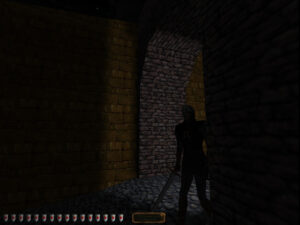
Looking Glass understood that, in order for Thief to work as a vehicle for emergent narrative, all of the other actors on the stage have to respond believably to your actions. It’s a given that guards ought to hunt you down if you blatantly give away your presence to them. Thief distinguishes itself by the way it responds to more subtle stimuli. An ill-judged footstep on a creaky floor tile might cause a guard to stop and mutter to himself: “Wait! Did I just hear something?” Stand stock still and don’t make a sound, and maybe — maybe — he’ll shrug his shoulders and move on without bothering to investigate. If you do decide to take a shot at him with your trusty bow or blackjack, you best not miss, to steal a phrase from Omar Little. And you best hide the body carefully afterward, before one of his comrades comes wandering along the same corridor to stumble over it.

These types of situations and the split-second decisions they force upon you are the beating heart of Thief. Bringing them off was a massive technical challenge, one that made the creation of 3D-graphics engine itself seem like child’s play. The state of awareness of dozens of non-player characters had to be tracked, as did sound and proximity, light and shadow, to an extent that no shooter — no, not even Half-Life — had ever come close to doing before. Remarkably, Looking Glass largely pulled it off, whilst making sure that the more conventional parts of the engine worked equally well. Garrett’s three principal weapons — a blackjack for clubbing unsuspecting victims in the back of the head, a rapier for hand-to-hand combat, and a bow which can be used to shoot a variety of different types of arrows — are all immensely satisfying to use, having just the right feeling of weight in your virtual hands. The bow is a special delight: the arrows arc through the air exactly as one feels they ought to. You actually get to use your bow in all sorts of clever ways that go beyond killing, such as shooting water arrows to extinguish pesky torches — needless to say, darkness is your best friend and light your eternal enemy in this game — and firing rope arrows that serve Garrett as grappling hooks would a more conventional protagonist.

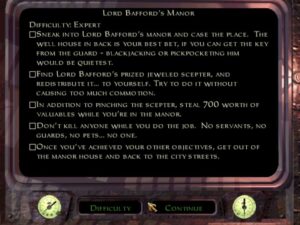
Looking Glass being Looking Glass, even the difficulty setting in Thief is more than it first appears to be. It’s wouldn’t be much of an exaggeration to say that Thief is really three games in one, depending on whether you play it on Normal, Hard, or Expert. (Looking Glass apparently wasn’t interested in the sorts of players who might be tempted by an “easy” mode.) Not only do the harder settings require you to collect more loot to score a passing grade on each mission, but the environments themselves become substantially larger. Most strikingly, in a brave subversion of the standard shooter formula, each successive difficulty setting requires you to kill fewer rather than more people; at the Expert level, you’re not allowed to kill anyone at all.

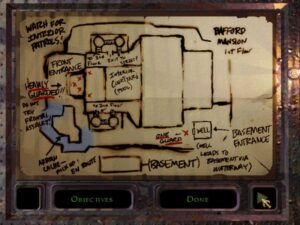
Regardless of the difficulty setting you choose, Thief will provide a stiff challenge. Its commitment to verisimilitude extends to all of its facets. In lieu of a conventional auto-map, it provides you only with whatever scribbled paper map Garrett has been able to scrounge from his co-conspirators, or sometimes not even that much. If your innate sense of direction isn’t great — mine certainly isn’t — you can spend a long time just trying to find your way in these big, twisty, murky spaces.

When it’s at its best, Thief is as amazing as it is uncompromising. It oozes atmosphere and tension; it’s the sort of game that demands to be played in a dark room behind a big monitor, with the phone shut off and a pair of headphones planted firmly over the ears. Sadly, though, it isn’t always this best version of itself. In comparison to Ultima Underworld or System Shock, both of which I enjoyed from first to last, Thief strikes me as a lumpy creation, a game of soaring highs but also some noteworthy lows. I was all-in during the first mission, a heist taking place in the mansion of a decadent nobleman. Having recently read Sarah Dunant’s The Birth of Venus and written quite a lot about Renaissance Florence, my receptors were well primed for this Neo-Renaissance setting. Then I came to the second mission, and suddenly I was being asked to fight my way through a bunch of zombies in an anonymous cave complex. Suddenly Thief felt like dozens of other first-person action games.

This odd schizophrenia persists throughout the game. The stealthy experience I’ve just been describing — the boldly innovative experience that everyone thinks of today when they think of Thief — is regularly interspersed with splatterfests against enemies who wouldn’t have been out of place in Quake: zombies, rat men, giant exploding frogs, for Pete’s sake. (Because these enemies aren’t human, they’re generally exempt from the prohibition against killing at the Expert level.) All told, it’s a jarring failure to stick to its guns from a studio that has gone down in gaming lore for refusing to sacrifice its artistic integrity, to its own great commercial detriment.

As happens so often in these cases, the reality behind the legend of Looking Glass is more nuanced. Almost to a person, the team who made Thief attribute the inconsistency in the level design to outside pressure, especially from their publisher Eidos, who had agreed to partially fund the project. “Eidos never believed in it and until the end told us to put in more monsters and have more fighting and exploring and less stealth, and I’m not sure there was ever a point [when] they got it,” claims Doug Church. “I mean, the trailers Eidos did for Thief were all scenes with people shooting fire arrows at people charging them. So you can derive from that how well they understood or believed in the idea.”

And yet one can make the ironic case that Eidos knew what they were doing when they pushed Looking Glass to play up the carnage a little more. Released in November of 1998, Thief finally garnered Looking Glass some sales figures that were almost commensurate with their positive reviews. (“If you’re tired of DOOM clones and hungry for challenge, give this fresh perspective a try,” said Computer Gaming World.) The game sold about half a million copies — not a huge hit by the standards of an id Software or Blizzard Entertainment, but by far the most copies Looking Glass had ever sold of anything. It gave them some much-needed positive cash flow, which allowed them to pay down some debts and to revel in some good vibes for a change when they looked at the bottom line. But most importantly for the people who had made Thief, its success gave them the runway they needed to make a sequel that would be more confident in its stealthy identity.


Did you enjoy this article? If so, please think about pitching in to help me make many more like it. You can pledge any amount you like.


SourcesThe book Game Design Theory & Practice (2nd. ed.) by Richard Rouse III; Next Generation of March 1997 and June 1997; PC Zone of December 1998; Computer Gaming World of September 1995, June 1996, August 1997, April 1998, and March 1999; Retro Gamer 117, 177, and 260; Los Angeles Times of September 15 1995; Boston Globe of May 3 1995.

Online sources include the announcement of the Intermetrics acquisition on Looking Glass’s old website, InterMetrics’s own vintage website, “Ahead of Its Time: A History of Looking Glass” by Mike Mahardy at Polygon, and James Sterrett’s “Reasons for the Fall: A Post-Mortem on Looking Glass Studios.”

My special thanks to Ethan Johnson, a fellow gaming historian who knows a lot more about Looking Glass than I do, and set me straight on some important points after the first edition of this article was published.

Where to Get Them: Terra Nova: Strike Force Centauri and Thief Gold are available for digital purchase at GOG.com. The other Looking Glass games mentioned this article are unfortunately not.

Footnotes

Footnotes
1 Dornbrook wound up signing on with a tiny startup called Harmonix Music Systems, which in 2005, after years of diligent experimentation with the possibilities for combining music and games, altered the landscape of gaming forever with Guitar Hero.
Read the whole story
mikemariano
4 hours ago
reply
Share this story
Delete

This Thanksgiving, I'm Sharing Something That I Am Thankful For, Joe Dante's Foreword for The Fractured Mirror

1 Share

When I was putting the finishing touches on The Fractured Mirror, my massive new book about the history of American movies about filmmaking, I only had one person in mind to write the foreword: Joe Dante, one of my favorite filmmakers, a figure legendary for his cinephilia and the director of two of the best movies about filmmaking, Hollywood Boulevard and Matinee, as well as such classics as Piranha, The Howling, Gremlins, Innerspace, The ‘Burbs, Gremlins 2: The New Batch, and Small Soldiers.

When he very generously said yes to my request, I was so overjoyed that I thought, no matter what happened, I would consider the book a success on that basis alone. I still feel that way, but it never hurts to sell a whole lot of books.

This Thanksgiving, I am thankful for much, and apoplectic about even more, but I figured it would be good form to share with you something I am particularly grateful for: the foreword to my epic new book, from a man whose movies have made the world a better, weirder, more joyful place:

When Nathan Rabin, whose online column I follow enthusiastically, suggested I write an introduction to his latest, long-gestating venture, The Fractured Mirror, I happily
accepted, because the subject matter has always fascinated me.

After all, I thought, anybody who loves movies would want to read informed analyses of how they're made, who they're made for, who sees them, and how they intersect with our lives.

Having actually made a couple of movies about making movies (in fact, there's a school of thought that every movie I make is about film), I fancied myself as kind of an expert on the subject, so I assumed there might be a few hundred of these titles in the book, tops.

But I seriously underestimated! Nathan has cast his net extremely widely, from Abbott and Costello in Hollywood, all the way through Zeroville; there are over 500 films chronicled here: an astonishing array of motion pictures, many, if not most, of which will be completely new to readers.

It's laden with Nathan's knowledgeable and opinionated takes on everything from beloved classics like The Bad and the Beautiful and Sullivan's Travels to dreck like Burn Hollywood Burn and Babylon. But the remarkable thing about The Fractured Mirror is that Nathan manages to cover, in bite-sized digestible chunks, such a vast array of films by actually watching them, which must've taken him forever, and I wonder when he had time to eat or sleep. Based on my knowledge of these movies, he's seen everything he's writing about.

That makes this not only a marvelous and revealing exercise in scholarship, but also a rewarding deep dive for all those of us who have cinema in our blood.

I guarantee that you will find movies on this list that you have never heard of before and will want to seek out, which is the purpose of books like this. I don't suggest reading it in order. It's the kind of volume that's best experienced by just skipping around to the things that interest you, which will always take you into something else that you didn't expect.

It's quite an achievement, and I'm honored to be a small part of it. And for those who delve into its depths, there's some seriously smart writing to be found here.

Rabin on The Other Side of the Wind:

With his dazzling posthumous film, the old magician
performed one last trick: He pulled a final masterpiece out of his
hat decades after his death, distributed via technology that did
not exist during his lifetime

Rabin on Inland Empire:

This isn't a movie; it's a nightmare. It's Lynch's vision of hell
as Hollywood and Hollywood as hell, but there's a method to
Lynch's madness as well as a madness to his method.

Rabin on Abbott & Costello Meet the Keystone Kops:

Unfortunately, most of the original Keystone Cops were too
busy being dead to appear in 1955's Abbott and Costello Meet
The Keystone Cops. The comical crime-fighters only figure in the
last fifteen minutes.

This is really one of the more impressive collections of
essays that I have seen in some time, and I can't imagine that it
won't become a go-to handbook for movie lovers everywhere.

Congrats, Nathan.
Now get some sleep.
Joe Dante

To promote The Fractured Mirror, I'm running the Fucking Golden deal: sign up for a yearlong membership at Nathan Rabin's Bad Ideas for just 45 dollars a year (ten percent off for Black Friday!), and get signed copies of The Fractured Mirror and The Weird A-Coloring to Al, a 125-page "Weird Al" Yankovic-themed coloring book for FREE. The next 12 subscribers to take advantage of this deal also get a 5-by-7 "Weird Al" Yankovic-themed print, signed by Felipe Sobreiro and me. Check it out here:

Nathan Rabin's Bad Ideas

Movie Reviews, Stephen King, Autism in Entertainment, Joy of Positvity and Weird-Ass Side Quests

OR you can buy the book straight from me here or from Amazon here.


Read the whole story
mikemariano
3 days ago
reply
Share this story
Delete

A Single Warehouse in Jersey City Moved Over A Thousand Tons of Military Cargo to Israel Every Week

1 Share
The front of G&B Packing at 1A Colony Road in Jersey City, New Jersey (Photo provided by authors).

JERSEY CITY, NEW JERSEY—A single warehouse in Jersey City, New Jersey, packaged and transported over a thousand tons of military equipment to Israel every week in the first eight months of 2025, according to a report jointly released today by the Palestinian Youth Movement (PYM) and Progressive International (PI). A network of businesses based in New Jersey uses the privately owned warehouse to inspect, organize, and move military equipment, including Merkava tank parts, F-16 parts, ammunition, military gear, and armored and unarmored vehicles. The equipment is then packaged and delivered to nearby airports and sea ports and sent to Israel, researchers revealed.

The transfer of military gear to Israel is spearheaded by three overlapping Jersey-based companies—Interglobal Forwarding Services (IFS), G&B Packing Company, and G&G Services—which are all seemingly owned and operated by the same people. IFS and G&B serve as contractors with the Israeli Ministry of Defense (IMOD), which works closely with U.S. weapons manufacturers to purchase weapons. IFS primarily handles administrative matters; G&B Packing Company handles, packages, and loads the equipment onto trucks; and G&G Services makes shipments to local ports with its own fleet of trucks.

The PYM and PI’s report documented that 91% of all Israel-bound sea exports of military gear that did not go through a U.S. military base passed through the IFS and the G&B warehouse.

Until now, little has been known about the Jersey-based companies that operate the warehouse and their role transferring U.S. weapons to Israel. The revelation of the warehouse, which serves as a significant pit-stop in the military equipment supply-chain, comes as Israel continues its assault on Gaza, despite a U.S.-brokered “ceasefire.”

Between January and late August 2025, the month when the PYM and PI report was compiled, an average of 878 tons of sea cargo and between 263-525 tons of air cargo passed through the Jersey warehouse weekly, according to the bills of lading tabulated by the researchers. The equipment often travels “from the IFS warehouse to Port Newark–Elizabeth Marine Terminal, where they are loaded onto a Maersk vessel on the MECL line, dropped off in Tangier, Morocco, and picked up by another Maersk vessel on the Med Loop C to be taken to Haifa,” researchers found.

The majority of the shipments are for tank and armored vehicles. In addition to shipments to the Israeli Ministry of Defense (IMOD), IFS handles packages for private Israeli military companies, including Rafael Advanced Systems and the Israeli Military Industries (IMI). One 2025 shipment to IMI contained “340 tons of rifle ammunition,” researchers calculated. The warehouse is “the default location for any export of military goods to Israel,” researchers claim. In one Israeli government document, the IMOD requires companies to label cargo with G&B Packing’s address.

As recently as November 6, G&B Packing was listed as a point of contact for shipments to the IMOD in a U.S. government contract bid that is open for moving “unclassified spare parts in support of C-130, T-6, F-15, and F-16 aircraft” until February 2026, according to federal contracting data reviewed by Drop Site.

Subscribe now

It is possible that more deadly military equipment and weaponry passes through the Jersey warehouse, which is then transported to airports and military bases, and then sent by air to Israel. In contrast to sea cargo information, air cargo details are redacted in logs, so it is likely that other types of Israeli-bound air cargo passes through the warehouse.

The warehouse at 1A Colony RD in Jersey City is in a remote industrial park, circled by railways and surrounded by other warehouses and logistics and transport companies. At 125,000 square feet, the facility houses HAZMAT rooms to inspect and pack hazardous materials, including explosives. The grounds are surveilled by a 24-hour security camera system around the facility, which includes license plate readers.

When Drop Site visited the warehouse earlier this month, a tactical vehicle parked just outside, within a fenced off area, was identified as a “David” by the researchers. “Davids” are manufactured in Alabama by MTD Armor Corporation and used by Israeli soldiers; a 2021 contracting document obtained by Drop Site shows IFS was involved in delivering “David” vehicles to Israel.

Several Maersk containers were next to the warehouse in the loading zone. The Danish logistics company has long shipped weapons to Israel, and since the war in Gaza began, Maersk has been protested for the company’s involvement in supplying weapons to Israeli forces.

A picture taken at the G&B warehouse where a Maersk container can be seen on the left and a green “David” military vehicle on the right. “David” military vehicles are used by Israeli forces and was identified by researchers on the grounds of G&B packing in a fenced off area behind the warehouse (Photo provided by authors).

“This warehouse is not just a logistics company; it’s the lifeline of Israel’s war machine,” said Nadya Tannous of PYM. “Israel will use it to restock for its next assault on Gaza.”

Shortly after arriving at the facility and requesting to speak with company representatives, an employee at the site asked Drop Site to leave the premises. In a follow-up call, a G&B Packing Services secretary hung up the phone, refusing Drop Site’s request to speak with representatives of the company.

Drop Site emailed detailed requests for comment to the companies involved, the Israeli Ministry of Defense, and the State Department. None responded to Drop Site’s requests by time of publication.

The Supply Chain For Israel’s “Mission”

The IMOD has had a major logistics office in New York City for decades, known as “the Mission,” which it uses to coordinate with weapons manufacturers, handlers, and transport companies.

The Mission, whose tagline is “protecting our homeland from afar,” originated in 1947—a year before the creation of the state of Israel “in anticipation of independence,” their website reads. It is now in charge of reviewing bids from vendors, negotiating with weapons manufacturers, analyzing the costs, approving purchases, and then working with logistics companies, like IFS and G&B Packing, to transport the weaponry.

The U.S. is the world’s largest provider of weapons and military equipment. In Israel’s case, the U.S. provides Israel with Foreign Military Financing: a lump sum of at least $3.3 billion every year to purchase weapons and military equipment from U.S. companies and an additional $500 million in missile defense. A report by the Center for International Policy (CIP) showed that the U.S. delivered nearly $4.2 billion worth of military equipment to Israel between October 2023 and May 2025. That includes both weapons sales to Israel brokered by the U.S. government and direct sales with private U.S. companies; IFS manages the transfer of weapons to Israel for both types of sales.

At least five companies are linked to the same operation that ships weapons from New Jersey to Israel. Aside from IFS, G&B, and G&G, two Israeli-based partner companies are involved in transferring cargo to the country, Interglobal Shipping 3001 and Interglobal Cargo.

IFS and G&B are both owned by Lawrence Grossman and Stanley Grossman, according to company registry documents. The companies trace their origins to 1947, when they were founded in the U.S. by the Grossman family, and expanded into shipping to Israel in the 1980s, according to Interglobal Shipping 3001’s website. Contracts between the U.S. Department of Defense and IFS date back at least to 2003, according to data from HigherGov.

In 2008, IFS was implicated in a federal investigation into Ori Zoller, a former member of the Israeli special forces and an Israeli arms dealer since the late 1990s who acted in 2007 as a middleman illegally selling U.S.-supplied weapons from Guatemala to Century Arms, a U.S.-based company. Zoller co-owned a private Guatemalan arms dealership that was a subsidiary of the then-Israeli state-owned company Israeli Military Industries (IWI)—later privatized and renamed Israeli Weapons Industries (IMI), which still uses IFS for packing and shipping. Zoller relied on IFS as a logistics hub to transport weapons to Guatemala.

That year, “several hundred automatic assault rifles and accessories manufactured by Israeli Weapons Industries (IWI)” were seized by U.S. Customs and Border Protection (CBP) in January in Newark, New Jersey, because the shipments lacked proper import licensing, according to State Department cables released by Wikileaks. Zoller held IFS responsible for the bureaucratic mishap, suggesting at least 30 of their shipments had gone through IFS. The diplomatic cable noted that “Zoller’s comments suggest” IFS transported items through the U.S. “without proper authorization.”

Later, according to a separate WikiLeaks cable, a State Department compliance office ordered a check on two shipments from IFS to the IMOD to determine whether the detonators sent by IFS were being integrated into cluster munitions—a use that could violate U.S. regulations. It’s not clear if that check was conducted or if any action was taken against the company.

The U.S. government and the IMOD continued to work with IFS and its partner companies. In 2012, Electronic Intifada reported that over 1,300 shipments from IFS were sent from the U.S. to IMOD, some including counterinsurgency weapons produced by U.S. military equipment company Combined Systems (CSI), according to trade export data reviewed at that time.

Researchers in 2017 with the International Peace Information Service (IPIS) discovered that from 2011 to 2014 Israel and IFS shipped over 16,000 tons of “diplomatic” cargo to Israeli ports on Maersk vessels. The IPIS researchers expressed concern in their report, questioning whether the massive amount of cargo was really for “diplomatic” purposes. The same report also said that IFS acted as a “shipper of convenience” on behalf of the Israeli government, so that “the bills of lading did not report the name of the company that was actually shipping the military equipment.”

“The Chain of Complicity”

Last week, the UN Security Council approved the Trump administration’s “stabilization” plan for Gaza. From October 11, the first full day of the “ceasefire,” Israel continued its assault on Gaza, with its supply of weaponry still flowing from the U.S. to the IMOD. Since the “ceasefire” went into effect, Israel has killed at least 339 Palestinians in Gaza and wounded 871.

“A number of western states—chief among them the United States—are criminally liable for aiding and abetting a genocide,” said Ari Tolany, the director of the CIP’s Director of Security Assistance, Arms Trade, and Technology. Tolany tracks U.S. military sales to other countries, including Israel. “The severity and length of these atrocities has been made possible only through the United States’ supplying of munitions and broader political cover.”

As of 2023, the majority of guns in Israel came from the U.S., the CIP report notes. But it’s not just guns: the CIP report noted that depleted uranium, explosives and bombs, detonators, tanks and armored vehicles, aircraft and aircraft parts, and much more was also delivered to Israel. It is unclear whether depleted uranium, explosives, and bombs are delivered through the Jersey warehouse, since air-bound shipment details are redacted.

“The supply chain to aid and abet the genocide is involving massive amount of stakeholders, including international shipping companies and different vessels,” added Tolany. “More attention and research on the financial and shipping and logistics firms that facilitate the transfers is absolutely welcome.”

PYM and PI researchers say companies like IFS, G&B, and others in the supply chain are implicated in Israel’s war crimes. Reuters reported this month that U.S. intelligence officials learned that Israel’s own military lawyers warned there was evidence of war crimes in Gaza.

“The chain of complicity runs straight from Gaza’s rubble to the heart of the US American logistics industry,” said David Adler, Co-General Coordinator of the Progressive International. “By exposing Interglobal’s role, we can begin to sever that chain—and confront the system that turns civilian slaughter into a business opportunity.”

Subscribe now

Leave a comment

Read the whole story
mikemariano
7 days ago
reply
Share this story
Delete

Poland Repurposed a Nazi Factory Site to Make TNT to Drop on Gaza

1 Share
Dense smoke and flames rise from the area after the Israeli army targets a house in Gaza City, Gaza, on September 13, 2025 (Photo by Abdalhkem Abu Riash/Anadolu via Getty Images).

A Polish firm plays a central role in providing trinitrotoluene (TNT), the key explosive used in Israel’s genocidal war on Gaza, according to “The Missing Ingredient: Polish TNT,” a report published today by a coalition representing the People’s Embargo for Palestine, Palestinian Youth Movement, Shadow World Investigations, and Movement Research Unit. Nitro-Chem, a state-owned company located in Poland’s northeast, produced 90% of the TNT imported by the U.S. to make the aerial bombs sent to Israel in recent years, the report claims.

Since October 2023, the Israeli Air Force (IAF) unleashed tens of thousands of bombs likely containing payloads of Polish-made TNT, resulting in the destruction of as much as 80 percent of Gaza’s buildings, including civilian infrastructure such as hospitals, schools, and refugee camps. “Based on information provided by the bomb’s U.S. manufacturer, General Dynamics Ordnance and Tactical Systems, the Polish company Nitro-Chem, and U.S. government databases, we can conclude that there is a high probability that a significant proportion of [Mk 84s] that Israel dropped on the Gaza Strip since October 2023 are filled with Polish-made TNT,” the report found.

Drop Site is reader-supported. Consider becoming a free or paid subscriber.

Nitro-Chem contracts with U.S weapons manufacturers in the Mk 80 supply chain date back to at least 2016, with the most recent orders signed in April of this year featuring delivery dates continuing until 2029. The timing of one major contract at the height of the air campaign against Gaza in April 2024 suggests that the Israeli army was burning through its large supply of one-ton Mk 84s—a barrage that was already without recent military precedent. According to an estimate in Haaretz based on officer interviews, as many as two-thirds of the 50,000 bombs dropped by the IAF through the end of August 2024 were Mk 84s. Military experts described the display as one “not seen since Vietnam.”

Although the Biden administration placed a hold on Mk 84 shipments to Israel, it was lifted within days of Trump taking office in January. The hold Biden placed on the shipments was a hiccup, and the supply chain is as robust as ever, according to the report, with multiple contracts showing the three countries—Poland, the U.S., and Israel—eager to replenish the IAF’s bomb.

Israel requested to purchase 35,529 one-ton bombs from General Dynamics in February. Two months later, Nitro-Chem signed its largest ever deal to deliver 18,000 tons of TNT to Paramount Enterprises International—a U.S. intermediary that delivers the TNT to General Dynamics—between 2027–2029. According to the report,

“The agreement was signed in Poland by the CEOs of PEI and Nitro-Chem, in the presence of Poland’s Deputy Defense Minister, Cezary Tomczyk, who stated that Poland’s deals with the U.S. concerning TNT exports are “iron-clad.” The underlying mechanism of this partnership was detailed by [Polish investigative news outlet] Onet which in June 2025 investigated why Poland, despite an ongoing war on its eastern border for over three years, has been unable to produce basic artillery shells for its own military, while at the same time the country’s only NATO TNT producer, Nitro-Chem, sells enormous quantities of TNT to the United States at very low prices. The article quotes an anonymous military source, who said: “Polish politicians were told that if Poland wants the American security umbrella, we must continue selling them TNT. Breaking this contract was portrayed as an act against American companies in Poland.”

As with the bombs already dropped on Gaza, the replacements will fix Polish-made TNT into warheads at a General Dynamics factory north of Dallas. The company has been the prime contractor for Mk 80 bombs since the Vietnam War, when they became standard for the U.S. and its allies.

Israel would not have been able to decimate Gaza to this extent without the TNT production capacity of Nitro-Chem, which after the Cold War emerged as the largest producer of the explosive among NATO and EU members. During the October War of 1973, the Israeli Air Force (IAF) adopted the U.S.-made Mk 80 series, which features an admixture of aluminum powder to increase the heat and destructiveness of the charge. Israel’s air campaign in Gaza mostly featured the largest bombs in the series—the 1,000-pound Mk 83 and the 2,000-pound Mk 84. By April of 2024, Israeli pilots had detonated around 75,000 tons of Polish-made TNT on the densely populated enclave. In nuclear terms, this is an explosive force equivalent to a 75-kiloton fission bomb—significantly more than twice the combined yield of the bombs dropped on Hiroshima and Nagasaki.

Along with Vietnam, the Mk 80 supply chain echoes another dark chapter of history—one closer to the mixing site of its main ingredient. The Nitro-Chem plant is located on the former grounds of one of the biggest arms factories built by the Nazis between 1940 and 1944. The authors of the TNT report note that, during the German occupation, Polish resistance cells repeatedly “infiltrated the plant and carried out acts of sabotage.” No such acts have been reported in recent years, as the TNT used in the Gaza genocide uses roads and train tracks in the vicinity of multiple Holocaust memorials, including the site of a mass grave known as the Valley of Death, and the Potulice Concentration Camp, where an estimated 25,000 prisoners were processed.

This irony is not lost on the report’s authors who write, “We call on Nitro-Chem and the Polish authorities to immediately cease the supply of TNT for the production of Mk 80 series bombs and artillery used by Israel, as well as direct supplies of explosives to Israel. Their failure to do so may meet the legal criteria for aiding and abetting genocide and other international and domestic crimes.”

Subscribe now

Leave a comment

Read the whole story
mikemariano
11 days ago
reply
Share this story
Delete

"You Have a Mother"

1 Share

Concentration Camp Auschwitz, Women survivors in the barracks at Birkenau. February 1945. Photo taken from a Russian film about the liberation of the camp. The Soviet First Army of the Ukrainian Front entered Auschwitz on the afternoon of January 27, 1945, finding 7,650 surviving prisoners, 1,200 in Auschwitz I, 5,800 in Auschwitz II-Birkenau, and 650 in Auschwitz III-Buna-Monowitz. Poland. (Photo by Galerie Bilderwelt/Getty Images)

Subscribe now

BROOKLYN, N.Y — Lola Mozes’ childhood came to an end in the fall of 1939 at a small bridge in Poland. She was 9 — seated in a horse-drawn wagon, her back propped against her family’s silver Sabbath candelabra, which was wrapped in a blanket — when she saw the aftermath of a German bomb attack. The sight of human bodies, along with eviscerated horses gasping in pain and struggling to rise despite their gaping wounds, reduced her to tears and panic. Her mother, Helena Rewitz, born Schwimer, who would hover over her daughter like a guardian angel later in a Jewish ghetto and the Auschwitz-Birkenau death camp, took the terrified child into her arms.

I sat with Lola Mozes at her dining room table in Brooklyn on Friday. Short and petite, with curly black hair and white gold hoop earrings, she had a soft, infectious laugh, an impish sense of humor and fine facial lines that she inherited from her father and mother. Her charm and warmth were girlish and slightly coquettish.

“I am the great pretender,” she said, smiling. “It is always there, what I went through. I am tormented by it. It keeps repeating and repeating itself in my head.”

Lola grew up living next to her family’s small grocery in Katowice, a city in southwestern Poland. The language at home was German. She learned Polish in school. Her parents, especially when they wanted to talk privately, spoke Yiddish. Her parents and older brother celebrated the Sabbath and went to synagogue on religious holidays but lived as secular Jews. Her father, Emil, who sang arias as he bathed in the mornings, dressed in imported German suits and spats when he left the house. They lived in a working-class section of the city. Catholic children in the neighborhood taunted her as a “Christ killer” and once pushed her brother Oskar off a tram and beat him. But nothing prepared the family for what was to come. A dark future was only hinted at when the parents, their faces knotted in consternation, listened to Adolf Hitler on the radio.

The bloody scene at the bridge would foreshadow a crucible of mass murder and extreme deprivation lasting six years. For Lola, playing with her favorite doll, skating, swimming and picking out candy from her father’s grocery was replaced by a bitter struggle to survive. Ogres — including a drunken SS officer in the ghetto who used to hold her on his lap and complain about his boots being soiled by the blood of his victims, including the infants he dashed against walls — rose up like monsters in medieval fairy tales. Concentric circles of death and life would radiate around her. Her parents’ fierce love seemed, often, no match for the murderous intent of the armed and the powerful who held the family in their grip.

Execution of 56 Polish hostages in Bochnia near Krakau by Germans (Photo by ullstein bild/ullstein bild via Getty Images)

Lola’s family was herded with other Jews in 1941 into the ghetto in Bochnia, along the river Raba in southern Poland. The ghetto was surrounded by a high wooden fence. It was divided in two parts — Ghetto A and Ghetto B. Ghetto A housed the 2,000 Jews who worked in German factories and workshops where they made shoes, underwear, uniforms, gloves, socks and other items for the German army. The Jews in Ghetto B had no jobs. Many were elderly and sick. They lived in extreme poverty and were malnourished. Many Jews pooled what little they had and formed communal kitchens. The Germans segregated the men, including the husbands and fathers, from women at night. Lola and her family lived with her aunt, who had been well off before the war, in a large wooden house that had been incorporated into the ghetto.

“At one point they told us to stay in our houses,” she said. “I don’t remember when. I peeked through the window and saw strong young men who used to work in the salt mines marching. Every 10th or fifth man was being shot. In the morning there was a strange odor. It was nauseating. We peeked through the curtains. There were wagons with dead bodies. They were stripped. There were puddles of blood in the gutters. We went back to work the following day. We worked 12-hour shifts. For the morning shift we left when it was dark. I remember [when we went back to work again] it was raining. I was walking with my friend. I was carrying my bread. It fell on the ground. My friend said, ‘It fell in the blood.’ We thought this was very funny. We started laughing. I picked it up and brought it home after work and we ate it. It was too precious to throw away.”

Lola had a friendship with a gentle boy who lived with his family in the B section of the ghetto. He cut up newspapers and made a little book he lent to her. It was about a seventh-century rabbi named Sabbatai Zevi who claimed to be the Jewish Messiah and walked from town to town promising to save the people. “He took me to where he lived,” she said. “It looked like a hovel. There were rags on the floor. It was dirty. There were a lot of people, especially old people. The stench was terrible. He was the nicest boy. I said, ‘How can people live like that?’ He was so embarrassed. I will never forget how embarrassed he was. He had been in my aunt’s house where each family had a room. My aunt’s house was clean. We had a stove. There was some heat. I don’t know what happened to him. Those in Ghetto B were the first to go in the transports [to the death camps].”

Her father constructed a small, underground bunker in a wooden shed that was filled with sawdust. When the deportations began in 1942 the family would hide in the bunker. There was barely enough room to huddle together. They would wait breathlessly as the Germans with their dogs prowled around the shed. Lola’s father sneaked out at night to scavenge for food.

Jews could leave the ghetto only under guard. They were marched out of the ghetto in rows of five to work in German factories. Hans Frank, the governor-general of the territories in occupied Poland, ordered that any other Jews found outside ghetto walls be executed. Nearly 2,000 Jews from the ghetto were shot. Most of the others died from disease or in the death camps. Only 90 of the 15,000 people originally in the Bochnia ghetto survived the war.

Reichsminister Hans Frank in Graz. Photography. 1938. (Photo by Imagno/Getty Images) [Der Reichsminister Hans Frank in Graz. Fahrt durch die Herrengasse. Photographie. 1938.]

Lola’s father and brother worked cleaning German offices. She and her mother knitted socks for German soldiers in a large red brick building on Floris Street.

“They sent us socks from the Russian front,” she said. “By the time the socks came to the factory they had been washed. The bottom parts had been cut off. Only the top part was left. We started knitting downwards to make a new sock. We sometimes found blood, toes and parts of flesh in the socks. That is how we knew the Germans were struggling someplace where they were freezing.”

One day the Jewish foreman at the knitting factory asked her to knit a pair of men’s gloves. He gave her gray wool. A few weeks later a high-ranking group of Nazis visited the factory. Among them was Frank, whom the foreman introduced to Lola.

“He was wearing the gloves,” she remembered. “He shook my hand. He smiled. He told me the gloves were keeping him very warm. He said they fit well. He thanked me. That evening my father came home from work. He was full of smiles. He told me everyone had been shaking his hand. They were congratulating him. Everyone said to him that because Frank shook your daughter’s hand it would save the Jews. We thought if they were pleased with our work they would let us live.”

A year ago she happened upon a picture of Frank. She learned, for the first time, that after the war he had been condemned and hanged by the Allies at Nuremberg. He was one of the very few Nazis at Nuremberg who, before being executed, expressed remorse for his crimes.

The photograph and news of Frank’s execution were devastating. “I cried hysterically,” she told me. “I don’t know why. I could not connect him smiling at me like a father, shaking my hand and thanking me and then think of him hanging dead.”

In the ghetto her parents arranged for her brother Oskar, who was two and a half years older, to study with a rabbi.

“My brother became, because of this rabbi, very orthodox,” she said. “He was about 14. He would be charitable to everyone because the Bible said to be charitable. My mother would get some potatoes and peel them. She would say that when she came home from work she would cook us potatoes. But sometimes the potatoes were gone when she got home. My brother would have taken them to a poor family and we would have nothing to eat. One day he came home in wooden shoes. We asked, ‘Where are your shoes?’ He had given them to someone who was barefoot. He became like that. He was like a monk.”

Once, hiding under the sawdust pile during one of the mass deportations, Lola crawled over to her brother. “We talked,” she said. “It was the first time we really talked. He had a piece of bread. He said, ‘I am not hungry.’ ”

Her voice broke. She began to weep.

“That is hard,” she said haltingly. “And he did give me that piece of bread. It was like a rind. We were not like sheep. We lived. When we finally left the bunker I saw him dressing. His belly was distended from hunger.”

The factories and workshops were closed in 1943. Large sections of the ghetto were emptied. Most of the ghetto residents had been executed or taken to death camps. When Lola’s father sneaked out of the bunker at night he would wander through empty streets and forage in abandoned apartments. It resembled a ghost town. The fence around the ghetto was being rebuilt and pushed inward to open the emptied sections of the ghetto to the non-Jews in the city.

Lola’s father decided to move the family, along with her aunt’s family of four and two cousins, to a basement in an abandoned part of the ghetto. He said that when it got dark he would take five of them at a time to the basement. He took Lola, her mother, Lola’s aunt and a young cousin to the basement and went back to get his son and nieces and nephews.

“He never returned,” Lola said. “He was captured by a Jewish policeman. It was Succoth. My mother and aunt lit candles in the basement. We found a deeper basement. There was an Orthodox man hidden in the attic of that house. He visited us. He told us stories about the Messiah. He told us when we died we would go to heaven. I felt better, even with that gripping fear. My cousin and I went out at night to a vegetable field to dig up something to eat. There was a well, but it made noise when you cranked it up. That was dangerous. We could hear dogs barking.”One morning we heard a sound like someone scraping a stick along a fence,” she said. “My mother stiffened. She knew. They were shooting people. We could see the man in the attic make a sign with his arms like shooting. Then we heard singing. It was Shema Yisrael.”

She began to sing Shema Yisrael, the central prayer in the Jewish prayer book, softly in Hebrew.

Hear, O Israel: The Lord our God is one Lord. And thou shalt love the Lord thy God with all thine heart, and with all thy soul, and with all thy might. And these words which I command thee this day shall be in thine heart.

“There were 200 people singing Shema Yisrael, including my father and brother, going to death,” she said. “I did not at the time connect the shooting with my father and brother and cousins. The shots became steady and constant. My mother held me tight.”

Subscribe now

Lola read from a letter she wrote in 1981 to her four children:

Here is the essence of my story. To help my children grow, flourish and multiply without guilt or remorse, without a feeling that they are descended of people who went to slaughter like sheep. No song like Eli Eli or Ave Maria will surpass the chant of my father, my brother, my cousins and hundreds of others as they were led to be shot. It was the most powerful, courageous and victorious hymn. Their voices did not bleat like sheep. Their voices told of victory overcoming evil by dying like men without somebody’s blood on their hands. Their voices sang in unison a praise to the Lord. There was a might in them as if they were already one with their master. And it said Shema Yisreal, Hear Oh Israel, I will take you from your suffering and you will flourish. This was the message I received. That song was sung for me by my father. I flourished as I wish and hope my children will. My children, my dear sweet children. Your daily problems, which you try to solve with so much determination, are insignificant in the view of the awesome past of your ancestors. So you are told, but this is not true. Life is made out of difficulties and joys, of sorrows and utter happiness, but as long as your souls are not soiled with meanness which hurts others be proud of your life. Your life is the extension of the ones which are gone. And now they are immortal. Don’t pity them. They went peacefully because they had hope for the future, your present. My father’s mighty chant was meant as well for you and yours. With all my love, your Mom.

German soldiers discovered Lola, her mother, her aunt and her cousin in the basement. They were detained and, because hiding was a capital offense, waited to be shot. Her mother, holding her, told Lola they were going to the Garden of Eden to meet those in the family who had died. But they were spared and assigned to the last detail of 100 Jews used to clean up the remnants of the ghetto. The mother, working in a laundry, found her son Oskar’s shirt, apparently cut from his lifeless body. Josef Müller, the commander of the ghetto, had by then a Jewish mistress, a practice common among ghetto commanders and camp guards. The remaining Jews in the ghetto nicknamed her Mata Hari.

“She was quite beautiful, very tall,” Lola said. “She was dressed elegantly and wore makeup. She had a husband and a daughter my age. She ordered me around. I had to clean her room.”

Lola and her mother were then sent to the labor camp in Plaszów, a southern suburb of Kraków. Plaszów was commanded by Amon Göth, a brutal SS officer who routinely shot prisoners for sport and was portrayed in the 1993 film “Schindler’s List.” Göth was hanged after the war.

Amon Göth mug shot, 29 August 1945

Lola and her mother were put to work with other prisoners digging up a Jewish cemetery. The headstones were used for paving roads and constructing latrines. After spending two months in Plaszów they were sent to work in a munitions factory hidden in a forest near Pionki. It was there Lola was forced to watch the hanging of four or five Jews who had tried to escape. She took her mother’s place in the front of the formation of prisoners to spare her the sight of the hangings.

“They were calm and collected,” Lola said of the condemned. “They had their hands tied behind their backs. They said something before they died, but I don’t remember what. We were ordered to look at the hanging. We could not turn away our heads. As I watched, I saw what a horrific death it is — you can actually see life being squeezed out of the body. The face purple, red, almost swelling, as the hanging body twitches in last rebellion. The wife of one of the men, belly swollen with child, stood by the gallows the whole week as the Germans kept the spectacle on display.”

Lola was eventually transported to Auschwitz-Birkenau. The journey by train took three days. When she stumbled off the train with her mother, aunt and her cousin, she ran toward a ditch to get a drink of water. She visited Auschwitz-Birkenau years later and searched out the ditch. She said the death camp stripped of the emaciated bodies, stench, fear, shootings, barking dogs, beatings, smoke from the crematoriums, shouts of the guards, overcrowded barracks and foul, overflowing latrines failed to convey its reality. “They should plow it under and plant a field,” she said.

View of Auschwitz-Birkenau concentration camp. Two rows of barbed wire encircle the camp. The path between could be easily machine-gunned from the watch towers. (Photo by © Hulton-Deutsch Collection/CORBIS/Corbis via Getty Images)

“I did not recognize my mother when we got off the train,” she remembered of her arrival at the camp. “She scared me. It was like seeing a ghost. She was drawn. She had big, round eyes.”

They were quarantined in Camp C after being shaved, sprayed with DDT and tattooed. She remembers seeing a group of dwarfs in the camp. “They were so beautiful,” she said. “I wanted to play with them. They were like dolls. On the second or third night they all disappeared.”

She and her mother spent about eight months working in Birkenau. At one point they were stripped and forced into a gas chamber with a large group of women before the execution was abruptly canceled. Lola had begged her mother before entering the gas chamber for their last piece of bread. “I said, ‘I don’t want to die hungry,’ ” she remembered. “My mother, said, ‘When we come out you will tell me you are hungry.’ I said, ‘I don’t care.’ And she gave me the bread. When we got out of the gas chamber my mother said, ‘I told you so.’ ”The women were later put to work twisting strips of oilcloth into braids to be used, she believed, to make plane doors airtight.

“Two guards would pull on the ends of the braid, and if it broke the workers would be beaten, often to death,” she said.

In January 1945, with Soviet forces advancing on occupied Poland, the Nazi guards began to plan the destruction of the crematoriums. They told the prisoners the Birkenau camp would be dynamited and ordered some 60,000 prisoners from Birkenau and the satellite camps to begin a 35-mile march through the snow to a freight yard. Fifteen thousand prisoners died on the march. Lola’s aunt and cousin, who survived the war, hid under a pile of corpses. Lola and her mother, shortly before joining the march, found turnips in a barracks and gorged themselves. The turnips gave her mother diarrhea.

“My mother ripped a piece of her dress and asked me very shyly the next morning if I could wash her off, and that is when I felt what love is,” she said. “She told me they would dynamite the camp and we should leave, that I could withstand the march. We walked through the night. We passed our town, Katowice. We saw the lights. The next day my mother wasn’t feeling good. She was dizzy. She asked me for a little sugar. We were not allowed to bend down for snow. If you bent down they would shoot you. There were bodies on the sides of the road. But my mother asked me for some snow. I bent down quickly to get her some snow. The women around us helped my mother for a little while. They walked with her. Then my mother couldn’t walk. There was a tree. She lay down. She told me, ‘Run quickly and maybe you will save myself.’ Then a German materialized. I fought with him. I told him, ‘You have a mother. You know what it means to have a mother. Let her rest a minute and she will be able to get up.’ He smiled. I will always remember that strange smile. Something amused him. By that time his pistol was drawn. The soldiers began to hit me and push me away. He shot her. I was on the road again. At one point my little sack fell down. I picked it up. I thought to myself, you picked up the sack but you did not pick up your mother. Years later, as I replayed the scene of my mother’s death, her laying, reclining under that tree with her arms a bit outstretched, I thought of her as being crucified.”

Lola made it to the freight yard and was loaded onto open cars. She was transported to Ravensbrück, a women’s concentration camp in northern Germany. She was then put on a train to the Malhof camp. As Allied soldiers neared Malhof, the Germans closed the camp. Lola was soon marching again. Then the guards began to disappear. She remembers the bloated and blackened bodies of soldiers in the fields. One morning she and the other prisoners saw the camp commander in civilian clothes riding away on a bicycle. The war was over.

Hanged people at Ravensbruck concentration camp in Ravensbruck, Germany in 1945. (Photo by Keystone-France/Gamma-Keystone via Getty Images)

There is, somewhere in the vastness of the universe, amid galaxies and stars that light emanating from our planet takes decades to reach, the airy image of a girl playing with a doll in the Polish town of Katowice, the image of a girl terrified and clutched by her mother near a bombed bridge, the image of a girl hiding with her brother under a pile of sawdust and accepting a small piece of bread, the image of a girl shaking the hand of the Nazi governor of Poland and the image of a girl in her mother’s arms in a basement listening to men and women about to die singing Shema Yisrael. There is, too, the image of a girl telling a German soldier with a drawn pistol, “You have a mother.”

“I believe in God and heaven,” Lola said. “I speak to my husband, who I lost three years ago, and my parents. My belief saves me from talking to walls and air.”

I did not write this story to say that Germans are bad and Jews are good. The line between good and evil runs through all hearts. It is, sadly, as easy to become an executioner as a victim. This is the most sobering lesson of war. And it is something the greatest writers on the Holocaust, such as Primo Levi, who was also in Auschwitz, understood. There were, after all, Jüdische Ghetto-Polizei, Jewish Kapos, Judenräte, Sonderkommandos and Blockälteste whose contributions to the organization of the ghettos and the death camps kept the crematoriums functioning. The prisoners who lowered themselves to the moral squalor of the SS were soon lost.

I did not write this piece to say that virtue or goodness triumphed after the Holocaust. The Nazi extermination of 12 million people, including 6 million Jews, was a colossal, tragic and absurd waste of human life. I wrote this piece to say that the fierce and protective love of a mother and a father is stronger than hate. It can overcome evil. After the war Lola met a young German man in Spain. “He could have been a soldier,” she said. He asked Lola about her wartime experience. She told him. She kissed him on the cheek in saying goodbye.

Where time and light bend and twist in space, perhaps defying the known laws of physics, a mother and a father, fighting to protect their daughter and son from death, still exist in faint particles of light, making visible an iron bond of fidelity. They gave up life to save it. Scarred emotionally and physically — she rolled up her sleeve as we talked to show me her tattooed concentration camp number, A-14989 — Lola would nevertheless marry a survivor to raise, love and nurture four children of her own. Emil Rewitz and Helena Rewitz, at least in this small house in Brooklyn, won the war.


You can see the three-part interview I did with Lola at the links here: (Part 1, Part 2, Part 3)


Share

The Chris Hedges Report is a reader-supported publication. To receive new posts and support my work, consider becoming a free or paid subscriber.

Read the whole story
mikemariano
16 days ago
reply
Share this story
Delete
Next Page of Stories