1130 stories
·
0 followers

The Manifold Splendors of Mid-State

1 Share

The 12 blocks of State Street between Sola Street and Constance Avenue are remarkably diverse, which may be why no specific visual pops up when I think of the “Mid-State” area. Another factor is that I rarely ever walk more than one block at a time; it’s a part of town where you’re more likely to drive directly to your destination.

Starting at Sola, I headed up the east side of State and down the west. One point of differentiation from lower State Street quickly became clear: the open space—mainly for parking lots and gardens—makes the area feel less dense, and therefore less urban. Moreover, the placement of parking lots at the street, rather than behind buildings, pushes the atmosphere in a suburban direction. Take the Welch-Ryce-Haider funeral home (named for three individuals, as we learned during the Arts District walk), and the U.S. Bankruptcy Court.

The suburban feel kicks up a notch at the Community West Bank and IHOP. In a city desperate for housing, downtown properties like these seem so ripe for redevelopment.

The handsome Trinity Episcopal Church took me back to my college days at Duke—because of the Gothic architecture, and also because it essentially has a quad to the north.

The huge garden at 1436 State Street, home to a Village Properties office, would make a lovely public plaza. The shield shape on the facade has me thinking that the building might have been a financial institution at one time.

The open space is occasionally in the middle of a lot, as is the case with the Orange Tree Inn and Presidio Motel.

Speaking of hotels, every now and then inquiring minds ask me why the Mission Inn, between Islay and Pedregosa, is taking so long. It certainly is a maximalist affair, even more remarkable when you consider the location overlooking a gas station. Someone on site recently told me that the rooms are basically finished, and the hotel should be open in six months or so. I’m still hoping for a tour.

The back of the hotel is less frosted. Don’t let the entreaty to “shake hands with beef”—er, pass—distract you from the trio of side-by-side doors.

Another work by the same artist/poet.

The Courtyard by Marriott Santa Barbara Downtown—a name optimized for search engines, not mouthfeel—does indeed have a courtyard with a pool, as well as an expansive rooftop terrace.

The weirdest hostelry? The short-term rentals at 1524 State Street. Being in a unit toward the back wouldn’t be so bad, but the room right on State is another story. In a perfect world, these would be apartments, but given the way city politicians treat landlords, one can hardly blame developers for choosing hotels over housing.

Another distinguishing characteristic of the area: houses, often converted to commercial use. The single-story buildings are especially charming when a paseo threads through or between them.

I love the L.M. Caldwell building at 1509 State. It was a pharmacy; the Independent and Noozhawk covered the business’s 2017 closing in starkly different ways.

Bigger buildings hog the spotlight, of course. There are some doozies, like the aforementioned U.S. Bankruptcy Court and 1722 State (below), which could pass for a Masonic Temple and brings up three thoughts: 1) The freestanding arch in front is a fascinating folly—it reminds me of a small fish being eaten by a big one; 2) the use of “arts” in regard to medicine always makes me a little nervous—I like my science straight up—but it’s more apt in this case (plastic surgery); and 3) the bench on the south side of the building sure is a pleasant spot to ponder the mechanicals.

PayJunction‘s headquarters at 1903 State is also a mishmash, with vestigial doorways. Was it once an inn? Or another funeral home? (If you were wondering, “The PayJunction platform simplifies the integration of payment processing for developers and businesses, enabling them to accept payments with no-code.” Cleared it right up, eh?)

Last I heard, in early 2023, the midcentury building at 1919 State, along with its neighbors at 1913 and 1921 State, is being converted into a 73-room self-service hotel (i.e., any staff is not necessarily on site and reachable via text). It’s another lot that could’ve/should’ve been housing—and maybe even would’ve been housing, if the city made the prospect more appealing.

One one hand, 1704 State earns credit for putting the parking lot in back. On the other hand, the corner (Valerio) got short shrift. Corners are an opportunity! They deserve better than a maintenance closet.

And let’s put some effort into that devil’s strip.

Attention must be paid to the building’s extreme cornice and massive sconces.

Buildings, buildings, buildings…. There were so many to ponder that I must’ve gotten a little bleary because I didn’t notice the sculpture adorning the facade of the sprawling El Dorado building at 1900 State until I returned home and looked at the photo. (A few days later, while on the way to a dentist appointment, I grabbed a shot of the artwork. It’s much more rewarding up close.) The owner of the building didn’t have any info on the artist, so I asked Nathan Vonk of Sullivan Goss gallery. “According to the public art map that I helped create last year, it was made in 1963 by Janis Mattox,” he replied. Its title is “Santa Barbara.”

Also, I missed the sculpture the first time because I was busy trying to guess what some of the tenants do based on their name. Casa Serena treats addition in women; Bay Kinetic helps cannabis farms with compliance.

There are also quite a few standout buildings. Take 1801 State Street, as engaging in profile as it is straight on.

And the Hawkes Building at 1847 State, with its oversize arched gate to the south. “Est. 2019” is on the front, and the name refers to the developer, the late Emmet J. Hawkes, Sr. (The current tenant is architect Tom Ochsner.)

And the First Congregational Church at 2101 State. Look at the way the cross separates the two doorways! I even like the old-school metal canopy on the side.

Wouldn’t it be nice?

More great buildings: 1811 State Street, with its scalloped roofline (although the fenestration looks off, like the windows want to be enlarged or raised higher up).

1625 State, which I assume is a house that has been converted to commercial.

1628 State Street, which doesn’t look all that amazing from across the street but really charms up close.

La Torre at 1532 State Street, with its tower, balcony, and arches.

The little area next to the driveway is depressing, though. Take care of that plant or kill it already.

I even like 1936 State Street, despite two tenants that aren’t my jam, as no one says anymore. The filled-in archways in the middle would look so much better as windows, and if they have to be filled in, do it with more panache—perhaps referencing the striping at the 7-Eleven’s entrance.

Oh la la, 1421 State! Designed by Carleton Winslow, it was built in 1919-1920 for the Santa Barbara Clinic. It’s a Santa Barbara Structure of Merit, and deservedly so. From the Historic Significance Report submitted to the Historic Landmarks Commission:

The white-washed walls, red-tiled tower, and arcade immediately place the building into the Spanish Colonial Revival Style. The recessed main entrance with a regal iron work door imitates the thick adobe walls common to Spanish and Mexican homes of colonial California. However, the rest of the details place the building in another category of Spanish Colonial Revival itself.

Santa Barbara’s Spanish Colonial Revival style is based primarily on Spain’s Andalusian architecture, which is simplified, vernacular, and pastoral. 1421 State Street is anything but pastoral—the classic Doric columns, the recessed entryway’s sandstone quoining and floral design below shields, and the arched windows of the second story suggest a higher form of design. You wouldn’t find this kind of building in a small Andalusian village.

Instead, the building exhibits characteristics of Plateresque style. Plateresque, or Plateresco in Spanish, translates to “Silversmith-like” and was the dominant architectural style of Spain and its American colonies in the late fifteenth and sixteenth centuries. Facades were richly ornamented—as if decorated by an adept silversmith—with floral motifs, heraldic escutcheons, sinuous scrolls, and clusters of jewelry-like patterns (“Plateresque”). Out of Santa Barbara’s many Spanish Revival Buildings, 1421 State Street is the one that references Spanish architecture of the late Gothic and early Renaissance urban styles with Plateresque detailing.

We can see this especially in the second-story façade fitted with gem-like stones. Extravagant seals with scrollwork and dentils can be found above the central window and above each of the arches of the arcade. The decorative balcony features bite-sized Doric columns, supporting Gothic or Moorish arches that abut paneled squared piers. These small intricate and exuberant details place the building firmly in a Plateresque interpretation of Spanish Colonial Revival, making it architecturally significant.

I got lost in the font while trying to figure out what’s written in Latin on the emblems on the facade, so I ran them by a friend. His answers: “ars obstetrica” (the art of obstetrics), “ars medica” (the art of medicine), “chirurgia” (surgery), “radiologia” (radiology).

This sign, however, is an aesthetic mismatch and in need of updating. Reicker Pfau is a law firm; CompuVision and Vision Communications are tech-solution companies that have merged into a new entity called Converged.

And it could go without saying—but won’t—that there is also a fair bit of architectural dreck in Mid-State. That wall on the right really kills the first building below. As for the second one (1815 State), in 2022 there was a plan to convert it to residential—specifically, “a new 16-unit, four-story residential development [that] would remodel the existing commercial building fronting State Street, demolish the existing rear commercial building, convert the front building to four residential units, and attach a new 12-unit residential building and a new 16-space parking stacker.”

Some buildings aren’t what I could call obvious successes, but at least they have their own distinct character. The second one below includes four apartments; the penthouse (7 E. Arrellaga Street) sold for $3.85 million in January 2025.

Enough with the buildings! (For now.) I did this the walk between Christmas and New Year’s, when holiday decor could still be found here and there. The runner-up: Goodwin & Thyne, where the Santa made a stronger impression in real life than it does in the photo. And I also admired the cute garage building off to the side.

The winner was obviously Members Only Barber Shop, a.k.a. MOBS. Check out the little patch of “snow” on the sidewalk.

The lower half of Mid-State is predominantly commercial, and many of the businesses are old-school—a neighborhood market, a diner, a copy shop, a postal shop…. (Props for the latter’s sign, by the way.)

There’s even a newspaper (or was, because I think the Independent has moved to E. De La Guerra.

Speaking of which, when do we get to get rid of them? They’re an eyesore.

Back to the businesses. Mid-State was also home to a gun shop…

…and is still home to a wig shop. The brunette bob—and the accompanying facial expression—remind me of when my friend Tim would dress up as “Nadja.”

In December 2023, when House of Rio opened, I told them I’d swing by sometime. Another promised fulfilled! The shop has a lot of nice stuff. I can’t decide whether my preferred scent is Trophy Wife or Ranch Hand.

I still think Achilles Prosthetics and Orthotics has the best name in town.

More tenants! Casa Azteca does a little of everything: “Whether you’re an individual seeking tax advice, a business owner in need of comprehensive financial solutions, or someone looking for hassle-free DMV services, you can count on us.”

1727 State runs the gamut: precious metals; tax prep; hypnotherapy and life coaching; bookkeeping; makeup artists (HGM stands for Hello Gorgeous Models); cremation (“Low Cost Simple Cremation Arrangements Via Phone, Fax and E-Mail”); house painting; glass tinting; land surveying; and more.

At 1825 State, I had to resist the urge to ring the bell for Private Penthouse.

Again with the arts.

Is this sign part of the eye exam? Because two of those Ts are not like the others.

Above Mission Street, State Street shifts to predominantly residential. There are some apartment complexes and duplexes…

…but mostly houses. And a lot of them are really lovely. I didn’t focus too much on the east side of the street, because I had covered that when I walked the Upper Upper East. Nonetheless, 2304 State (at the corner of E. Pueblo), with its marvelous roof, warrants a second mention.

Here’s a photo dump of the other homes that caught my eye.

These two are undergoing renovations. I’ll have to check back.

Where there are nice houses, you’ll often find nice gates.

Surely David Shelton’s work.

I could use some R&R, but it must’ve been beyond the boundaries of this walk. As for the second shot, any guesses? I think the first line says “no sleep.”

Every walk has to have a Little Free Library, although this one didn’t include anything worth noting. And I think the cart was free, but without a sign, you’re taking a risk.

Speaking of signs, there were ones both amusing and sad.

I would’ve liked to have been there when the maker of this one decided to tilt the numbers.

And here’s one of my very favorite address markers in town. It’s so good.

Every downtown walk also includes moments featured in Where in Santa Barbara…?, like the mosaic at the corner of State and Padre.

And every walk everywhere brings up questions—like what happened here?

And at what point can wayfinding signs get removed?

And why didn’t the city put left-turn lanes in the State Street Parkway between Mission and Constance? The double yellow lines always make me wonder if I’m supposed to turn from the driving lane.

And why is the word “handicap” still acceptable in this usage?

And what is this thing? I don’t think I’ve seen one anywhere else.

And, finally, were the streets above Mission Street once numbered?

They were! The good folks at the Santa Barbara Historical Museum directed me to a 1995 Santa Barbara News-Press article explaining how (in the museum’s words) “a section of Santa Barbara’s streets was originally numbered; but city leaders in the late 1920s changed the numbered street names to names that were tied to people, places, events, etc. in Santa Barbara’s Spanish and Mexican history.” From the News-Press article:

Second Street became Los Olivos. Third Street turned into Pueblo. Fourth Street was rechristened Junipero. Fifth Street became Quinto. […] Los Olivos referred to ‘the olives’ for the nearby mission olives introduced here by early missionaries, according to Rosario Curletti in her book, Pathways to Pavements.

On March 11, you can ask historian Neal Graffy about it when he gives a talk at the museum about Santa Barbara street names.

················

Walk With Me…

Downtown Santa Barbara
The Arty Heart of Downtown Santa Barbara
Downtown and a Little to the Left
The Gritty Glamour of the Funk Zone
• The Upper Upper East Is Busting Out All Over
• The Presidio: In the Footsteps of Old Santa Barbara
• Brinkerhoff, Bradley, and Beyond
• Mixing Business and Pleasure in East Beach
• It’s Only Milpas Street (But I Like It)
• The Haley Corridor Is Keeping It Real
• The Small Pleasures of Bungalow Haven
• Is There a Better Neighborhood for a Stroll Than West Beach?
• E. Canon Perdido, One of Downtown’s Best Strolling Streets

Eastside
• Where the Eastside Meets the Lower Riviera

Oak Park / Samarkand
• The Side Streets and Alleyways of Upper Oak Park
• The Small-Town Charms of Samarkand

The Riviera
• The Ferrelo-Garcia Loop
• Scaling the Heights of Las Alturas
• High on the Lower Riviera

Eucalyptus Hill
• On the Golden Slope of Eucalyptus Hill
• Climbing the Back of Eucalyptus Hill

San Roque
• Amid the Saints of South San Roque
• Voyage to the Heart of the San Roque Spider Web

TV Hill / The Mesa
• Higher Education on the Mesa
• The Metamorphosis of East Mesa
• The Highs and Lows of Harbor Hills
• Walking in Circles in Alta Mesa
• West Mesa Is Still Funky After All These Years
• A Close-Up Look at TV Hill

Hidden Valley / Yankee Farm / Campanil
• Campanil is a Neighborhood in Flux
• An Aimless Wander Through Hidden Valley
• The Unvarnished Appeal of Yankee Farm

Hope Ranch / Hope Ranch Annex / Etc.
↓↓↓ A Country Stroll on El Sueno Road

Montecito
The Westmontish Region of Montecito
East Meets West on Mountain Drive
• A Relatively Modest Montecito Enclave
• Strolling Under a Canopy of Oaks
• Out and Back on Ortega Ridge
• The Heart of Montecito Is in Coast Village
• Quintessential Montecito at Butterfly Beach
• Once Upon a Time in the Hedgerow
• Where Montecito Gets Down to Business
• In the Heart of the Golden Quadrangle
• Up, Down, and All Around Montecito’s Pepper Hill
• Montecito’s Prestigious Picacho Lane
• School House Road and Camphor Place

Summerland / Carpinteria
• On Summerland’s Western Fringe
• A Stroll in the Summerland Countryside
• Admiring the Backsides of Beachfront Houses on Padaro Lane
• Whitney Avenue in Summerland

Goleta / Isla Vista
• In the Shadow of Magnolia Center
• A Tough Nut to Crack in Goleta
• Where the Streets Have Full Names
• The Past Is Still Present in Old Town Goleta
• Social Distancing Made Easy at UCSB

················

Sign up for the Siteline email newsletter and you’ll never miss a post.

Read the whole story
mikemariano
2 days ago
reply
Share this story
Delete

The US Military Aided Mass Child Rape in Afghanistan. Now Its Soldiers Are Committing This Crime At Fort Bragg

1 Share
US Army Afghanistan 2006. Staff Sgt. Brandon Aird, 173rd ABCT PAO, Public domain, via Wikimedia Commons
In one of the scariest moments in modern history, we're doing our best at ScheerPost to pierce the fog of lies that conceal it but we need some help to pay our writers and staff. Please consider a tax-deductible donation.

By Alan MacLeod / MintPress News

There is an epidemic of child sex crimes in and around Fort Bragg, North Carolina. Since 2021, and the American withdrawal from Afghanistan, dozens of elite soldiers stationed at the military base have been convicted of raping children, distributing child pornography, and other similar offenses. 

Many of these soldiers served in Afghanistan, where it is now acknowledged that the U.S. military aided their local allies in “bacha bazi” (boy play): the practice of kidnapping and keeping boys as sex slaves, large numbers of whom were enslaved on U.S. military compounds. 

MintPress News explores this dark and deeply disturbing topic. 

Unspeakable Crimes

In August 2023, Joshua Glardon – a first sergeant in the 4th Psychological Operations Group (Airborne) at Fort Bragg – was sentenced to 76 years in prison, followed by lifetime supervised released, for the distribution of child pornography across the internet. An unnamed woman – his accomplice – was sentenced to 30 years in prison after she “confessed to allowing him to rape” her child. 

Just two weeks later, Major Vincent Ramos was arrested at North Carolina’s Raleigh-Durham International Airport on one count of statutory rape of a child younger than 15, seven counts of statutory sex offense with a child younger than 15, and two counts of indecent liberties with a child. A logistics officer based at Fort Bragg, he was later charged with two more counts of indecent liberties with a child. 

And one month after that, in October 2023, Chief Warrant Officer 2 Stuart P. Kelly of the 82nd Airborne Division was sentenced to 16 years in prison and a dishonorable discharge after pleading guilty to raping and abusing a child under the age of 12. Kelly had made the child touch him and perform oral sex on camera. 

Meanwhile, Staff Sergeant Carlos Castro Callejas was handed a 55-year jail term, a dishonorable discharge, and a demotion to the rank of private, after facing 13 charges of rape of a child under 12 years old.

All four of these men were not only based at Fort Bragg, but have served lengthy tours in Afghanistan. But they are merely the tip of a shockingly large iceberg of dozens of individuals from Fort Bragg who have been arrested on crimes related to abusing and trafficking minors.

According to investigative journalist Seth Harp, who uncovered a massive narcotics smuggling and distribution network run by elite military operators at the base in his book, “The Fort Bragg Cartel: Drug Trafficking and Murder in the Special Forces,” there has been a tenfold increase in such cases since 2021 and the U.S. withdrawal from Afghanistan. But even more chilling is the choice of victims for these sexual predators; “I have not heard in years about one case of these special forces guys raping a woman. In the same time, I’ve heard about 15 cases of them raping children,” he told Abby Martin and Mike Prysner on the Empire Files podcast.

All this raises a plethora of serious questions about what is going on at the base, and what sort of dark and chilling secrets are being kept there. 

“Laughing Off” Child Sexual Assault

A sprawling, city-sized base on the outskirts of Fayetteville, North Carolina, Fort Bragg is home to some 50,000 military personnel, making it one of the largest military installations anywhere in the world. It is home to many of the U.S.’ most elite organizations, including JSOC, Delta Force, the 3rd Special Forces Group, and the 82nd Airborne Division. 

It also lies minutes away from I-95, the primary north-south interstate route on the American Eastern Seaboard. I-95 stretches from Miami in the south to the Canada/Maine border in the north, making it a crucial transport highway. Fayetteville is near its halfway mark. “It is a natural point, almost like a city that grew up upon the Silk Road in ancient times,” Anthony Aguilar told MintPress News, “It is a matter of fact that throughout this part of North Carolina, along the 95 corridor, there are vast amounts of sex trafficking and human trafficking in these areas. It is because of the accessible route from border to border that these things are trafficked or smuggled.” Anthony Aguilar is a former United States Army Lieutenant Colonel, Special Forces Green Beret, and a former Battalion Commander at Fort Bragg. In 2025, he became a whistleblower, revealing serious misconduct about U.S.- and Israeli-backed operations in Gaza. 

He alleged that other commanders at Fort Bragg are well aware of the epidemic of child sex crimes, but “laugh about it or brush it off,” stating:  

“Military leadership at the highest ranks are aware of what is happening, and they choose to cover it up. Not ignore it; they don’t ignore it. They acknowledge it. They choose to cover it up, because nobody wants to look like their unit is a bad and undisciplined unit. Nobody wants to look like troublemakers.” 

Aguilar shared with MintPress an example of this from was when he was a commander of the 18th Airborne Corps at Fort Bragg. A warrant officer was accused multiple times of sexually assaulting and abusing his stepdaughter – a minor – and producing pornography of these events. His chain of command decided not to do anything about it, but simply transfer him to Aguilar’s unit. 

“He came to ours, and he did it again. My position on it was: court-martial, grand jury hearing, criminal case, criminal prosecution before a military judge,” he said. However, he was unable to carry this out as, “a three-star general circumvented my authority to charge him, and took that court-martial case up to his level, and then recanted those charges, and simply offered him a deal: ‘get out the Army and we won’t charge you criminally.’” The warrant officer took the deal, was discharged, and faced no criminal charges. Clearly disturbed by the event, Aguilar noted:

“That is why this continues to happen. That is why this is part of the culture. That is why these things continue to grow. It is because commanders at the highest level continue to hide it. They lie about it. And they do not hold those who do it accountable, in fear that it makes them look bad as a commander.” 

“Women Are For Children, Boys Are For Pleasure”

Many American soldiers and operators encountered a similarly widespread practice of child sexual assault in Afghanistan – and found a correspondingly permissive attitude from U.S. officials and military top brass. 

The practice is called bacha bazi, a process by which men exploit and enslave adolescent boys, coercing them into cross-dressing, wearing makeup, dancing suggestively, and acting as sex slaves. The bachas (boys) are generally aged between nine and fifteen years old, and inordinately come from impoverished or vulnerable backgrounds. Many grew up in orphanages, are street children, or have been sold into slavery by relatives facing starvation. Others are simply abducted. Bacha Bazes (boy players) are typically older, wealthier men who consider the ownership of one or more young boys to be a status symbol, often giving them money and expensive clothing. In Afghanistan’s strictly gender segregated society, a common saying is that “women are for having children, boys are for pleasure.” 

The United Nations has condemned bacha bazi. “It is time to openly confront this practice and to put an end to it,” Radhika Coomaraswamy, then Under-Secretary-General of the United Nations, Special Representative for Children and Armed Conflict, told the U.N. General Assembly in 2009. “Laws should be passed, campaigns must be waged and perpetrators should be held accountable and punished,” she added. 

Although it had been known for centuries, occurrences in Afghanistan exploded in the 1980s with the ascendancy of the U.S.-backed Mujahideen government. It was briefly quashed under the Taliban (1996-2001), but returned again in the 21st century under the U.S.-protected Afghan government, made up of many of the same elements who were in power two decades previously.

How Washington Participated In Mass Child Sexual Slavery

The United States government actively tried to ignore the practice – an open secret in military and diplomatic circles. However, as it was withdrawing from the country, the State Department belatedly released a report admitting that, for nearly 20 years of occupation, there existed, “a government pattern of sexual slavery on government compounds.” U.S.-trained and funded authorities, it noted, “continued to arrest, detain, penalize, and abuse many trafficking victims, including punishing sex trafficking victims for ‘moral crimes’ and sexually assaulting victims who attempted to report trafficking crimes to law enforcement officials.” NGOs who helped the children, the report noted, advised them not to go to the police, as they were often the ones responsible for enslaving them in the first place. 

Bacha bazi was primarily practiced by high-status individuals put in power by U.S. occupation forces – police, military, teachers, and government officials. Many of these people lived with their boys on U.S. compounds. This meant that, in practice, the U.S. taxpayer was subsidizing the widespread rape of children, one of the many reasons that American personnel were so unpopular with the local population, and why the U.S.-installed government fell within days of the 2021 military pullout. As Harp stated

“The whole time that the U.S. was in Afghanistan, they were working with, protecting, funding, and arming guys who were systematically raping little boys, keeping them in chains on U.S. military bases – chained children on U.S. bases who were raped on a nightly basis! What can we even make of this? I struggle to wrap my mind around not only the evil of it, but how little anybody ever said about it.”

One example of the levels of depravity of the U.S.’ allies comes from Jordan Terrell, a former Fort Bragg paratrooper with the 82nd Airborne. At Forward Operating Base Shank in Logar Province in 2014, Terrell recalls seeing a group of young bachas running around the base. One, he noticed, “had something hanging out of his butt.” At first confused by the site, he later realized that what he saw was the child’s prolapsed anus from being repeatedly sodomized. “Dudes were exposed to that stuff so much,” he said, “The Afghan National Army, Afghan police… The contractors who cooked our food. Those guys raped children.”

Officially, Washington saw nothing. On 5,753 occasions between 2010 and 2016, the U.S. military was asked to review Afghan units to see if there were any gross human rights abuses noted. American law requires military aid to be cut off from any offending unit. On zero occasions did they report any abuses. 

Yet bacha bazi was so widespread that virtually all U.S. personnel had heard about it. Aguilar stated that soldiers were relieved to make it to Friday every week, joking that: “It’s man-boy love Friday, so we are not going to get attacked very much today, because they are all having sex with their young boy concubines.”

The practice was as open as it was widespread. In 2016, an Afghan police commander invited a Washington Post journalist to his office for tea, where he gleefully showed off what he called his “beautiful boy slave.” The Afghan police were just one of a myriad of organizations the U.S. government sponsored during its 20-year, $2 trillion occupation of the country. 

“I heard of it a number of times from both U.S. military and State Department officers throughout Afghanistan and in D.C., usually off-hand, with an exasperated what are you going to do type affect to their comments,” Matthew Hoh, a former U.S. Marine Corps Captain and State Department official told MintPress News, adding: 

“It was clear that such crimes were not to be intruded upon. I doubt there was official paperwork to that effect, but it was clearly understood that we were to accept the rape of children as part of the bargain in our relationship with the Afghans we had put and kept in power.” 

In 2009, after growing increasingly disillusioned with the U.S. mission in Afghanistan, Hoh resigned from his position at the State Department in Zabul Province.

Other Americans who tried to blow the whistle on the disturbing practice (and American complicity in it) ended up dead. One was Lance Corporal Gregory Buckley Jr., who was kept up at night by the shrieks of children being raped by Afghan police in rooms beside him at Forward Operating Base Delhi in Helmand Province. 

Via a phone call, Buckley told his father that, from his bunk, “we can hear them screaming, but we’re not allowed to do anything about it.” His officers told him to “look the other way” because “it’s their culture.” It would be the last time his father heard Buckley’s voice, as he was murdered on the base days later by the very locals he was trying to train and protect.  

Others who have taken matters into their own hands have had their careers destroyed by the military. Green Berets Captain Dan Quinn and Sergeant First Class Charles Martland found out that a local police commander in Kunduz Province had kidnapped a boy and was keeping him chained to the bed as a sex slave. After learning that she had turned to the Americans for help, the commander also beat up the boy’s mother. Quinn and Martland confronted him, but he laughed it off, telling them “it was only a boy,” after all. Incensed, the pair threw him to the floor, punched and kicked him. 

Quinn was relieved of his command and sent back to the United States, where he left the military. Martland was originally going to be expelled from the Army, but, after a public backlash, he was quietly reinstated

Drug Abuse, Child Abuse

The prevalence of Bacha bazi closely mirrors that of U.S. involvement in Afghanistan. The practice was far less common in the 1970s and 1980s, under the U.S.S.R.-backed, secular, Communist government. In an effort to overthrow the regime and bleed the Soviets dry, Washington spent $2 billion funding, training, and arming local Mujahideen militias (including Osama bin Laden). The Mujahideen seized control of Afghanistan in 1992, not long after the demise of the Soviet Union. 

Presented as brave and gallant freedom fighters, the Mujahideen were lauded in the West. But, as in Venezuela, Iran, Cuba, and much of the rest of the world, the U.S. so often allies itself with deeply unsavory movements in order to achieve its ends. 

Not only were the Mujahideen religious reactionaries, but they displayed a conspicuous penchant for kidnapping and molesting children, and the practice exploded once they attained power. 

Although bacha bazi was widely adopted by the Mujahideen, it was never accepted by much of the public, who saw it as barbaric and monstrous. Therefore, despite their depiction as the Afghan equivalent of the Founding Fathers in the Western press, many in Afghanistan saw their new rulers as little more than a gang of U.S.-imposed pedophile warlords. 

The Mujahideen would be supplanted in only four years by the Taliban, who rose to power in no small part due to the nationwide revulsion and outrage over bacha bazi. Indeed, Mullah Omar, the leader of the Taliban until his death in 2013, shot to fame due to his prominent opposition to the practice. In 1994, he led a group of armed men on a series of raids to rescue kidnapped and enslaved boys and girls. 

The stunt made him a national hero, and greatly increased the Taliban’s strength and prestige. From a force of just 30 fighters, his militia grew to 12,000 by the year’s end, as thousands joined his cause, paving the way for their march on Kabul in 1996. Upon seizing power, the Taliban outlawed bacha bazi, making it punishable by death. Thus, while the Taliban are hardly known for their human rights policies, they were at least able to gain some public support through their actions to stamp out child rape. 

This period, however, proved to be short-lived, as just five years later, in 2001, the United States would invade Afghanistan in order to topple the Taliban, putting in place many of the deposed Mujahideen figures from the previous regime. The return of the U.S.-backed government saw the reemergence of bacha bazi, with many top government, police and military officials flaunting their child concubines. This included even family members of President Hamid Karzai. 

Likewise, drug production in Afghanistan directly correlates with U.S. involvement in the country. In the 1970s, heroin production was minimal, and largely for domestic consumption. But as the Western-backed regime change war dragged on, Washington looked for other ways to support the insurgency. They found their answer in opium, and soon, refineries processing locally-grown poppy seeds sprang up on the Afghanistan-Pakistan border. Trucks loaded with U.S. taxpayer-funded weapons entered Afghanistan from their ally, Pakistan, and returned filled to the brim with opium. 

As Professor Alfred McCoy, author of “The Politics of Heroin: CIA Complicity in the Global Drug Trade,” told MintPress, 

“What the resistance fighters did was they turned to opium. Afghanistan had about 100 tons of opium produced every year in the 1970s. By 1989-1990, at the end of that 10-year CIA operation, that minimal amount of opium — 100 tons per annum — had turned into a major amount, 2,000 tons a year, and was already about 75% of the world’s illicit opium trade.”

The operation caused a worldwide boom in opium consumption, with heroin addiction more than doubling in the United States alone. The drug became a cultural touchstone, as illustrated in popular movies such as Trainspotting and Requiem for a Dream. By 1999, annual production had risen to 4,600 tons.

Once again, the deeply religious Taliban stepped in to suppress the practice. A 2000 ban on opium cultivation led to a precipitous drop in production, with just 185 tons harvested the following year. Although the prohibition hit local farmers hard, it did begin to combat Afghanistan’s terrible opioid crisis, again gaining the Taliban some legitimacy with the local population. 

Like with bacha bazi, though, the U.S. occupation reversed this trend. Under American supervision, opium production skyrocketed, reaching a high of 9,000 tons in 2017. Afghanistan became the world’s first true narco-state, with McCoy noting that by 2008, opium was responsible for well over half of the country’s gross domestic product. By comparison, even in Colombia’s darkest days, cocaine only accounted for around 3% of its GDP. More land in Afghanistan was under cultivation for opium than was used for coca across all of Latin America. 

Many of those making fortunes from the business were the U.S.’ closest allies. This again included the Karzai family; the president’s brother, Ahmed Wali, was among the biggest and most notorious drugs kingpins in the region. 

Shortly after coming back to power, the Taliban again banned the production of opium, sending teams of men across the country to eradicate poppy fields. In what even Western corporate media called “the most successful counter-narcotics effort in human history,” production fell by over 80% almost overnight, and has only continued to decrease since then. The speed and success of the operation raised serious questions about the United States’ true relationship with the global drug trade. 

An Incredibly Lucrative Business

Soldiers at Fort Bragg were closer than anyone else to the unseemly underbelly of the Afghanistan occupation. Units such as JSOC, Delta Force, the 3rd Special Forces Group and the 82nd Airborne Division worked closely with Afghan security forces, and had a front row seat to their activities. 

“The Fort Bragg Cartel” uncovers a giant gun and drug trafficking network centered around the base, revealing how soldiers used military planes to sneak arms and narcotics into America, distributing them across the continent. Criminals in the U.S. military, Aguilar notes, have learned a great deal about trafficking and smuggling contraband, stating that: 

“When you deploy as a military and you have all of your 90 cubic inch containers that get locked up will all your stuff in it. Those don’t get inspected when they fly back over on a military aircraft and land at Fort Bragg…[They learn] How easy it would be to transport and traffic weapons, drugs, and yes, even humans, back and forth, from country to country. It is all very doable. And it is all very lucrative.”

Military bases are the perfect smuggling operation centers. There is little oversight or inspection, and soldiers can move around the country from base to base, and are less likely to be stopped and searched by the police. A disproportionate amount of those soldiers convicted came from backgrounds in logistics, where they were trusted with transporting large shipments of goods to and from the U.S., all with minimal input or scrutiny from higher ups. 

Selling guns and drugs is one thing. But trafficking and raping children is quite another. How could anyone consider engaging in such sickening behavior? And why has the practice exploded around Fort Bragg? For some, the answer was psychological: American troops, taught to dehumanize their enemies and exposed to child abuse on a daily basis come to see it as normal behavior. As Terrell suggested, “In some sick way…when they came back, maybe they just internalized it, and turned it into a sexual proclivity.” 

There is, however, a simpler explanation: money. Some Fort Bragg soldiers stationed in Afghanistan and exposed to bacha bazi came back to the United States and see an opportunity to make huge amounts of money trafficking humans, and creating and selling child pornography. 

“It is less of a matter of soldiers coming home from Iraq or Afghanistan and having this learned behavior of sexual deviance, child pornography, or abusing children, it is a learned behavior that child pornography and sex trafficking minors is very very profitable,” Aguilar said; “They see that, and they think, ‘This is really lucrative.’”

The Taliban have once again made bacha bazi a capital offense. It is unclear if the new law has suppressed the practice, or merely driven it underground. After all, Afghanistan’s sanction-hit economy means that the economic incentives for destitute families to sell their sons to rich officials are as pressing as ever. Moreover, there are reports that some Taliban commanders allegedly hold bachas themselves. 

What is clear, however, is that the tactics and practices used by the United States military abroad are increasingly being used against the domestic population. From surveillance and militarized policing to increasing intolerance of dissent, civil liberties are being eroded by forces using techniques honed on subjects in Western Asia. In November, an Afghan commando and former member of a CIA-trained death squad, carried out a mass shooting in Washington, D.C.

While it is clear that the U.S. invasion destroyed Afghanistan, it also took its tole on America itself. The occupation directly contributed to the opioid crisis at home. And it appears that it is also connected to the epidemic of child sexual abuse documented here, as soldiers abuse children for profit. What has been happening at Fort Bragg, then, is part of the wider psychological degradation of American society, one that is controlled a by a government that has sacrificed everything sacred to protect and advance its imperial ambitions. 

You can also make a donation to our PayPal or subscribe to our Patreon.

Alan MacLeod

Alan MacLeod is Senior Staff Writer for MintPress News. After completing his PhD in 2017 he published two books: Bad News From Venezuela: Twenty Years of Fake News and Misreporting and Propaganda in the Information Age: Still Manufacturing Consent, as well as a number of academic articles. He has also contributed to FAIR.orgThe GuardianSalonThe GrayzoneJacobin Magazine, and Common Dreams.

Please share this story and help us grow our network!

Read the whole story
mikemariano
9 days ago
reply
Share this story
Delete

What Did Germans Know About the Holocaust? What Do We Know About the Gaza Genocide?

1 Share

Some eight decades after the end of World War II and the trial of the Nazis before the International Military Tribunal at Nuremberg, “the Final Solution of the Jewish Question,” today known as the Holocaust, remains an almost incomprehensible mega-crime, unique in its nihilism, its mission-like execution, its mechanisms of concealment and secrecy, ultimately in […]

The post What Did Germans Know About the Holocaust? What Do We Know About the Gaza Genocide? first appeared on CovertAction Magazine.

Read the whole story
mikemariano
15 days ago
reply
Share this story
Delete

The End of Liberal Zionism

1 Share

The settlers have a lot to celebrate these days. In the span of a single month, an unauthorized outpost overlooking Beit Sahour—on land once zoned for a Palestinian children’s hospital—was transformed from a handful of mobile homes into a state-sanctioned settlement: guarded by soldiers, connected by roads, publicly embraced by senior ministers, and folded into Israel’s newly redrawn map of the West Bank.

The pipeline from violent land seizure to official authorization has never run more smoothly. It’s only a matter of time before groups selling homes there are welcomed into synagogues across the U.S.

Even as the IDF itself reports a steep drop in Palestinian attacks in the West Bank—57 incidents in 2025, down from 258 the year before—it continues to claim a heightened risk of an October 7–style attack from a population it has largely disarmed, and from resistance groups it has systematically decimated. That claimed threat now justifies permanent deployments in Jenin and Tulkarm: new roads carved through refugee camps, buildings leveled, and residents treated as removable obstacles to “security”—all of it paving the way for resettling the north.

Meanwhile, the real growth curve is on the settler side: 867 Jewish attacks in 2025, a 27 percent increase from 2024, including 128 severe incidents—shootings, arson, and serious physical violence—up more than 50 percent year over year.

The settler pioneers, as their allies in government call them, are building new frontiers. A new outpost has popped up near Qusra—the deepest yet inside PA-controlled Area B—and it’s already been used as a base for settler attacks. Israeli forces have responded by tear-gassing the Palestinian village under siege.

To top it off, National Security Minister Itamar Ben-Gvir approved gun permits for residents of eighteen West Bank settlements this week, extending a firearms policy that has rapidly militarized civilian settlers.

In light of all this exciting news, the Knesset hosted an actual celebration. On Monday, MK Limor Son Har-Melech held a tribute ceremony for the Hilltop Youth—the loose moniker for the most violent settlers at the front lines of land seizure—billed as a “Great salute to the pioneers of the settlements, the hills and the farms.”

Subscribe now

Among those honored was Daniella Weiss, the “godmother” of the settlement movement, who proudly tells anyone who’ll listen that she feels no empathy when Palestinian children are killed, and who closed her eyes when a reporter tried to show her my footage of a settler clubbing a Palestinian grandmother.

“I don’t believe in videos,” she said, which, let’s be honest, is quite funny.

Also in attendance at the Knesset ceremony was Elisha Yered, who was suspected of involvement in the murder of a Palestinian teenager in 2023. I highlighted Yered in my piece Good Settler, Bad Settler, documenting how he functioned as a central ideologue and organizer within the hilltop movement, bridging violent outpost builders with the senior politicians and ministers who protect and empower them.

Here is Yered on X after the ceremony, waxing poetic about how far the settlement movement has come—from state alienation to full embrace, and from the myth of “good” versus “bad” settlers to open unity (emphasis mine):

Just back now from a historic and moving event held today in the Knesset. An official tribute ceremony in the Knesset building to the pioneers of settlement, the hilltop outposts and farms, every minute of which was like a healing balm for the wounds of the past that refused to heal until this day.

Years of persecution, of scorn and contempt, of lack of recognition for the life’s work of those who stubbornly kept the ember alive, carved deep wounds also in the hearts of the toughest among the activists.

And after them came other years of awakening and breaking forward. The contempt was replaced by awe and support, but alongside them grew a disgusting selection by certain elements who tried to divide between the settlement movements, between the pioneers and their comrades, between those worthy of government support and those whose blood is fair game, between those carried on shoulders and those deserving of condemnation and hostile treatment.

And here came MK Limor Son Har-Melech, who from her very first day in office refused to toe the line with those who tried to sow division and discord, to divide and conquer. At the tribute and appreciation conference she launched today for all the pioneering movements, we sat there together. Activists from the hilltops alongside members of the Nahala movement, farm residents alongside veterans of the young settlement. Jews filling different roles in the campaign, but all fighting for the same goal and even joining hands many times.

The Knesset members and ministers who came to express their support and appreciation repeated the same message again and again. You are the ones on the front lines of settlement, pulling the State of Israel forward to its Zionist values that it forgot over the years. Every boy, woman or father sitting here—they are soldiers in every sense. And not just them, also members of the second circle and the supporting environment without whom nothing would have succeeded in happening.

He then goes on to thank many members of the Israeli government who attended the ceremony.

Image
Weiss is speaking into the mic. Yered is two to her left. The others are leaders of various settler factions. And a baby.

As I often say, I truly appreciate the settlers for their candor. They understand the assignment laid out from the earliest days of Zionism, and have no patience for the pretense of “peaceful coexistence.”

Here’s what I wrote in The Baffler about Bezalel Smotrich—the finance minister and de facto governor of the West Bank—who has done more than anyone to pave the way for the current explosion in settlement growth:

Smotrich has always understood the origin of the current propelling him. “I believe that the yearning of generations for this land, and the confidence in our ultimate return thereto, are the most profound driving forces of the progression of the Return to Zion which led to the establishment of the State of Israel,” he wrote in the 2017 plan. On the inconvenient reality of the land’s current inhabitants, he added, “The statement that the Arab yearning for national expression in the Land of Israel cannot be ‘repressed’ is incorrect. It worked fine for the State of Israel, and it needs to work in the same way for Judea and Samaria.”

For Zionism, Smotrich knows, the formula has never changed: the founding myth will drive you forward, force will deliver the promise.

And the end of my article in The Drift about Israel’s archaeological warfare:

Aharon Tavger, another settler archaeologist at Ariel University, contends that the law around the occupied territories has never made much sense. “If we accept the recognition of Israel — the Israeli state,” Tavger said, “because of the historical right, or the connection of the people of Israel to the land, there is no difference between Tel Aviv and Sebastia.” He continued, “And I can say even the opposite: The heartland of Israel, of the ancient Jewish land, is Judea and Samaria — the West Bank — much more than Tel Aviv.” The whole argument against excavating in the West Bank, in his view, raises a thornier question.

“In 1948, Israel also occupied territory,” he said. “So what’s the difference?”

This is not a story about excesses or deviations, but the logical extension of a project that has always depended on ethnic cleansing to sustain itself. The fantasy that liberal Zionism could restrain or civilize it has fully collapsed.


All of my reporting is self-funded. If you want to help me keep doing this work, consider upgrading to a paid subscription—you’ll also get access to exclusive interviews, reporting, and essays.


Over the past several years, Democrats and liberal institutions in the United States have cheered on, amplified, and ultimately helped operationalize what had long been a far-right smear campaign against UNRWA, the largest aid agency for Palestinians in Gaza and the West Bank, effectively equating it with Hamas.

On Tuesday, that campaign reached its logical conclusion, as Israeli bulldozers tore through its headquarters in occupied East Jerusalem, confiscating equipment, expelling guards, and raising an Israeli flag over the ruins. Israeli ministers arrived on site to celebrate. National Security Minister Itamar Ben-Gvir called it “a historic day.”

Created in 1949, UNRWA exists to serve Palestinians displaced during Israel’s founding and, in doing so, to preserve their status as refugees. That role alone makes it intolerable to a political project committed not just to removing Palestinians from the land, but to erasing the fact that they were ever there. In recent years, UNRWA has functioned as a lifeline in both Gaza and the West Bank—running schools, clinics, food distribution, and basic infrastructure where no substitute exists. In Gaza in particular, dismantling UNRWA has meant dismantling the only system capable of delivering food at scale, directly leading to the starvation crisis last year.

In early 2024, Israeli officials alleged—without publicly verifiable evidence—that twelve UNRWA employees, out of a workforce of roughly 30,000, had participated in the October 7 attacks. A U.S. intelligence assessment later characterized those claims with “low confidence” and could not independently confirm them. Even so, the damage was already done. Major U.S. outlets—most notably The New York Times and The Wall Street Journal—treated the accusations as credible breaking news, splashing them across front pages while burying caveats deep in the text. The timing was exquisite: the allegations broke just hours after the International Court of Justice found that Israel was plausibly committing genocide in Gaza.

Dozens of Western governments initially froze funding to UNRWA. Most quietly resumed it once the claims collapsed. The United States did not. Instead, President Joe Biden signed a bipartisan spending bill that extended the UNRWA funding ban, backed by Democratic leadership including Chuck Schumer and Hakeem Jeffries.

That complicity continues to this day, including from presidential hopeful Rep. Ro Khanna, who, just last week, voted for a bill that defunded UNRWA while sending security assistance to Israel. Days later, he offered a textbook display of liberal hypocrisy by circulating a strongly worded letter condemning Israel’s actions in the West Bank. (In September, Khanna also signed onto a letter decrying “man-made mass starvation,” apparently without noticing what policies were helping produce it.)

Here’s a remarkable exchange I had with Khanna last week, presented without comment:

The UNRWA precedent is now metastasizing. Israel has moved to shut down Doctors Without Borders clinics in Gaza, demanding staff lists, restricting speech, and barring supplies—explicitly citing the group’s use of words like “genocidal” as grounds for expulsion. Patients interviewed inside these facilities say that without these clinics, they will not survive. Amputees will lose access to physical therapy needed to walk again; burn victims will miss daily wound care that prevents infection and death; surgical wards performing dozens of operations a day will simply disappear. In a territory where Israel has already destroyed most hospitals, there is no backup system waiting to take over.
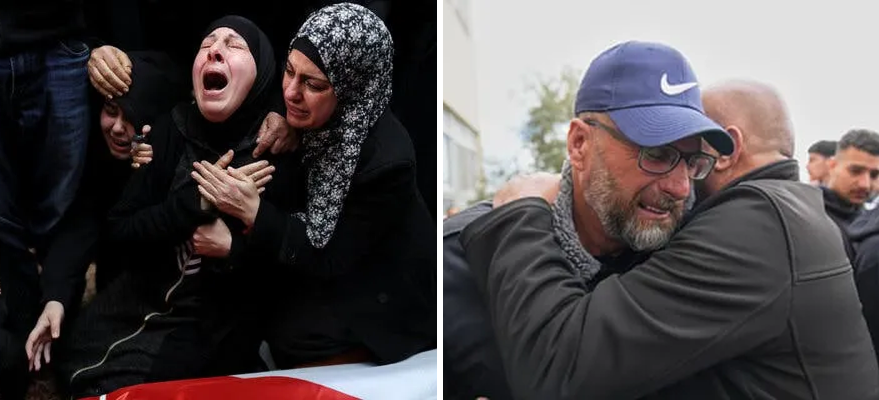
This is not an attempt to absolve Republicans. I take for granted that they will do what they have always done: inflict harm on brown people, wherever they are in the globe. What demands scrutiny are the “Good Liberals” who launder smears into respectable discourse, cast votes behind closed doors to codify them into law, and then retreat into moral language while the consequences unfold.

To be perfectly clear: countless mainstream Democrats and liberal institutions helped deliver Itamar Ben-Gvir one of his lifelong dreams—the destruction of the largest aid agency for Palestinians. That is whose team they’re on.
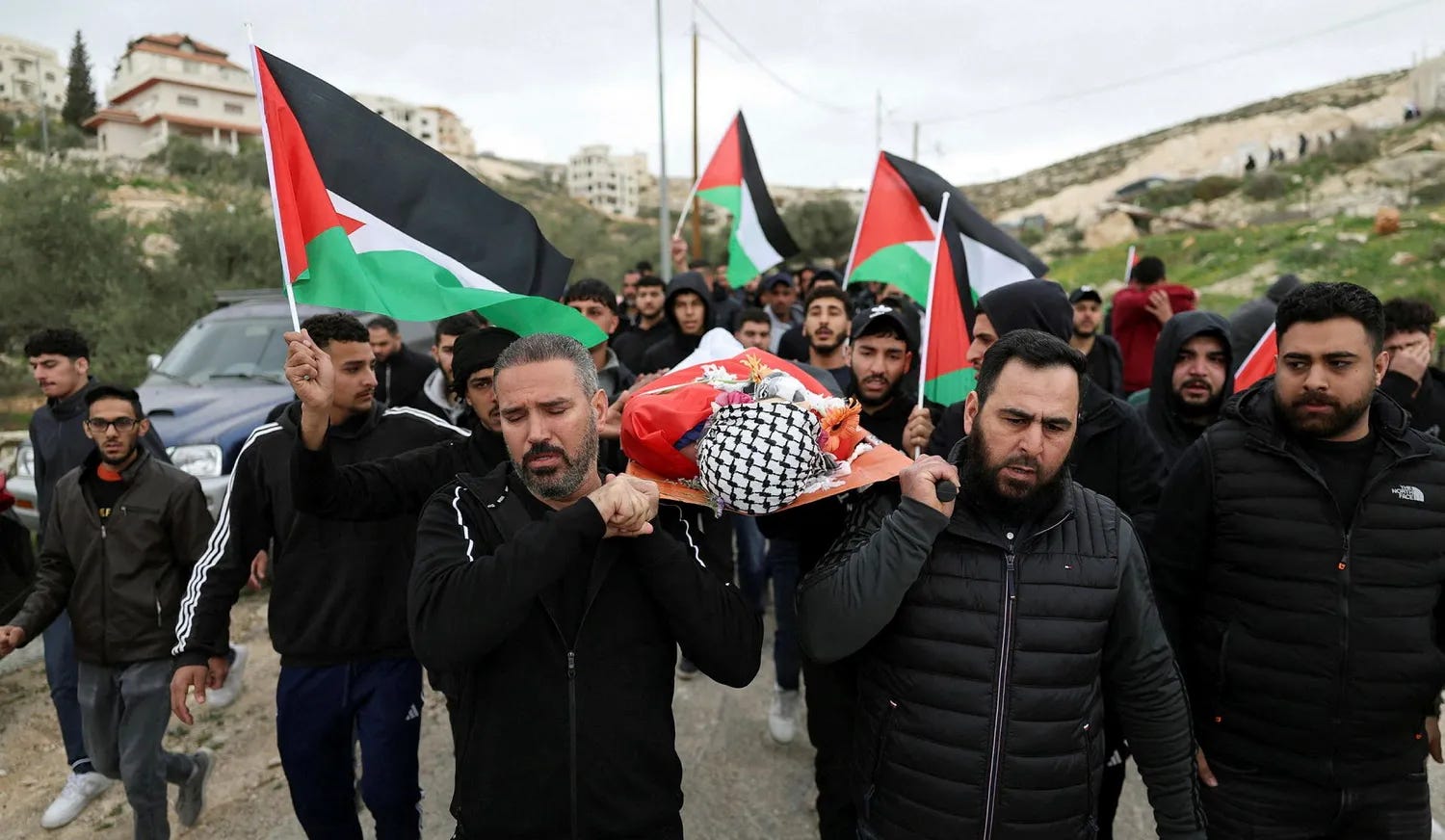
Whatever one thinks about Israel’s history, the comforting versions of that story no longer do any explanatory work. What matters is what Israel is today. The Israel that has thrown its full support behind the most violent settlers in the West Bank. The Israel that is dismantling critical aid networks for Palestinians just because it can. The Israel that, on Wednesday, violated the “ceasefire” for the umpteenth time by killing three Palestinian journalists in Gaza while they were documenting life in displacement camps.

In the United States, as we sink deeper into fascism, the way our bipartisan consensus on Israel intersects with this trajectory has become impossible to ignore. Figures like Jonathan Greenblatt, Bari Weiss, and Chuck Schumer have systematically downplayed the rise of literal Nazism on the American right in favor of targeting critics of Israel. (A Justice Department official who resigned in May put it plainly: “There was no interest in antisemitism unless it involved protests of Israel or the war in Gaza.”) Last week, Israel dispatched officials across the U.S. to pressure institutions into banning the term “West Bank” in favor of “Judea and Samaria.”

This is why, as I wrote last year, Trump was so savvy to deploy a crackdown on pro-Palestine activists as the vanguard of his assault on the Constitution, one that was facilitated every step of the way by Democrats. America’s unwavering support for Israel—the “beacon of democracy in the Middle East,” where millions can’t vote or claim basic rights—has long been one of its central contradictions. It was only a matter of time before an authoritarian cashed in.

It should come as no surprise, then, that ICE’s tactics increasingly resemble the IDF’s: executing civilians in broad daylight with impunity, blocking medical care, and issuing bald-faced lies about the circumstances of these killings. This is not to suggest that one is derivative of the other, but that this is what a fascist crackdown looks like, whether it’s carried out at home or abroad.

Today, support for Israel means support for a far-right, antidemocratic movement that is killing and displacing Palestinians and Arabs across the region, while feeding into the erosion of civil liberties here in the United States. And as if we needed further proof of that connection: On Thursday, Haaretz reported that U.S. authorities chartered a private jet owned by an Israeli-American businessman and close friend of Donald Trump to deport eight Palestinians living in the United States to the West Bank. Days earlier, Israel deported an American Jewish activist due to his “leftism,” citing as evidence a photo of him protesting against Nazis in Charlottesville.

The through-line is no longer subtle. A single political logic now runs from hilltop outposts to humanitarian strangulation, from Gaza to the West Bank, and straight into the heart of American institutions—where many of the same Democrats who maintain steadfast support for Israel now caution against the push to abolish ICE. This is the end of the story liberals told themselves: that power could be outsourced without consequence, violence compartmentalized, and moral language made to stand in for material reality. What remains is a single, expanding architecture of force. History will not be confused about who made that possible.


A few final notes before I sign off:

  • In case you missed it, I had what I thought was an excellent conversation with Mouin Rabbani about Israel’s endgame in the West Bank. You can watch it here.

  • Columbia Journalism Review interviewed me about how I navigate the line between reporting and activism.

  • I’ll be joining an online panel discussion on the West Bank hosted by the Arab Center Washington DC on January 29 at 10 a.m. EST. You can register here.

  • And some rare good news: after a sustained global pressure campaign, Israel called off plans to demolish a youth soccer field in Aida Refugee Camp in the West Bank.

See you next time.

All of my reporting is self-funded. If you want to help me keep doing this work, consider upgrading to a paid subscription—you’ll also get access to exclusive interviews, reporting, and essays.


Read the whole story
mikemariano
23 days ago
reply
Share this story
Delete

Searching for Le nègre blanc (1912; Fr.; Abel Gance)

1 Share

I often find myself searching on the FIAF database for the location of archive film prints. The database isn’t definitive, but it is often a helpful indicator. Anyone searching for archive copies of Abel Gance films would likely have spotted an entry for Le nègre blanc (1912). Click further and you would have seen that the Filmmuseum Düsseldorf was listed as holding a 16mm print of this film. I think I’ve known, vaguely, of this FIAF listing for many years. It had never occurred to me to investigate it further. Why? Well, I supposed that something so rare would have long since been checked and confirmed by another researcher. I also suspected that the copy might be so fragile that it was unavailable for viewing. The fact that the recent Gance retrospective at the Cinémathèque française did not include this film in its “complete” screening schedule seemed to confirm this (see my four posts from September 2024). But the question remained, lodged in my brain.

In the last few years, I have felt more willing and able to venture onto the continent in order to pursue various strands of my research. With a prospective trip to Germany planned for December 2025, I decided in advance that I should investigate this mysterious print in Düsseldorf. Over the autumn, there followed a long exchange of emails with various archivists, and the team at Düsseldorf kindly agreed to check their print in advance of my visit. I received the startling information that they had two prints of this title: one on 16mm and another, shorter, copy on 9.5mm. The former was approximately the length one would expect for an early two-reel film; the latter was clearly an abbreviated version of a single reel. My curiosity grew (as did my doubts), but I knew I must hold my excitement until someone had checked the prints to confirm their identity. Before I reach the inevitable (and I’m sure not surprising) conclusion of this search, I should say why the very idea of this film’s existence is so interesting. Interesting to me, anyway…

For a start, this print of Le nègre blanc would be the earliest surviving film directed by Gance. Some of his earlier appearances as an actor are preserved in films by others, but La Folie de Docteur Tube (1915) is his earliest known work as a director to exist. That this is so is something of a miracle, as the film was never commercially released. It is also frustrating, since all of Gance’s two- or three-reel films that did get released in 1912-15 are considered lost. These are the films that earned him enough success to make the more substantial features of 1916-18, films which anticipate so much of the dramatic and aesthetic qualities of his masterpieces of the next decade. What was Gance like as a filmmaker before 1916? We simply don’t know. So to find a print of any Gance film from 1912 would be of enormous interest.

Secondly, Le nègre blanc is of interest for its subject and stars. The earliest synopsis I have to hand is in Sophie Daria’s Abel Gance, hier et demain (1959), which was based on a number of conversations with Gance. As a result, it is often inaccurate and evasive – but certain details are found nowhere else. The book offers a brief sketch of Le nègre blanc, adding that “it was never projected” (44). Having searched the major film journals and major newspapers of the period, I can indeed find no evidence of a public screening. But that the film was actually made is indicated by the survival of a document from 16 April 1912, citing payment for Gance’s performance from Le Film français, the company which produced Le nègre blanc. (They paid him 500F. You can see below an image of this document, taken from the auction catalogue of 1993, at which Nelly Kaplan sold her huge collection of Gance’s personal papers. Happily, the highest bidders were two French state archives.) And before you ask, yes, Gance did play the lead role of the titular black character, so presumably would appear on screen in blackface. To what end? Well, a little more information on Le nègre blanc is given in Roger Icart’s biography of Gance from 1983:

A black boy goes to school with white children. Cold-shouldered and ridiculed by his classmates, he decides to make himself look like them by painting his face and body white. His appearance thus disguised provokes a redoubled dose of mockery, while he dies, his body slowly poisoned by his naive stratagem. (49)

As I discovered when I searched for the phrase, “le nègre blanc” (which I hope you don’t need me to translate) had a remarkably wide circulation in the early twentieth century. It appeared in any number of cultural and political contexts, as a derogatory term, a term of entreaty, of warning, of classification. In using it for the title of his film, Gance was clearly tapping into a phrase that was common enough on people’s lips. Sophie Daria cites the film as “anti-racist”, while Roger Icart cites it as “anti-racist(?)”. I like the hesitancy of Icart’s parenthetical question mark. Clearly, the film can be read both as a parable about the poison of racism – but might also hint at something less palatable about the insurmountable nature of race. Added to these murky cultural waters is the fact that, in the 1930s, Gance was identified by some as Jewish and vilified as such. (The right-wing press in France mounted numerous vile attacks on his films and him. The label “Jew”, for them, could be applied to anyone they didn’t like. Chaplin, too, was called a “Jew” by like-minded fascists in this period.) That Gance was adopted seemed to hint at family secrets, and the figure of a fatherless male seeking to rebuild (or adopt) a family is a recurrent theme throughout his films. However crude, Le nègre blanc is surely an important marker of this interest in lone men seeking identity and belonging – a kind of destiny – and being destroyed by it.

But Gance was not the first to use this title for a film. Le nègre blanc was the title of one of the numerous “Rigadin” comedies starring Charles Prince, this one being produced by Pathé in 1910 (some sources say 1912). This film (viewable online) follows much the same plot as Gance’s, though its comedy is less touched by tragedy. In the Pathé version, a black man is mocked at a high society party when he proposes to a white woman. Rejected because of his colour, he finds a potion to turn himself white. In this form, he returns to the woman – but she is now engaged to another man. In revenge, he slips her some of his potion and she turns black. Rejected by her fiancé because of her colour, she tries to seek solace with Rigadin. But now he has the last laugh and rejects her because she is “black” and he is “white”. Like Gance’s synopsis, the Pathé film is an awkward satire on the idea of race – and (in its casting and use of blackface) a perpetuation of racial stereotypes. Perhaps the very existence of this contemporary film discouraged Gance’s producers from releasing his version.

Whatever the reason, the theme of Le nègre blanc reappeared in one of the few Gance films of this period about which we have a fuller description: Le masque d’horreur (1912), starring Édouard de Max. In this film, an artist has spent years trying to create a lifelike mask expressing the greatest fear imaginable. Driven almost to the point of madness, he decides at last to become his own model. He sits before a mirror, takes poison and cuts his wrist. (As the artist smears his blood over the lamp that lights his face, so Gance tinted his film red to mimic the gruesome aesthetic.) As the artist dies, so the mask becomes more and more lifelike. He embraces his creation, and dies. Like Le nègre blanc, therefore, Le masque d’horreur portrayed a figure seeking self-transformation through the creation of a mask – and the adoption of this mask caused his death. Unlike Le nègre blanc, however, Le masque d’horreur was actually shown. After a processing error botched the first print struck of the film, it was seemingly reprinted and projected in May 1912. This brief foray into the public realm did not stop the film’s disappearance. Like everything else from this period of Gance’s directorial work, it remains lost.

Returning to Le nègre blanc, another major interest is the fact that it was made in the year Gance married his co-star in this film, Mathilde Thizeau. About Thizeau, I know frustratingly little. Though she was his first wife and starred in at least two of Gance’s films in 1912, she is a virtual non-entity in most accounts of the filmmaker. Sophie Daria cites the existence of this woman in a carelessly off-hand way: “the young cineaste had married a journalist older than himself: Mathilde, a good and simple girl with whom he lived in harmony for a few years” (65). Ouch. Given that Daria certainly got her information from Gance himself, this is quite an insult. (Of course, by 1959 he was married to Sylvie (née Marie Odette Vérité), his third wife.) The truth is that Mathilde Thizeau was only five months older than “the young cineaste”: they were both 23 when they married in 1912. Furthermore, Gance’s biographer Roger Icart offers a far fairer (though no less brief) account of Mathilde as “a young journalist of great spirituality, like [Gance] enamoured by art and philosophy, who would participate in all his endeavours and inspire him to write numerous poems, dedicated ‘to my Thilde’. Above all, she would reinforce his ambitions as an author” (23).

But who was Mathilde Thizeau? Where did she come from? What was her background? Who were her family? All I know is drawn from the scant evidence of her name in some contemporary journals. Thus on 28 October 1912, the Journal des débats announces the marriage of Abel Gance, “dramatist”, to Mathilde Thizeau, “journalist”. I am re-reading Proust at the moment, and today reached the last part of Swann’s Way (1913), in which the narrator recalls his childhood love for Gilberte. They often play together on the Champs-Élysées, and while the narrator waits in hope of Gilberte’s arrival, he makes friends with an old woman who comes loyally to sit on a bench. Here, she passes the time – come rain or shine – by reading what she calls “my old débats”. To this scene, set one imagines sometime in the early 1880s, an old woman expresses her fondness for her old journal. Proust’s novel was first published the year after the announcement of Gance’s marriage. What a strange world this is, and how charmingly old-fashioned, even then, to announce one’s marriage in the Journal des débats.

Searching for anything written by Thizeau, I eventually found my way to the issue of Le Gaulois du Dimanche published on 31 August 1912, two months before her marriage. There – among the pretty pictures, the silly adverts, the coverage of Massenet’s death and the latest crisis in the Balkans, the photos of cats and dogs, the latest women’s fashions, and a sentimental song – is Mathilde Thizeau’s piece: “La Rose qui a vu jouer ‘Héliogabale’”. A curious title, and it took me a little while to identity the “Héliogabale” it cites. It seems that Héliogabale (the Roman emperor Elagabalus) was the subject of a small number of artistic works in France around the turn of the century – there were a few plays, plus Louis Feuillade’s film Héliogabale (1911). Thizeau quotes a line from act I, scene ix of her particular source: “…et les plafonds ouverts / Sur eux laissent tomber les roses une à une…” (“…and over them the open ceilings / Let fall the roses one by one…”). I eventually found these enigmatic lines in the libretto of Déodat de Séverac’s eponymous opera of 1910. I knew Séverac by his lovely piano music, as well as by his charming opera Le Cœur du moulin (1908). He was from Languedoc in southern France and portrayed the landscapes and people of this region in his music, so it’s no surprise to learn that Héliogabale was first performed in Béziers. This took place in August 1910 in a huge arena populated by 15,000 spectators. Despite its place in a festival in high summer, the opera was a financial disaster and swiftly disappeared. But it was revived for a small number of performances at the Salle Gaveau in Paris in February and April 1911. It was here, one presumes, that Mathilde Thizeau experienced it.

Thizeau’s short prose poem takes inspiration from the scene in which Héliogabale arranges that his enemies, whom he has invited to dine, be smothered by thousands of rosebuds and petals emptied from the rafters. In Thizeau’s text, a rose watches the performance of this scene in the opera as the blossoms smother the banqueters below. She marvels at what she imagines to be the revenge of the roses against the men who have cut them from their stalks. At night, she decides to take her own revenge on the beetle which seeks to steal the nectar from her heart. When the beetle finally crawls into the flower, she “bleeds” herself to death: emptying her nectar into a delicious pool that the beetle drinks until it is insensible. Then the rose lets herself die, her petals falling over the beetle and entombing it in blossom. Thus ends the only piece of writing I have ever read by Mathilde Thizeau. What to make of it? Well, it’s very fin-de-siècle, and the imagery of male predator entombed inside a female flower is very… well, familiar. But it’s charming for how particular it is, and the fact that the story is taken from the perspective of a flower is curious. It’s a sidelong glance at a tiny corner of the world of 1912, and it’s an animistic close-up of nature.

I suppose it interests and charms me because it makes me want to know more. Did Thizeau see this opera with Gance? What was his reaction? And did they write together? Gance was performing in the theatre as well as being involved in the cinema. In the 1910s, he appeared in some important productions of D’Annunzio’s exotic, multimedia French plays – including Le Martyre de saint Sébastien (1911) and La Pisanelle ou La Mort Parfumée (1913). The latter ends with the protagonist being suffocated while inhaling the heady scent of roses, so not so far away from the world of Héliogabale. (And I have written about the links between D’Annunzio and Gance elsewhere.) So here we have this newly married couple, thinking and living theatre and music, within touching distance of the heady world of late romantic art. Such a world must have seemed far in advance of some of the films they were able to make in 1912-13, and Gance abandoned cinema for a year or more in 1913-14 in order to complete his own epic, multimedia stage drama La Victoire de Samothrace. How much of Mathilde lies in this piece, and what kind of life did they lead in these years? Sometime in 1914, Gance met Ida Danis, a secretary working for his new production company, Le Film d’Art. He fell in love with her and divorced Mathilde in 1919. Of course, Ida died in 1921 during the production of La Roue, leaving the filmmaker with a lifelong sense of loss. (Never having married Ida, he married her sister Marguerite in 1922. The marriage ended in turmoil in 1930, by which point Gance had met Sylvie…)

All of which is to say that Gance’s choice of film over theatre was echoed in his choice of Ida over Mathilde. Film history knows all about Ida as Gance’s “great love”, which only makes Mathilde’s fate the more poignant to me. Here are the limits of history. I know when Mathilde was born and died, and when she married and divorced Gance. But I don’t know her: her interests, her ambitions, what animated her soul, what drew her to Gance, or how they fell in love. I don’t even know what Mathilde looked like. Perhaps there is a photo somewhere in the archives, but when I did my research in Paris many years ago, I didn’t think to inquire. She died in 1966, but of her life after her divorce from Gance I know nothing. Did she know or care what happened to him – or see his films? Did he know or care what happened to her? And what did she do with her life?

For all these reasons, therefore, I was keen to know if the Filmmuseum Düsseldorf did indeed hold one or even two prints of Le nègre blanc. Eventually, the prints were located and examined. I received my answer… As I’m sure you’ve guessed, neither print was of Gance’s 1912 film. Instead, they were reduced versions of a film by the same name from 1925. This was made by Serge Nadejdine, Nicolas Rimsky, and Henry Wulschleger for Films Albatros. (I told you that title had surprising circulation in the early twentieth century.) At some point in the past, decades ago perhaps, the wrong iteration of this particular title was selected and recorded on a database. So no lost oddity for me, and no lost oddity for you.

But this wild goose chase offers another valuable lesson in the problems of film history. Evidently, we rely on a lot of unverifiable data. Scholars (including myself) copy and paste much of our information on a film’s cast, crew, length, date etc. without being able to check it against primary sources. (I discussed this same issue in my frustrated search for Der Evangelimann (1923).) And many films like Le nègre blanc do not survive for us to test our information or assumptions. But my experience chasing after a false entry on the FIAF database demonstrates that it’s always worth asking archives directly about what they possess. Material from this period is often sketchily catalogued on archival databases, let alone centralized platforms like FIAF. And the archivists themselves are a necessary and inspiring set of guides through the unique material they hold. If I did not get to see Le nègre blanc, I’m sure there are plenty of other surprises out there, waiting to be discovered.

Paul Cuff

My thanks to Andreas Thein and Thomas Ochs of the Filmmuseum Düsseldorf, and to Oliver Hanley for oiling the wheels of communication.

References

Sophie Daria, Abel Gance, hier et demain (Paris: La Palatine, 1959).

Roger Icart, Abel Gance, ou Le Prométhée foudroyé (Lausanne: l’Age d’homme, 1983).


Read the whole story
mikemariano
33 days ago
reply
Share this story
Delete

Here Today, Gone Tomorrow: What Happens After an ICE Arrest

1 Share

Jupiter Castillo, a UC Santa Barbara graduate and healthcare worker, shares his experience of detention and deportation.

The post Here Today, Gone Tomorrow: What Happens After an ICE Arrest appeared first on The Santa Barbara Independent.

Read the whole story
mikemariano
36 days ago
reply
Share this story
Delete
Next Page of Stories