1136 stories
·
0 followers

Is the Super Mario Galaxy Movie’s Rosalina Reveal Canon?

1 Share

Warning: This post will contain spoilers… inasmuch as The Super Mario Galaxy Movie can be spoiled.

If I had to review the new Mario movie succinctly, it would be as follows: exhausting but colorful, and with superfluous Wart content while also somehow not enough Wart content. That’s it. I think it’s overall a more entertaining thing to watch than the first movie was, but it’s also less interested in plot, character development and giving things a reason for happening. But if you don’t feel conflicted lowering your brain function to only the level needed to recognize things, you might have a decent time. 

I mean it literally when I say The Super Mario Galaxy didn’t bother with traditional narratives. I don’t think a single character had an actual arc. And things just happen because they need to happen, to the point that Toad at one point comments on this, complaining that Yoshi has joined the group for no apparent reason. But because the film seems to avoid the kind of structure you’d expect from most movie plots, I was surprised that it did attempt to fill in the blanks regarding a question that the games have never answered: Why does Rosalina look so much like Peach if they’re not related?


In this new movie, it turns out they are. Rosalina is somehow Peach’s older sister, even if their origins beyond that are explained with only a single line: they’re “made of stardust,” although we’re never explained exactly what this means. It’s not much, I will admit, but it’s certainly more of an explanation than we’ve been given before. The games leave it more or less at Peach being the princess of the Mushroom Kingdom and Rosalina being some kind of mystical space lady who sometimes displays god-like powers and who also has Peach’s face.

And yes, I realize that Daisy already existed in the Super Mario games as a princess who looked like Peach for years before Rosalina came along. But I’d wager Daisy now looks less like Peach or Rosalina than Peach or Rosalina look like each other.


In an interview with Forbes about the production of The Super Mario Galaxy Movie, Shigeru Miyamoto explained that while it explores Peach and Rosalina’s relationship in a way the games don't, the kernel of this big plot twist is something that originated nearly twenty years ago. It came about during the development of the video game Super Mario Galaxy, but not a whiff of it made it into the game in any meaningful way.

When we were developing Super Mario Galaxy, the director for that game, Yoshiaki Koizumi, and I were discussing what Rosalina and Peach’s actual relationship was. We had this vague idea about what their actual relationship could be, and how it would play into the concept of space. We had a lot of discussion about this, but we never came to a conclusion. So we decided that let’s take this opportunity to give this idea some meat and get into the specificity of it, and we had a lot of fun having this discussion back and forth.

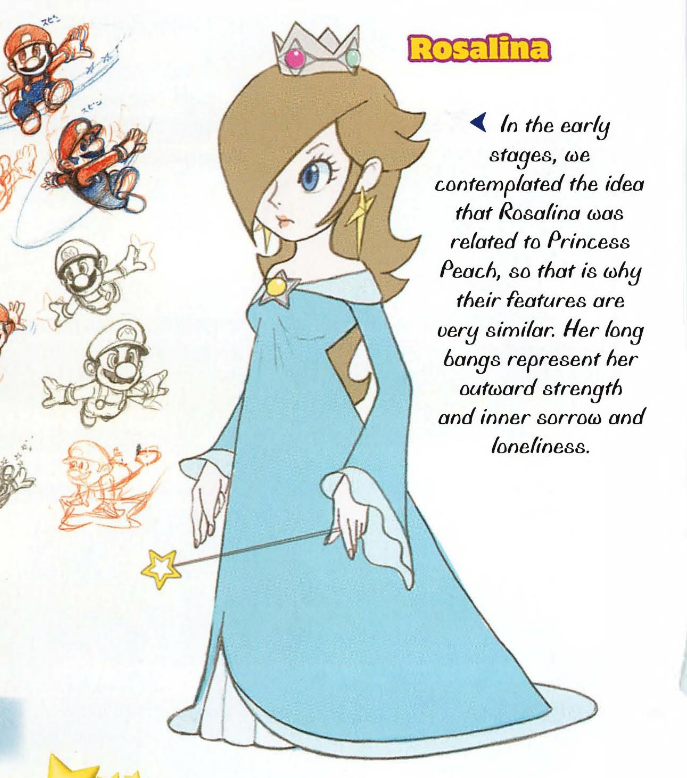
I will point out that Miyamoto isn’t saying that Nintendo specifically intended Rosalina to be Peach’s sister. In fact, there’s a note in the Prima guide to Super Mario Galaxy that makes it seem like the team only took it as far as making Rosalina some kind of relative without specifying which: “In the early stages, we contemplated the idea that Rosalina was related to Princess Peach, so that is why their features are very similar.”

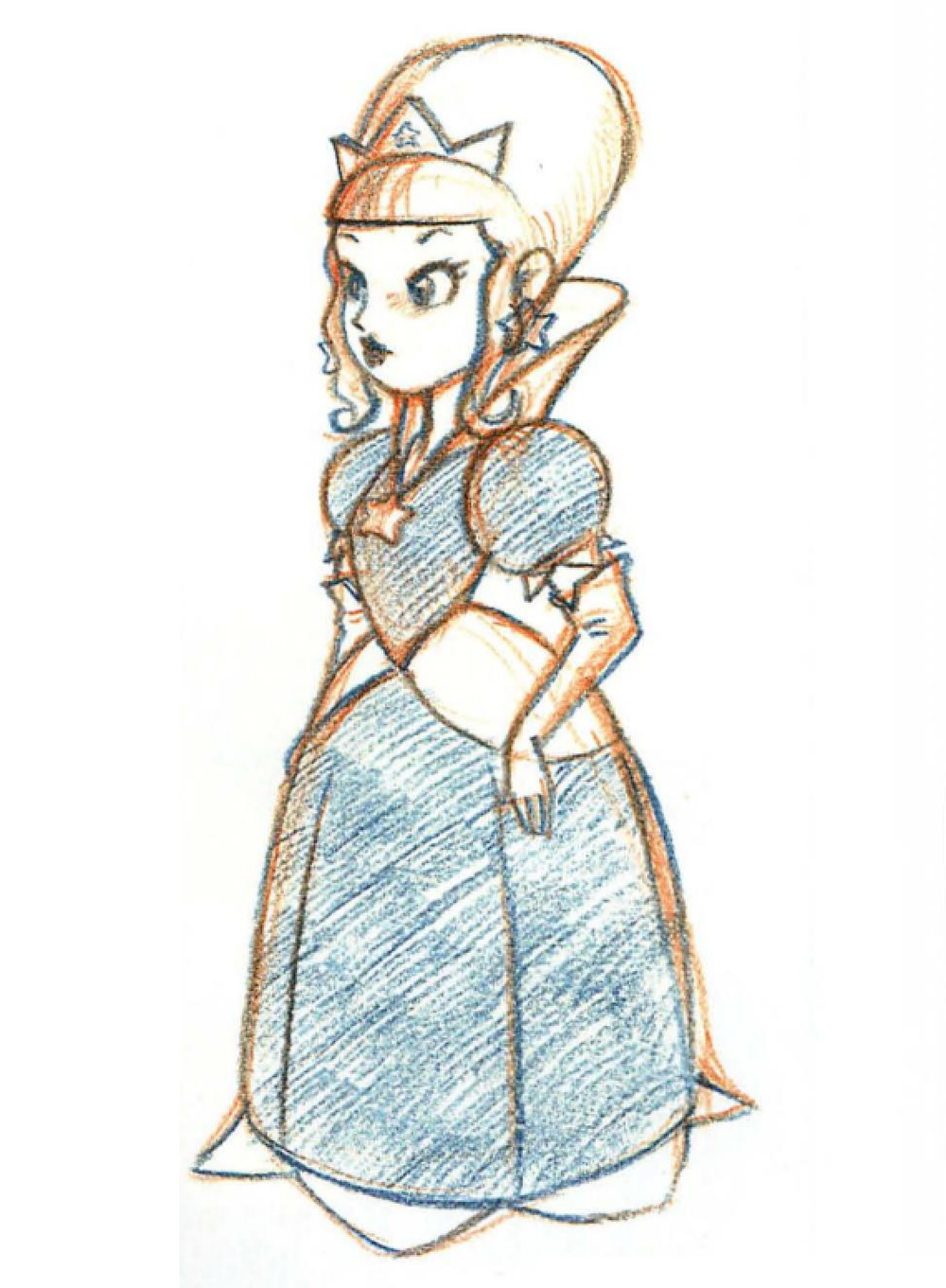
Of course, as I pointed out in a post about connections between Rosalina and Glinda from The Wizard of Oz, one of the original designs for the former dressed a lot more like the latter — and with a dress that looked a lot more like the standard princess gown that Peach and Daisy wear.


It’s interesting that this new character’s clothes were restyled but her face remained more or less the same, as if they wanted to differentiate her in some ways without deviating too far in others.

So does this mean that the dea of Peach and Rosalina being sisters have any basis in the games? 

No, not technically, aside from the fact that they look like they should be related. But the games don’t comment on this or hint that there’s a reason Peach and Rosalina physically resemble each other. This is very weird, I must say. In most fictional continuities, if a new character showed up looking strikingly like an existing character, you’d expect that to be explained in some way — a long-lost child, a secret sibling or an evil clone, for example — but the Super Mario video games have just declined to address this matter. 

Before you do what I did and default to blaming Shigeru Miyamoto for this, I feel like I should point out that this particular subject tends to make fans bring up his alleged hatred of story elements in the Super Mario series. This rep might be unfair, however. For one thing, there’s a 2023 IGN interview in which Miyamoto clarifies that he just thinks other elements should be given equal or greater consideration in the creation of video games. For another, the perception that he’s anti-story has colored a misconception regarding Super Mario Galaxy specifically. In the game, we get a hint at where Rosalina came from via her storybook time with the Luma, which is such an emotional touchstone of this character and this series that it’s literally how The Super Mario Galaxy Movie opens.

As the story is often told, this element had to be inserted into the original game covertly so Miyamoto didn’t remove it. Looking at the accounts of how it came to be, however, this seems inaccurate. In a 2007 interview for Wired, Chris Kohler does in fact lead with a quote from Yoshiaki Koizumi, the director of the Super Mario Galaxy video game, that basically calls Miyamoto anti-story.

“I would sort of try to find sneaky ways to get [story elements] in without them noticing too much,” Koizumi said of his early work. “These are aspects of the games that Miyamoto wasn’t nearly as fond of, and occasionally didn’t like.”

Importantly, however, this quote has Koizumi referring to his early work at Nintendo. When it comes to how Rosalina’s storybook vignettes made it into Super Mario Galaxy, he mentions no interference from Miyamoto.

For a long time, it really felt like telling a story in a Mario game was something that wasn’t allowed. But I felt in this case that the Lumas and Rosalina really needed a story to explain what they were doing out there and to give the players a deeper understanding of their presence. So telling her story as a fairytale by reading the book to all the Lumas as if they were young children at storytime just seemed like the mood-appropriate way to accomplish this.

Dropping it into the game in the middle of the hub right there as something you could choose if you wanted to, I felt worked very well. If the book was standing all alone on its own, or if the game story was standing on its own, neither of them work very well as separate elements. But together, they reinforce each other quite nicely. And people have the option of hearing that story if they want to, or never going into that room if they don't want to hear it. Even so, just making the children's book was quite a feat. It was a bit of a struggle for us to get it done. And a couple things that we cut from the book ended up going into the main story as well. So it was a pretty good process.

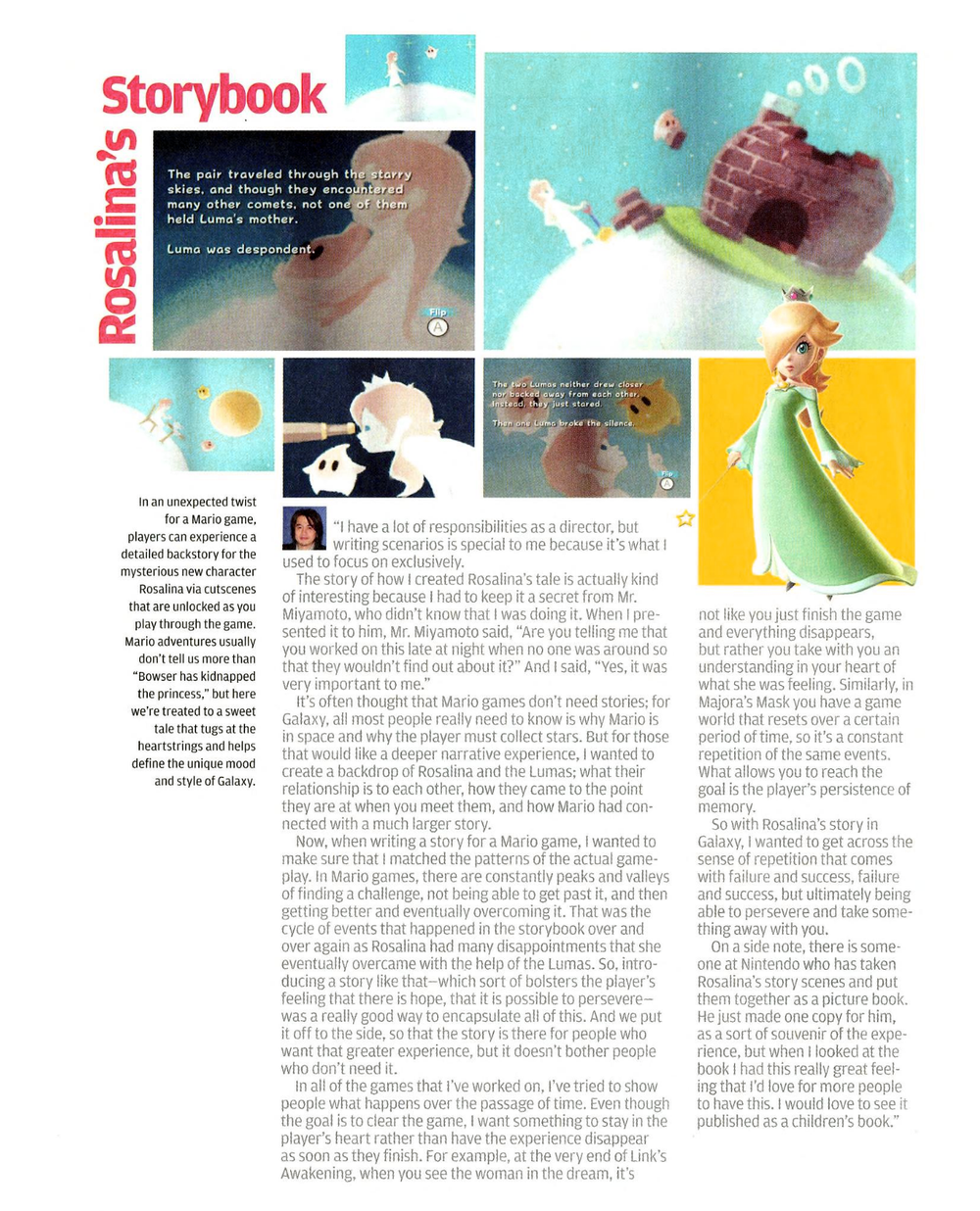
We get even more insight as to the process in the February 2008 issue of Nintendo Power.

I have a lot of responsibilities as a director, but writing scenarios is special to me because it’s what I used to focus on exclusively.

The story of how I created Rosalina’s tale is actually kind of interesting because I had to keep it a secret from Mr. Miyamoto, who didn’t know that I was doing it. When I presented it to him, Mr. Miyamoto said, “Are you telling me that you worked on this late at night when no one was around so that they wouldn't find out about it?” And I said, “Yes, it was very important to me.”

It's often thought that Mario games don't need stories; for Galaxy, all most people really need to know is why Mario is in space and why the player must collect stars. But for those that would like a deeper narrative experience, I wanted to create a backdrop of Rosalina and the Lumas; what their relationship is to each other, how they came to the point they are at when you meet them, and how Mario had connected with a much larger story.

Miyamoto’s role is stated in an elliptical manner here, but if you just read what Koizumi is presenting, it’s pretty clear that he wrote the Rosalina’s storybook sections on his own because it carried emotional weight for him, not because he was necessarily hiding it from Miyamoto. And however negotiations between him and Miyamoto went, the segments made it into the game, so ultimately Miyamoto approved them.


I suppose it’s possible that Miyamoto may have also considered and then rejected any kind of in-game confirmation that Rosalina was Peach’s long-lost sister, cousin, mother, or daughter from the future, Sailor Moon-style. But without asking them both, we don’t know who made that call. For all we know it was Koizumi, as the story ultimately leaves this vague.

This is a long-winded way of saying that nothing concrete made it into the game. Regarding the notion of Peach and Rosalina being sisters, The Super Mario Galaxy Movie is not drawing on the games per se but rather something that predates Super Mario Galaxy — something ultra obscure, behind the scenes and on the drawing boards only, to the point that it’s not actually canon. It’s actually something the canon rejected.

So does the movie mean that Rosalina will become Peach’s sister in the games?

Obviously, I don’t work at Nintendo, but I’d imagine not. There’s nothing in Miyamoto’s quote to Forbes that makes me think the games will adapt the movie’s canon in the future. I should point out that the versions of characters we see in the movie are often distinct from their video game counterparts. The movie version of Peach is a little colder than the game version, and the movie version of Rosalina is a little warmer than the stoic star mother we get in the games, to the point that I feel like Ana Taylor-Joy and Brie Larson would have been better off swapping roles, but whatever. The movie also makes the point of calling Rosalina a princess, even though she’s never been called that in the games, despite the fact that she looks like she belongs in that club just based on the dress, the brooch and the crown. In fact, both the games and the movie use the term in a way that makes me wonder what exactly it means in either universe.

I mean, it’s not as if the first movie reintroducing Foreman Spike resulted in that character having anything to do in the subsequent games, official name change notwithstanding.

If you want more of my thoughts on The Super Mario Galaxy Movie, I was a guest in last week’s episode of Nintendo Cartridge Society. I also recorded an episode just this morning with Retronauts, so look forward to that one as well.

Miscellaneous Notes

My primary reaction to the movie making Peach and Rosalina sisters is that I worried it would make people think that Nintendo was trying to play off the success of Frozen. Rosalina debuted in the Super Mario games years before Frozen opened in theaters, but Frozen proved to be such a pop culture juggernaut that I can imagine some people might see Rosalina as Disney’s answer to Elsa. They’re both emotionally restrained, full of mystical powers and fond of a certain shade of blue. Rosalina has even been associated with ice even though there’s nothing about her Super Mario Galaxy appearances that connects her with that. What’s worse, her being surprise sisters with Peach just makes Peach seem like Anna. Oh well!

If anyone in the Super Mario games seemed like she should be Peach’s sister, it really seems like Daisy makes more sense. Daisy is often the Luigi to Peach’s Mario, after all, but I suppose Rosalina makes a more compelling character, especially if you’re setting the story primarily in outer space. I can’t imagine how they’d fit Daisy into things in a subsequent movie, especially because she theoretically has less “stuff” than Rosalina, since Rosalina is the one with magic powers. Daisy is just pep and sports gear.


Read the whole story
mikemariano
3 days ago
reply
Share this story
Delete

Your Silent Face: Jiggs the Dog

1 Share

NB: This article is very long, so it may be best read on the website.


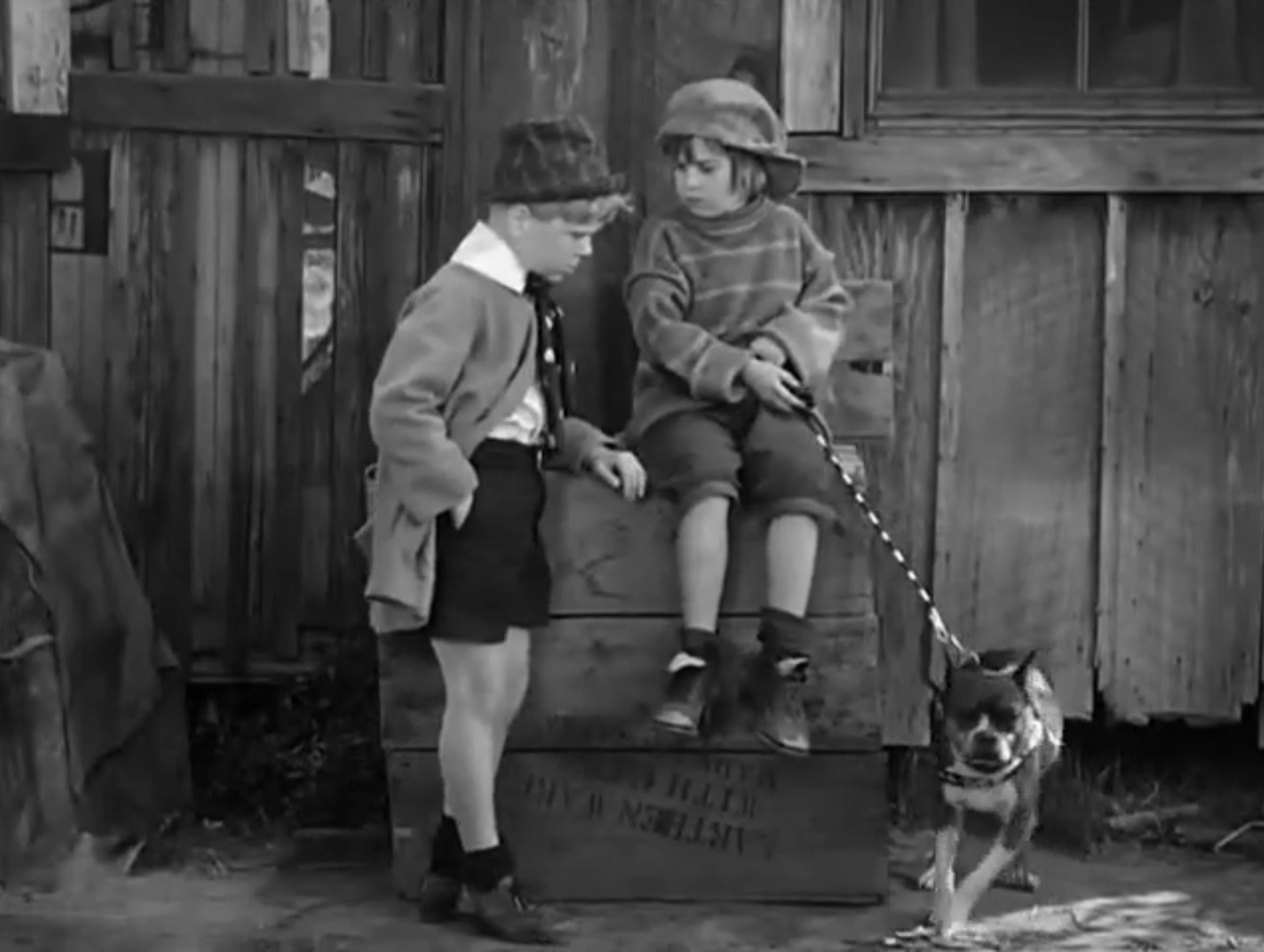
Jiggs the Dog in Ernst Lubitsch’s The Love Parade (1929)

Fans of the silent era probably know slapstick companion Luke the Dog and action star Rin Tin-Tin. If you’re a fan of films from the 1930s, you know Skippy (aka Asta from The Thin Man), Terry (aka Toto from The Wizard of Oz), and of course Lassie. But you might not know about Jiggs1, although if you’re a silent film fan, I’m willing to bet you have seen him in at least one film. Dubbed the “Caniniest of Canines,” Jiggs was a Boston Terrier, although he is often referred to as a “Boston Bull” and a “Bull Dog” in fan magazines. Described in the February, 1928 issue of Picture Play Magazine as “a veteran of the screen whose successes are too numerous to mention,” Jiggs likely began their career in the 19232. In the 1926 Standard Casting Directory, Jiggs’ owner is listed as Jack Ewing3.

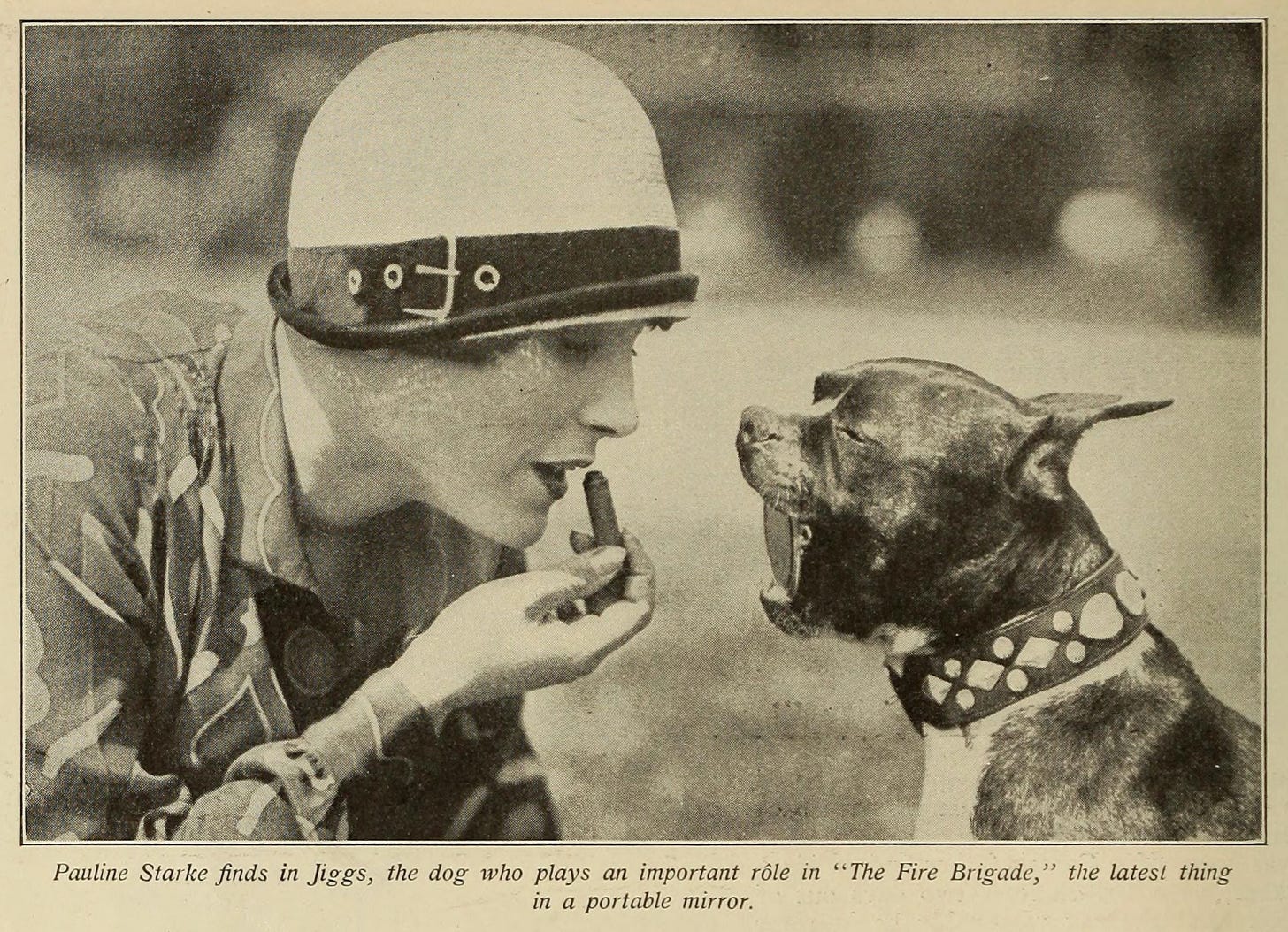
Another version of this image claims that Starke trained Jiggs to follow her around the MGM lot holding her mirror

Although I had seen Jiggs in a few films, which I will mention in a bit, I had never heard the name before until I came across an image in the October, 1926 issues of both Photoplay Magazine and Picture Play Magazine, which shows Jiggs holding a lipstick mirror for actress Pauline Starke4. I immediately wanted to know more about this pupstar.

What I have discovered is that during the silent era, Jiggs appeared in over a dozen films, including the drama film Bread (1924)5, Fifth Avenue Models (1925) starring Mary Philbin, the Bebe Daniels’ comedy Miss Brewster’s Millions (1926); the action thriller The Fire Brigade (1926)6; the lost action serial The Fire Fighters (1927); the lost comedy Her Father Said No (1927); the crime caper Ladies Beware (1927), the lost film The Coward (1927) produced by Joseph P. Kennedy; the drama Women’s Wares (1927) starring Evelyn Brent; John M. Stahl’s In Old Kentucky (1927); the lost comedy Ritzy (1927); the Leo McCarey shorts Flaming Fathers (1927) and What Every Iceman Knows (1927); the Roscoe Arbuckle directed Eddie Cantor film Special Delivery (1927); and The Understanding Heart (1927) opposite Joan Crawford.

Jiggs also appeared in William A. Wellman’s Best Picture winning war epic Wings (1927), Ernst Lubitsch’s The Student Prince in Old Heidelberg (1928), and the lost comedy A Certain Young Man (1928) starring Ramon Novarro, Marceline Day, Renée Adorée, and Carmel Myers. I also found a reference to Jiggs appearing in the boxing serial The Leather Pushers, which would actually put the dog’s screen debut as 1922. Some of these credits I have been able to verify, others not so much.

In Wings, Jiggs plays the dog of Richard Arlen’s character David, who, as he bids farewell to his family to head off for the WWI trenches in Europe, also gives his loyal pup a lovely goodbye kiss. Although Jiggs was known for his tricks, he isn’t asked to do much here other than sit and be sweet. If you look closely, it appears that Arlen has some treats in his hand in order to elicit a goodbye nuzzle from his beloved pup.

Jiggs with Maurice Chevalier in Ernst Lubitsch’s The Love Parade (1929).

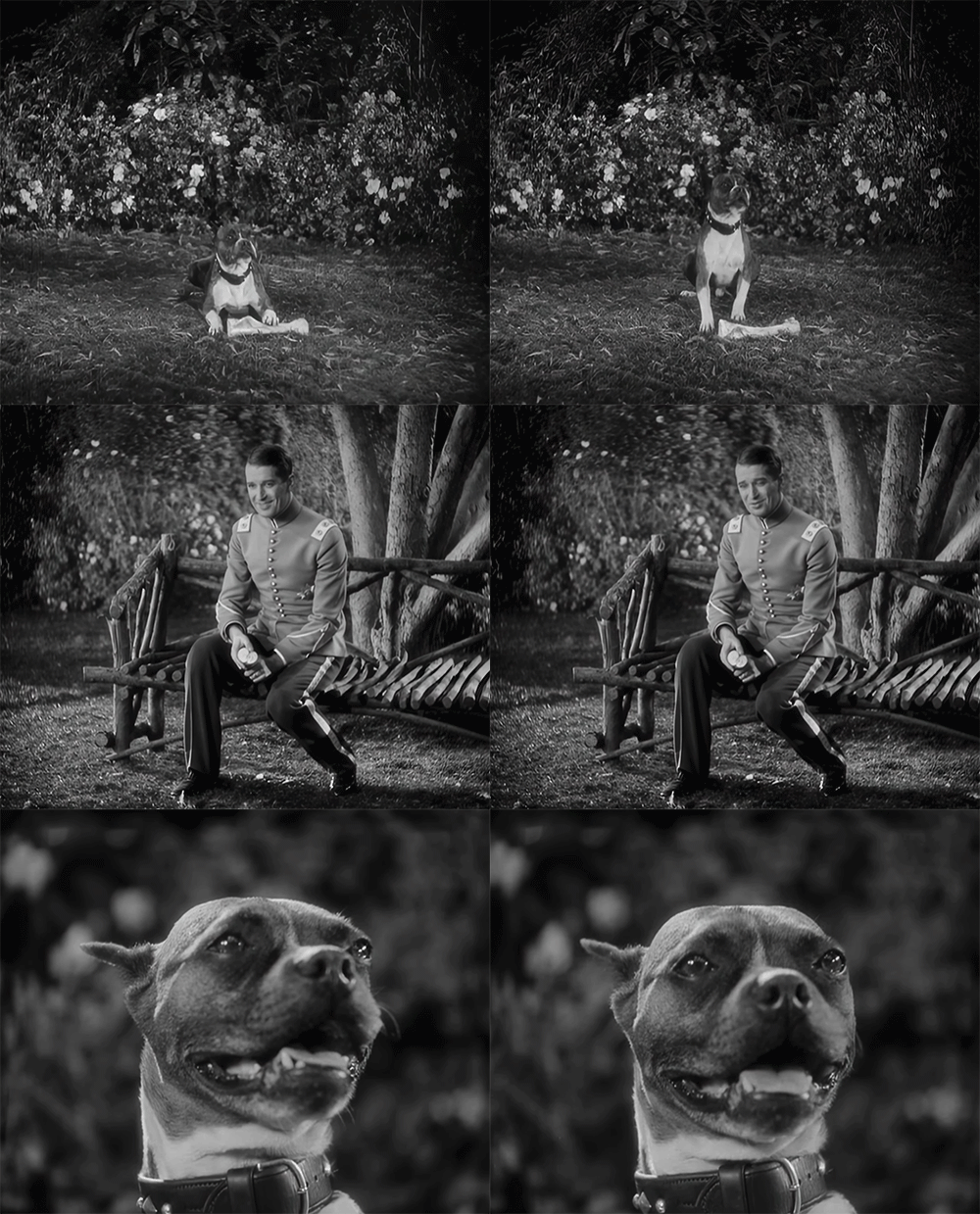
With the advent of sound, Jiggs made the transition into the talkies seamlessly. His first major role was co-starring opposite Maurice Chevalier in Ernst Lubitsch’s pre-Code comedy The Love Parade (1929). In this film Jiggs plays Chevalier’s loyal dog companion. When Chevalier’s character must leave Paris after one too many scandals, he bids his farewell to the ladies of Paris. Jiggs is given a similar scene, barking his goodbyes to his canine comrades. Along with helping his master with his shenanigans, Jiggs also flirts with Queen Louise of Sylvania (Jeanette MacDonald)’s poodle. Later in the film, Jiggs is Chevalier’s only friend, and the two share a sweet scene in the garden, under the moonlight. Here Jiggs gets a great close-up and a moment to showcase his ability to do tricks on command.


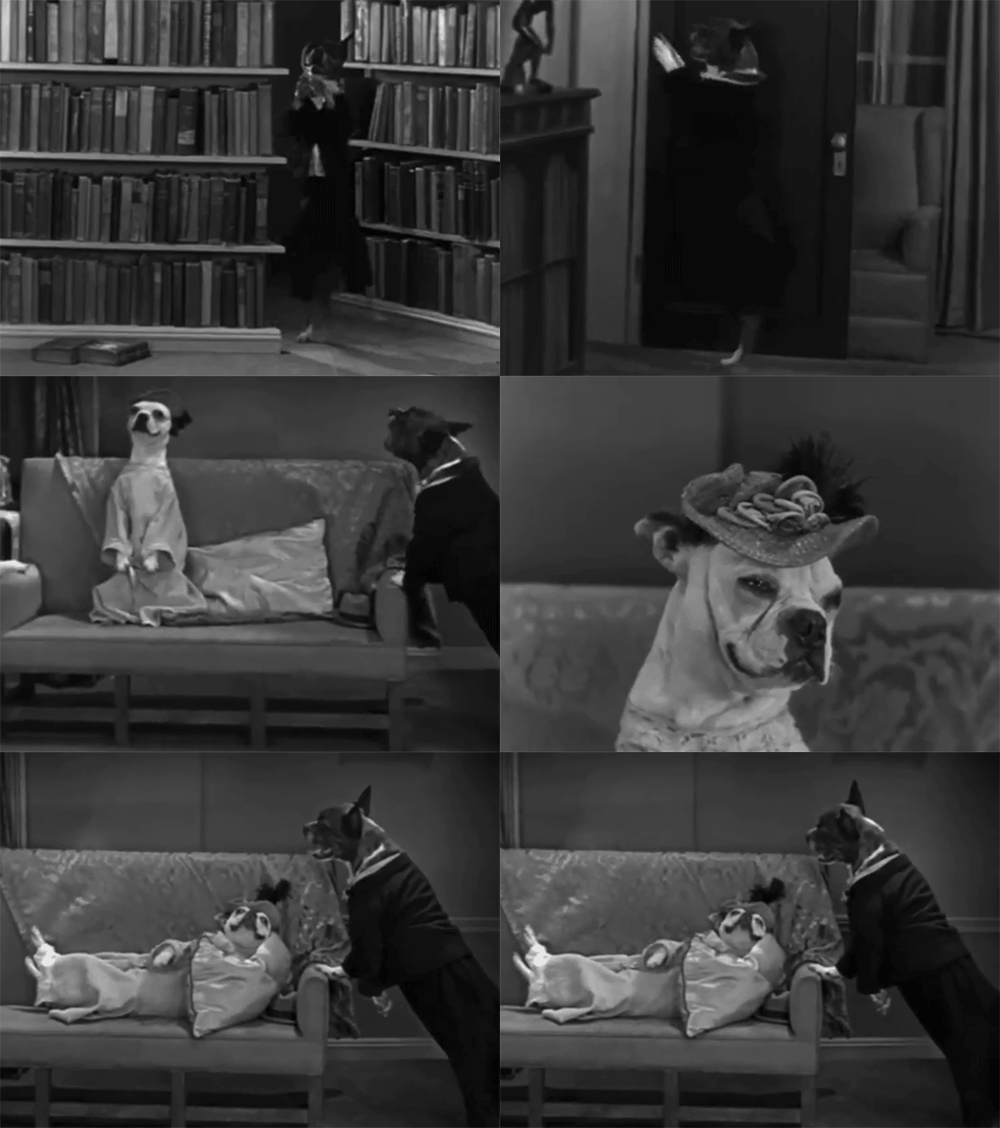
The sets for the Dogville barkies were made in miniature

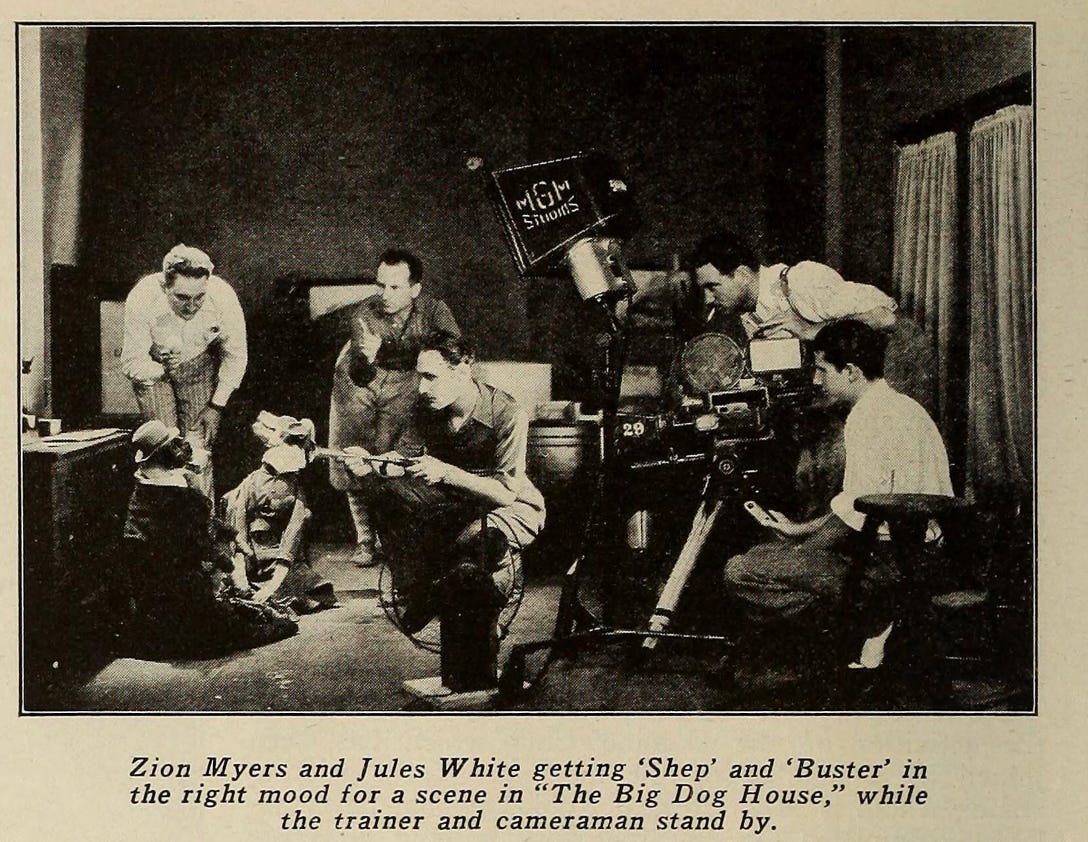
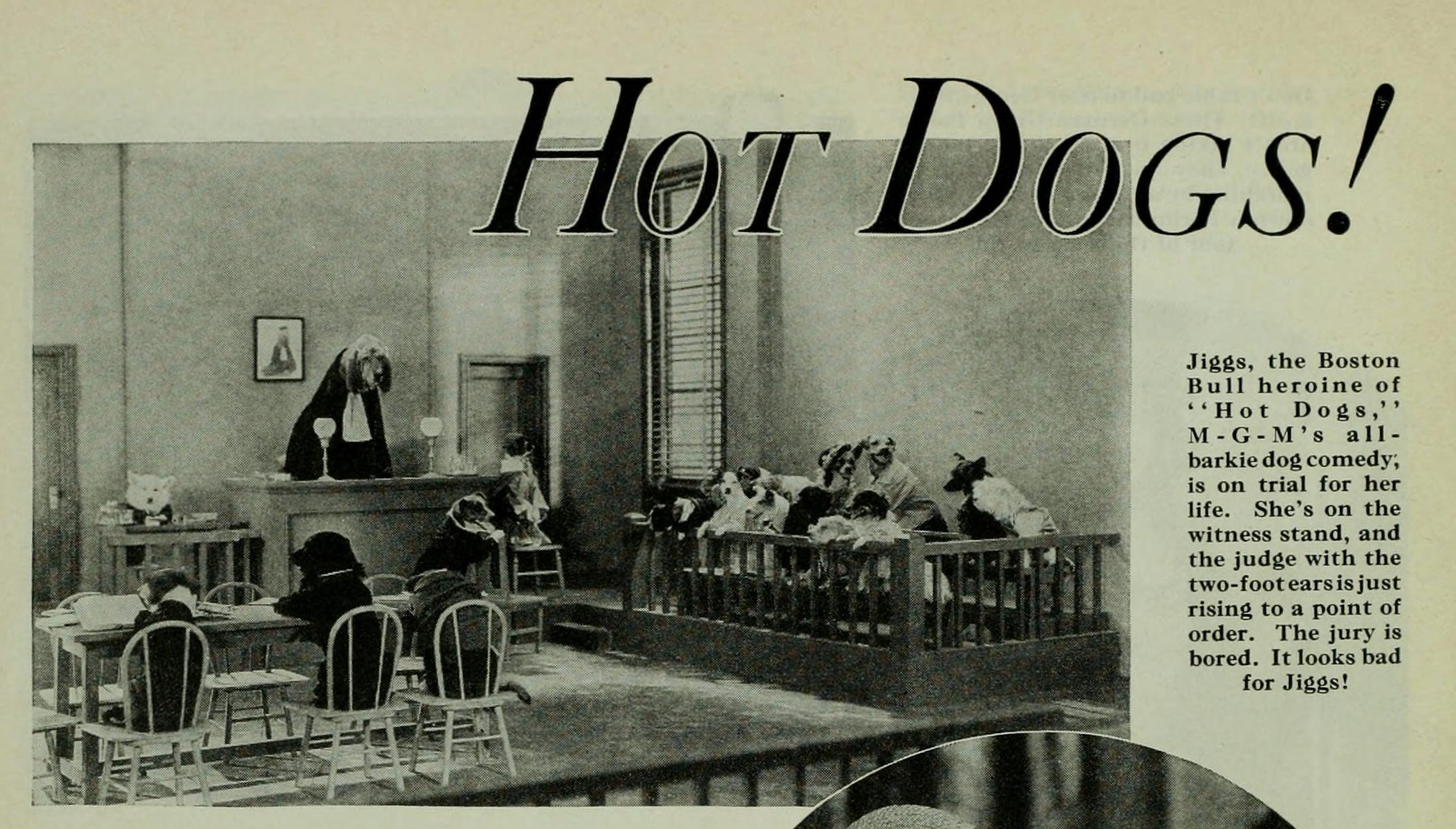
Later in 1929, Jiggs appeared with several other dog talents in a series of shorts originally called Hot Dogs!, later renamed the Dogville Comedies. A piece entitled “Hollywood Goes To The Bow-Wows” by Marie House found in the December, 1930 issue of Screenland profiles how Zion Myers (brother of star Carmel Myers) and Jules White conceived and co-directed the series, which were often short, melodramatic parodies of popular films.

One of the first Dogville shorts was a riff on Madame X (1929)

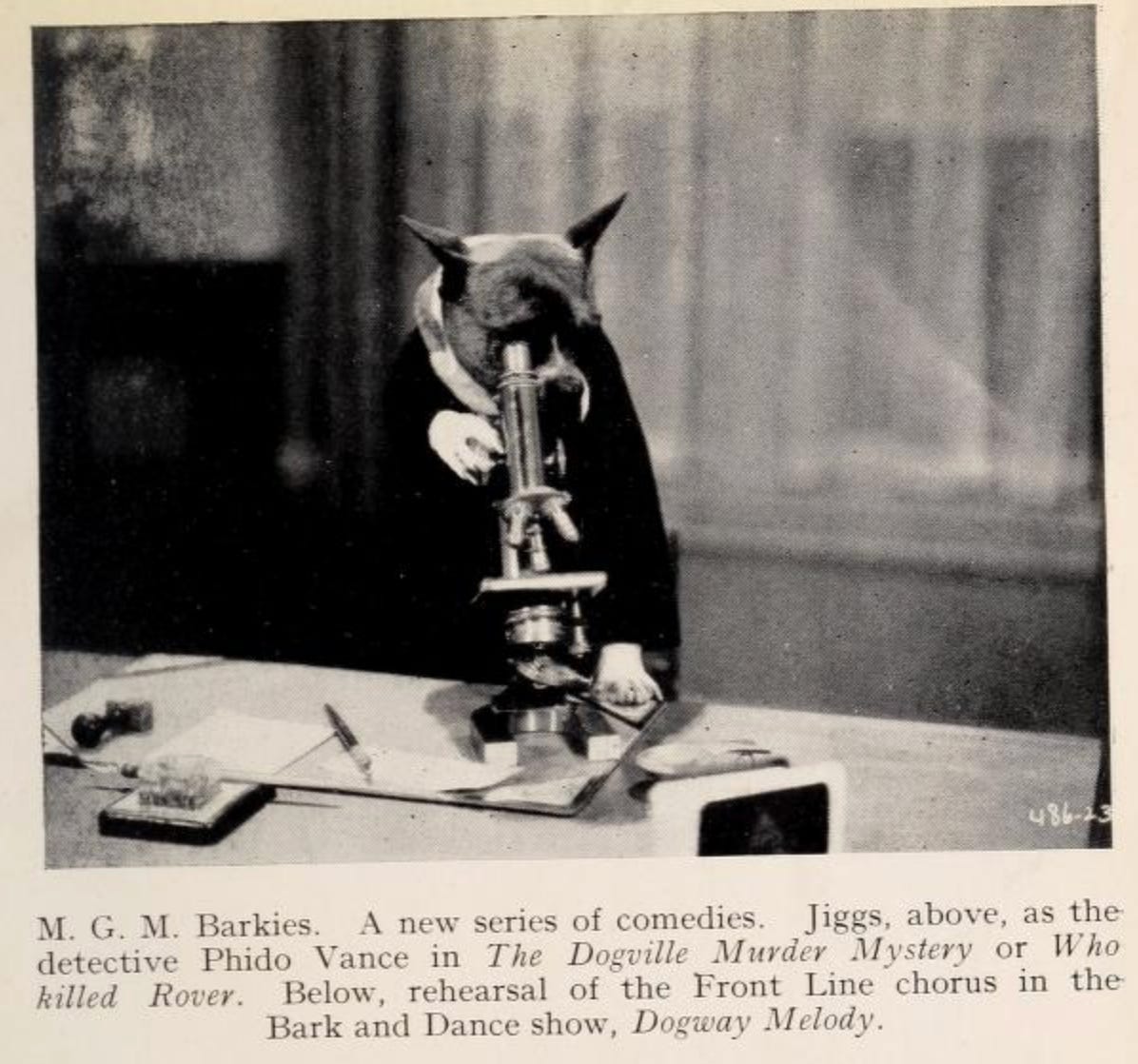
These “barkies” were cast by combing through all the trained dogs listed in various talent directories. From what I have read, Jiggs was always described as a hard-working professional. In House’s piece she writes, “But you must know Jiggs. Jiggs really has a movie reputation. Why he’s been in pictures for years. . .Jiggs is one of those aloof, high-brow personalities. Remember him as Phido Vance in Who Killed Rover? — he’s a Ronald Colman or William Powell, sort of— or maybe even Greta Garbo, you might say. Silent. Mysterious. Aloof.”

House also claimed that Jiggs can walk, that he has a “psychosis about mice” and loves to chase them, and that Jiggs often doubles in shots for dogs that cannot walk on two feet. The piece also “interviews” Jiggs, where the dog says they like movies, but that they live very quietly outside, never goes out socially, doesn’t care for the ladies7, and that his favorite food was hamburger. Allegedly, Jiggs could also say the words “hamburger” and “Mama.”

Jiggs as Phido Vance in Who Killed Rover? (1930)

Although Jiggs was a male dog, in these barkies he often played female roles, as profiled in a January, 1930 issue of Picture Play Magazine. In this piece Jiggs is described as the first “pup female impersonator.” In the January, 1930 issue of Photoplay, the dog is described as the heroine of the Hot Dogs! series. In the series’ second film, entitled Hot Dog (1929), a parody of courtroom dramas like the Ruth Chatterton melodrama Madame X (1929), Jiggs plays a female character who ends up in a love triangle that results in a scandalous trial.


Subscribe now


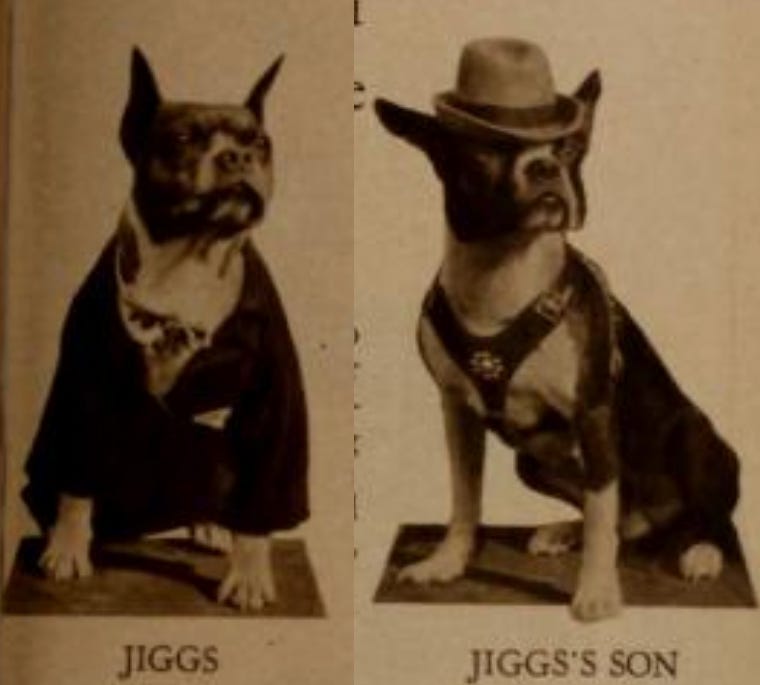
I couldn’t find much information about Jiggs’s son

In the November, 1930 edition of Motion Picture Classic an article entitled “They’re In The Barkies Now” by Helen Louise Walker describes how Jiggs receives “voluminous fan mail” and sends out photographs to admirers all over the world. The piece goes on to describe Jiggs as a versatile actor who can play “old men and young flappers with equal verve and enthusiasm.” Allegedly, Meyers and White had thousands of costumes for these shorts and the dogs knew their own costumes. White is quoted as saying, “You should see the fireworks, if we try to put one dog’s costume on another! They can smell the difference, you know. And how they resent it!”

Jiggs with Jackie Cooper and Robert Coogan in Norman Taurog’s Skippy (1931)

One of the last films that I can confirm featured Jiggs is Norman Taurog’s pre-Code comedy Skippy (1931). This film is notable for its Oscar trivia: along with being nominated for Best Picture, its 32-year-old director Taurog was the youngest Best Director winner in Oscar history until Damien Chazelle won for his 2016 musical La La Land. Also, the film’s nine-year-old star Jackie Cooper is still the youngest nominee for Best Actor in a Leading Role. Jiggs appears late in this film, hanging out with one of the film’s other young stars, Robert Coogan, whose more famous brother Jackie Coogan8 you may recognize from Charlie Chaplin’s The Kid (1921).

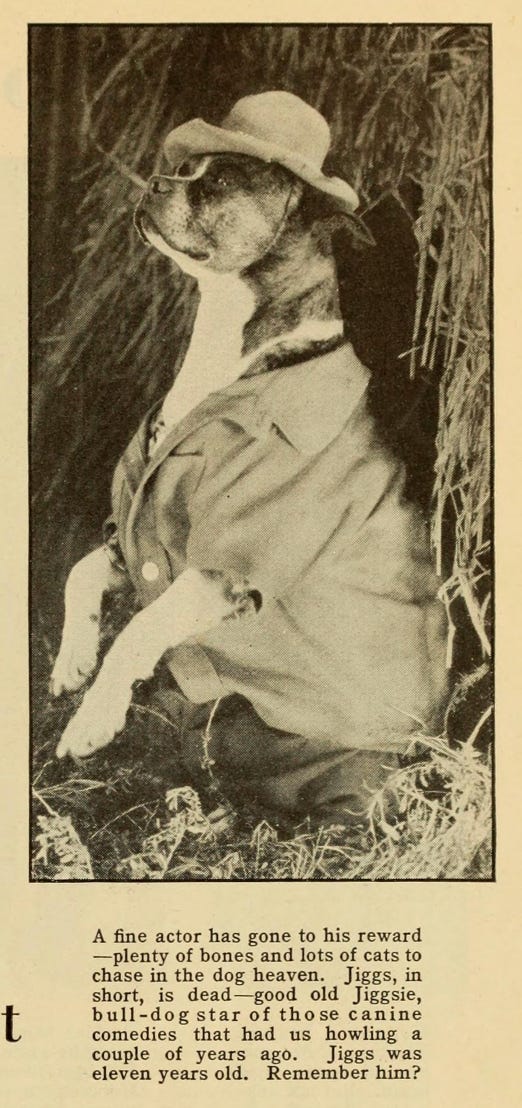
A visual memorial for Jiggs after his death in 1932

Jigg’s obituary appeared in the September, 1932 issue of Photoplay, where he was described as “that famous talking bull dog of the movies.” After listing various credits, the obit goes on to say that Jiggs “always gave an outstanding performance” and that he was eleven years old when he died. The pup was buried in a “tiny redwood casket made especially for him” and that one of his puppies died on the same day. The obit ends by insisting that the “movies will miss good old Jiggs. It will be a long time before his place can be filled.”

Jiggs “walking” in Who Killed Rover? (1930) [his co-star is another “female impersonator” dog named Oscar]

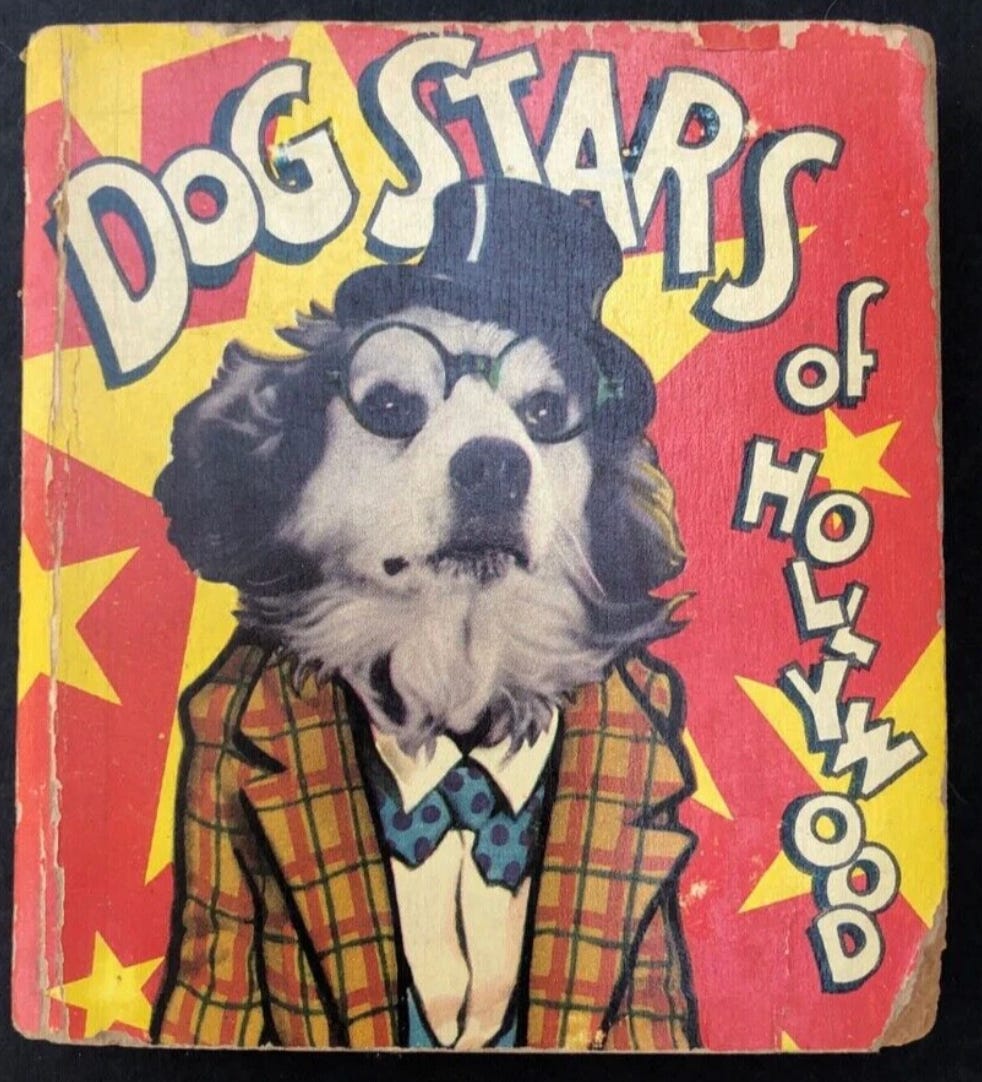
In 1936, Jiggs was one of the many dogs profiled in Gertrude Orr’s book Dog Stars of Hollywood. Unfortunately, I could not find a digital copy of the book and on eBay it is going for $145! After his death and the publication of Orr’s book, it seems, like many silent film stars, Jiggs faded into obscurity. I’m sure he was a good dog.

The cover of Gertrude Orr’s book Dog Stars of Hollywood.


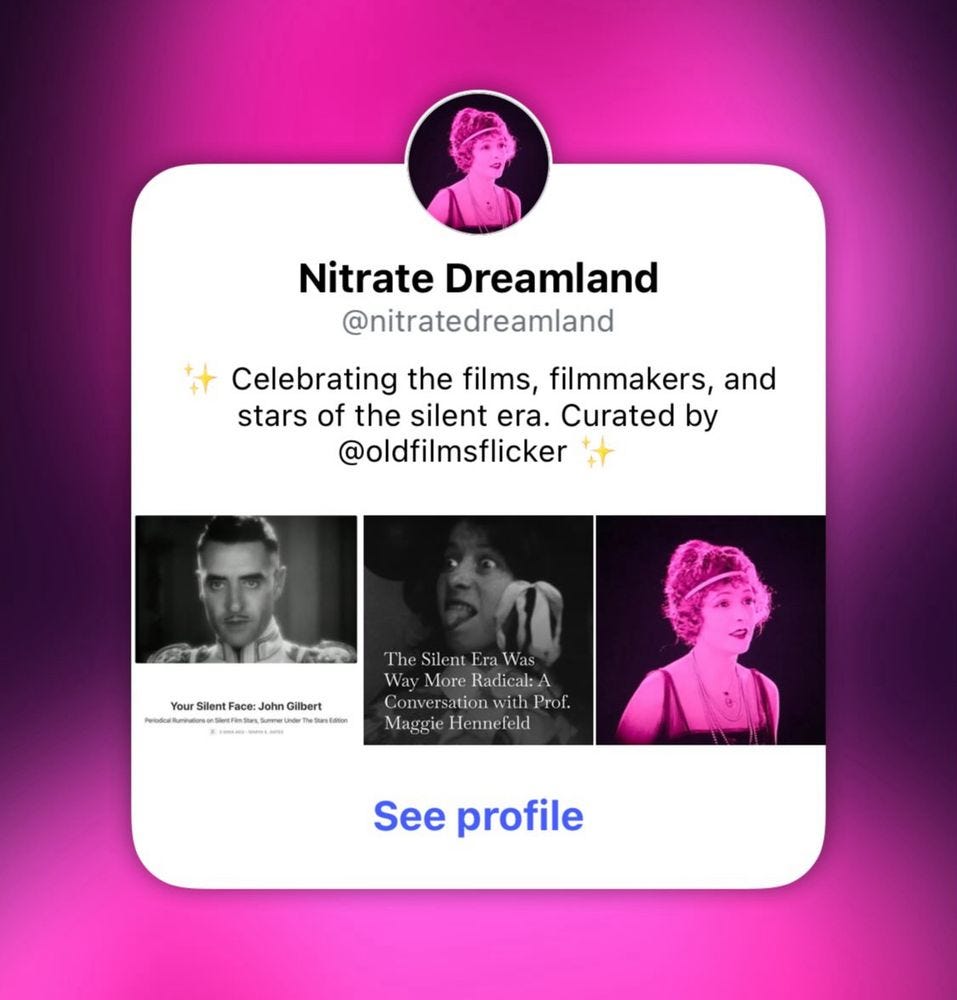
I started an Instagram account for my love of the silent era, so if you’d like more micro-doses of silent film daily, give ✨ Nitrate Dreamland ✨ a follow.


This is a reader-supported publication. To receive new posts and support my work, consider becoming a free or paid subscriber.

1

Jiggs was at one point so popular that in an op-ed in the June, 1929 issue of Screen Secrets Magazine about the highs and lows of Hollywood, Margaret Livingston used the name Jiggs for the name of a dog in an metaphorical story about the chokehold synchronized sound was about to have on the movies. This piece is also interesting because the last two paragraphs may as well be the rise and fall of Nellie LaRoy in Babylon. Also, around this same time there was a bulldog named Jiggs II who was a mascot of the United States Marine Corps and won a blue ribbon at the 1926 Westminster Dog Show.

2

A 1929 ad says Jiggs had been in the movies for six years.

3

In the 1928 edition of the same directory the dog’s owner is listed as Murray J. Ewing. I couldn’t find any information about Ewing.

4

Pauline Starke was born in Joplin, Mississippi in 1901. According to Anthony Slide in his book “Silent Players,” she moved to LA with her mother where she caught the attention of D.W. Griffith while acting as an extra. She made films from 1916 through 1935, and was named a WAMPAS Baby Star in 1922 and made her final film appearance in an uncredited role in Lost Angel (1943).

5

This is completely unrelated to Ida May Park’s 1918 film of the same name.

6

This film included a few sequences shot in two-strip Technicolor.

7

In this same piece a dog named Buster is described as having been out all night and having “quite a reputation.” In the “interview” with Jiggs, he describes Buster as a “regular Don Juan.” The piece continues stating, “Lusty little rumors as wagging about town that he makes love to all his leading ladies and it is even whispered (though don’t tell Will Hays), that the ladies can only break into the pictures through his patronage — well, ahem!” I also read a New York Times article that describes Buster as always playing “heavy lovers.” When I tell you these old fan magazines were wild, believe me when I say they were wild.

8

Coogan’s fight for his wages after his earnings as a child were squandered by his mother and stepfather eventually led to the California Child Actor’s Bill, commonly called the Coogan Act.

Read the whole story
mikemariano
5 days ago
reply
Share this story
Delete

The Limitlessness Of Our Hopes

1 Share
The mood in the air isn’t so good. You know what I’m talking about. Call it cynicism, call it disillusionment, call it fear, call what’s causing it even worse than that, this is the world we live in right now and things don’t seem like they’re getting any better. How different this is from the cynicism of other times is tough to pin down but the feeling has certainly been around before. It was there back in the ‘70s, even if that was a very different era and one thing which set it apart was how much so many of the films could be a true reflection of what was going on, which you can’t really say now to that extent. By 1978, those things were beginning to change as if the very idea of a ‘70s film had peaked, maybe it was in November ’76 when ROCKY opened only days after NETWORK, so a few of the most popular films of the year—GREASE, SUPERMAN, ANIMAL HOUSE, JAWS 2—didn’t have such things on their mind and feel like they were already looking forward to what the flashier, shallower ‘80s became. CAPRICORN ONE, which opened in June of ‘78, isn’t as known today as you’d expect possibly due to rights issues and feels like it falls into a middle ground between the two decades, exploring the paranoia and mistrust in the air that was such a part of the time while also trying to be a slick, enjoyable popcorn thriller where you shouldn’t think too much about those things. The film was written and directed by Peter Hyams, a longtime genre journeyman of the sort we don’t really have now, one who made so many films and even later served as his own director of photography, that it’s hard not to admire such a body of work even if the results didn’t always match his ambition.
There are at least a few films directed by Peter Hyams which have substantial followings that I honestly wish I liked better but, on the other hand, there are others where I’m still pleasantly surprised at how effective they are so let’s just say there are some which will go unnamed here that you might like more than I do but maybe I like THE RELIC and his remake of NARROW MARGIN more than you do. Sometimes what a film is going for, even if those aims are modest, hits the mark just right. We’ll leave it at that. CAPRICORN ONE is a slick, entertaining film but I always find myself wishing that I liked it just a little bit more, unable to shake that the feeling that it could use more to chew on in the narrative, the way it provides a rush of excitement but still plays like it’s missing a certain something to give it all some extra weight and make it completely satisfying. Either way, it’s still one of the most impressive ever made by the director, right up there with 1974’s BUSTING which, like CAPRICORN ONE, also starred the great Elliott Gould and was at least as cynical, maybe even more so. CAPRICORN ONE is impressively mounted even while raising a lot of questions that it doesn’t spend enough time exploring, all the way up to an ending that brings out a ‘…so what happens now?’ response in practically everyone who sees it like few other films ever have. On each return viewing through the years I keep wishing there was a little more to it all, but the film still manages to be enjoyable in an old-fashioned popcorn thriller way and that at least counts for something.
Only moments before liftoff of the first manned crew to Mars known as Capricorn One, the three astronauts onboard are rushed out of the space capsule and whisked away to an unknown location as the empty spacecraft takes off. When the astronauts, Charles Brubaker (James Brolin), Peter Willis (Sam Waterston) and John Walker (O.J. Simpson) arrive at what appears to be an abandoned military base, NASA head James Kelloway (Hal Holbrook) informs them it was recently discovered that the life-support system on the spacecraft was faulty which would have meant their deaths within weeks. And to keep funding for the space program alive, as well as public interest, he has arranged to fake the entire landing on Mars entirely on a makeshift soundstage that has been set up there, using a threat to their families as an assurance the astronauts will take part in the coverup. Meanwhile, NASA technician Elliot Whitter (Robert Walden) has noticed irregularities from his console while monitoring but when he mentions the suspicions to his friend, reporter Robert Caulfield (Elliott Gould), he immediately vanishes, sending Caulfield on the trail of what has happened to him. But while the fake Mars landing goes according to plan, months later a faulty heat shield causes the empty ship to burn up on reentry, which leads the three astronauts to realize there’s no way they’ll be allowed to live. They make their escape and soon crash in the desert with Kelloway sending men after them to finish the job as Caulfield continues his investigation, getting closer to something he knows is very wrong about the entire Mars mission.
Practically the first lines of dialogue in CAPRICORN ONE are delivered by Lou Frizzell, a familiar aw, shucks type of character actor born in Missouri who died of lung cancer just after his 59th birthday a year following the release of this film, his last, although there were multiple TV appearances in between. Here he plays the small role of Horace Gruning, a NASA technician who tearfully informs the astronauts how proud he is to be even a small part of this historic mission that his whole life has been building up to as he hands over a bible for them to have on their journey. He alone in this film seems to represent the optimistic, naive belief of the American public in the dream of looking up at the stars and going to space, a belief the movie undercuts only moments later in various ways like how even the Vice President attending the launch isn’t that interested in what he’s getting to witness. Watching the film now is a reminder of how much CAPRICORN ONE was a product of a time of that particular sort of cynicism, a feeling is made clear impeccably in the lengthy speech that Hal Holbrook’s mission head gives which lays out the public indifference to the space program and what he feels needs to be done about that to keep it alive by any means necessary. Even the reporters covering the launch played by Elliott Gould and Karen Black don’t seem too impressed by what’s going on, instead focusing on the drudgery of their lifestyle and whether Gould’s Robert Caulfield should keep trying to flirt with her, no idea of the big story that’s really going on right at that moment. “There’s nothing left to believe in!” Holbrook shouts at James Brolin to justify perpetuating a massive fraud on the public. Only lies can keep the dream alive in the USA.
Starting there, CAPRICORN ONE has what feels like a perfect setup that only partly gets followed through on and the film becomes not so much about the deception which it slightly rushes through or how to sell that story to the unknowing public as it does keeping such a conspiracy going through whatever nefarious means necessary, all done with a plot structure that almost feels schematic as if working out the story was determined by how many filming days some of the actors would need to be available for. After their initial shock at the situation, the three astronauts mostly brood while instead of providing details about the conspiracy to pull over this fraud on the public feels like it’s left entirely on faith. Blanks aren’t filled in, even with all the dialogue Hal Holbrook gets there’s not enough we’re being told about the machinery behind all this to believe it. It’s hard to swallow that only one technician in all of Mission Control notices anything wrong but there’s apparently an endless amount of people involved in the coverup whether employed by NASA, and it’s kind of crazy that NASA cooperated with this film, or some men in black-type outfit. All this at least looks forward to THE X-FILES but a more skillful approach might find a way to deal with the plotting so it’s not an issue, good dialogue to wave some of that away and get it to work but the film doesn’t spend enough time trying to do this. As much cleverness as there is to the staging and dialogue, it’s the details needed to have the story fully work that are missing, just as there are likely more than a few flaws in the science to the supposed Mars mission presented as well, and it all makes me want to read the book this is based on that doesn’t exist to fill in some of those details. The cynicism of the time may have been an inspiration for Hyams but it feels like too much of a comic strip approach, THE PARALLAX VIEW for kids who read Dynamite Magazine.
But even with all the flaws that run through it, Hyams clearly knows how to keep the intrigue of the story going and the way he shoots it is always effective like the eeriness to the makeshift Mars set that’s been constructed or how the dark, almost ominous look of mission control prefigures the way his visual style got more extreme, and much darker, as the years went on, as if trying to see how far he could go and still have an image. All of CAPRICORN ONE is richly well-photographed by Bill Butler, one of the most underrated cinematographers of the ‘70s, giving each scene a flavor which captures the various locations in the right way and always finds just the right angle on the actors as they rattle off some of their endless speeches. The individual sequences almost always have a kick to them, whether the POV of Elliott Gould’s car when it goes dangerously out of control without any brakes or the way the film cuts between the astronaut’s breakout and Hal Holbrook’s speech to the press memorializing them. And the invigorating, full-bodied score by Jerry Goldsmith which is likely one of his best of the period, adds immeasurably to the excitement and growing suspense right from the moment it begins during the opening credits.
Along with this, any movie where Elliott Gould becomes the one guy to depend on to save the day is something I’m going to all in favor of and the more his storyline becomes the focus of the film the more the tension seems to rise. Gould’s scenes with his co-stars throughout like Karen Black as the fellow reporter he flirts with, Brenda Vaccaro as Brubaker’s wife and David Doyle as Caulfield’s boss are all written in a somewhat mannered way, dialogue that becomes about the dialogue they’re rattling off at each other which in theory should be annoying but still gives the film an energetic lift that it doesn’t otherwise have. Hyams clearly loves giving his actors long, colorful speeches to chew their way through, which makes the more stoic approach taken to the astronauts a little disappointing since it feels like James Brolin could use one of those rather than just looking upset all the time. Sam Waterston does crack jokes which helps and is pretty much his main characterization while O.J. Simpson as the third is basically just there. When the three of them separate to attempt an escape and Brolin says, “There’s not enough time, there’s too much to say, so let’s go,” it’s a good moment with appropriate gravity but I still wish he could take the moment to say a little more. When their plane crash lands in the desert and one of them compares it to arriving on to Mars it’s a funny observation but the scenes of the astronauts trying to make their way through the landscape becomes too repetitive and when it spends five minutes of screentime on James Brolin fending off a rattlesnake, I find myself wishing we could get more details about the coverup and Elliott Gould’s investigation instead.
But so much of the film keeps moving, maybe faster than you’d expect in the first hour, and after slightly rushing through the machinations to the faked Mars landing and the aftermath it becomes about the race to cover all this up as fast as possible. All the paranoia makes sense when the government is depicted as conspiring to murder its best and brightest, with the idea that the film prefigures a world when certain entities would be too big to fail buried under all the chases, even if NASA isn’t what anyone has to worry about these days. On the DVD audio commentary Hyams talks about how audiences at the time would cheer when news cameras turn to capture a certain sight in the final scene but I’m not sure we can count on the media for that in the real world anymore and maybe we couldn’t even then. At least the momentum is there as the film builds to the climax and when Elliott Gould enlists the help of crop-dusting pilot Telly Savalas there’s a confidence in the way the comedy of the moment is played between the two men, which suddenly feels like it’s ok to just sit back and enjoy the movie at this point. And there are far worse things a film can do than provide an awesome helicopter chase in the climax, especially one as good as this. I still wish there was more to the end gets me to imagine the epilogue of the book that, again, doesn’t exist and which makes the film feel incomplete. Enjoyable, but still incomplete. The Billy Wilder screenwriting rule that says, “Don’t hang around” at the end doesn’t work here, not when the beat it ends on without more details isn’t entirely satisfying. Still, there’s a reason why I come back to this every few years, maybe because I’m hoping to like it a little better, maybe because I already know I’m going to like it just enough. Or maybe because we’ve gotten to the point where the movie isn’t cynical enough about the way things are and it’s become comforting to revisit what people thought was possible at another point in time.
Elliott Gould is top-billed and though he enters the film too late to be called the main character (the final shot seems to indicate who that is, I suppose) he still brings a delightfully off-kilter feel to his everyman, getting deeper into the conspiracy even though he doesn’t even know what it is for a long time and the energy the actor brings to it makes the film that much more endearing all by himself. James Brolin is dependably serious and the way he presents himself you believe that he is someone who has always believed in the ideals he strives for, that he wouldn’t know how to be sarcastic about something if he tried. Hal Holbrook is so good in his long speeches that he almost gets us to believe in the outlandishness of the entire plot with so many memorable phrasings like the way he says, “I can understand if it was a new Lucy show…” when bemoaning people complaining about television coverage of past moon missions which sometimes comes to me in the dead of night. Brenda Vaccaro brings the right sort of humanity to her unknowing wife, Sam Waterston gets to steal each moment he has a bad joke to deliver and it may as well be mentioned that O.J. Simpson is there too as the third astronaut but it’s easy to forget about that since I can’t think of anything he does in this that ranks with handing the cat over to Fred Astaire at the end of THE TOWERING INFERNO. Among the many familiar faces, David Doyle looks like he’s never had more fun in his life than when he gets to bark his way through those lengthy speeches he gets to say to Elliott Gould. Telly Savalas yelling “Perverts!” plays like this film’s version of Keenan Wynn in DR. STRANGELOVE, James Karen is the Vice President, James B. Sikking in the base control room keeping an eye on the astronauts holds a pipe in his mouth just like he does in POINT BLANK and playing the oddly named Judy Drinkwater, the interplay Karen Black has with Gould in her ‘special appearance’ about how much they want to jump each other is enjoyable enough to make me imagine sequels where they investigate other government coverups and it leans even further into the whole Nick & Nora thing by making her a co-lead. I’ve imagined far worse movies that never got made.
To get into a specific memory from the past year, back in October 2025 there was a day on the TCM Classic Cruise when the ship made a stop at Castaway Cay at Lighthouse Point where we went to the beach, did a little snorkeling, had lunch, then on the way back got caught in a sudden downpour which soaked us only since we were in the middle of a very long bridge that led to the ship and had nowhere to go. Once we got back and dried off the two of us went to a screening of CAPRICORN ONE featuring one of the guests of the voyage, Brenda Vaccaro. I mean, of course we did. Maybe this was the best day of last year. Maybe I’d like to be back there again right now. At least I got to experience it all that one time. And incidentally, she had some problems with the ending too but that’s what happens when you see CAPRICORN ONE for the first time. As for Vacarro, who really is the emotional center of the film, she was a terrific guest on the cruise and seems like a real trip, recalling a few details like Hyams’ background as a war photographer during Vietnam and that the director came up with the emotional scene where she reads Dr. Seuss to her kids during production because he wanted to give her more to do. I did not get to meet her myself but one other person on the cruise told me that she gladly talked to him about SUPERGIRL for twenty minutes, so Brenda Vaccaro seems ok in my book. During her talk I also kept remembering how the film’s gentle love ballad on the Jerry Goldsmith soundtrack album is named after her character, titled “Kay’s Theme”. But to get back to the film itself, CAPRICORN ONE is film that I’ll always have fondness for even as I wish it were as good as the one that I want it to be. I’m still glad it’s there to return to and remember certain dreams we have, whether it’s going to Mars or the idea that Elliott Gould really can save the day. That’s definitely something we can believe in and such a dream is just as important now as ever.
Read the whole story
mikemariano
19 days ago
reply
Share this story
Delete

Epstein Army: Jeffrey Epstein Helped Place 18-Year-Old Woman in ‘Elite IDF Unit’

1 Share
“Release the Epstein files!”-Text in Hofer Altstadt. PantheraLeo1359531, CC BY-SA 4.0 https://creativecommons.org/licenses/by-sa/4.0, via Wikimedia Commons
In one of the scariest moments in modern history, we're doing our best at ScheerPost to pierce the fog of lies that conceal it but we need some help to pay our writers and staff. Please consider a tax-deductible donation.

By Wyatt Reed and Max Blumenthal / The Grayzone

Jeffrey Epstein personally recruited an 18-year-old girl from New York to serve “in one of the elite IDF units,” email records show.

Epstein’s request came in a June 29, 2011 email to Anat Barak, the daughter of former Israeli Prime Minister Ehud Barak. In the message, the financier described the girl in question, “Tali,” as an 18-year-old who’d been accepted to Columbia University’s Barnard College and had “been to Israel more than a dozen times.”

His young female friend had spent a summer hiking the so-called Israel Trail and another “working as a counselor at a summer camp in Dimona Israel for children who are victims of terrorist attacks,” and would therefore “be a great asset to any unit,” Epstein wrote.

Tali, he said, would continue serving Israeli interests long after her placement in the Israeli army. Upon her return from military service in Israel, Epstein wrote that “she would be a fantastic ambassador for Israel” at what he called “one of the more important college campuses in the country, Columbia.”

A few hours later, Barak fired back an email saying that Tali “sounds like an amazing girl” and informing the lecherous billionaire: “I’ll be in touch with her, and we’ll take care of her.”

The senior Israeli politician’s daughter then sent an email of her own to Tali, explaining that “Jeffrey Epstein told me about you and about your plans to join the IDF this summer.”

“This is absolutely wonderful,” Barak gushed, adding: “Kol Ha’kavod!,” a Hebrew expression meaning “much respect!” She requested to speak with Epstein’s young associate over the phone, adding, “if there’s anything you might need while you’re in Israel please don’t hesitate to call me.”

A review by The Grayzone of public records indicates that “Tali” is Talia Lefkowitz. Her father, Jay Lefkowitz, worked as Epstein’s lawyer and helped negotiate the billionaire’s sweetheart deal with then US Attorney Alex Acosta. At the time, her father argued that Epstein was “not in any way a typical sex offender.” 

Talia Lefkowitz did not respond to an email from The Grayzone requesting comment on her relationship with Epstein, and his role in advancing her pro-Israel crusade.

According to her LinkedIn profile, Talia went on to serve as a sergeant in a “Special Forces Paratrooper Unit” – likely Israel’s 35th Brigade. The 35th Brigade is an elite unit of the IDF’s 98th Division, which was responsible for the destruction of large swaths of the city of Khan Younes during Israel’s genocidal assault on Gaza in 2024. Its commanders were documented burning civilian homes and leaving behind graffiti taunting their former residents.

When she returned to study at Barnard after her time as a ‘lone soldier,’ she quickly emerged as a vocal advocate for Zionism, penning op-eds for prominent Israeli media outlets. In one such piece in the Jerusalem Post, Lefkowitz tearfully recalled taking shelter while volunteering at the camp mentioned by Epstein, declaring: “We are the kids of the bunker.” In another, published by The Times of Israel, Lefkowitz accused Columbia of “support… for a one-state solution” because the university failed to reserve a space for Zionists to protest against an anti-apartheid exhibit set up by Students for Justice in Palestine and Jewish Voice for Peace. 

At that point, Lefkowitz had become heavily involved in the Columbia-Barnard chapter of Hillel International, a global Jewish youth organization which supports Israel unequivocally. Her branch, she wrote for the Jewish Telegraph Agency, was “a magnet for students from Orthodox backgrounds, many of whom begin college after spending a gap-year in Israel.”

Lefkowitz later returned to Hillel, serving on its board from 2020 to 2022. Currently, however, Lefkowitz is employed as a “philanthropy advisor” to the Areivim Philanthropic Group, which says it aims to “impact the next generation of Jews through formal and experiential Jewish, Hebrew, Zionist, and Israel education.”

According to her bio at Areivim, Lefkowitz “worked for five years for The Paul E. Singer Foundation,” which ultra-Zionist billionaire Paul Singer has used to support neoconservative media outlets and pro-Israel causes. Singer is a top donor to the presidential campaigns of both Donald Trump and Marco Rubio, and currently owns Venezuela’s Citgo Petroleum, securing it in a fire sale through his Elliott Capital Management Fund.

While Lefkowitz’s exploits in the upper echelons of the Zionist movement are public, it was unknown until now that she received assistance from Jeffrey Epstein, who despite having no apparent military or special forces experience himself, was seemingly able to arrange her acceptance into “one of the elite IDF units.” The emails between Epstein and Anat Barak raise serious questions about nepotism in the Israeli military’s recruitment process. 

They also highlight Epstein’s involvement in Zionist lobbying efforts within the US, both on and off campus. As proposed by Epstein, Lefkowitz appears to have served as an unofficial “ambassador for Israel,” engaging heavily in Zionist activism at Columbia. Her recent tenure on the Hillel board enabled her to take her campus crusade onto the global stage.

While Epstein is best remembered as a well-connected financial dealer who solicited young women and girls for assorted sex acts, his gift as a recruiter for Israel’s genocidal occupation army is just becoming known.

You can also make a donation to our PayPal or subscribe to our Patreon.

Wyatt Reed

Wyatt Reed is a correspondent and managing editor of The Grayzone. Follow him on Twitter at @wyattreed13.

Max Blumenthal

The editor-in-chief of The Grayzone, Max Blumenthal is an award-winning journalist and the author of several books, including best-selling Republican GomorrahGoliathThe Fifty One Day War, and The Management of Savagery. He has produced print articles for an array of publications, many video reports, and several documentaries, including Killing Gaza. Blumenthal founded The Grayzone in 2015 to shine a journalistic light on America’s state of perpetual war and its dangerous domestic repercussions.

Please share this story and help us grow our network!

Read the whole story
mikemariano
33 days ago
reply
Share this story
Delete

How Often Is ICE Acting as a Goon Squad for Landlords?

1 Share
ICE helps clear apartment complexes and evict tenants while incarceration buildout throws a lifeline to commercial real estate.
Read the whole story
mikemariano
38 days ago
reply
Share this story
Delete

An American Lynched in the West Bank

1 Share

On Wednesday, in the small Palestinian shepherding village of Mukhmas, a masked Jewish settler armed with an M16 shot and killed a 19-year-old Philadelphia native named Nasrallah Abu Siyam. It’s highly likely that the gun was supplied by the United States. At least four other local Palestinians were wounded by settler gunfire during the invasion of the village, including another young man whose foot may be amputated. Some were shot while carrying the wounded to safety. Many others were severely beaten with metal rods. Israeli soldiers, who accompanied the settlers into the village, responded to the shooting rampage by firing stun grenades and tear gas into the residential area, burning an elderly man. When it was over, settlers walked off with more than 300 of the village’s sheep and goats under the military’s watch. It was the first full day of Ramadan. As of this writing, no one has been arrested.

Nasrallah Abu Siyam, 2007-2026. This photo was taken four days before his death.

Two days after the attack, I spoke with eight young men who had been there, several of them injured, some among those who carried Nasrallah to a car and drove him toward the hospital. Teenagers and men in their early twenties. At least one of them had braces—Nasrallah had them, too. Not hardened fighters; students, farmers, and shepherds. They looked exhausted. A few had fresh wounds on their faces. They startled at sudden noises, repeatedly springing up to peer out the window. I am protecting their identities, as retaliation in cases like these is common.

In all likelihood, no one will be held accountable for this killing, but it is important to bear witness and to leave a record of what happened. What follows is a reconstruction based on the account of these eight witnesses. To be clear, I did not obtain the settlers’ version of events, though if I had their contact information, I certainly would have tried. The IDF did not respond to my request for comment. The testimony presented here is consistent with reporting in major Israeli and Palestinian outlets, available video evidence, the patterns of state and settler violence that shape daily life in the West Bank, and my own experience there over the past several years.

Before turning to their account, I want to situate what happened within the broader system that produced it. Late last year, I wrote two pieces unpacking Israel’s machinery of annexation in its current form, based in part on an op-ed from a settler leader and unusually candid testimony from within the Israeli military. The picture that emerged was of a system in which settler leaders and military officers work in close collaboration to map target areas for land seizure and establish illegal outposts under army protection, from which settlers launch pogroms on vulnerable Palestinian communities, often with military escorts, in an effort to terrorize them into leaving.

Sometimes that pressure alone is enough—over 80 rural Palestinian communities have been abandoned since October 7. Other times, the military declares a “closed military zone,” clearing Palestinians from their land under the pretense of preventing further violence. In some cases, settlers provoke a confrontation that is then used to justify further military action. One way or another, the relentless settler attacks function as the spearhead of a state policy of ethnic cleansing, with the government managing the aftermath and absorbing the gains. Through this process, vast stretches of Area C—where Israel exercises full control—have been emptied of Palestinians, while settler incursions are increasingly pushing into Areas B and even A, nominally controlled by the Palestinian Authority.

The broader vision, articulated openly by settler leaders and their allies in government, is to force Palestinians to emigrate, and to concentrate those who remain into a handful of urban enclaves—Jenin, Tulkarm, Nablus, Ramallah, Jericho, and Hebron—while annexing the rest of the territory. “The principle of sovereignty is maximum land and minimum population,” Finance Minister Bezalel Smotrich said while outlining the plan.

There is another angle to this story—that yet another American citizen has been killed by Israelis, with no expectation that anyone will be held accountable—but I’m going to leave that for another time. For now, I will say only that I learned of the killing from Kamel Musallet, the father of Sayfollah Musallet, who was beaten to death by settlers in July.


For generations, a Bedouin encampment known as Khallat al-Sidra—a cluster of tents, cinderblock shelters, and animal pens—sat on the edge of Mukhmas. The land belonged to the village, but a mayor many decades earlier had invited the Bedouins to settle there, to plant olive trees and graze their livestock. Over the years, the community also served as an incidental buffer between the village of Mukhmas and the most violent settlers descending from the hills. While Mukhmas residents were regularly attacked in their fields, they were typically safe in the village itself, as Khallat al-Sidra absorbed the worst of the attacks. In part, this was a matter of basic geography. But the Bedouin encampment and surrounding farmland also lay in Area C, making them far more vulnerable to settler violence than the built-up village of Mukhmas, which sits in Area B.

When settlers raided Khallat al-Sidra, Mukhmas residents often came down to help protect them, but after October 7, that became nearly impossible. A new ring of outposts went up around the area, and the settlers’ proximity allowed them to strike fast, often in the dead of night, launching attacks before the village could even be roused.

In a period of just over three months between late October and late January, settlers descended on Khallat al-Sidra and torched homes on three separate occasions. Each time, the community rebuilt, only to see it burned again. I was present the morning after one of these pogroms, and toured the charred structures with men and their traumatized children as settlers circled us on their ATVs, many with machine guns slung over their shoulders. Two activists had been sent to the hospital.

From my visit to Khallat al-Sidra on October 26, the morning after a settler attack.

In a January attack on Khallat al-Sidra captured on video, the settlers split into groups, moving methodically from structure to structure, burning the whole village to the ground in minutes. Settlers blocked a man and a woman from escaping from their burning home, beating them when they finally escaped. Videos circulating on far-right social media celebrated the pogrom, set to the beloved settler anthem, May Your Village Burn.

After the most recent attack in late January, the Israeli military, rather than arrest the settlers responsible and evacuate their outposts, declared the area a closed military zone and forcibly expelled the Bedouin community. This was, of course, a tragedy in its own right. It also meant the frontier shifted overnight—from Khallat al-Sidra in Area C to Mukhmas in Area B—exposing the village to the same tactics used to clear the surrounding hills.

Subscribe now


On Wednesday at 2:35 pm, a shepherd from Mukhmas, grazing his sheep and goats in the village’s farmland, was surrounded by settlers who harassed him and attempted to steal his livestock. He managed to escape with his flock and ran back toward the village, just outside the girls’ school, where a group of local men gathered to form a defensive barrier. Many of the settlers wore masks, but the villagers recognized several from previous attacks. Among them was a settler named Amir, a security guard for one of the nearby outposts. He claimed he was there to help, firing his M16 into the air and ordering Mukhmas’s residents to retreat, promising he would escort the settlers away without incident. The villagers knew that if they withdrew, their livestock would be taken.

Minutes later, more settlers arrived, accompanied by soldiers—the same platoon, villagers said, that routinely appears during these incursions, likely assigned to this particular settler gang by the IDF’s Central Command. Now there were roughly 30 settlers and five soldiers at the edge of Mukhmas. The troops joined Amir in ordering the Palestinian men back into the village, assuring them the animals would not be touched. But as soon as the villagers began to withdraw, settlers opened the enclosure and started driving the livestock out.

At 3:27 pm, the first physical violence broke out as several Palestinian men moved to retrieve their livestock and were beaten back by settlers and soldiers. Troops fired tear gas and stun grenades into the village; an elderly man was badly burned by a canister. In footage from the incident, women and children can be heard screaming from inside their homes. Settlers pushed deeper into the residential area in the chaos, opening additional enclosures and driving off more sheep and goats.

A group of villagers broke off and took a back route, hoping to intercept the settlers driving off their animals—their primary livelihood. One of the men was seized and surrounded, settlers beating him with metal rods as he lay unconscious on the ground. Others rushed forward to attempt to pull him free. The settlers hurled stones to drive them back, and the villagers threw stones in return.

At 3:48 pm, a settler raised his M16 and began firing into the crowd rushing toward their wounded fellow villager. Four or five others followed suit, gunning down the Palestinians on their own land. Five men were hit, including the brother of the wounded man. Nasrallah was shot in the thigh, the bullet severing his main artery. Settlers crowded around him after he fell, striking him with rods. At least one of the gunmen dropped to a knee in a military firing position, taking deliberate aim at those carrying the injured to safety. As the shooting unfolded, the army, just down the hill, continued gassing the village.

When the shooting ended, the army did not stick around to provide medical assistance to the men lying wounded with gunshot injuries. Instead, they withdrew from Mukhmas alongside the settlers, who walked off with more than 300 of the village’s sheep and goats—a crippling economic blow to three shepherding families.

The villagers called an ambulance, but it couldn’t get past a nearby army checkpoint, so they loaded the wounded into several cars and began driving toward the hospital in Ramallah. Traffic was gridlocked near the checkpoint, and as word spread, other drivers tried to clear a path, waving vehicles aside and shouting for space. Nasrallah was bleeding heavily in the back seat, his pulse fading. When the cars could move no further, the men lifted him out and carried him on foot toward a waiting ambulance on the other side. By the time he reached the hospital at 5:30 pm, nearly two hours had passed since he was shot.

For four and a half hours, doctors attempted to save his life. But he had lost too much blood. At 10 pm, 19-year-old Nasrallah Abu Siyam was pronounced dead.

Later that night, settlers returned to Mukhmas, revving their engines and shining lights into homes. The men came out again to protect their village, this time in even larger numbers, and the settlers left without incident.

Nasrallah’s mother, Raghad, and father, Mohammad, mourn over his body. (Ammar Awad/Reuters, Nasser Nasser/AP)
(Ammar Awad/Reuters)

When I returned home from the West Bank after last year’s olive harvest, I found it difficult to articulate the feeling of sheer terror in Palestinian villages subjected to regular settler attacks, where I spent many sleepless nights. There is nothing quite like the real fear of physical danger, knowing it can arrive at any moment, and that you are completely defenseless. (In communities across the West Bank, residents know that if they take up arms to defend themselves, their village may be wiped from the map—as has happened in Jenin and Tulkarm, long associated with militant activity.) I, of course, could leave whenever I chose; for the Palestinians, this is daily life.

I can only imagine it as something akin to the atmosphere Black families described in parts of the Jim Crow South, where the Ku Klux Klan rode at night, the law often on their side, delivering warnings in fire and blood. Lynchings were staged to strike maximum fear into the hearts of entire communities—to enforce racial hierarchy, crush political participation, and drive families from land and livelihoods they had built. The message was unmistakable: you have no protection here, and whatever you have can be taken.

Today, in the West Bank, giant Stars of David jut from the ground, lit at night like flaming crosses. The assailants often arrive with military-grade assault rifles capable of ending a life in an instant. Again, I am lost for words trying to describe the feeling of a belligerent teenager aiming one of these death machines right at you. They operate not with tacit protection from the law, as the KKK did, but with the visible backing of soldiers and a state apparatus whose purpose, in practice and in stated policy, is to assert dominance over every aspect of daily life. To make you disappear.

Many of the most violent settlers and their leaders are well known to local Palestinians, activists, journalists, and Israeli authorities alike. Several participants in the Mukhmas attack have already been identified by activists, and I have previously written about the settler leader Amishav Melet, whom I believe orchestrated the Turmus’ayya assault I documented in October. If major news organizations devoted to this historic campaign of violence the same investigative resources they apply to other conflicts, I have no doubt they could map the settler terror infrastructure and chain of command much as they do clandestine militant groups elsewhere. Israeli authorities almost certainly possess such intelligence already, but the pattern suggests it is used to manage and protect these networks rather than dismantle them.

In other words, the Israeli reign of terror in the West Bank is not an inevitable force of nature. It can be stopped. Allowing it to continue is a series of choices—by the Israeli government, by its backers in Washington, and, more tacitly, by a mainstream media ecosystem that largely treats it as a peripheral regional conflict, surfacing only when the violence becomes too graphic or politically destabilizing to ignore.

On Saturday, the U.S. State Department broke its silence, failing to condemn the killing or mention the assailants: “We can confirm the death of a U.S. citizen in the West Bank on February 18. We extend our deepest condolences to the family and expect a full, thorough, and transparent investigation into the circumstances surrounding the death. U.S. Embassy Jerusalem has been in direct contact with the family to provide assistance.”

Ambassador Mike Huckabee, for his own part, has been in crisis mode—though for different reasons—firing off 31 tweets in two days defending his calamitous interview with Tucker Carlson, during which he asserted Israel’s biblical right to claim all the land between the Nile and the Euphrates, triggering a diplomatic crisis.

Nasrallah Abu Siyam is at least the seventh American killed by Israeli settlers or soldiers in the West Bank since October 7. No one has been arrested in any of the cases. No one has been held accountable.


If you’d like to support farmers in the West Bank, consider donating to Roots of Resilience.


All of my reporting is self-funded. If you want to help me keep doing this work, consider upgrading to a paid subscription—you’ll also get access to exclusive interviews, reporting, and essays.

Read the whole story
mikemariano
48 days ago
reply
Share this story
Delete
Next Page of Stories