1140 stories
·
0 followers

The Self and Selfishness (On Liberalism)

1 Share
The Self and Selfishness (On Liberalism)

Western liberalism is not about the self, but selfishness. Who gets to be a self? Who gets the right to self-defense? This is the central contradiction of liberalism, so much so that it's not really a contradiction, it's just central. 'Israelis' get selves that must be mourned, whereas Palestinians get torture cells and must be bombed. 'Israelis' get to pre-emptively bomb everyone in ‘self-defense’ whereas the natives are terrorists if they dare resist. This is really classical liberalism. Rights for Whites and might for everyone else. They've always been like this. This is not some flaw in liberal democracy. This is working exactly as intended.

John Locke's lofty ideas about the rights of man were limited to the White man, he himself was a slaveholder in the Royal African Company. A self for him, certainly, with rights extending to owning other men. For were these even men? As Montesquieu said, “It is impossible for us to assume that these people are men because if we assumed they were men one would begin to believe that we ourselves were not Christians.” One of the oldest churches is Ethiopian, but since we're taking a selfish view, never mind them. These guys took Greek slave states as inspiration to make slave empires.

Thus John Stuart Mill's liberal ideas did not extend to “those backward states of society in which the race itself may be considered as in its nonage.” This is still why Palestinians are ‘given’ an ‘authority’ and not a state, until they can grow into it. It comes down to the selfsame assumption. The selfish hoarding of human identity in order to go beastmode on everyone else.

This is the central contradiction of liberalism, the Oreo cookie of orientalism. Separating slavery from liberalism is like separating the black and white parts of an Oreo cookie. Why would you do that, except to dunk on it? Putting the contrasts together is precisely the whole thing.

As Samuel Johnson said, “How is it that we hear the loudest yelps for liberty from the drivers of negroes?” Or as Jonathan Boucher said, “the most clamorous advocates for liberty were uniformly the harshest and worst masters of slaves.” In 1778 John Millar said, “Fortune perhaps never produced a situation more calculated to ridicule a liberal hypothesis, or to show how little the conduct of men is at the bottom directed by any philosophical principles.” Because there is no principle at work here. Just selfishness.

As Domenico Losurdo (who I'm cribbing almost all these quotes from) “said in all three liberal revolutions the demand for liberty and justification of the enslavement, as well as the decimation (or destruction), of barbarians, were closely intertwined.” And again, asking why is like asking why Oreos have black and white sides. The tension between black and white is precisely what makes the spring of White Empire wind! As Malachy Postlethwayt said, defending the Royal African Company,

 ‘The Negroe Trade and the natural Consequences resulting from it, may be justly esteemed an inexhaustible Fund of Wealth and Naval Power to this Nation’; they were ‘the first principle and foundation of all the rest, the main spring of the machine which sets every wheel in motion’. The British Empire as a whole was merely ‘a magnificent superstructure’ upon this commerce.

This central contradiction of liberalism is precisely what gave the White Empire energy, ignition, and direction. Remember that Europeans came looking for us, we didn't come looking for them! Europe was a backwater penninsula of Asia, getting precious little sun, and everybody else had more wealth than them. The rest of the world (naturally) had more land and more energy (at that point 100% renewable, mainly solar to grow stuff and labor to pluck it), and Europe desperately wanted in, looking for India in all directions. Thus Europe was driven not to trade (what did that have that we wanted?), as everybody else was doing, but to drive slaves onto land they depopulated. As Montesquieu said,

The peoples of Europe, having exterminated those of America, had to make slaves of those of Africa in order to use them to clear so much land. Sugar would be too expensive if the plant producing it were not cultivated by slaves. Those concerned are black from head to toe, and they have such flat noses that it is almost impossible to feel sorry for them. One cannot get into one’s mind that god, who is a very wise being, should have put a soul, above all a good soul, in a body that was entirely black.

Montesquieu's racism is not coincidental, it's consequential. White Supremacy is the whole play. The color of your skin did matter, it was a physical measure of how much energy you got from the only power source at the time, the sun. Being white was a physical measure of how little energy your people had available. It was literally a broke face. Meanwhile being darker meant you were somewhere where the sun shone, and thus food grew, and supported large populations too. Europeans cunningly turned this material inferiority into ideological superiority. Honestly, well played Whitey, well-played.

Europe exploited solar differentials across the planet to create a great assault battery of planetary proportions. Because the solar battery has been shaken around so much, the physical Whiteness doesn't give you as much of a clue now (brown people can be White now too) but it's still a pretty big clue! The source code of White Empire is White Supremacy, which was not coincidental, it was a highly convenient way of identifying who had skin in the game, and who was to be skinned like game. It told you, at a glance, who had a self and who was beneath them, literally beasts of burden. Hence Locke described such beasts (referring to criminals, but 'Indians' are criminal by default), saying,

And one may destroy a Man who makes War upon him, or has discovered an Enmity to his being, for the same Reason, that he may kill a Woolf or a Lion; because such Men are not under the ties of the Common Law of Reason, have no other Rule, but that of Force and Violence, and so may be treated as Beasts of Prey, those dangerous and noxious Creatures, that will be sure to destroy him, whenever he falls into their Power.

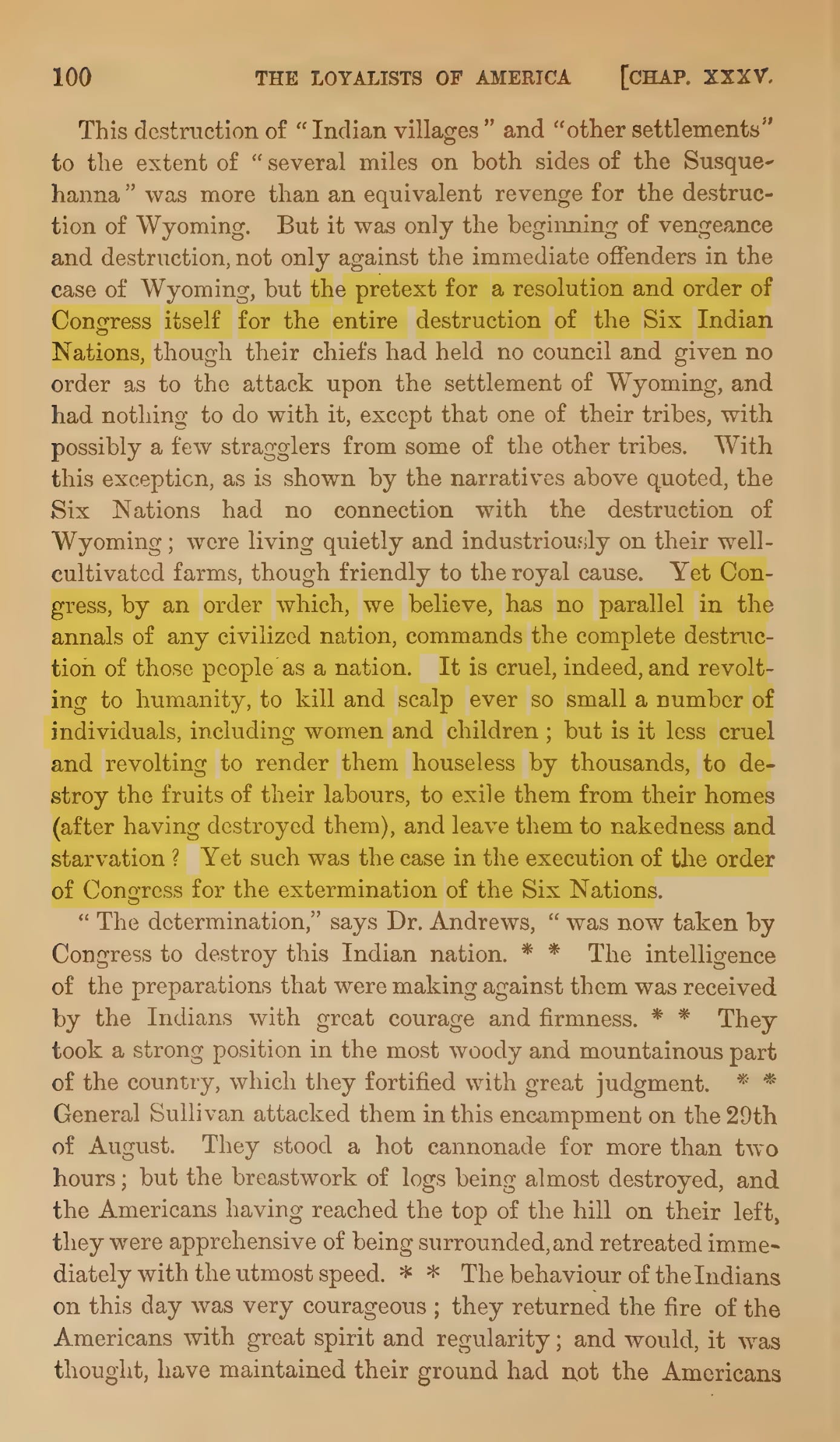
I won't even get to the human supremacy here, but suffice it to say that animal animals got it worse. Anyways, the US Declaration of Independence encoded this Lockism in their Declaration of Independence, saying that George III “endeavoured to bring on the inhabitants of our frontiers, the merciless Indian Savages, whose known rule of warfare, is an undistinguished destruction of all ages, sexes and conditions.” And then they turned it into a practical genocide (remember that every accusation is a confession). As Egerton Ryerson said in this old-ass (1880) book (I'm just going through Losurdo's footnotes),

Yet Congress, by an order which, we believe, has no parallel in the annals of any civilized nation, commands the complete destruction of those people as a nation. It is cruel, indeed, and revolting to humanity, to kill and scalp ever so small a number of ‘individuals, including women and children; but is it less cruel and revolting to render them houseless by thousands, to destroy the fruits of their labours, to exile them from their homes (after having destroyed them), and leave them to nakedness and starvation? Yet such was the case in the execution of the order of Congress for the extermination of the Six Nations.
The Self and Selfishness (On Liberalism)

Do you not see this happening now, is this not the exact logic used for the extermination of men, women, and children in Gaza, and Lebanon, and Iran, and wherever liberal democracy goes? Can you not see, at long last, that the racism is not a bug in this system but rather intrinsic to the system itself? The core of liberal democracy is this selfishness, that some people have selves and the right to infinite offense, and that other people do not, and have no right to self-defense.

Trump's logic for a ‘Gaza Riviera’ is Locke's logic just with stupided words. Locke said “God gave the World to Men in common; but since he gave it them for their Benefit, and the greatest conveniencies of Life they were capable to draw from it, it cannot be supposed he meant it should always remain common and uncultivated. He gave it to the use of the industrious and rational.” This is what Trumps son-outlaw Jared Kushner meant when he said, “Gaza’s waterfront property could be very valuable … if people would focus on building up livelihoods... It’s a little bit of an unfortunate situation there, but from Israel’s perspective I would do my best to move the people out and then clean it up.”

What is he saying here? Nothing crazy really, this is standard liberalism. What Benjamin Franklin said in his autobiography, “if it be the Design of Providence to extirpate these Savages in order to make room for Cultivators of the Earth, it seems not improbable that Rum may be the appointed Means. It has already annihilated all the Tribes who formerly inhabited the Seacoast.” Again and again, these are not anomalies in the liberal project! This is the whole project! See what they did, and also see them still doing it!

Locke's selfish idea of ‘men’ doesn't included colored men or any women, just as Kushner's idea of ‘people’ doesn't include Palestinians. This is by design. Citizenship since the Greeks has always meant in-groups with rights and out-groups ruled by might. If you're White, this is just right. This is just the background logic of White Empire, which goes unnoticed like the white of this page, and bro, I need you to know, they haven't changed.  

The central premise of liberalism is and was not some abstract self but a very real selfishness. Very precious property rights in the imperial core, including the right to make property of people across the globe, and to genocide and assassinate anyone that says no. Very precious speech rights (as long as you say what you're supposed to), which is the casual idea that this or that government should be overthrown, or that these natives are ‘illegal’ and should be thrown out; basically to hate who you're supposed to. Your love of the Empire is not necessary. Your selfishness will do.

Read the whole story
mikemariano
20 hours ago
reply
Share this story
Delete

Two Iranian Women in ICE Detention Are Not, In Fact, Related to Qasem Soleimani, Documents Show

1 Share

Drop Site is reader-funded — no corporate owners, no outside influence. Your support is what keeps this journalism independent and free. Please consider making a tax-deductible donation to support our work.

SUPPORT DROP SITE TODAY

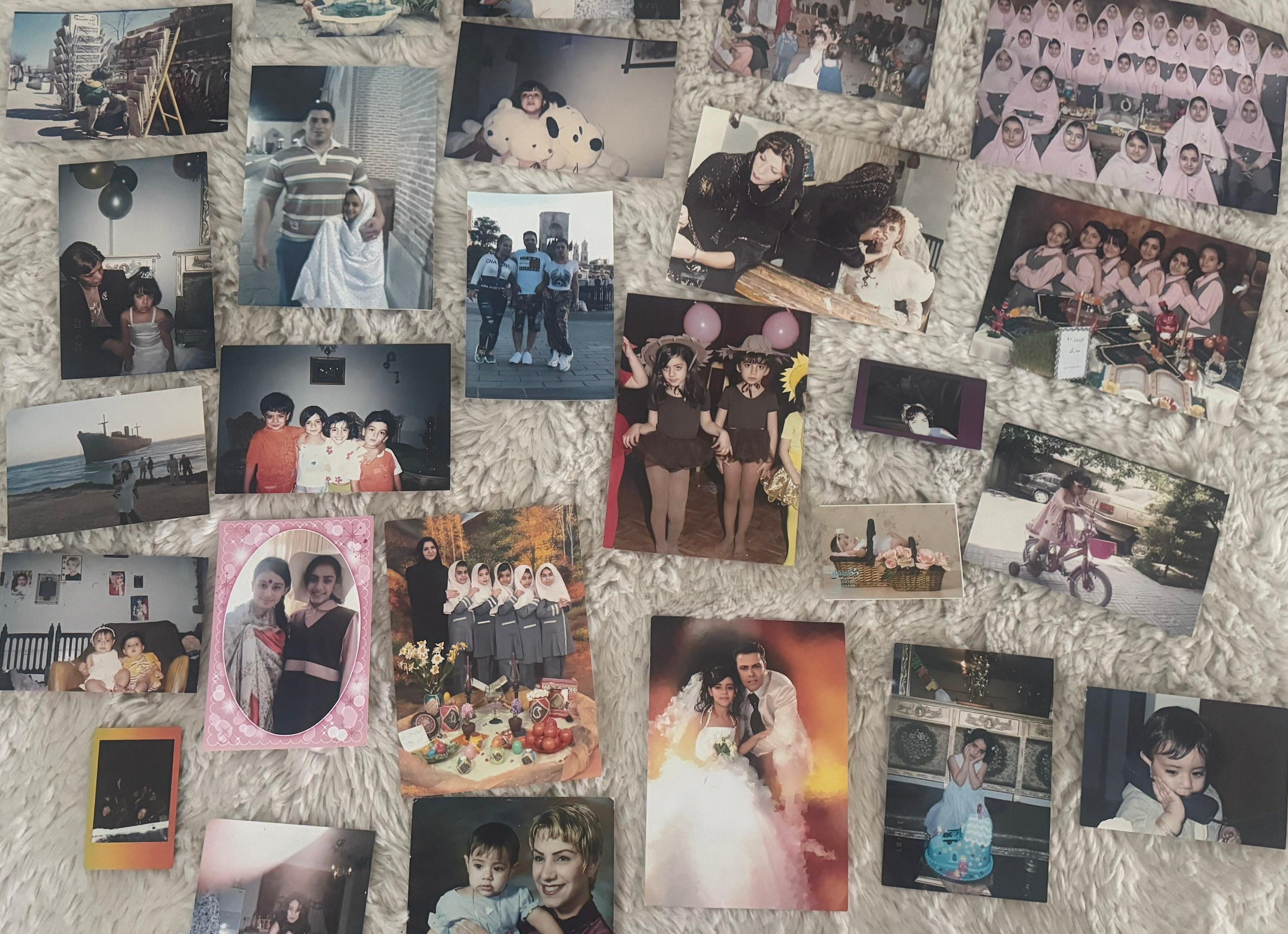
Family photos of Sarina Hosseiny and her mother, Hamideh Soleimani Afshar.

Two Iranian women remain in immigration detention, arrested earlier this month on accusations of being the niece and grandniece of Qasem Soleimani, despite no connection to the late Iranian military commander. Drop Site reviewed Iranian birth records, identification papers, a family will, and other personal documents and found no connection whatsoever to him or his extended family. One of the women is now seriously ill in a Texas facility, her chronic blood condition left effectively untreated.

On March 8, right-wing activist Laura Loomer posted on X calling for the deportation of a woman she claimed was Soleimani’s niece. The commander of the Quds Force of Iran’s Islamic Revolutionary Guard Corps, Maj. Gen. Soleimani was assassinated by a U.S. drone strike, ordered by U.S. President Donald Trump, in Baghdad on January 3, 2020. The day after Loomer’s original post, she tagged Secretary of State Marco Rubio on X, claiming to have reported the woman to the Department of Homeland Security (DHS) for “posting content sympathetic to the Iranian regime and Ayatollah.”

On April 3, Hamideh Soleimani Afshar and her daughter, Sarina Hosseiny, were taken into custody by Immigration and Customs Enforcement (ICE) at their home outside Los Angeles. Rubio issued a statement headlined, “Secretary Rubio Revokes Green Cards of Foreign Nationals with Ties to Iranian Terror Regime,” identifying them as “the niece and grand niece of deceased Islamic Revolutionary Guard Corps Major General Qasem Soleimani” and describing them as “green card holders living lavishly in the United States.”

The claims made headline news in the U.S., while triggering immediate denials from Soleimani’s family that the two women were relatives of the military commander. The Trump administration has gone largely quiet about the women’s cases since their arrest, as they remain in ICE detention pending deportation to Iran.

As attention has faded, the situation for the women has turned dire at the South Texas ICE Processing Center in San Antonio, particularly for Hamideh, 47, who lives with autoimmune hemolytic anemia, which requires regular treatment and blood transfusions she isn’t getting.

Subscribe now

As a student in the late 1990s and early 2000s, Hamideh was active in protest movements in Iran, and, she says, even spent a week in prison after getting arrested at one demonstration. Sarina, in a phone interview from the ICE facility where they are being held, said that her mother—not one to hold back her opinions—was most looking forward to having “freedom of speech” when she moved here to the United States. She remains opposed to the son of the former Shah, Reza Pahlavi, as well as Trump’s current war. “She’s kind of a passionate person overall, and she thought that she was going to come here and be able to talk freely when she’s been threatened and imprisoned in Iran for speaking about politics, and now she’s again in prison for speaking out about politics,” she told Drop Site.

They were forced to leave Iran under duress after Sarina took part in a dance performance on vacation in Turkey at the age of 12. The dance competition was filmed and later aired by the satellite channel “TV Persia” and her dance went viral. (Two of her performances are still viewable on YouTube.) The channel is illegal in Iran but many residents have access to it. She said she was expelled from her public school, only to enroll in a private school and later to be expelled from that one, too, when the scandal recirculated. Some of her more conservative family members, who had connections to the government, beat and threatened her mother, Hosseiny said, and the situation became increasingly unbearable. At 14, she came to the United States on a student visa and the two of them applied for asylum.

In terms of its alignment with how the United States professes to see its place in the world, and the claims it makes about Iran’s treatment of women and girls, it’s hard to think of an asylum claim that would more neatly fit into the American agenda.

Sarina Hosseiny.

Sarina translated for her mother, who added that she doesn’t know where to turn if the U.S. isn’t safe either. “We came to America to seek calm and to feel safe and protected from that regime,” Hamideh said, according to her daughter’s translation. “And now we’re being treated almost the same—even worse than there. We’ve been here for three weeks now. I don’t know where to go from here.”

Sarina, 25, has also spoken with friends outside the detention facility, conveying that her mother has been denied the treatment she needs, is regularly in and out of consciousness, with dangerously low hemoglobin levels. Her mother recently passed out and was left unconscious on the floor for over ten minutes, Sarina reported to her friend Shawna Ruhland.

“She’s basically just trapped in there watching her mom die,” Ruhland said of Sarina. Ruhland, who served for eight years in the U.S. military, has set up a GoFundMe to help cover the family’s legal bill, which Drop Site verified is legitimate. (Update: GoFundMe had not yet approved the fundraiser, so she started a different on here.)

The South Texas ICE Processing Center, where the women are being held, declined to provide information on them other than to confirm they were in custody; their attorney, Sam Faragalla, did not respond to requests for comment.

Both were legal permanent residents until Rubio revoked their legal status. A State Department spokesperson, in an odd statement, said the government stood by its determination. “While we do not comment on matters of classified intelligence, we remain certain of the Secretary’s determination,” said Assistant Secretary Dylan Johnson. “If ‘Drop Site News’ is aware of anti-American green card holders with ties to terrorists presently in the United States, we would gladly investigate those individuals for possible termination of legal status and deportation.”

A review of personal documentation undercuts the allegation of a personal connection to Soleimani. Birth certificates from Iran, collected by the family, lay out a documented family tree spanning multiple generations with no connection to Qassem Soleimani, or even to relatives of the late general. Drop Site also reviewed other personal identification documents, including passports, family photographs, and work documentation from both Iran and the U.S. that strongly contradict the allegations that the two women were connected to the late Iranian military commander, or living lavishly from any connection to the Iranian government.

In order for Qasem Soleimani to be Hamideh’s uncle, based on her last name, he would need to be the brother of Hamideh’s father, Ali Soleimani-Afshar, who was born in Tehran in 1947. Yet according to the documents, Soleimani-Afshar had no brothers at all and his father died in the early 50s. Gen. Soleimani was born years later—in 1957—in a small village in the southern province of Kerman. Ali Soleimani-Afshar’s parents died in his childhood. Historical passport documents also show that Soleimani-Afshar’s family origins go back generations to the city of Yazd in central Iran, a province away from the roots of Gen. Soleimani.

The late general is also known to have two brothers, Sohrab and Hossein, who have previously given interviews about their upbringing in rural Kerman that identify themselves as his only brothers and make no mention of a connection to Ali Soleimani-Afshar.

Qassem Soleimani’s own family in Iran issued numerous strident denials that they had any relation to the late general. Soleimani’s youngest daughter, Zeinab Soleimani, a well-known political figure inside Iran, said in Iranian media that the State Department’s allegations were “false” and that “the individuals arrested in the United States have no connection whatsoever to our family.” Another daughter, Narjes Soleimani, went further in a separate statement, adding that, “To this day, no member of the Soleimani family, nor any relative of General Soleimani, has resided in the United States.”

To be clear, even if the women were in fact distantly related to Soleimani, such a link would not, under any version of justice, make them guilty of anything. While the U.S. says spouses and children of alleged terrorists can be detained, the law deems arresting other relatives inadmissible. The U.S. recently took immigration action against leading Emory University cancer researcher Dr. Fatemeh Ardeshir-Larijani, simply for being the daughter of Ali Larijani, a top Iranian official and Kantian scholar assassinated by the U.S. and Israel in March, along with his son. She was out of the country at the time her legal permanent resident status was stripped and barred from re-entering. Emory fired her.

In the wake of their detention, the State Department said that the asylum claim filed by the two Los Angeles women was undercut by the fact that they had visited Iran in subsequent years.

In general, a grant of asylum is indeed called into question if the asylum seeker travels back to the country where they have claimed they are unsafe, immigration lawyers say. Hosseiny said that because they are not political dissidents wanted by the government, but rather a girl and her mother who had pushed the boundaries of gender politics in a repressive environment, they deemed the trips home safe enough. She said that she had informed the government about the trip and there was no objection until they were arrested years later. “They’re about to lose everything that they’ve built here, because no one’s willing to help,” said Demi Uredi, a friend of Sarina, who is figuring out how to pay the mortgage for their house or sell it entirely.

Patrick Taurel, an immigration attorney at Grossman Young & Hammond, questioned the merits of the arrest. “Based on what I have seen firsthand as an immigration lawyer… I would not be surprised if the recent targeting of Iranians is based on shoddy and unreliable evidence,” he said. “That was true in the Mahmoud Khalil case and the cases of the other Palestinian dissidents; that was true with my client, Reginald Boulos; and that could well be true here. Congress must rein in this power.”

Sarina’s friends also disputed characterizations by the State Department that the family had been living lavishly in the United States, pointing out that they had been behind on mortgage payments and that they had been relying on the support of friends to pay for legal support in ICE detention. The jewelry and handbags flaunted on Instagram and highlighted by the U.S. government were, like much else in North Hollywood, entirely fake, her friends said.

“They’re not blood money, like regime trust fund kids, none of this is true whatsoever,” said Uredi.

In the meantime, Sarina’s mother is at severe risk. “The only thing that they can do is a blood transfusion with a match, because she has a severe anemia,” said Uredi. “And Sarina might be a match, but they’re like, we don’t even have the equipment here to do this for you. And that was two weeks ago, and now this week, they’re like, Yeah, we still don’t have the equipment. They just put her on antibiotics. That’s not going to save her life.”

Loomer, reached for comment, was unmoved, insisting the women were indeed related, but that it didn’t matter either way. “I want all Islamic immigrants deported. I don’t support any of their asylum claims,” she said.

Areeba Fatima contributed reporting.

Leave a comment

Share

Read the whole story
mikemariano
7 days ago
reply
Share this story
Delete

Rare Survivors of Pacific Boat Strikes Allege U.S. Forces Kidnapped and Tortured Them

1 Share

The extraordinary story you’re about to read, by Camila Lourdes Galarza, is a dark look into what it’s like to live and die on the other side of U.S. headlines. As we expand deeper into reporting on South and Central America, particularly with the hiring of our Latin America bureau chief José Luis Granados Ceja, this is the kind of journalism we hope to be bringing you more of. (Granados Ceja just returned from a reporting trip to Cuba; watch him discuss the situation there on Breaking Points.)

This expansion has been made possible by a surge in reader support over the past six months or so, and if you want to see more of this, please consider upgrading to a paid subscription or make a one-time or recurring contribution. Reporting like this isn’t cheap, but the world is far poorer if it doesn’t exist. If you do upgrade, please put a note in there that you’d like to see more Latin America reporting.

We rely on our readers to keep producing articles like this. Consider subscribing below.

Survivors of an attack on the fishing boat Don Maca, provided to Drop Site News.

QUITO, Ecuador—The last time Roxanna Mero heard from her husband Carlos was January 19. Calling from sea on an emergency line, he said an “American aircraft, two drones, and a blue patrol ship” had been circling La Fiorella, the Ecuadorian fishing boat he captained. The presence of an airplane worried him, given that Trump’s extrajudicial airstrikes across the Pacific and Caribbean have killed more than 170 people in 6 months, but a local coast guard had already inspected the vessel, found nothing and cleared them to continue.

The next day, the boat went up in smoke. The eight fishermen aboard have not been seen since.

Three independent accounts from relatives of the missing crew assert that eyewitnesses, on a nearby raft at the time of the incident, saw La Fiorella engulfed in flames. “They’ve been threatened not to speak to the press. They’re scared for their lives,” said Angelica Lourdes Mero, whose son and spouse are among the disappeared men.

Subscribe now

Ninety days after La Fiorella vanished, Roxanna told Drop Site News, “No search team has been sent out. In Manta, we live with constant military helicopters circling overhead every hour but none of them have been used to find my husband.” The helicopters are part of ongoing US-Ecuadorian joint operations, despite 60% of Ecuadorians voting to uphold the constitutional ban on foreign military presence in their territories this past November. The ban was originally introduced in 2007, precisely due to the U.S. military sinking fishing boats off the coast of Manta.

Under right-wing president Daniel Noboa, Ecuador has become a critical U.S. proxy in the region; described as a “North American colony” by political analyst and former advisor to Ecuador’s Secretary of International Relations Daniel Granja.

The military regime, which rules by martial law, has stonewalled all inquiries into the whereabouts of the fishermen. “They slammed the door in our face,” Angelica Mero told Drop Site News.

The United Nations Committee on Forced Disappearances, which was already investigating Noboa’s armed forces prior to this incident, has issued a letter demanding answers on La Fiorella. Opposition lawmaker Mónica Palacios echoed those calls, announcing she will bring this case directly to the U.N.

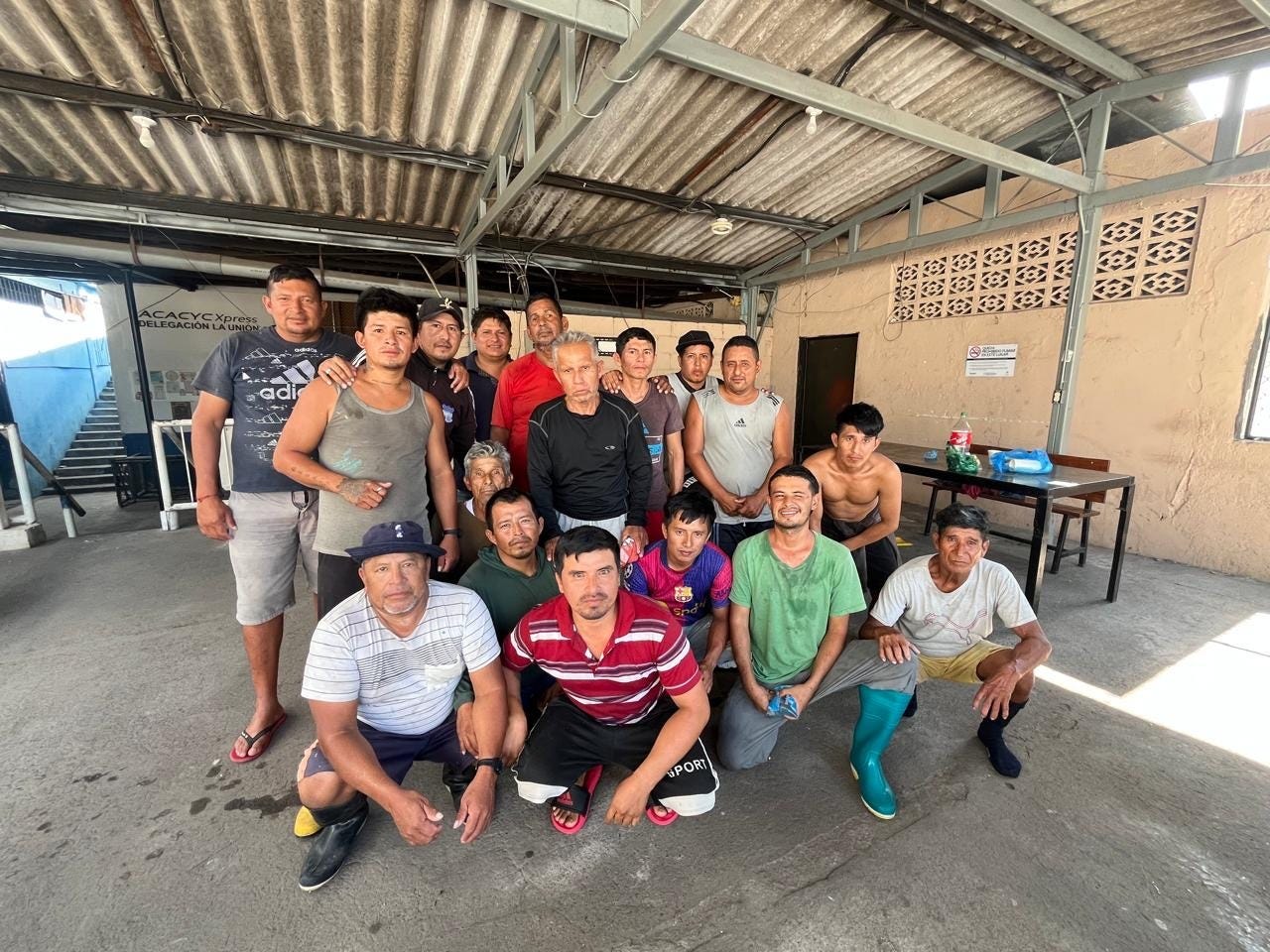
Now, 36 survivors of two Pacific attacks fitting a similar profile alleged that they were abducted and tortured by American forces and taken by boat all the way to El Salvador before being returned to Ecuador. Drop Site spoke to multiple survivors and attorneys from both boats.

Drop Site reached out to the U.S. Southern Command for comment on all three incidents; they said they had no information to provide and directed questions to Ecuador. Drop Site asked Ecuador’s Port Authority for comment. They hung up after hearing the call was from journalists.

“Filled the floor of our lifeboat with blood”

On March 23, 16 Ecuadorian fishermen from a second vessel, La Negra Francisca Duarte II, were found by El Salvador’s coast guard, their limbs mangled and backs etched with burns. One man’s foot was spliced open, exposing bone. Another had lesions on the nape of his neck that left him dizzy whenever he moved.

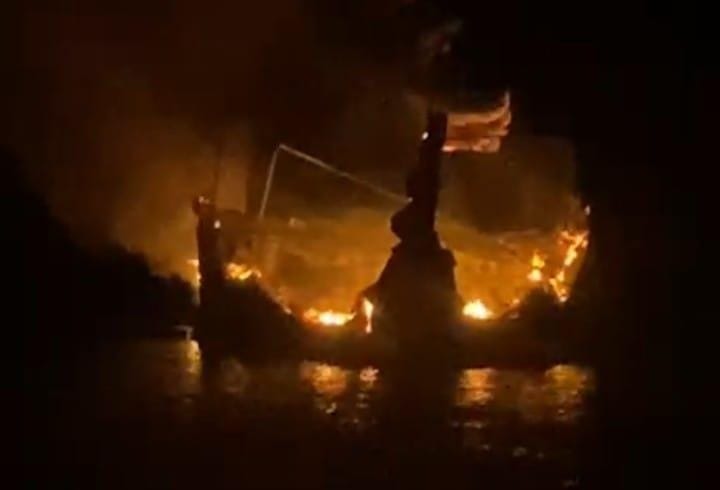
The fishermen told Drop Site News they’d been struck by a drone with a yellow cylinder five days earlier, forced to jump overboard to escape the fire caused by the explosion, and subsequently taken captive by forces on a U.S.-flagged blue patrol ship—just like the one Roxanna Mero’s husband, Carlos Valencia Mero, had described before he disappeared. Captain Hernán Flores, one of the 16 survivors, said the word “Spear” was written on the hull of the blue ship. Trump’s counternarcotics military program in the Americas is named Operation Southern Spear.

“A lot of us had wounds all over our bodies from the explosion. One young man was bleeding so much he filled the floor of our lifeboat with blood,” said Flores. “The drone had flown through our cabin window, torn my nephew’s foot so bad you could see flesh and bone, and made the boat’s roof cave-in on the back of my neck. A few seconds later, an explosion shook the boat causing a terrible ringing in our ears. Out of exasperation, the guys threw themselves into the water, some without life jackets, even the ones who don’t know how to swim.”

As the fishermen made their way toward what they hoped was safety on the nearby blue boat, an aircraft hovered directly overhead. Nearing closer, they spotted blonde-haired men, armed to the teeth, dressed in camouflage uniforms, and yelling “hands-up” in English. Flores said they began to pray, convinced they were going to die.

Guns drawn, the men placed hoods over the fishermens’ heads, handcuffed them, and held them on the blue ship’s scorching metal deck for over 24 hours, blistering their skin. The Ecuadorian crew of La Negra Francisca Duarte II were surprised to find themselves detained following the attack. Like Mero’s husband, they had been cleared to proceed by Ecuadorian coast guard personnel just hours earlier at a checkpoint near the Galápagos.

The gunmen, issuing instructions through an interpreter, offered no explanation for why they were being apprehended, nor did they bother to inquire what had happened, as a rescue team might, or search their boat for evidence, as a counternarcotics operation would. All but one fisherman were denied medical attention, despite the severity of what they had just endured. Held for days, they were refused food and given only one bottle of water.

La Negra Francisca Duarte II burning on March 17, 2026, captured by nephew of Captain Hernan Flores and provided to Drop Site News.

The following day, despite being in Ecuadorian waters near the Galapagos Islands, the kidnappers transported the fishermen roughly 900 nautical miles north, turning them over to El Salvador’s coast guard.

Drop Site News spoke to 11 associates across El Salvador’s Ministry of Defense, coast guard, and navy, all of whom said they were aware of the incident but were unauthorized to comment. In recent years, El Salvador’s government has drawn scrutiny from human rights advocates over President Nayib Bukele’s embrace of U.S. President Donald Trump’s migration policies, labeling him an accomplice to U.S. human rights violations, with several documented cases of torture in its prisons—facilities the Trump administration has contracted to hold deported migrants. On March 24, El Salvador’s authorities began coordinating the return of the fishermen to Ecuador.

“Just like the Americans didn’t do anything to help save us when our boat was bombed, the Ecuadorian government also hasn’t done anything to help us,” Flores told Drop Site. “It was our families who made sure we got home safe.”

“El pueblo salva al pueblo,” he said, a popular Spanish saying about solidarity and mutual support between working-class people.

Ecuador’s Foreign Minister, Gabriela Sommerfeld, cast doubt on the innocence of the fishermen and defended the extrajudicial assault. “Ecuador and North America are working cooperatively with joint activities. I cannot tell you for sure what activities the fishermen were carrying out or the situations they are in,” Sommerfeld told local media.

Throughout her tenure, Sommerfeld has repeatedly come under fire for failing to uphold international law. Most notably, when Ecuador stormed the Mexican embassy to kidnap former Vice President Jorge Glas of left-wing party Revolución Ciudadana, ending diplomatic ties between the two nations for the first time since they were established in 1838. An event that Tamara Lajtman, researcher with the Lawfare Observatory and the Institute for Latin American & Caribbean Studies, said was the foreshadowing for an autocracy rife with abuses, “It revealed a willingness to use state force outside of any legal limits. It’s really not an isolated incident, but rather a symptom of an authoritarian way of exercising power.”

Legal counsel for La Negra Francisca, Jorge Chiriboga, frames the airstrike as a similar breach of international law. “This is an invasion of Ecuador’s airspace and maritime because it occurred within Ecuador’s Insular Exclusive Economic Zone,” Chiriboga told Drop Site. Chiriboga, shared GPS photos with Drop Site News taken at the site of the bombing showing La Negra Francisca was operating within permitted limits.

“These attacks are no longer just a mistake,” he continued. It is a planned and coordinated abuse against working-class civilian fishermen who are unarmed and they should be condemned by international law. Imagine these bombs would’ve killed all of them, it is an extrajudicial action by a foreign nation, it’s an abuse by the biggest force in the world.”

“They treated us like animals”

The second report of torture came two weeks later. On April 3rd, 20 more Ecuadorian fishermen aboard the Don Maca were intercepted by El Salvador’s coast guard. Arriving with vision and hearing loss, bruised limbs, and perforated arms, they reported a strikingly similar account of an alleged attack by U.S. soldiers: a bombarded boat, a round of bullets, and no due process.

This time, the men charged that they had been held hostage and hooded for eight days.

Survivors of the Don Maca attack, provided to Drop Site News.

“They treated us like animals,” said Sebastián Palacios of the Don Maca vessel, his thousand-yard stare welling with tears as he embraced his family at the Manta airport upon finally returning to Ecuador weeks later.

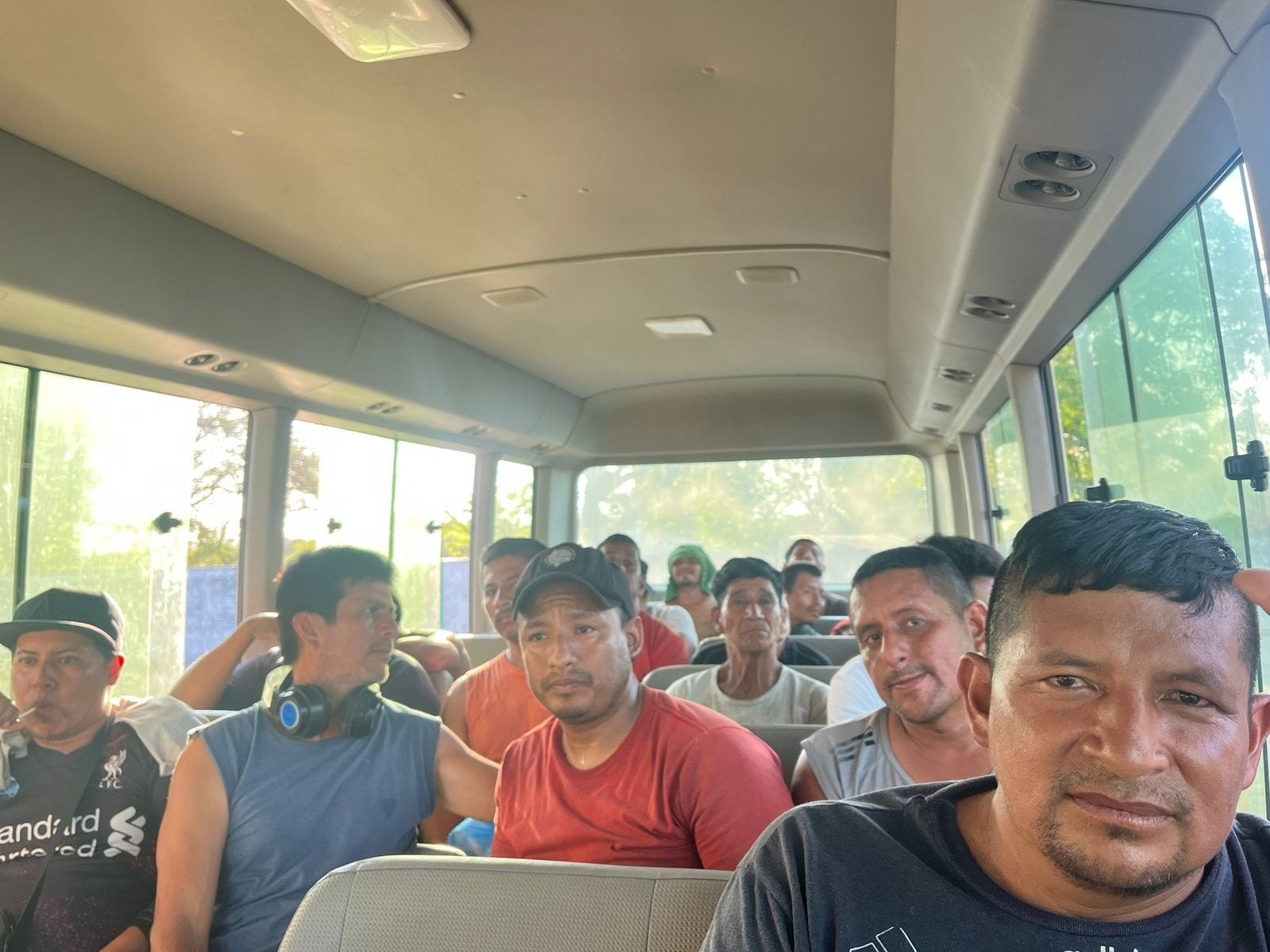
Several workers of both the Don Maca and La Negra Francisca remain hospitalized; many are receiving psychiatric care, as well.

The attorney for the Don Maca crew, Pilar Muñoz, recounted her clients’ testimonies to Drop Site News.

“Two small drones and one big drone had been tailing them for 24 hours,” she said. “They informed Don Maca’s owner, Cristian Mendoza, of the sighting, and he assured them not to worry, as the boat and fishermen had all the proper licensing and registration. He told them, ‘There’s no problem since you’re just there to fish.’”

“But the next day,” Muñoz continued, “a drone struck their boat, causing an explosion just 15 centimeters from the gas tank. Had it hit any closer, they would’ve all died from the explosion, and there would’ve been no survivors to tell this story.”

Immediately, the crew scrambled to raise a white flag, signaling they were unarmed and in distress. Men in uniforms on an adjacent boat—who the survivors of Don Maca also identified as U.S. military—followed with multiple rounds of glass pellet gunfire, leaving crew member Erik Coello with 70% vision loss and his arms riddled with puncture wounds and embedded glass. They eventually ceased and instructed them to approach their boat.

The fishermen said the kidnappers were white, spoke English, and accompanied by a translator with an Ecuadorian dialect.

A survivor, who asked not to be named due to pending legal action, told Drop Site News that, once detained on the boat, he was fired on again with a pellet gun. The account resembled what Coello had experienced, though by then the men had been hooded and were unable to see what exactly was being done to them.

Photos of scarring, perforation, and bruising left on Erik Coello’s body from the drone strike and gunfire. Taken by his attorney upon returning to Ecuador.

Just before men in fatigues forced hoods over their heads, the fishermen caught a glimpse of them doubling back to bomb and sink their already damaged boat.

“If the boat would’ve actually been carrying drugs, they wouldn’t have drowned the boat because they would’ve needed to use it as proof,” Muñoz pointed out.

Ecuador’s interior minister, for example, released video of a different detained vessel around the same time that was found carrying 300 packages of cocaine 180 nautical miles off the coast of Manta. In the video, officials are seen carefully locating, documenting, and preserving the evidence with no signs of a drone strike. Unlike Don Maca or La Negra Francisca’s fishermen, the alleged traffickers aboard the vessel were returned to Ecuador the same day, alive and without apparent serious injuries— paraded in front of TV outlets as a victory lap for the Ecuadorian government.

Sign of El Salvador’s migration center where Don Maca survivors were transferred, provided to Drop Site by legal counsel for the survivors.

Noboa’s Unconstitutional War

While no drugs or illicit behavior were found on any of the three boats, the same cannot be said for ships belonging to the family and private enterprises of Ecuador’s right-wing president, Daniel Noboa.

In 2025, Colombian investigative journal, Revista Raya, revealed that €26 million worth of cocaine headed for Croatia had been seized by Ecuadorian authorities from the shipping containers of Noboa Trading. Leaked chats showed Balkan drug traffickers bragging that they had exclusive access to Noboa Trading ports and containers.

An employee of Noboa Trading, Jose Luis Rivera, responsible for inspecting the ports for narcotics, has been arrested by Ecuadorian officials four times in connection to drug trafficking. Noboa’s personal attorney, who he later appointed Minister of Health, served as the legal representation for Rivera. Rivera’s charges were dismissed after Ecuador’s attorney general decided not to pursue charges. In March the head of Ecuador’s notorious cartel, Los Tiguerones, told Spanish newspaper El Mundo that President Noboa struck a deal with the group to whip votes for his election in exchange for immunity, contradicting his primary campaign pledge to combat drug trafficking and corruption.

The Miami-born billionaire was elected president of Ecuador only after the assassination of his political rival, Fernando Villavicencio; American mercenary group, Blackwater, patrolled voting sites on election day. Noboa has since built a military regime, backed by the U.S. through Pentagon-supplied bombs, and enforced using a never-ending decree that the country is in a state of war. The FBI even opened its first office on Ecuadorian soil under the pretext of fighting drug trafficking. A UN probe determined there was insufficient legal basis for Noboa’s state of war decree.

Tamara Lajtman, researcher at the Lawfare Observatory, calls it “the consolidation of an authoritarian project with strong elements of militarization and geopolitical alignment with the United States.” “Ecuador is being reconfigured as a strategic enclave in the hemispheric security architecture of the United States, especially in that strategic competition with China,” Lajtman continued. “We’re seeing raids, judicial proceedings, actions in the electoral arena, public stigmatization.”

All the while, drug trafficking has soared under Noboa’s presidency, now accounting for 70% of the world’s cocaine distribution.

The spectacle of “combatting drug trafficking” while actually targeting civilians is reminiscent of Colombia’s 2006 “Falsos Positivos” scandal wherein U.S.-funded armies massacred an estimated 6,000 disabled men, luring them to remote areas under the false promise of a job, then slaughtering and dressing them in guerrilla uniforms to meet wartime quotas.

In March, the New York Times published an investigation that found campesinos, in the indigenous and oil-rich Sucumbíos region of the Amazon, had been kidnapped, waterboarded, electrocuted, and bombed during a joint operation by the Ecuadorian military and U.S. Southern Command. Using U.S. intelligence, the operation had supposedly identified a FARC dissident drug camp. However, the New York Times, and several local journalists, found no proof of a drug camp—only a farm whose workers were left with severe physical and psychological trauma.

A few months prior, 16 Ecuadorian soldiers were convicted for the kidnapping and burning to death of 4 Afro-Ecuadorian children as young as 11 years old. The military tried to justify the atrocity by wrongfully accusing them of drug trafficking.

As executive power continues to be unconstitutionally consolidated in Ecuador, through the banning of political opposition parties, the rescheduling of elections, the kidnapping of democratically elected officials, and the assasination of indigenous workers on strike, a sense that the country has slid into autocracy now prevails. As former president of Ecuador’s National Assembly and the leader of Noboa’s largest political opposition party, Gabriel Rivadeneira, said, “Ecuador is living under dictatorship. Whoever raises their voice to defend the rights of their people either has their life threatened, their house raided, or is sent to jail.”

Leave a comment

Share

Correction, April 21, 2026: Noboa’s personal attorney is the former Minister of Health, not the current minister. The mistake was due to an editing error.

Read the whole story
mikemariano
8 days ago
reply
Share this story
Delete

Psycho III, or, Crane in Vain

1 Share

Going into Psycho II, I made sure to make clear how much disdain I had for the idea of even trying to live up to such an undisputed classic. I gave it a pass only after it was clear that they were showing proper reverence for the original, and that they were more interested in continuing the story than trying to live up to it in terms of filmmaking.

Watching Psycho III, I was reminded of Hitchcock’s extended trailer for the original movie. It takes full advantage of the persona that had been well-established on Alfred Hitchcock Presents, starting with a jaunty theme and his style of straight-faced opening narration of each episode, that almost always included some macabre gag. He deadpans his way through a tour of the murder scenes, teasing the horrific events that took place at each one, stopping himself just short of saying too much.

In other words: I have a tendency to take Hitchcock way too seriously, concentrating on the Master of Cinema bit and forgetting how much he was also a showman and master manipulator.

So while Psycho II was a pleasant surprise, both for having clever ideas on how to continue the story and for being careful to pay homage to the original, Psycho III feels like it really gets the original. Not just how it felt to audiences 20 years after its release, but how it might’ve felt in its original context. And most surprising of all was how much I enjoyed it.

The movie picks up just a months after the previous one, and it’s about Norman Bates’s obsession with a young woman who arrives at the Bates Motel and by a bizarre and unfortunate coincidence, happens to look nothing like Marion Crane.

Maybe that’s not being fair to Norman1, because the opening of the movie does an extended riff on Vertigo, priming us to take it in stride when a guy falls hard for a doppelgänger.

A familiar bell tower

In any case, she looks similar enough for Norman to get imprinted on her, at least. And his new real mother doesn’t like it one bit.

The situation isn’t helped at all by his new sleazy assistant manager Duke, played by Jeff Fahey with the idea of “What if H.I. McDunnough, but hot?” and frequently shot like this:

Jeff Fahey wants you to watch the guitar

Duke is trash. He’s also perpetually horny and he mistreats women, so it’s a good thing he’s in Psycho III, which is a very horny movie. But while Psycho II just seemed to be hinting at psychosexual frustration in an outdated and almost even TV-safe way — everyone calling it “making love,” implications of the kinds of lurid things that are going on in the motel now that it rents rooms by the hour, a doomed teenager sneaking into a murder house with his girlfriend and only making it to second base — the third movie is eager to go there and explore it.

It’s pretty hilarious when we get to see how Duke has transformed his room of the motel into a sex palace for one-night stands with local barflies. He’s been hard at work making collages from nudie magazines and pasting them on the walls, and somehow he’s managed to find colored bulbs for all the lamps. Women can tell he’s bad news, but they still can’t resist the temptation to enter his den of passion, where he’s always playing cartoons on the TV for some reason.

Having Duke at the Bates Motel sets up this interesting dynamic that plays with the audience’s sympathies, and even turns Norman back into a kind of anti-hero. Psycho II started with the baseline assumption that everybody would constantly be thinking of Norman as one of the most famous horror movie murderers, so it milked the ambiguity of “has he really reformed, or is that impossible?” for everything it was worth. Psycho III can’t really do that.

We know from the start that the hasn’t reformed. His introduction leans hard into images of the motel and the house in decay and neglect, with Norman surrounded by death. He’s poisoning birds so he can taxidermy them, and as far as I could make out, eating peanut butter from a jar with the same spoon he uses to stuff the insides. All while having visions of when he stuffed the body of his mother, who’s now residing in the upstairs bedroom. He’s unambiguously unwell, and it’s really driving home how hard Reagan-era budget cuts limited the availability of social workers to be assigned to recently-released serial killers.

But Duke is such a piece of garbage — and unlike Toomey from the last movie, he’s surface-level charming, instead of instantly unlikeable — that the contrast makes you think of Norman more like the way he thinks of himself: a quiet, awkward, and repressed, but overall polite and respectful man. An identity completely separate from his insane and domineering mother.

Because Psycho III comes right out of the gate with the weirdness turned to maximum — the opening shot is a black screen with a woman screaming, “There is no God!!!!” — a lot of it plays out like a surreal coming-of-age story starring a man in his early 50s. The relationship between Norman and not-Marion plays out like a budding romance between two shy and awkward innocents, instead of two deeply repressed people who are mentally unwell. At a dinner after they get tipsy from having wine that neither of them have been allowed to drink before, Norman invites her to dance and teaches her the box step.

Even the pianist can’t help but be charmed by the sight of them, and the movie cuts away to show him looking on approvingly, in what is my single favorite shot in all of Psycho III:

The pianist approves

The core relationship in Psycho II never felt sexualized to me, for several reasons. The most obvious is that Mary (Meg Tilly’s character) is introduced as a co-worker with boyfriend troubles, both of which immediately put Norman in the friend zone. In the original, we’re introduced to Marion in her underwear after a rendezvous with a still-shirtless Sam Loomis, inviting the audience to think of her as an adult woman who has sex out of wedlock!

Did audiences really still think that way in 1960? Or is that just a modern interpretation, which invariably infantilizes previous generations as being repressed and naive? People have spent so much time analyzing Psycho that I spent years being told that even the sight of a flushing toilet was shocking and risqué for the time, so it’s near impossible for me to tell how much of that is accurate and how much is like the stories of people fainting at the sight of an oncoming train.

In any case, Psycho II was less interested in exploring sexual repression as it was in building up the suspense and tension around people in danger. Even in the scene where someone is watching Mary’s body double coming out of a shower, it feels set up to emphasize how physically vulnerable she is, instead of sexually vulnerable. The nudity seems more like a movie from the early 1980s playing around with how much they can get away with showing now, instead of actually digging into what any of it means.

Both of the sequels are filled with notes to Norman from his mother, calling women sluts and whores. And yet in Psycho II, they somehow always read as general-purpose gendered insults instead of sexual ones. It’s always ambiguous where the notes are coming from, or even if they actually exist, so they seem to be written more for shock value than to actually mean anything. “Don’t take it personally. Mother calls every woman a whore.”

But when Norman’s mother in Psycho III calls a woman a slut, she really means it.

Mother is home

It’s really interesting, because the easiest take on Psycho III is that it’s just lurid, melodramatic, trash. Dispensing all of the manipulative craftsmanship of the original, and the clever whodunnit twists of the first sequel, in favor of turning the franchise into a weird mid-80s slasher movie. Everything that was suggested in the original is now made explicitly obvious, all of the subtext is now exploitative text.

And yeah, Psycho III was undeniably capitalizing on the trend in slasher movies — the Friday the 13th series, which was also about a murderer with an unhealthy relationship with his mother, already had five installments by this point — but I think it was clearly commenting on them as well. I don’t think it’s simply a case of clumsily making implicit ideas more explicit, but using them as a baseline to take them further.

As a counter-example: in Gus Van Sant’s awful and truly unnecessary remake of Psycho, he made sure to add sound effects to the scene where Norman is looking at Marion through a hole in the wall, to make it clear that he was masturbating. That’s a case of making the implicit explicit while adding nothing.

When there’s a similar scene in Psycho III, the camera spends a long time lingering on Norman looking at the creepy painting that’s covering the hole in the wall. It shows two dark, brutish men abducting a nude woman in the forest.2 As he stares at it, it transforms: the men look even more sinister, and they’re looking more directly at out of the painting, at him. The woman’s expression of distress has changed into a smile, an image suggesting not just consent, but temptation.

Norman and his peep hole painting

There’s a tendency to interpret horror movies, and the entire genre of slasher movies in particular, as cases of filmmakers unwittingly telling on themselves. All of their prejudices and hang-ups are encoded into the movies, ready for modern audiences to come in and decode them into the various symbols and cliches like “the virtuous final girl” and “horny teens punished for their transgressions.” And then turn them into self-aware riffs on those ideas, like Scream and The Cabin in the Woods.

Psycho III feels like it was commenting on those while they were still happening, before they were being regularly deconstructed. It makes it clear that its targets are repression, and the objectification and mistreatment of women, while also making it clear that it’s condemning them, not just indulging in them. It’s still manipulating the audience’s sympathies — because by this point that’s become a key part of the franchise — but it also includes enough outsiders to remind us how none of the residents of the motel or the house are the “normal” ones.

For one thing, there are simply enough women characters, and they’re given just enough agency, that they’re allowed to remain distinct personalities instead of collapsing into symbols. (“Personalities” instead of “characters,” since this is still Psycho III, after all). Even the characters that come right out of a slasher movie, and who might as well have “VICTIM” written on their foreheads, are given enough time to establish how completely random and unprovoked the violence against them is.

The movie seems to make a point of distinguishing between a healthy attitude towards sex, vs repression, sexual violence, and exploitation. For a lot of the runtime, the motel is being taken over by a bunch of loud, rowdy adults in town for a homecoming event. Like this woman, who thinks it’s hilarious that her bear boyfriend just invited her to twirl on his baton:

It wasn’t that funny

And one of the VICTIMs that I mentioned earlier would seem to fit perfectly into the horror movie cliche of “woman punished for the sin of being sexually promiscuous,” but I had a hard time reading the movie as being complicit. She’s the most explicitly sexualized of any character, but the scene doesn’t seem to blame her, so much as it emphasizes how much Duke is an asshole for treating her like a prostitute. And her nudity afterwards seems so matter-of-fact that it’s treated like an inconvenience. Unlike the nudity in the previous two movies, for instance, which felt like the filmmakers were experimenting with just how much they could get away with.

It’s possibly the oddest thing about this very odd movie, because I’m so used to slasher movies serving up simultaneous sex and violence with a shrug of, “we’re just givin’ the people what they want, and you’re complicit, or you wouldn’t be watching.” And this whole sequence looks like it should be exactly that. But in the context of this movie’s overt theme of sexual repression, it ends up feeling like a vehement rejection of the whole idea. It doesn’t feel like indulging your voyeurism, but rejecting it. Essentially equating you with Norman’s mother, for seeing any sign of sexuality in a woman as sinful and something that deserves to be punished.

Because Perkins was directing, it’s tempting to theorize that the reason I didn’t find the female nudity in Psycho III as pandering as most slashers, is because all of the Male Gaze was focused on Jeff Fahey. And I admit I like to imagine that Perkins was slyly playing on the way Hitchcock was infatuated with Grace Kelly and Tippi Hedren by filming Fahey the same way. But the obvious fact is that it simply wouldn’t work the same way, even if he weren’t introduced to the movie in a scene that ends with his sexually assaulting a woman. The baseline for what’s considered acceptable male sexuality is just different.

But even if that wasn’t part of the intent, I do firmly believe that Perkins knew exactly what he was doing with this movie. I really like this quote that was included with the Wikipedia entry on the movie:

“I liked how wild the script was, and how tight it was at the same time. It’s the perfect blend of the reasonable and the unreasonable. I’ve always been looking for a project to direct with which I have an affinity with the subject and characters. I felt this would be a good script for an unknowing director to take on because the scenes were so well written, they directed themselves.”

It’s unnecessarily self-effacing for Perkins, because the script absolutely would not have worked for anyone who didn’t fundamentally understand the original Psycho, the character of Norman Bates, and the reason that movie was such a phenomenon.

Mother points the way

A quick shot of Norman’s mother warning him of impending danger, for instance. Psycho II would never have included something like that, because it was playing it too safe. It’s funny how quickly I went from accusing that movie of the most outrageous audacity for even trying to continue the classic original, to concluding that it didn’t go far enough.

Part of the reason I’m including so many screenshots from the movie3 is because it so frequently feels like it’s trying to present an original, surreal image. And it’s full of homages to Hitchcock, but it’s more interested in getting across how they felt, instead of just doing a simple remake.

A huge part of why it feels so weird is the amazing soundtrack from Carter Burwell, full of odd electronic noises, creepy chanting, 80s rock, and even turning into a bouncy synth pop tune over the end credits. This was in the middle of doing music for Blood Simple and Raising Arizona, and proves how Burwell is a master at recognizing how the lines between suspense, horror, surreality, and comedy are all blurred. It’s a reminder of how much Bernard Hermann’s soundtrack for the original is memorable just for being so weird.

It’s an essential part of how Psycho III mashes it all up and has fun with it, without it ever quite descending into camp. I’m not going to claim that it’s a multi-layered masterpiece; it doesn’t have anything that works with as much restraint and nuance as the “we all go a little mad sometimes” from the original, for instance.

But it does embrace the entirety of the original, the parts that make it a classic and the parts that Hitchcock was eager to have fun with. It was never intended to be a deep and thoughtful examination of repression and mental illness4; it was intended to be shocking and surprising and pull people into the theaters to see what all the fuss was about. I love the movie, but I frequently forget how it was basically “elevated trash,” and not the least bit ashamed of that.

Psycho III understood that bringing the original into the 1980s meant preserving both the experimental filmmaking and the lurid exploitation. I was surprised that the previous movie was any good at all. I’m even more surprised that the third — and as far as I’m concerned, final — movie is not only a fascinatingly weird horror movie on its own merits, but made me have a greater appreciation for the original, by being less reverent of it.

1    I mean, she doesn’t even have the same hairstyle, though. She looks a lot more like Christina Crawford than Janet Leigh.
2    It looks like a creepier, more dark-gothic remake of the one in the original, which just gets a glimpse.
3    Apart from having watched it from a friend’s Plex server, which doesn’t black out still frames like every other Mac media player does
4    Which I guess should have been abundantly evident from the title, in retrospect
Read the whole story
mikemariano
11 days ago
reply
Share this story
Delete

Is the Super Mario Galaxy Movie’s Rosalina Reveal Canon?

1 Share

Warning: This post will contain spoilers… inasmuch as The Super Mario Galaxy Movie can be spoiled.

If I had to review the new Mario movie succinctly, it would be as follows: exhausting but colorful, and with superfluous Wart content while also somehow not enough Wart content. That’s it. I think it’s overall a more entertaining thing to watch than the first movie was, but it’s also less interested in plot, character development and giving things a reason for happening. But if you don’t feel conflicted lowering your brain function to only the level needed to recognize things, you might have a decent time. 

I mean it literally when I say The Super Mario Galaxy didn’t bother with traditional narratives. I don’t think a single character had an actual arc. And things just happen because they need to happen, to the point that Toad at one point comments on this, complaining that Yoshi has joined the group for no apparent reason. But because the film seems to avoid the kind of structure you’d expect from most movie plots, I was surprised that it did attempt to fill in the blanks regarding a question that the games have never answered: Why does Rosalina look so much like Peach if they’re not related?


In this new movie, it turns out they are. Rosalina is somehow Peach’s older sister, even if their origins beyond that are explained with only a single line: they’re “made of stardust,” although we’re never explained exactly what this means. It’s not much, I will admit, but it’s certainly more of an explanation than we’ve been given before. The games leave it more or less at Peach being the princess of the Mushroom Kingdom and Rosalina being some kind of mystical space lady who sometimes displays god-like powers and who also has Peach’s face.

And yes, I realize that Daisy already existed in the Super Mario games as a princess who looked like Peach for years before Rosalina came along. But I’d wager Daisy now looks less like Peach or Rosalina than Peach or Rosalina look like each other.


In an interview with Forbes about the production of The Super Mario Galaxy Movie, Shigeru Miyamoto explained that while it explores Peach and Rosalina’s relationship in a way the games don't, the kernel of this big plot twist is something that originated nearly twenty years ago. It came about during the development of the video game Super Mario Galaxy, but not a whiff of it made it into the game in any meaningful way.

When we were developing Super Mario Galaxy, the director for that game, Yoshiaki Koizumi, and I were discussing what Rosalina and Peach’s actual relationship was. We had this vague idea about what their actual relationship could be, and how it would play into the concept of space. We had a lot of discussion about this, but we never came to a conclusion. So we decided that let’s take this opportunity to give this idea some meat and get into the specificity of it, and we had a lot of fun having this discussion back and forth.

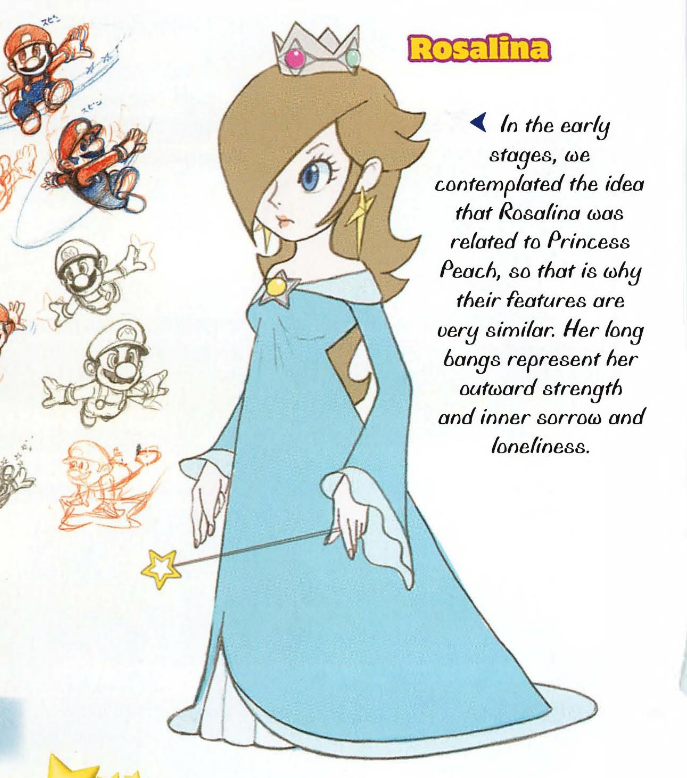
I will point out that Miyamoto isn’t saying that Nintendo specifically intended Rosalina to be Peach’s sister. In fact, there’s a note in the Prima guide to Super Mario Galaxy that makes it seem like the team only took it as far as making Rosalina some kind of relative without specifying which: “In the early stages, we contemplated the idea that Rosalina was related to Princess Peach, so that is why their features are very similar.”

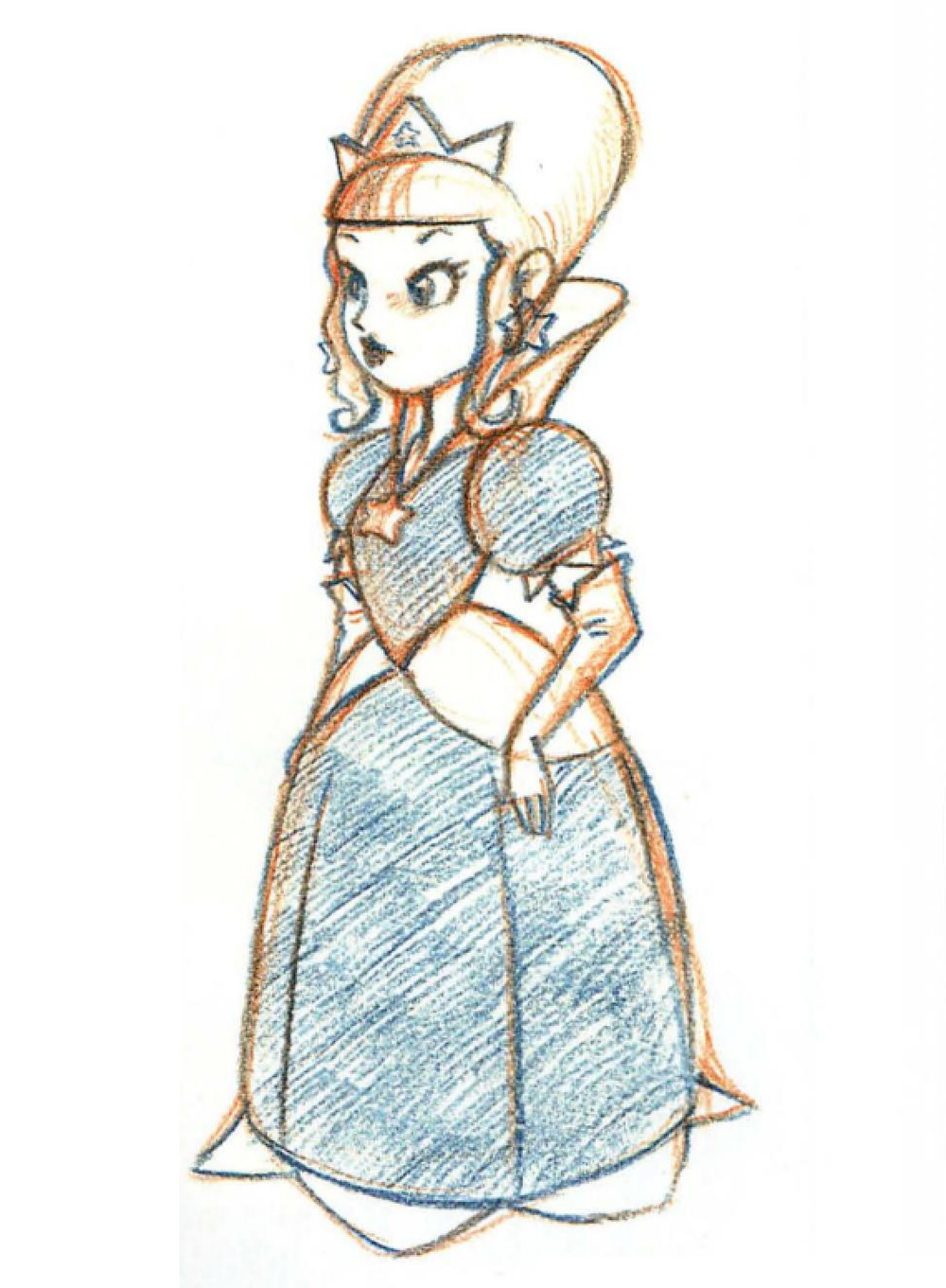
Of course, as I pointed out in a post about connections between Rosalina and Glinda from The Wizard of Oz, one of the original designs for the former dressed a lot more like the latter — and with a dress that looked a lot more like the standard princess gown that Peach and Daisy wear.


It’s interesting that this new character’s clothes were restyled but her face remained more or less the same, as if they wanted to differentiate her in some ways without deviating too far in others.

So does this mean that the dea of Peach and Rosalina being sisters have any basis in the games? 

No, not technically, aside from the fact that they look like they should be related. But the games don’t comment on this or hint that there’s a reason Peach and Rosalina physically resemble each other. This is very weird, I must say. In most fictional continuities, if a new character showed up looking strikingly like an existing character, you’d expect that to be explained in some way — a long-lost child, a secret sibling or an evil clone, for example — but the Super Mario video games have just declined to address this matter. 

Before you do what I did and default to blaming Shigeru Miyamoto for this, I feel like I should point out that this particular subject tends to make fans bring up his alleged hatred of story elements in the Super Mario series. This rep might be unfair, however. For one thing, there’s a 2023 IGN interview in which Miyamoto clarifies that he just thinks other elements should be given equal or greater consideration in the creation of video games. For another, the perception that he’s anti-story has colored a misconception regarding Super Mario Galaxy specifically. In the game, we get a hint at where Rosalina came from via her storybook time with the Luma, which is such an emotional touchstone of this character and this series that it’s literally how The Super Mario Galaxy Movie opens.

As the story is often told, this element had to be inserted into the original game covertly so Miyamoto didn’t remove it. Looking at the accounts of how it came to be, however, this seems inaccurate. In a 2007 interview for Wired, Chris Kohler does in fact lead with a quote from Yoshiaki Koizumi, the director of the Super Mario Galaxy video game, that basically calls Miyamoto anti-story.

“I would sort of try to find sneaky ways to get [story elements] in without them noticing too much,” Koizumi said of his early work. “These are aspects of the games that Miyamoto wasn’t nearly as fond of, and occasionally didn’t like.”

Importantly, however, this quote has Koizumi referring to his early work at Nintendo. When it comes to how Rosalina’s storybook vignettes made it into Super Mario Galaxy, he mentions no interference from Miyamoto.

For a long time, it really felt like telling a story in a Mario game was something that wasn’t allowed. But I felt in this case that the Lumas and Rosalina really needed a story to explain what they were doing out there and to give the players a deeper understanding of their presence. So telling her story as a fairytale by reading the book to all the Lumas as if they were young children at storytime just seemed like the mood-appropriate way to accomplish this.

Dropping it into the game in the middle of the hub right there as something you could choose if you wanted to, I felt worked very well. If the book was standing all alone on its own, or if the game story was standing on its own, neither of them work very well as separate elements. But together, they reinforce each other quite nicely. And people have the option of hearing that story if they want to, or never going into that room if they don't want to hear it. Even so, just making the children's book was quite a feat. It was a bit of a struggle for us to get it done. And a couple things that we cut from the book ended up going into the main story as well. So it was a pretty good process.

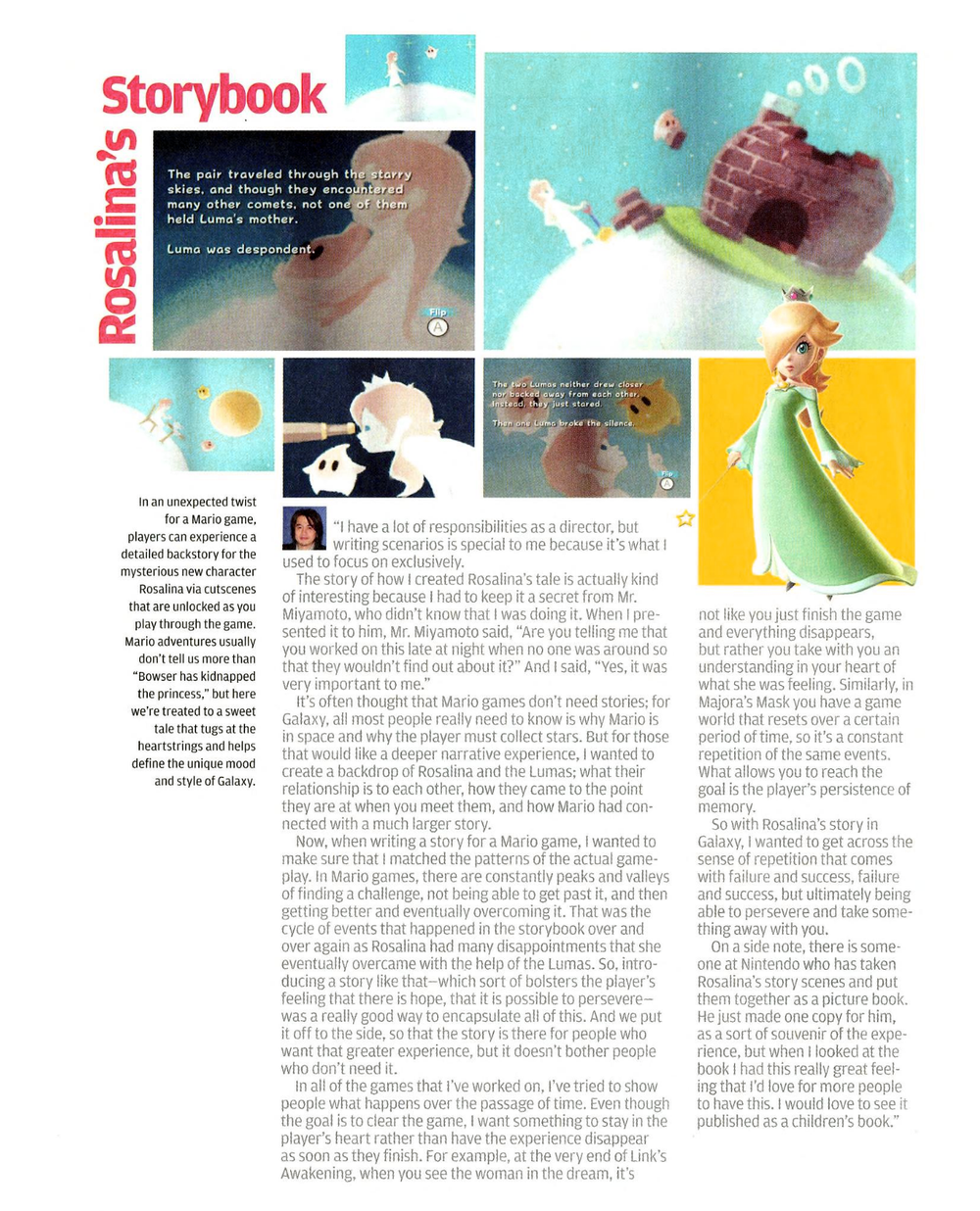
We get even more insight as to the process in the February 2008 issue of Nintendo Power.

I have a lot of responsibilities as a director, but writing scenarios is special to me because it’s what I used to focus on exclusively.

The story of how I created Rosalina’s tale is actually kind of interesting because I had to keep it a secret from Mr. Miyamoto, who didn’t know that I was doing it. When I presented it to him, Mr. Miyamoto said, “Are you telling me that you worked on this late at night when no one was around so that they wouldn't find out about it?” And I said, “Yes, it was very important to me.”

It's often thought that Mario games don't need stories; for Galaxy, all most people really need to know is why Mario is in space and why the player must collect stars. But for those that would like a deeper narrative experience, I wanted to create a backdrop of Rosalina and the Lumas; what their relationship is to each other, how they came to the point they are at when you meet them, and how Mario had connected with a much larger story.

Miyamoto’s role is stated in an elliptical manner here, but if you just read what Koizumi is presenting, it’s pretty clear that he wrote the Rosalina’s storybook sections on his own because it carried emotional weight for him, not because he was necessarily hiding it from Miyamoto. And however negotiations between him and Miyamoto went, the segments made it into the game, so ultimately Miyamoto approved them.


I suppose it’s possible that Miyamoto may have also considered and then rejected any kind of in-game confirmation that Rosalina was Peach’s long-lost sister, cousin, mother, or daughter from the future, Sailor Moon-style. But without asking them both, we don’t know who made that call. For all we know it was Koizumi, as the story ultimately leaves this vague.

This is a long-winded way of saying that nothing concrete made it into the game. Regarding the notion of Peach and Rosalina being sisters, The Super Mario Galaxy Movie is not drawing on the games per se but rather something that predates Super Mario Galaxy — something ultra obscure, behind the scenes and on the drawing boards only, to the point that it’s not actually canon. It’s actually something the canon rejected.

So does the movie mean that Rosalina will become Peach’s sister in the games?

Obviously, I don’t work at Nintendo, but I’d imagine not. There’s nothing in Miyamoto’s quote to Forbes that makes me think the games will adapt the movie’s canon in the future. I should point out that the versions of characters we see in the movie are often distinct from their video game counterparts. The movie version of Peach is a little colder than the game version, and the movie version of Rosalina is a little warmer than the stoic star mother we get in the games, to the point that I feel like Ana Taylor-Joy and Brie Larson would have been better off swapping roles, but whatever. The movie also makes the point of calling Rosalina a princess, even though she’s never been called that in the games, despite the fact that she looks like she belongs in that club just based on the dress, the brooch and the crown. In fact, both the games and the movie use the term in a way that makes me wonder what exactly it means in either universe.

I mean, it’s not as if the first movie reintroducing Foreman Spike resulted in that character having anything to do in the subsequent games, official name change notwithstanding.

If you want more of my thoughts on The Super Mario Galaxy Movie, I was a guest in last week’s episode of Nintendo Cartridge Society. I also recorded an episode just this morning with Retronauts, so look forward to that one as well.

Miscellaneous Notes

My primary reaction to the movie making Peach and Rosalina sisters is that I worried it would make people think that Nintendo was trying to play off the success of Frozen. Rosalina debuted in the Super Mario games years before Frozen opened in theaters, but Frozen proved to be such a pop culture juggernaut that I can imagine some people might see Rosalina as Disney’s answer to Elsa. They’re both emotionally restrained, full of mystical powers and fond of a certain shade of blue. Rosalina has even been associated with ice even though there’s nothing about her Super Mario Galaxy appearances that connects her with that. What’s worse, her being surprise sisters with Peach just makes Peach seem like Anna. Oh well!

If anyone in the Super Mario games seemed like she should be Peach’s sister, it really seems like Daisy makes more sense. Daisy is often the Luigi to Peach’s Mario, after all, but I suppose Rosalina makes a more compelling character, especially if you’re setting the story primarily in outer space. I can’t imagine how they’d fit Daisy into things in a subsequent movie, especially because she theoretically has less “stuff” than Rosalina, since Rosalina is the one with magic powers. Daisy is just pep and sports gear.


Read the whole story
mikemariano
21 days ago
reply
Share this story
Delete

Your Silent Face: Jiggs the Dog

1 Share

NB: This article is very long, so it may be best read on the website.


Jiggs the Dog in Ernst Lubitsch’s The Love Parade (1929)

Fans of the silent era probably know slapstick companion Luke the Dog and action star Rin Tin-Tin. If you’re a fan of films from the 1930s, you know Skippy (aka Asta from The Thin Man), Terry (aka Toto from The Wizard of Oz), and of course Lassie. But you might not know about Jiggs1, although if you’re a silent film fan, I’m willing to bet you have seen him in at least one film. Dubbed the “Caniniest of Canines,” Jiggs was a Boston Terrier, although he is often referred to as a “Boston Bull” and a “Bull Dog” in fan magazines. Described in the February, 1928 issue of Picture Play Magazine as “a veteran of the screen whose successes are too numerous to mention,” Jiggs likely began their career in the 19232. In the 1926 Standard Casting Directory, Jiggs’ owner is listed as Jack Ewing3.

Another version of this image claims that Starke trained Jiggs to follow her around the MGM lot holding her mirror

Although I had seen Jiggs in a few films, which I will mention in a bit, I had never heard the name before until I came across an image in the October, 1926 issues of both Photoplay Magazine and Picture Play Magazine, which shows Jiggs holding a lipstick mirror for actress Pauline Starke4. I immediately wanted to know more about this pupstar.

What I have discovered is that during the silent era, Jiggs appeared in over a dozen films, including the drama film Bread (1924)5, Fifth Avenue Models (1925) starring Mary Philbin, the Bebe Daniels’ comedy Miss Brewster’s Millions (1926); the action thriller The Fire Brigade (1926)6; the lost action serial The Fire Fighters (1927); the lost comedy Her Father Said No (1927); the crime caper Ladies Beware (1927), the lost film The Coward (1927) produced by Joseph P. Kennedy; the drama Women’s Wares (1927) starring Evelyn Brent; John M. Stahl’s In Old Kentucky (1927); the lost comedy Ritzy (1927); the Leo McCarey shorts Flaming Fathers (1927) and What Every Iceman Knows (1927); the Roscoe Arbuckle directed Eddie Cantor film Special Delivery (1927); and The Understanding Heart (1927) opposite Joan Crawford.

Jiggs also appeared in William A. Wellman’s Best Picture winning war epic Wings (1927), Ernst Lubitsch’s The Student Prince in Old Heidelberg (1928), and the lost comedy A Certain Young Man (1928) starring Ramon Novarro, Marceline Day, Renée Adorée, and Carmel Myers. I also found a reference to Jiggs appearing in the boxing serial The Leather Pushers, which would actually put the dog’s screen debut as 1922. Some of these credits I have been able to verify, others not so much.

In Wings, Jiggs plays the dog of Richard Arlen’s character David, who, as he bids farewell to his family to head off for the WWI trenches in Europe, also gives his loyal pup a lovely goodbye kiss. Although Jiggs was known for his tricks, he isn’t asked to do much here other than sit and be sweet. If you look closely, it appears that Arlen has some treats in his hand in order to elicit a goodbye nuzzle from his beloved pup.

Jiggs with Maurice Chevalier in Ernst Lubitsch’s The Love Parade (1929).

With the advent of sound, Jiggs made the transition into the talkies seamlessly. His first major role was co-starring opposite Maurice Chevalier in Ernst Lubitsch’s pre-Code comedy The Love Parade (1929). In this film Jiggs plays Chevalier’s loyal dog companion. When Chevalier’s character must leave Paris after one too many scandals, he bids his farewell to the ladies of Paris. Jiggs is given a similar scene, barking his goodbyes to his canine comrades. Along with helping his master with his shenanigans, Jiggs also flirts with Queen Louise of Sylvania (Jeanette MacDonald)’s poodle. Later in the film, Jiggs is Chevalier’s only friend, and the two share a sweet scene in the garden, under the moonlight. Here Jiggs gets a great close-up and a moment to showcase his ability to do tricks on command.


The sets for the Dogville barkies were made in miniature

Later in 1929, Jiggs appeared with several other dog talents in a series of shorts originally called Hot Dogs!, later renamed the Dogville Comedies. A piece entitled “Hollywood Goes To The Bow-Wows” by Marie House found in the December, 1930 issue of Screenland profiles how Zion Myers (brother of star Carmel Myers) and Jules White conceived and co-directed the series, which were often short, melodramatic parodies of popular films.

One of the first Dogville shorts was a riff on Madame X (1929)

These “barkies” were cast by combing through all the trained dogs listed in various talent directories. From what I have read, Jiggs was always described as a hard-working professional. In House’s piece she writes, “But you must know Jiggs. Jiggs really has a movie reputation. Why he’s been in pictures for years. . .Jiggs is one of those aloof, high-brow personalities. Remember him as Phido Vance in Who Killed Rover? — he’s a Ronald Colman or William Powell, sort of— or maybe even Greta Garbo, you might say. Silent. Mysterious. Aloof.”

House also claimed that Jiggs can walk, that he has a “psychosis about mice” and loves to chase them, and that Jiggs often doubles in shots for dogs that cannot walk on two feet. The piece also “interviews” Jiggs, where the dog says they like movies, but that they live very quietly outside, never goes out socially, doesn’t care for the ladies7, and that his favorite food was hamburger. Allegedly, Jiggs could also say the words “hamburger” and “Mama.”

Jiggs as Phido Vance in Who Killed Rover? (1930)

Although Jiggs was a male dog, in these barkies he often played female roles, as profiled in a January, 1930 issue of Picture Play Magazine. In this piece Jiggs is described as the first “pup female impersonator.” In the January, 1930 issue of Photoplay, the dog is described as the heroine of the Hot Dogs! series. In the series’ second film, entitled Hot Dog (1929), a parody of courtroom dramas like the Ruth Chatterton melodrama Madame X (1929), Jiggs plays a female character who ends up in a love triangle that results in a scandalous trial.


Subscribe now


I couldn’t find much information about Jiggs’s son

In the November, 1930 edition of Motion Picture Classic an article entitled “They’re In The Barkies Now” by Helen Louise Walker describes how Jiggs receives “voluminous fan mail” and sends out photographs to admirers all over the world. The piece goes on to describe Jiggs as a versatile actor who can play “old men and young flappers with equal verve and enthusiasm.” Allegedly, Meyers and White had thousands of costumes for these shorts and the dogs knew their own costumes. White is quoted as saying, “You should see the fireworks, if we try to put one dog’s costume on another! They can smell the difference, you know. And how they resent it!”

Jiggs with Jackie Cooper and Robert Coogan in Norman Taurog’s Skippy (1931)

One of the last films that I can confirm featured Jiggs is Norman Taurog’s pre-Code comedy Skippy (1931). This film is notable for its Oscar trivia: along with being nominated for Best Picture, its 32-year-old director Taurog was the youngest Best Director winner in Oscar history until Damien Chazelle won for his 2016 musical La La Land. Also, the film’s nine-year-old star Jackie Cooper is still the youngest nominee for Best Actor in a Leading Role. Jiggs appears late in this film, hanging out with one of the film’s other young stars, Robert Coogan, whose more famous brother Jackie Coogan8 you may recognize from Charlie Chaplin’s The Kid (1921).

A visual memorial for Jiggs after his death in 1932

Jigg’s obituary appeared in the September, 1932 issue of Photoplay, where he was described as “that famous talking bull dog of the movies.” After listing various credits, the obit goes on to say that Jiggs “always gave an outstanding performance” and that he was eleven years old when he died. The pup was buried in a “tiny redwood casket made especially for him” and that one of his puppies died on the same day. The obit ends by insisting that the “movies will miss good old Jiggs. It will be a long time before his place can be filled.”

Jiggs “walking” in Who Killed Rover? (1930) [his co-star is another “female impersonator” dog named Oscar]

In 1936, Jiggs was one of the many dogs profiled in Gertrude Orr’s book Dog Stars of Hollywood. Unfortunately, I could not find a digital copy of the book and on eBay it is going for $145! After his death and the publication of Orr’s book, it seems, like many silent film stars, Jiggs faded into obscurity. I’m sure he was a good dog.

The cover of Gertrude Orr’s book Dog Stars of Hollywood.


I started an Instagram account for my love of the silent era, so if you’d like more micro-doses of silent film daily, give ✨ Nitrate Dreamland ✨ a follow.


This is a reader-supported publication. To receive new posts and support my work, consider becoming a free or paid subscriber.

1

Jiggs was at one point so popular that in an op-ed in the June, 1929 issue of Screen Secrets Magazine about the highs and lows of Hollywood, Margaret Livingston used the name Jiggs for the name of a dog in an metaphorical story about the chokehold synchronized sound was about to have on the movies. This piece is also interesting because the last two paragraphs may as well be the rise and fall of Nellie LaRoy in Babylon. Also, around this same time there was a bulldog named Jiggs II who was a mascot of the United States Marine Corps and won a blue ribbon at the 1926 Westminster Dog Show.

2

A 1929 ad says Jiggs had been in the movies for six years.

3

In the 1928 edition of the same directory the dog’s owner is listed as Murray J. Ewing. I couldn’t find any information about Ewing.

4

Pauline Starke was born in Joplin, Mississippi in 1901. According to Anthony Slide in his book “Silent Players,” she moved to LA with her mother where she caught the attention of D.W. Griffith while acting as an extra. She made films from 1916 through 1935, and was named a WAMPAS Baby Star in 1922 and made her final film appearance in an uncredited role in Lost Angel (1943).

5

This is completely unrelated to Ida May Park’s 1918 film of the same name.

6

This film included a few sequences shot in two-strip Technicolor.

7

In this same piece a dog named Buster is described as having been out all night and having “quite a reputation.” In the “interview” with Jiggs, he describes Buster as a “regular Don Juan.” The piece continues stating, “Lusty little rumors as wagging about town that he makes love to all his leading ladies and it is even whispered (though don’t tell Will Hays), that the ladies can only break into the pictures through his patronage — well, ahem!” I also read a New York Times article that describes Buster as always playing “heavy lovers.” When I tell you these old fan magazines were wild, believe me when I say they were wild.

8

Coogan’s fight for his wages after his earnings as a child were squandered by his mother and stepfather eventually led to the California Child Actor’s Bill, commonly called the Coogan Act.

Read the whole story
mikemariano
23 days ago
reply
Share this story
Delete
Next Page of Stories