
1145 stories
·
0 followers

One Day the Sadness Will End

1 Share
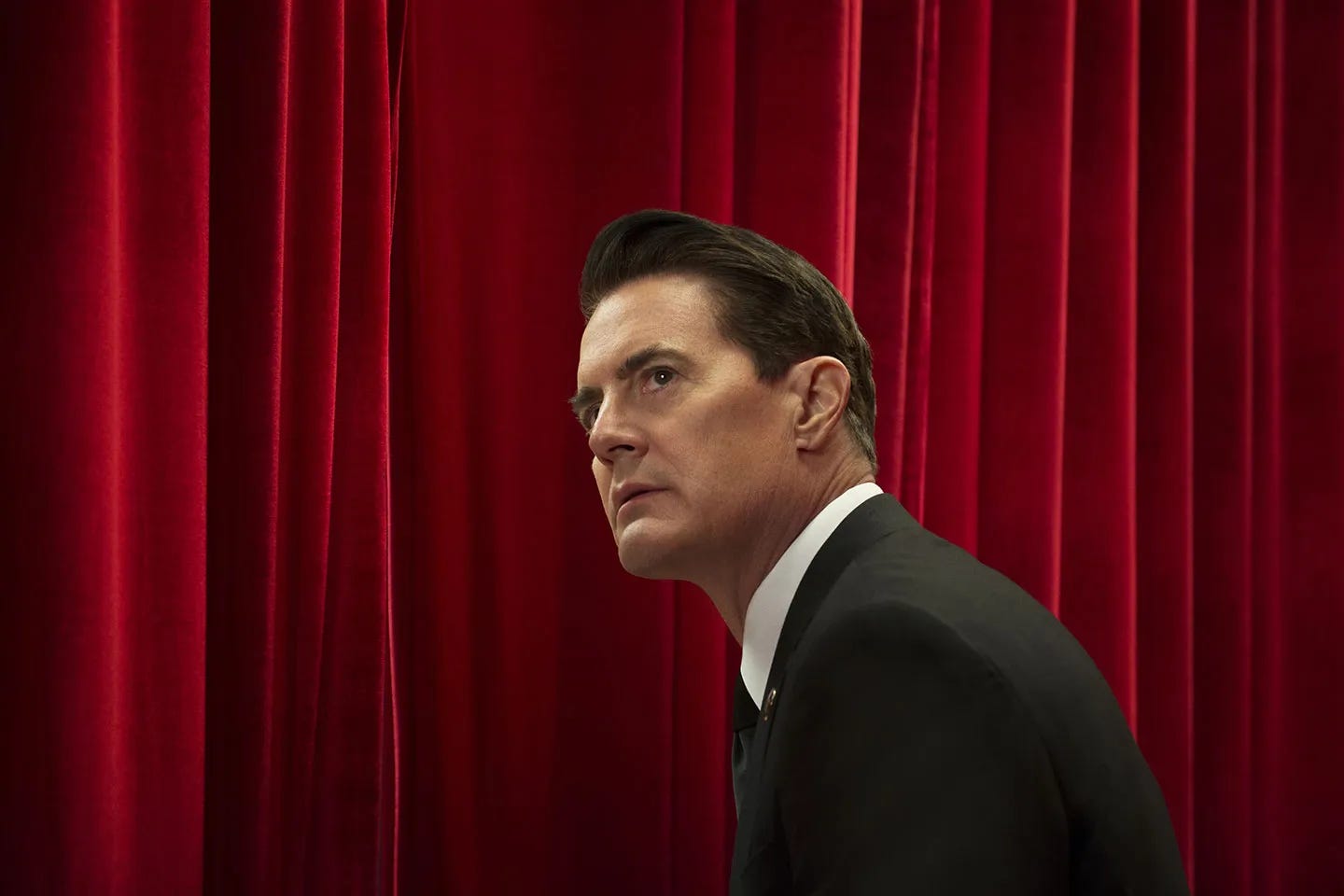
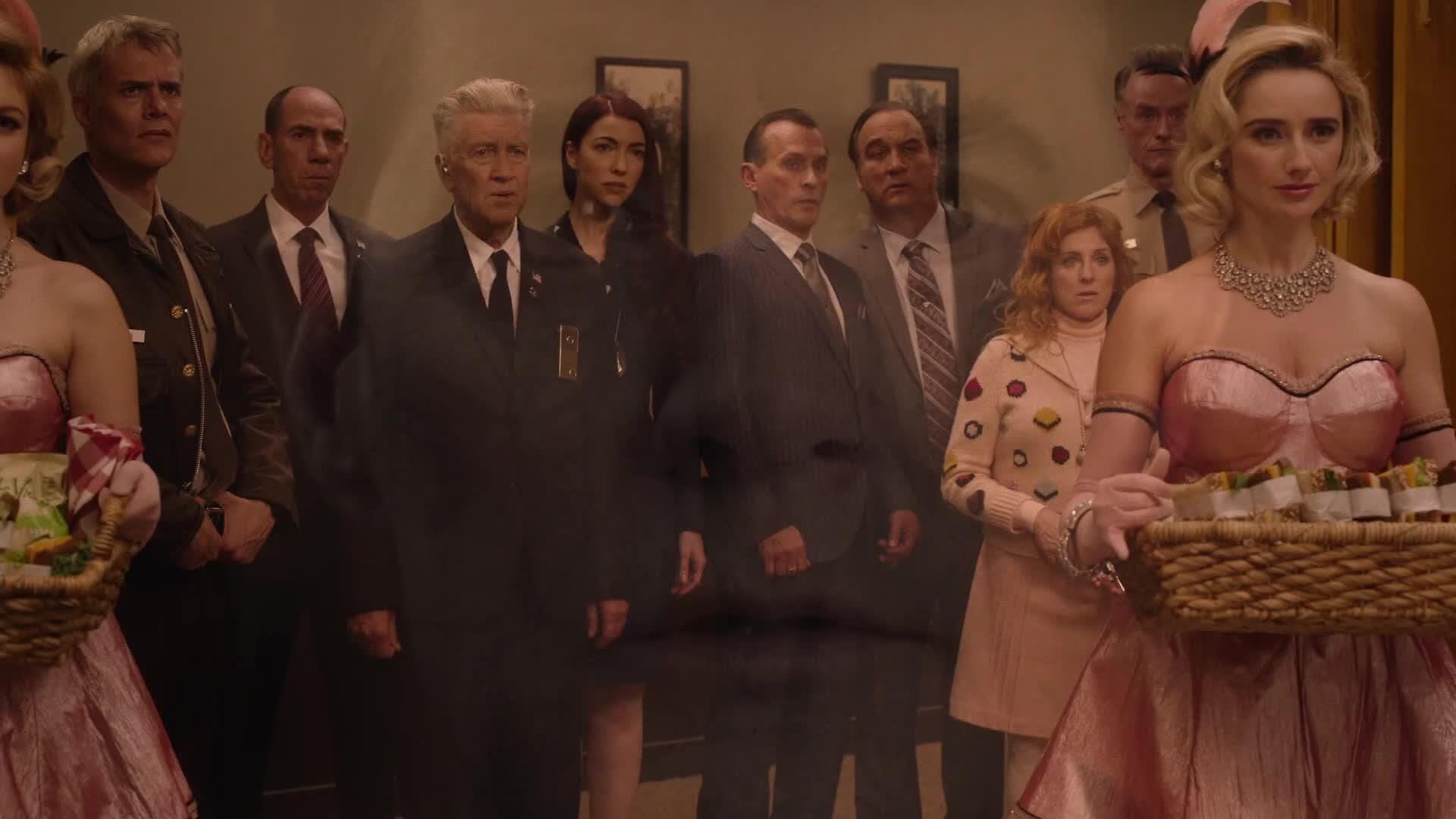
Twin Peaks: The Return (2017) dir. David Lynch

At the end of last year I decided to take a break from writing, burned out from my routine of crawling out of bed at 5 a.m., commuting for forty-five minutes, spending six hours performing menial tasks — cleaning floors, emptying trash cans, unclogging drain pipes, all in a day’s work — heading back home, and spending the rest of the day trying to extract words from my brain. The groove that had given me a lot of stability ever since I decided to settle here in Hamburg was finally turning on me, wearing me down little by little until the simple act of changing out of my work clothes became almost unmanageable.

When your body speaks, it’s important to listen. I’ve had to learn this through three decades of trial and error, failed relationships, prematurely quit jobs — I’ve somehow managed to never get fired — and countless missed opportunities at making a better life for myself. In August 2025 my body was more or less screaming at me, begging me to take a break but it still took me another six months to start listening. Given my financial situation as well as the fact that I had just started my current job, putting my writing on hold seemed like the only sound course of action so that ended up being the choice I made.

Writing has come to occupy a strange position in my life because it is essentially a compulsion for which I also happen to get paid occasionally. For a variety of reasons, most writers prefer not to discuss their economic circumstances, the ways in which they navigate their lives in order to make room for writing. A lot of it, I assume, has to do with shame; shame at one’s privilege, the rich, well-connected parents that paid for a liberal arts degree and subsequently made some calls to secure their kid a cushy job (or at least an interview) that affords them enough free time for a not-so-lucrative writing career or shame at one’s lack of such resources, shame at having to get one’s hands and knees and face dirty, shame at having to bend over toilets every day, shame at not advancing in life all because one refuses to give up this low-paying, time-consuming side hustle.

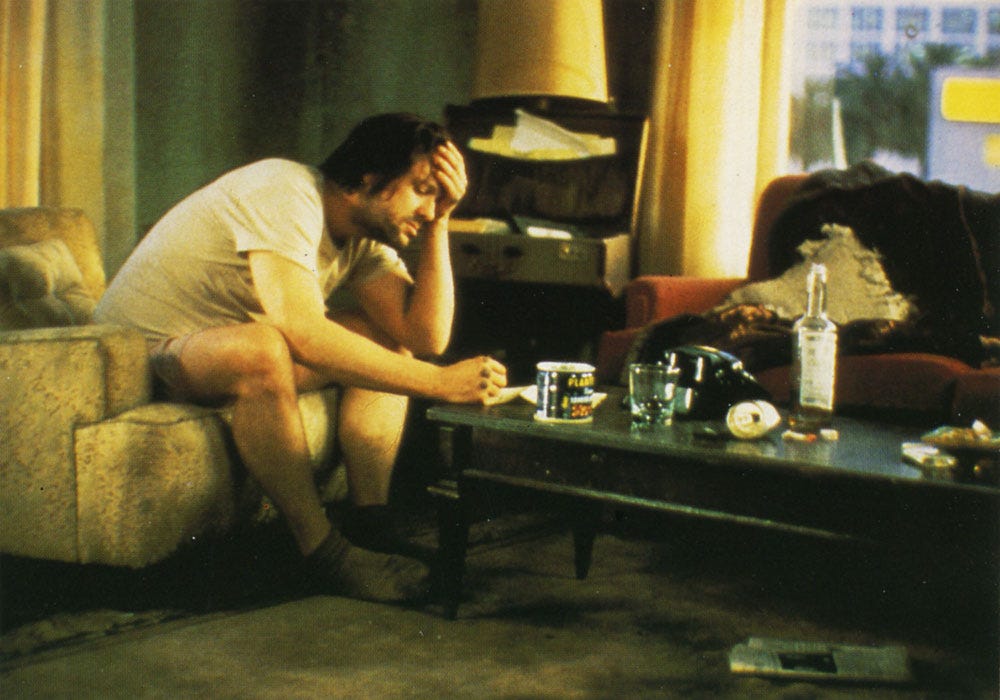
Barfly (1987) dir. Barbet Schroeder

It’s worth noting that the tide is changing somewhat. The Baffler published a piece in April wherein seven writers talk about the challenges they face while trying to eke out a living. The piece opens like this:

In the fall of 1971, Wallace Stegner, who was running his eponymous fellowship at Stanford, offered the writers in his program some financial advice. The Stegner Fellowship, which included a $3,500 annual stipend—the equivalent today of about $28,000—was one of the most prestigious an early-career writer could receive. […] Now, the fellows—looking forward to completing the program, publishing their novels, and maybe even earning a bit more money—asked Stegner what to expect. In the twenty years the program had been operating, one fellow asked, how many were now making a living as writers? “Young man,” Stegner replied, “you don’t understand. You’ve chosen a profession that doesn’t exist.”

Back in 2022 I did not understand that last part. I wasn’t blind, things were very clearly in decline but I foolishly believed that there was a way for me to bootstrap and elbow-grease myself into a life mostly occupied and paid for by writing. Writing can of course mean many things and for a while my compromise was freelance copywriting with the occasional spell of window-cleaning thrown in for extra cash. As time wore on, however, I realized that working ten-hour days, six days a week for what amounted to peanuts wasn’t sustainable so when I moved to Germany, I decided a regular, low-pressure day job would be the best way forward. And well…

Anyway, what I really ended up taking a break from wasn’t writing but rather writing for money as I still scribbled in my journal (only once or twice but still) and fed my Letterboxd diary film reviews on a regular basis. In February I decided to work my way through Kiyoshi Kurosawa’s filmography, a project I only recently completed (he has made a lot of pictures) and wrote a few hundred words on most of them. (Not to get ahead of myself but I have also begun writing an essay on his work which will most likely end up on here as well.) I even ended up saying yes to one paid gig: writing the booklet essay for an upcoming Blu-ray release of a widely-panned, barely-seen film from one of America’s finest genre filmmakers.

Retribution (2006) dir. Kiyoshi Kurosawa

What my time away from writing was really marked by though, was a slow slide into depression. The new job which was supposed to provide me with more money and more flexibility to structure my life around turned out to be even more rigid and demanding. I showed up every morning and poured whatever energy I had into making it through the workday. Coming home I would usually either fall asleep or just sit at the kitchen table for hours, staring out the balcony door, wondering how I was going to get through the next day. Writing became a struggle, reading became a struggle, watching movies became a struggle, listening to music, meeting friends, going to the store, the museum, a show, all of it. I felt like giving up and sometimes I still do.

In March I saw that Arte, the French-German public service channel, added all three seasons of Twin Peaks to their media library. On a lazy afternoon I was tempted to watch the pilot again but I knew — I said it out loud, in fact — that if I started I’d feel compelled to watch the entire thing. I sat down to watch it anyway and, predictably, ended up watching all of it. (Yes, this was a big reason for why it took me so long to watch all of Kurosawa’s films.)

I assume most people reading this have at least a passing familiarity with both Twin Peaks and David Lynch, who co-created the series with writer Mark Frost, but in case you aren’t, here’s the premise in brief: in 1989, the body of a young woman, Laura Palmer (Sheryl Lee), is found on a river bank just outside the fictional town of Twin Peaks, Washington. FBI Special Agent Dale Cooper (Kyle MacLachlan) is called in to head the investigation, aided by local law enforcement. It sounds simple enough but there is a lot more to the end result that this premise lets on.

Twin Peaks (1990–91)

It’s a show you will often hear described as “weird,” “quirky,” and “scary” and those descriptors are unquestionably accurate. However, it is the interplay between those tones that make it so unique and frankly inimitable. What Twin Peaks did was take elements of police procedurals and fuse them with comedy, drama, and horror. It wasn’t uncommon for a scene of characters killing time by engaging in small-town gossip to be followed by a character having terrifying visions of bloodstained carpets or being attacked by a supernatural nighttime intruder. Even the happy-go-lucky Cooper is regularly beset by bizarre nightmares that take place in what is later revealed to be a place called the Red Room, dreams he believes will help him solve the case of the murdered homecoming queen.

I have seen the entirety of Twin Peaks a few times throughout my life. There aren’t a great many TV shows I’ve watched and even fewer I’ve actually enjoyed but as far as the realm of television is concerned, Lynch and Frost’s creation forms a kind of best case scenario, one where even the format’s ostensible weaknesses are transformed into strengths by twisting the whole into something even more unwieldy and complicated.

Initially the show was built around the question of “Who killed Laura Palmer?” and this gave the (often digressive) series its dramatic momentum. When the series answers this question halfway through the second season, there is a noticeable dip in quality as well as a tangible feeling of aimlessness as the people behind it scrambled to find their footing again after losing both its central mystery and one of its main creative forces (Lynch stepped back from the show during its second season, unhappy about having been pressured by the network to reveal the killer’s identity and the direction the show took after the reveal, though he did return to direct the season’s finale.)

Twin Peaks, for all its eccentric charm and soap opera intrigue, can be harrowing: “Episode 14” (also referred to as “Lonely Souls”) culminates with not only the revelation that Leland Palmer (Ray Wise), Laura’s grief-stricken father, has been inhabited by the demonic entity BOB (Frank Silva) but also a long, drawn-out scene of him brutally murdering Laura’s cousin Maddy (also played by Sheryl Lee). What at first glance feels like a jarring reminder of just how high the stakes are turns out to be as emotionally overwhelming and upsetting as it is precisely because of the series’ general inclination toward the heightened, hysterical emotional register of melodrama.

Twin Peaks (1990–91)

In Twin Peaks, good cherry pie and a cup of coffee can turn a bad day great, an encounter with a beautiful woman can return a man’s hearing, and a single heartfelt speech can mend a broken father–son relationship. But if the beauty and love in Twin Peaks seem capable of moving mountains, the same is true of their opposites. Leland talks about BOB “visiting” him as a child and that trauma turns him into a vessel which in turn allows BOB to perpetuate abuse against Leland’s own daughter and niece. When Cooper gets trapped in the Black Lodge during the season two finale, his evil doppelgänger — a shadow-self that sprung from the Black Lodge, itself a shadow of the White Lodge — wreaks havoc on the world for the next twenty-five years.

The show never shied away from confronting the evil that humans and men in particular are capable of but there was a sense of cosmic balance when the series was first unveiled to the world at the beginning of the 1990s. The forces of evil were real and they sat smack-dab in the middle of our cities, towns, and homes but so were the forces of good, always busy and self-less in their pursuit of justice and the righting of wrongs. However, Cooper’s doppelgänger and Leland are the foremost examples of how those lines regularly got blurred as well: both the scene of Leland gleefully assaulting and murdering Maddy and the scene of him raping Laura in the 1992 film Twin Peaks: Fire Walk with Me cut back and forth between him and BOB committing these heinous acts, resisting easy interpretations of either demonic possession or a psychopathic male desire to exert dominance over women.

Even thornier is the case of Cooper’s doppelgänger. Whereas Special Agent Cooper came to represent the show’s light, my latest rewatch revealed something a little thoughtless and cruel about him as well. Think of how easily he slips into the role of drug financier in “Episode 7,” big wiry glasses magnifying his giddy and hungry eyes. The same goes for his relationship to 18-year-old Audrey Horne (Sherilyn Fenn); although he rejects her advances, he does so in the name of propriety rather than a genuine lack of attraction. Subsequently, the show’s third season, commonly referred to as Twing Peaks: The Return (2017), shows us that his doppelgänger has become a major figure in the world of organized crime and also raped and impregnated a comatose Audrey.

Twin Peaks: The Return (2017) dir. David Lynch

For me, every Twin Peaks rewatch is an inevitable journey toward The Return, the finest work of American television that I’m aware of and a massive feat of filmmaking. (I’d rather not rehash the tedious “television vs. film” debate here.) It explodes the established scale of the first two seasons which took place exclusively in and around Twin Peaks by ping-ponging between Twin Peaks, South Dakota, Las Vegas, New York, Philadelphia, and even Buenos Aires.

In “Episode 3” Sheriff Harry S. Truman (Michael Ontkean) says this to Cooper:

“There’s a sort of evil out there. Something very, very strange in these old woods. Call it what you want. A darkness, a presence. It takes many forms but… it’s been out there for as long as anyone can remember and we’ve always been here to fight it.”

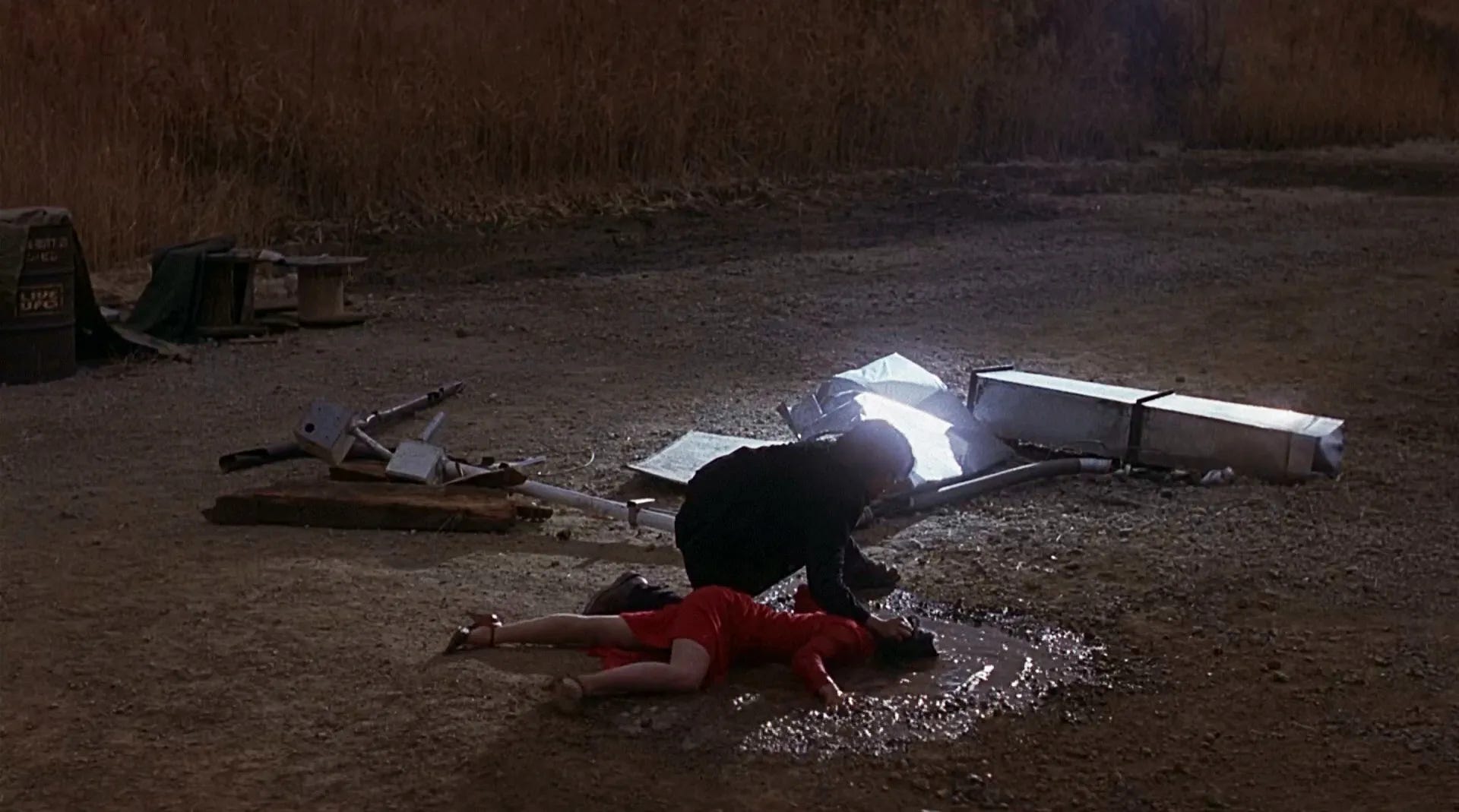
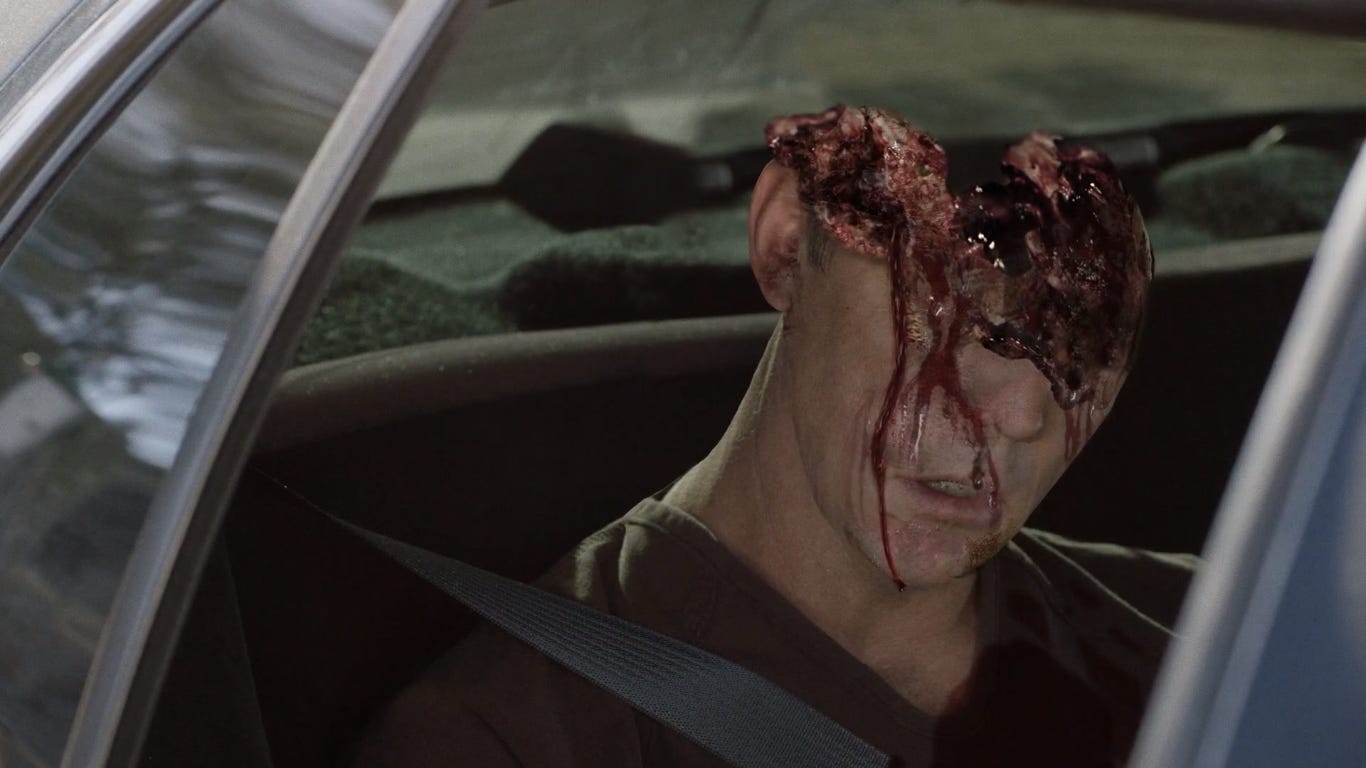
But by the third season this darkness has spread far beyond the appropriately named Ghostwood National Forest that surrounds Twin Peaks. What felt very of-the-moment almost a decade ago — an uglier, more violent show for uglier, more violent times — felt concussive in its naked emotional barbarism in 2026. The uneasy equilibrium of the first two seasons has all but broken down in The Return and the world it presents is cold, barren, unpleasant, and brutal. The third season is full of bashed faces, exploded and severed heads, open sores, gunshot wounds, drug abuse, suicide, and all manner of moaning, screaming, crying, and agony.

Twin Peaks: The Return (2017) dir. David Lynch

In a piece for n+1, film critic A. S. Hamrah wrote that “Twin Peaks foregrounds a kind of American emptiness of the soul that is filled by violence,” something that’s easy to agree with — the 2017 piece was mostly concerned with the Trump presidency, something that just so happens to also be a reality in 2026 — but has also begun to feel somewhat incomplete. If the last few years have shown anything, it’s that this emptiness sits at the heart of the entire world order. And as this order crumbles and deteriorates, the violence must be ramped up.

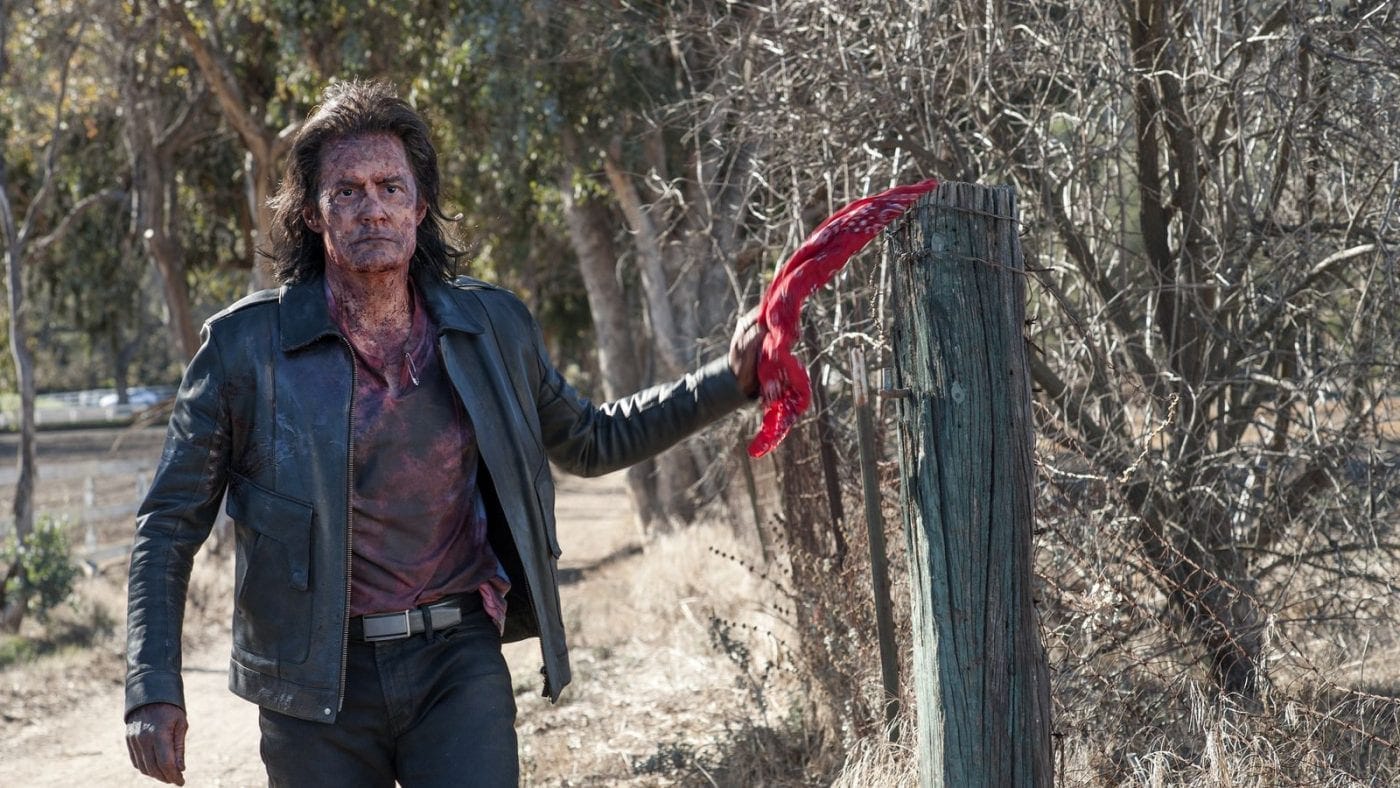
It’s a logic The Return follows as well, perhaps best illustrated by Cooper’s doppelgänger having apparently lived a life of luxury — the show offers a quick glimpse of a rather ridiculous photograph of him in front of a large mansion in Buenos Aires that his criminal activities have afforded him — but nonetheless spending the majority of the show either dealing with and occasionally disposing of small-time crooks (he even arm wrestles the leader of a gang before viciously killing him), covered in dust, dirt, and blood, or violently vomiting. The image of him in Buenos Aires is not only ridiculous for how obviously photoshopped it is — something The Return does throughout, one can assume intentionally — but also for how far removed the person in the photo, dressed in a slick white suit, is from the sweaty, dirty, black leather-clad goon we follow.

Twin Peaks: The Return (2017) dir. David Lynch

In reality, the world, like the show, wasn’t any more brutal than it had been in the past, certainly not more so than the blood-soaked twentieth century. What had changed was its visibility. The first Trump term wasn’t a break with the political order or with what Trump himself referred to as the deep state but rather a shift in rhetoric and decorum, a shift that exposed the violence, greed, and arrogance that was always at the heart of postwar liberal consensus and its institutions. The rest of the Western world was scandalized by his election victory, conveniently ignoring its own thriving right-wing populist parties and leaders and its role in maintaining (or at least playing lapdog to) the United States’ role as global hegemon.

Regardless of how much Trump’s first presidency shattered any delusions regarding the West’s civility or superiority, it was nothing compared to what his second term has done. When Hamrah wrote that “[Trump] has grafted his head onto our collective body,” he meant the American collective but again this specification feels too narrow. The collective body of the world has had several heads grafted on it shoulders, sewn on its arms, stapled to its back. A massive, hideous shambling god of death, a vulgar counterfeit of the Hindu goddess Kali in her cosmic Mahakali form, bearing the faces of Donald Trump, JD Vance, Benjamin Netanyahu, Friedrich Merz, Giorgia Meloni, Keir Starmer, Ursula von der Leyen, Mark Rutte, Alex Karp, Peter Thiel, Elon Musk, and countless others; dozens of lolling tongues, hundreds of thousands of severed heads and arms dangling from its pale, decaying body.

Cooper’s doppelgänger fits this new world perfectly, for his extraordinary cruelty and disregard for the people around him but also because he is simultaneously a product of this world as well as one of its architects. He, like the multi-headed god turning entire societies into what political theorist Achille Mbembe calls “deathworlds,” moves through the world while leaving a trail of death and misery in his wake. His black eyes are the eyes we all stare into when we get out of bed, unlock our phones, read newspaper headlines, turn on our TVs, open our laptops, talk to digital assistants, apply for job openings that turn out to not be real, and subject ourselves to five rounds of interviews for the ones that are.

His eyes are also what we stare into when we’re depressed. While going through depression it can feel like all life, goodness, and color has been drained from our existence, that we’re nothing more than empty husks, vulnerable to be overtaken by our darkest impulses. But is there a difference between being depressed and merely being alive in 2026? Life, goodness, and color are being drained from our existence because the people in charge, the people whose heads are grafted on our collective body, detest life and worship death. In his 1973 book The Anatomy of Human Destructiveness, psychoanalyst Erich Fromm used the term “necrophilia” and defined it as the “passionate attraction to all that is dead, decayed, putrid, sickly; it is the passion to transform that which is alive into something unalive; to destroy for the sake of destruction; the exclusive interest in all that is purely mechanical.”

Erich Fromm

Long before Israel began its genocidal campaign in the Gaza Strip, the Palestinian territory was already a laboratory for Israel-aligned governments, weapons manufacturers, and tech companies to test and develop tools for human surveillance and annihilation. To the people involved this was never just about foreign policy; the end goal is not only mass death but the replacement of all that is human with its mechanical shadow, one that doesn’t feel, doesn’t celebrate, doesn’t oversleep, doesn’t struggle, doesn’t complain, doesn’t dream. (Note how eerily this description fits Keir Starmer.)

This mechanical shadow is incapable of reading a book or listening to a song. When prompted, it will no doubt call the final lines of The Great Gatsby “beautiful” and “deeply moving” but it can’t find consolation in Fitzgerald’s words. It can’t think about the “the orgastic future that year by year recedes before us” as it grows older. If I had asked ChatGPT to generate an essay about me resuming work on the newsletter, would it have thought to talk about depression and what it felt like to rewatch three seasons and a film about a murder in a fictional small town while going through it? Had Neil Young been in a position to let an LLM write “Cortez the Killer,” a track about Hernán Cortés’ battles with the Aztecs, would it have thought to include a verse that makes reference to his then-recent breakup with Carrie Snodgress? Would it have included lines about brains falling out through teeth in a song about Anne Frank and her family hiding in an attic in the 1940s the way Neutral Milk Hotel’s “Two-Headed Boy, Pt. Two” does?

Twin Peaks and its convoluted plot, clash of tones, contradictory emotions, deliberate pace, occasionally messy production history, and frequently contentious relationship with critics and the viewing public is the kind of thing that has no place in this new world. Engaging with it requires more than solving a puzzle or looking for simple life lessons — the show isn’t “about” one thing, characters and places don’t “represent” the picayune concepts and ideas so popular in the age of the ideas industry. Like its characters, Twin Peaks is interesting because it manages to be two or more things at once, a trademark of Lynch’s oeuvre. This tendency reaches its apex with The Return, a work that thrives on contradiction, duality, and ambiguity.

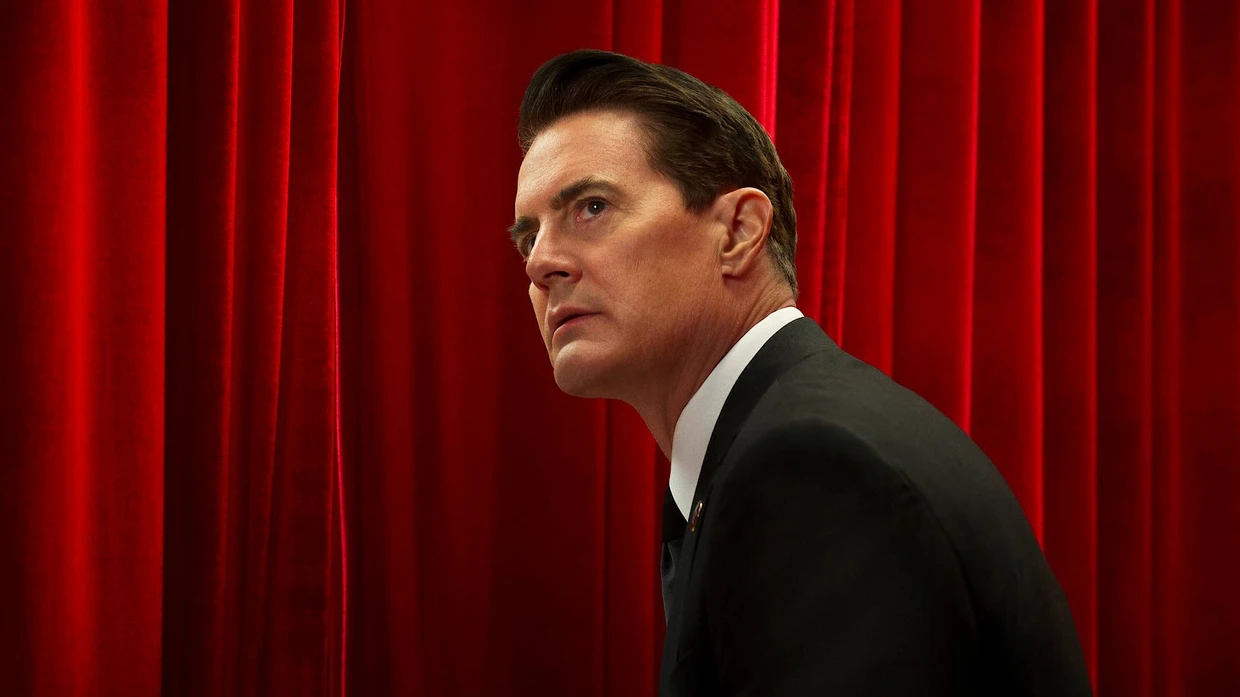
A big part of watching the third season is waiting for the inevitable (and perhaps titular) return of Dale Cooper and though Cooper escapes the Black Lodge early on, he isn’t all there and spends the overwhelming majority of the season as the bumbling, barely-verbal Dougie Jones. Jones is Cooper stripped of his competence and wit, a toddler in a man’s body who can only repeat other people’s words back at them and occasionally mutter his own name. He’s a hero with next to no agency who still somehow stumbles into heroics, constantly praised for turning people’s lives around, for the kindness of his heart, as he himself stares into the middle distance, unable to comprehend his circumstances.

Twin Peaks: The Return (2017) dir. David Lynch

It’s a rejection of people’s conception of Cooper’s character as a beacon of puppy-dog goodness, a Boy Scout simply trying to do right in a corrupted world. But even this rejection comes with its own duality for the simple fact that Dougie is, in fact, exceptionally likable. His movements echo those of another pitiful Lynch dope, Eraserhead Henry Spencer (Jack Nance), as well as silent-era legends like Buster Keaton. As is the case with those two, there is a melancholic quality to Dougie’s character as well, one that comes through when we see him staring at the bronze statue of a cowboy outside of his office building, completely transfixed as day slowly turns into night and even more so when he sheds a tear while looking at his son, Sonny Jim (Pierce Gagnon).

Lynch has always had a penchant for slapstick but it it particularly pronounced during Dougie’s scenes. As film critic Lawrence Garcia put it in his 2021 piece on The Return, slapstick comedy is “a genre explicitly based on assaulting the hero’s dignity […] Charted out over the course of roughly 14 episodes, the Dougie Jones scenes constitute nothing less than a protracted assault on Cooper’s heroic dignity.” Assaulting his most beloved character’s dignity in this way is perhaps the ultimate gesture of anti-nostalgia in a show that, at the very least, has conflicting feelings toward it.

When Cooper’s memory is restored in “Part 16” and he leaves Las Vegas for Twin Peaks, there is a sense that all the disparate plot threads strewn throughout the previous fifteen episodes will finally converge, for a coherent whole to emerge, for every question to be answered, for all the pieces to fall into place at last. Indeed there is a big, hokey final showdown in the Twin Peaks Sheriff’s Department between the forces of good and the forces of evil that involves Cooper’s doppelgänger being shot by the station’s ditsy receptionist Lucy Brennan (Kimmy Robertson) and an orb containing BOB being smashed to pieces by Freddie Sykes (Jake Wardle) with his gardening glove-covered right hand.

But as things play out and the characters begin their post-battle celebration there is a sense that things aren’t quite right, something seemingly confirmed when Cooper’s blank face appears superimposed over the scene, saying nothing aside from one line: “We live inside a dream.” Lynch has said that “endings are terrible things,” a quote that perhaps explains his career-long (and often thankless) fascination with television and The Return is, in part, about his, and indeed our complicated relationship to them. The Return came after not one but two endings — Twin Peaks in 1991, Fire Walk with Me a year later — and the rupture of “Part 17,” one of a great many Lynchian ruptures, answers the question of what lies beyond by throwing the narrative into the realm of dreams for good; “the other side of the mirror,” as Chris Marker described the second half of Vertigo (1958) in his 1994 essay on the film.

Twin Peaks: The Return (2017) dir. David Lynch

“See you at the curtain call,” says Cooper as he leaves the sheriff’s station, his boyish charm momentarily allowing him to travel back in time and offer a glimpse of the young man he was during the events of the first two seasons. It’s a very small bit of audience reassurance; before long he does actually end up traveling in time to prevent Laura’s murder by leading her through the woods and away from the cabin where she will meet her grisly fate. It’s hard to think of a more definite end to the Twin Peaks mythos than the prevention of the inciting incident — the episode even replays the series’ famous first scene of Pete Martell (Jack Nance) discovering Laura’s body, only this time there is no body to be found and he ends up fishing in peace — but of course the question of what comes after inevitably arises once more.

What’s most tragic is that for all of his illusions of being in control and doing good, Cooper is trapped within the confines of what is ultimately a television program, continually succumbing to the exact way of thinking that keeps the audience coming back time and time again: there must always be more, one more case to solve, one more mystery to unravel, one more beautiful woman to be yearned for, to be lusted after, one more helpless girl in need of saving, one more girl to be victimized. It’s a logic we’ve become so intimately familiar with that we don’t even bother asking ourselves what actually happens to the women Cooper becomes fixated on or infatuated with, why they all end up dead, comatose, or traumatized.

Twin Peaks (1990–91)

“Cooper’s great crime is [his] refusal to notice, to acknowledge,” writes Garcia. “It is a refusal born of an infantile fantasy of omnipotence, the idea that one can master time and space, and bend it to one’s will.” But Cooper’s failure is also a failure of imagination; he does the same things again and again hoping for a different result because he can’t fathom that things could ever be different. In his mind, cycles can never be broken. He believes the world needs and always will need him or at least people like him. When the tulpa of Dougie he has MIKE (Al Strobel) create finally unites with Jayne-E (Naomi Watts) and Sonny Jim in “Part 18,” the moment is less heart-warming than it is revealing of Cooper’s pathology, one of his endless attempts to solve problems with the same thinking that caused them in the first place.

“Part 18,” the show’s final episode, has been noted for its opacity but it is actually the one that fully lays bare The Return’s underlying belief that the old ways and its figureheads can’t save us. As we slide further into dystopia it can be tempting to look to the past, ignoring the ugly realities that nostalgia has a way of concealing. This tendency toward collective amnesia finds its clearest (and most troubling) expression in the continued whitewashing and rehabilitation of rancid political actors like Henry Kissinger or George W. Bush by the media apparatus but also comes through in our culture’s general refusal to let go of the past, to finally let the old ways die. Until we do, we will be stuck in an endless loop, doomed to repeat the same mistakes over and over again.

There is something profoundly sad and mournful about The Return. Many prominent characters have disappeared completely (Pete, Joan Chen’s Josie Packard), have been relegated to off-screen appearances (Ontkean’s Sheriff Truman), appear only through archival footage (BOB, Don Davis’ Major Garland Briggs), or in some kind of altered or “evolved” form (David Bowie’s Special Agent Phillip Jeffries, Michael J. Anderson’s Man from Another Place). The reason behind many of these decisions was the death of the actors, something that puts the passage of time in perspective in an unflinching way.

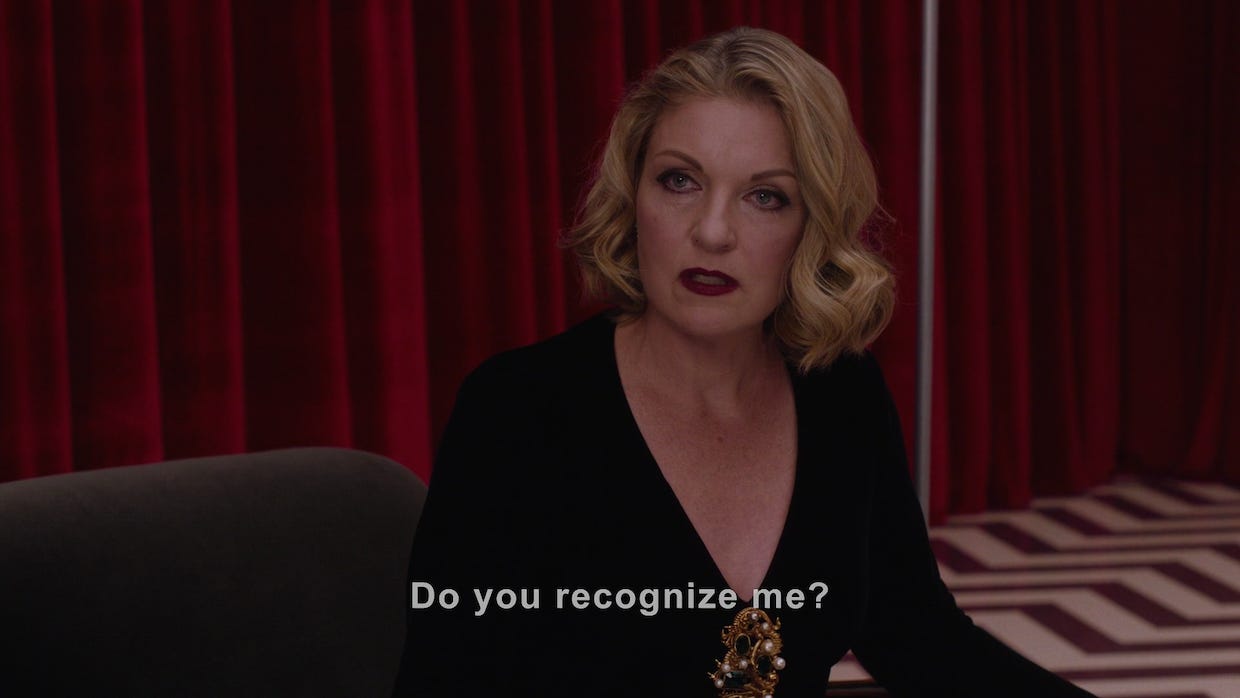
But there is real sadness in the return of familiar faces as well. Everyone we see has aged visibly since their last appearance but the first sight of Laura in the Red Room, wearing her black dress, her face older, wrinklier, and wearier is particularly overwhelming. The person whose angelic face hid so many dark secrets, the abuse victim whose likeness dangles from keychains and is emblazoned on t-shirts and stickers and glows on countless computer screens from digital pinboards, looking back at us, still sitting in the same chair in the same room, talking to the man she first saw in her dreams twenty-five years ago, only allowed to grow old in her role as the eternal murder victim.

Twin Peaks: The Return (2017) dir. David Lynch

Throughout The Return, Deputy Chief Hawk (Michael Horse) receives regular phone calls from Margaret Lanterman (Catherine E. Coulson), better known as the Log Lady, relaying messages from her log. Coulson, like her character, was dying of lung cancer when she shot these scenes and they are among some of the show’s most devastating. Lanterman is old and frail, hooked to an oxygen tank and has lost most of her hair. During her last conversation with Hawk she faces her fate head-on, tearfully telling him, “You know about death, that it’s just a change not an end. Hawk, it’s time. There is some fear. Fear in letting go […] I’m dying,” before bidding farewell one last time. “Good night, Hawk.”

Lanterman’s popularity was such that when the first two seasons of Twin Peaks were picked up to be rebroadcast by Bravo in 1993, Lynch shot brief monologues with Coulson, in character as Lanterman, to introduce each episode. For the most part they are classic Lynch nonsense clues — remember the insert that came with the Mulholland Drive (2001) DVD release? — but her introduction for “Episode 3” has resonated with me as I struggle to come to terms with the world and my place in it, with the fact that depression always lurks around the corner, the fact that everything we do and work for, life itself, seems so incredibly fragile: “We ask, ‘Will the sadness which makes me cry, will the sadness that makes me cry my heart out, will it ever end?’ The answer, of course, is yes. One day, the sadness will end.”


Thank you for reading. If you enjoyed this piece, please consider becoming a paid subscriber to support the work that goes into writing and editing this newsletter.


Read the whole story
mikemariano
1 day ago
reply
Share this story
Delete

Delcy’s ‘Gatekeeper’: Sources Say Ex-Trump Official Claver-Carone Holds Keys To Caracas

1 Share

Max Blumenthal The Grayzone

A mastermind of Trump’s hardline Latin American policies, Mauricio Claver-Carone no longer serves in the administration. But according to well-placed sources, he’s “picking who can operate” in Venezuela, controlling access to the government, and creating conflicts of interest.

Speaking with reporters on May 21, US Secretary of State Marco Rubio announced that Venezuelan President Delcy Rodriguez was on her way to New Delhi to discuss energy issues, and that he would be in India as well.

“This is an important trip, I’m glad we’re able to do it,” Rubio chirped after explaining the trio of nations would discuss how to increase Venezuelan oil sales to India.

His statement — and his announcement of Rodriguez’s trip before she had — perfectly illustrated Washington’s newfound dynamic with the Venezuelan government. Following over twenty years of hostile relations with Venezuela’s socialist-oriented leadership, the US Secretary of State was apparently so intimately involved with day to day affairs in Caracas that he was claiming responsibility for Rodriguez’s international itinerary.

In fact, according to an insider who enjoys close contacts within both the Venezuelan and US governments, Rubio’s influence over Rodriguez is said to be traced to one “gatekeeper”: former Trump Latin America envoy Mauricio Claver-Carone. “Mauricio [Claver-Carone] is picking who can operate and Delcy [Rodriguez] is taking instructions,” the source told The Grayzone. 

A former senior US official with access to leadership in both Caracas and Washington offered the same assessment, remarking to The Grayzone, “Mauricio’s calling the shots on private sector economic positions, and if anyone wants in, they have to go to him.”

Hand-selected by former National Security Advisor John Bolton to serve as his Latin America charge during Trump’s first term, Claver-Carone no longer occupies an official governmental role. Instead, he has leveraged his legacy in the public sector to establish a Miami-based investment firm called the Lara Fund which could become a key player in the MAGA financial feeding frenzy in Caracas.

Described by the New York Times as the “architect of Trump’s tough Latin America policies,” Claver-Carone is a Cuban-American regime change zealot who once engaged in fisticuffs with Cuban diplomats as a young man. During Trump’s first term, he unleashed a financial “flamethrower” on Cuba, issuing scores of new sanctions that unraveled the Obama-era normalization policy and plunged the island back into economic misery. 

Claver-Carone has similarly masterminded many of the policies that define Trump’s relationship with Venezuela, from its recognition of the previously unknown Juan Guaido as the country’s “interim president” to the deportation of hundreds of Venezuelan migrants from the US to El Salvador’s maximum security CECOT prison. Many of those migrants had been prompted to journey to the US by the economically crushing sanctions unleashed at Claver-Carone’s direction. 

The Grayzone’s sources described the Trump veteran as the architect of the military invasion that saw Maduro spirited away to a federal penitentiary and installed Rodriguez as president following a stand-down by Venezuelan security forces.

“If he was in charge of implementing the kinetic side, maybe [Rodriguez] thinks she has to listen to him on finance,” the Venezuela insider said of Claver-Carone.

report this January by investigative journalist Aram Roston described Claver-Carone as a “key backer” of Rodriguez following Maduro’s abduction, and cited sources who claimed he exercised decisive influence over Venezuela policy despite having left the administration.

Claver-Carone is now said to be at the heart of the most sensitive and consequential task Venezuela faces: the restructuring of its $170 billion in defaulted sovereign debt. Forced from several previous positions by corruption scandals and rancorous clashes, an operative with no official governmental position appears to be shaping the economic contours of Project Venezuela. 

“He’s got a lock on everything”

This May, the US Treasury Department authorized Caracas to hire a financial advisor to assist with the herculean task of restructuring its debt. The Venezuelan government selected Centerview Partners, a top-drawer investment and financial advisory firm based in New York City.

According to the former US senior official, Claver-Carone’s romantic partner and business colleague, Jessica Bedoya, boarded a private jet to Caracas soon after the big announcement, arriving with a top advisor from Centerview. It was her second trip to the Venezuelan capital, they said, after visiting in February to discuss financial matters. 

Claver-Carone did not respond to calls to his personal phone from The Grayzone, or to detailed questions sent by text and email. 

His partner, Bedoya, is the founder of the Lara Fund investment firm where he serves as managing partner. Her bio notes that she has also worked in the CIA and National Security Council.

Jessica Bedoya and Mauricio Claver-Carone’s headshots, as featured on Lara Fund’s webpage

Some insiders worry that her reported presence in the Venezuelan capital, together with Claver-Carone’s outsized influence, could represent a conflict of interest, allowing them to steer debt restructuring agreements to their own personal benefit.

“Now he’s got a lock on everything,” the Venezuela insider said of Claver-Carone. “He could say to anyone who wants to work in Venezuela, I’m the guy. I have the keys. If you want to play ball, invest with me.”

The former US official said Claver-Carone was raising capital for his Lara Fund while he served as a special government employee at the State Department. While Bedoya was running the firm, they said Claver-Carone was leveraging his position inside the Trump administration to pitch potential investors.

“Arbitrary and authoritarian actions that showed him to be a real thug”

When Trump appointed Claver-Carone to serve as the first American president of the Inter-American Development Bank (IDB) in 2020, he hired Bedoya as his chief-of-staff. The couple’s secret romance at the bank triggered an embarrassing ethics investigation after a hand-written contract was discovered showing they had agreed to pursue “absolute happiness,” and included a clause with punishments including “candle wax and a naughty box” if either party breached the deal. 

An independent probe ordered by the IDB discovered that Claver-Carone had increased his paramour’s salary by 40% – a $133,000 reward in less than a year. Investigators also found that the couple had racked up expenses on an IDB credit card during romantic getaways. 

Claver-Carone refused to participate in the investigation while accusing its authors of “fabrications.” In the end, IDB governors voted unanimously in favor of his firing. The US government endorsed their decision.

“President Claver-Carone’s refusal to fully cooperate with the investigation, and his creation of a climate of fear of retaliation among staff and borrowing countries, has forfeited the confidence of the bank’s staff and shareholders and necessitates a change in leadership,” they wrote.

The Argentine governor of IDB, Guillermo Francos, delivered a similarly harsh assessment of Claver-Carone’s tenure. “Claver was a disaster for several reasons,” Francos remarked in 2022. “For having an inappropriate relationship, for having disproportionately increased the salary of this inappropriate relationship, for having lied, and for these arbitrary and authoritarian actions that showed him to be a real thug.”

When Claver-Carone returned to the second Trump administration, it was not long before his proclivity for conflict jeopardized his position.

Throughout 2025, Claver-Carone’s spiteful attitude reportedly complicated Trump administration attempts to prop up a key right-wing ally in South America, Argentine President Javier Milei. Milei’s chief of staff happened to be Guillermo Francos – the former IDB governor whom Claver-Carone held personally responsible for outing his secret relationship with Bedoya. According to the Argentine paper Clarin, Claver-Carone attempted to retaliate by unsuccessfully pressuring Milei to fire Francos. He then attempted to undermine a major IMF loan package to Argentina by demanding the country first sever its credit line from China. This was met with an apparent rebuke from Treasury Secretary Scott Bessent, who visited Buenos Aires to express confidence in the IMF loan just weeks after Argentina’s central bank extended its credit line from Beijing.

The following month, in May 2025, Claver-Carone announced he was leaving the State Department to return to his Lara Fund. His departure gave the appearance that he had been forced out of his job, however, he maintained his clout through his direct line to Rubio.

The former US official told The Grayzone that Claver-Carone is now angling to become a Cuban American version of Jared Kushner, the Trump son-in-law who has leveraged his proximity to the president and role as Middle East negotiator to rake in billions from Israel and several Gulf monarchies despite having no official government title. To do so, he has allegedly inserted himself into the byzantine process of restructuring Venezuela’s debt.

When the Trump administration announced that Venezuela could hire a financial advisor to assist with its sovereign debt, Rodriguez initially planned a public bidding process for the coveted position. But then, according to the ex-US official, Claver-Carone issued support for Centerview, leading to the firm’s selection. (Opposition bloggers have speculated that Centerview was chosen because one of its partners, Matthieu Pigasse, is a self-described “pro-market socialist” who previously worked on deals with Maduro and Venezuela’s state owned PDVSA oil company.)

In recent weeks, according to sources, Claver-Carone has attempted to undermine financial advisors who had been working with the Venezuelan government to restructure its debt since 2014. 

They said that when Claver-Carone’s partner, Bedoya, arrived in Caracas this month, allegedly on a private jet with Pigasse, she began pushing to remove the advisory mandate from David Syed, a seasoned French lawyer who had advised Caracas on debt-related issues for over a decade, and is considered incorruptible. 

“The effort to push [Syed] out created a lot of tension,” remarked the Venezuela insider. “You can’t understand debt restructuring by parachuting in without his knowledge.”

Syed did not respond to The Grayzone’s request for comment. Hamouda Chekir, another Centerview partner who works on Venezuela’s debt, did not respond to calls and text messages sent to his personal phone.

Scandal-stained firms as vehicles for extracting profit from Venezuela

Just before leaving the State Department in May 2025, Claver-Carone convinced Rubio not to renew a sanctions waiver that allowed Chevron to sell Venezuelan oil in the US market. In doing so, he eliminated a mechanism which was explicitly designed to promote transparency and prevent local officials from skimming cash. 

This January, after abducting Maduro, the Trump administration granted confidential licenses to a pair of notoriously corrupt trading houses, Vitol and Trafigura, to export Venezuelan oil. The deal came months after Trump’s re-election campaign received a whopping $6 million donation from a senior trader at Vitol. 

Robert Bachmann, an analyst at the Swiss watchdog Public Eye, told the Washington Post at the time, “Trump is taking advantage of firms that know how to circumvent regulation.”

Both companies had been caught engaging in a series of elaborate bribery schemes across Latin America and Africa. In 2020, the Department of Justice (DOJ) forced Vitol to pay a $135 million penalty for bribing officials for licenses in Mexico, Ecuador and Brazil. Trafigura paid a similarly staggering fine in 2024 for a lucrative bribery scheme in Brazil. In the US, Vitol was rung up by the California Attorney General for manipulating spot market prices of oil.

But almost as soon as the Trump administration entered office, it neutered the DOJ corrupt foreign practices division charged with enforcing the judgments against Trafigura and Vitol on the grounds that it was “impeding America’s national security objectives.” 

Now, the profits these scandal-stained firms generate through oil sales abroad – including to Israel – are channeled back into a US-run account with little public oversight. A percentage of sales is then delivered back to the Venezuelan government. Where the rest goes is anybody’s guess. 

“The Venezuelans are the owners of the oil, and we know nothing. There is no transparency,” said José Guerra, an economist aligned with the Venezuelan opposition, complained to the Washington Post about the Trafigura and Vitol licensing agreements.

Trump, for his part, has essentially admitted Venezuelan oil profits are channeled into a slush fund for his international rampage. “We’ve taken out so much oil in Venezuela, we’ve paid for the cost of the war [with Iran] about 25 times over,” the president boasted during a May 23 campaign rally. While the president’s claim was absurd, as Venezuela is currently exporting only about one million barrels of oil a month – hardly enough to cover a full day of warfare – it revealed his avaricious attitude toward the entire operation.

Among certain Venezuelan opposition activists, Claver-Carone has become a figure of contempt who is partially blamed for Trump’s declaration that their de facto leader, the coup plotter and Nobel Peace Prize winner Maria Corina Machado, “doesn’t have the support within, or the respect within, the country.”

The Trump administration’s embrace of Delcy Rodriguez, and the Venezuelan president’s faithful compliance with Washington’s financial schemes, have prompted some top Democrats to adopt Machado as a partisan cudgel. This January, Chris Murphy, a ranking Democrat on the Senate Foreign Relations Committee, praised the opposition leader as “impressive” following a meeting on Capitol Hill, while taking a nasty swipe at Rodriguez. Machado “reminded us that Trump replaced Maduro with Maduro’s head of torture,” Murphy proclaimed.

If the Democrats take Congress after this year’s midterm elections, the Trump administration’s dealings in Venezuela will face intense scrutiny from the House Oversight Committee. Bipartisan pressure will then build for fresh elections to usher in a new government. “Delcy Rodríguez is a terrible person,” the regime change-obsessed Florida Republican Sen. Rick Scott told the Wall Street Journal this month. “We’ve got to have an election soon.”

In the meantime, a flock of MAGA-aligned financial vultures has swooped into Caracas to feast on the petro-state’s post-Maduro carcass. Donald Trump Jr. is said to be hunting for opportunities in the capital for his 1789 Capital fund, while a startup backed by pro-Trump tech oligarchs Peter Thiel and Palmer Luckey, Erebor Bank, just struck a lucrative deal to reconnect Venezuela’s central bank to the global economy. In the midst of this frenzy, a figure with no government title, Claver-Carone, appears to be establishing the new pecking order.

The editor-in-chief of The Grayzone, Max Blumenthal is an award-winning journalist and the author of several books, including best-selling Republican GomorrahGoliathThe Fifty One Day War, and The Management of Savagery. He has produced print articles for an array of publications, many video reports, and several documentaries, including Killing Gaza. Blumenthal founded The Grayzone in 2015 to shine a journalistic light on America’s state of perpetual war and its dangerous domestic repercussions.

You can also make a donation to our PayPal or subscribe to our Patreon.

Please share this story and help us grow our network!

Read the whole story
mikemariano
5 days ago
reply
Share this story
Delete

‘Israel’ Is The Last Jewish Ghetto

1 Share
‘Israel’ Is The Last Jewish Ghetto
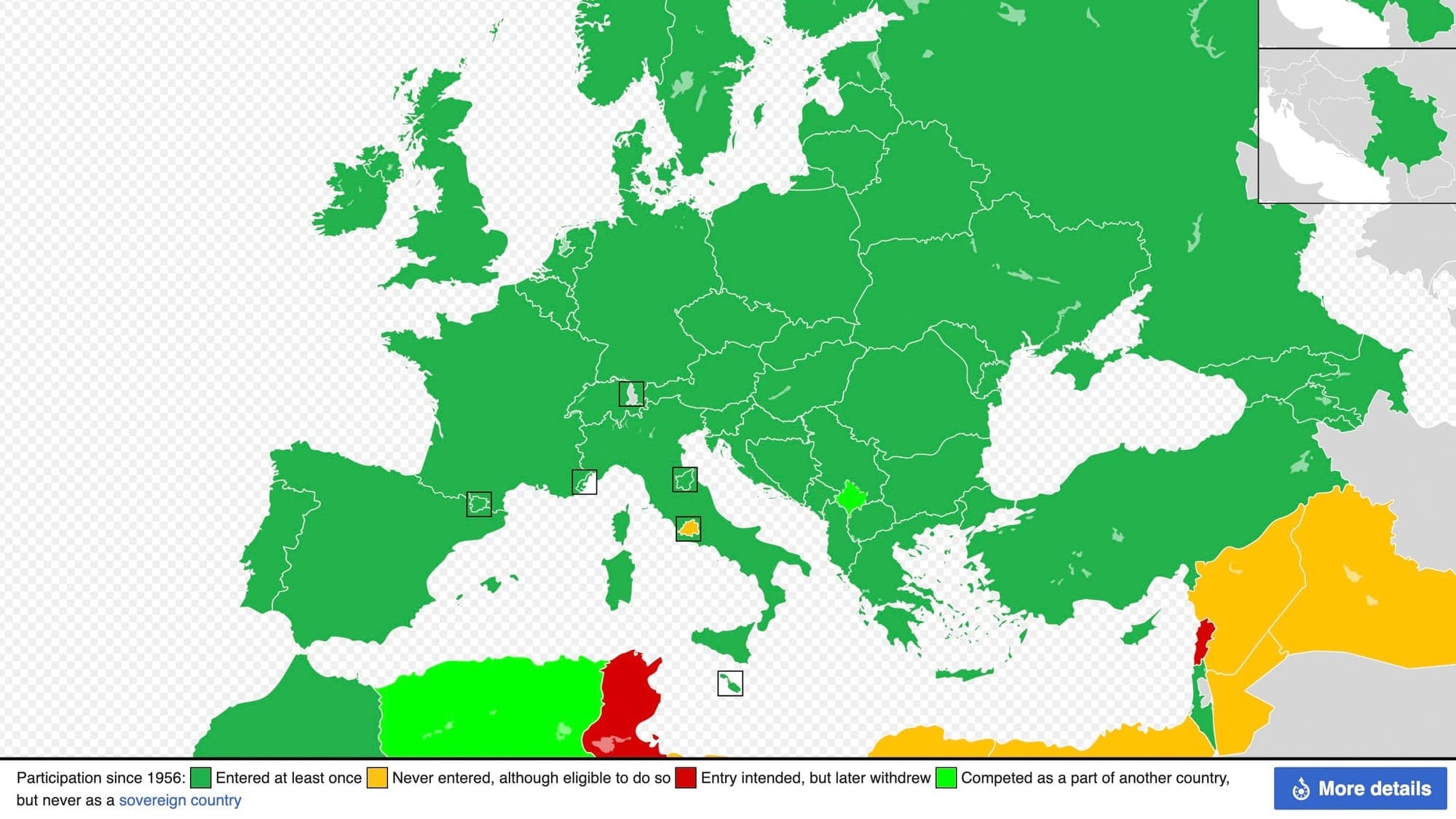
All the places that participated in Eurovision (before Russia got kicked out). You can see the Jewish ghetto on the fringes. What is Australia doing there lol.
‘Israel’ Is The Last Jewish Ghetto

‘Israel’ is the last ghetto Europeans deported their Jews too. They got them as far from Europe as they could, and all their ‘support’ for ‘Israel’ doesn’t extend to giving the property back they took. No, ‘after’ World War II, the Whites dusted off the Nazi/Zionist Haavara Plan and deported the Jews out of Europe entirely.

This is the most ‘antisemitic’ idea imaginable (go back to where you came from!) but if you complain you get called ‘antisemitic’ now. While the Jews slaughter actual Semitic peoples in front of you. Like everything else in the White Empire, they massacre language and logic first.

But just look at it on a map, if you dare. ‘After’ World War II, were Jews given their land back in Europe? No, they’re not there. Like Frankfurt pushing their Jews across the moat, Europeans pushed their Jews across the Mediterranean by boat. You can see ‘Israel’ at the very edges of the ‘Eurovision’, where Europeans don’t really have to see them (except during that dreadful song competition).

‘Israel’ Is The Last Jewish Ghetto
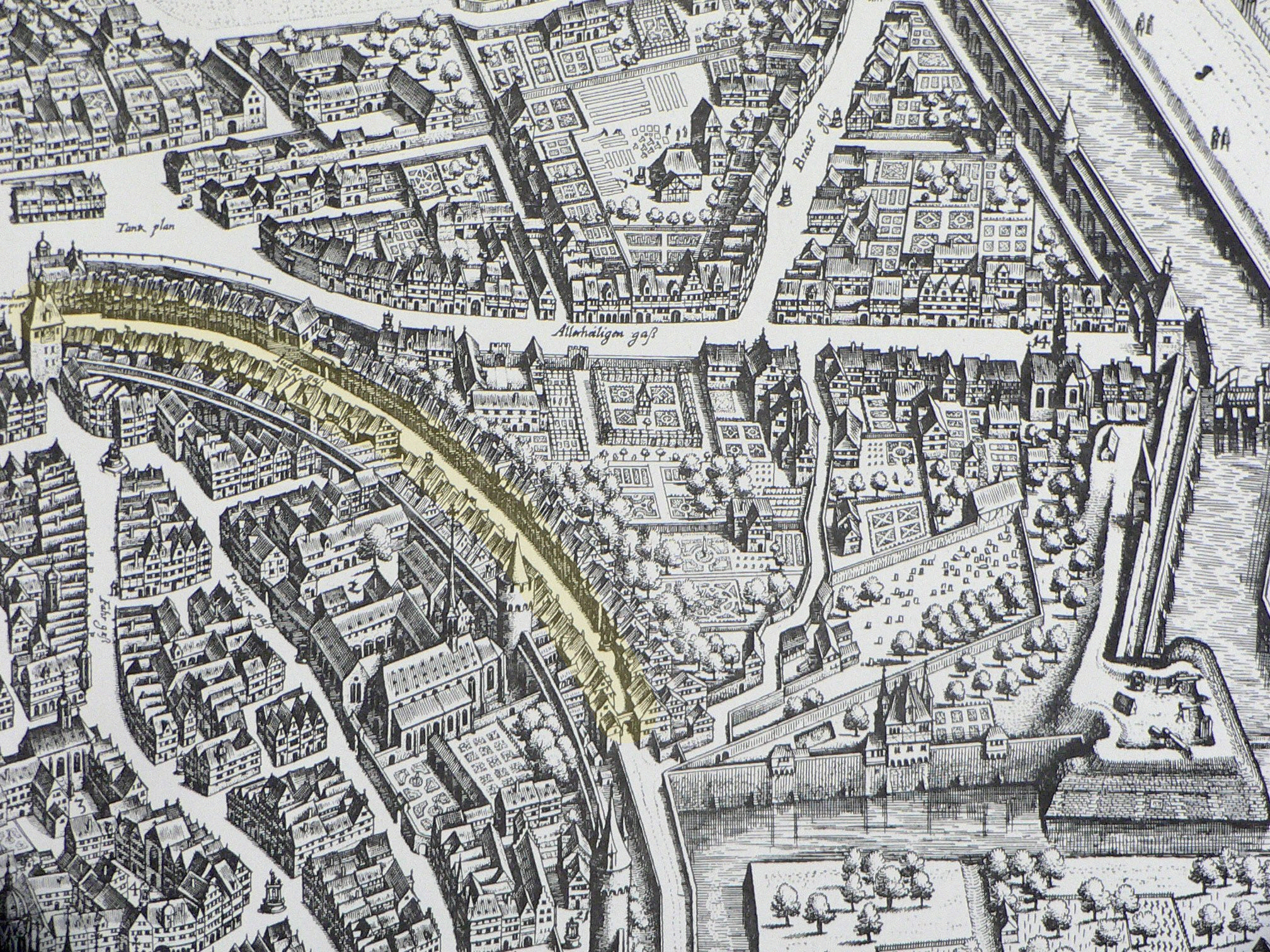
Frankfurt Judengasse in 1628, after the city expanded past the moat (moat highlighted).

Compare this to a map of Frankfurt in 1458, where you can see the same phenomenon in microcosm. Frederick III pushed the Jews outside the city moat into a narrow Judengasse. Within this ghetto, Jews could govern themselves (just as ‘Israelis’ can now), but they still depended on imperial protection (just as ‘Israel’ does). Jews were eventually given permission to build on the other side of the moat, until they were pushed completely out, across the Mediterranean Sea into ‘Israel’. I put it in quotes because this was not the promised land, Eretz Israel, which only the messiah can command. No, this Ersatz Israel was just another ghetto, a poisoned deal with the White Devils, now reaching its 80-year foreclosure.

You can bring all the Biblical stuff into it, and the fact that Zionist really believe in this ‘Israel’, but Zionism was a fringe belief at the time. It’s only recently that the death cult has corrupted the entire religion. Some Torah Jews still shout about the fact that Palestine was created not by the messiah but by the British incarnation of White Empire, which is as close to Satan as you get. Britain, much more than functionally illiterate ‘America’, specialized in bamboozling the natives using their own mythology.

As the ersatz ‘Israeli’ Yuval Noah Hariri said in his execrable book Sapiens, “The European conquerors knew their empires very well. Far better, indeed, than any previous conquerors, or even than the native population itself.” In his Jewish supremacy, Hariri couldn’t see that ‘Israel’ itself was conquered territory, not by the Jews, but by the Europeans, and used to deport Jews to.

The Jews actually think they’ve joined the White club now, but they haven’t. They’re still in the ghetto, serving as kapos over the real semites, slowly discovering that they lack the final, most vital White privilege, committing a genocide and getting away with it.

‘Israel’ was thus the post war act of pushing European Jews almost completely out of Europe, using the fringe belief of Zionism as a carrot and Hitler as a stick. But Hitler was kindling at this point, Jews could have (and should have) been given their European homes back and reparations, or encouraged to join relatives in ‘America’ at the least. But that didn’t happen. Which tells you what really happened. The Jews were not supported. They were deported instead.

Ghetto Fabulous

This much was obvious to many of the Jewish refugees landing in occupied Palestine. As David Nasby said in The Last Million, For many of the Jewish displaced persons who immigrated to Israel, the exhilaration of leaving Germany and arriving in their new homes was followed rather quickly by disappointment, approaching desperation. They had miraculously survived one war in Europe. They were now entering another war zone.”

This ghettoization seems less obvious now that ‘Israel’ is relatively rich, but they’re just ghetto fabulous. The constant shooting has never stopped, and Jews are increasingly ostracized from the White spaces they crave inclusion in. In sports, music, and commerce they face increasing boycotts and open derision. Not because of ‘antisemitism’, but because of what they’ve actually done to actual Semites. ‘Israel’ is thus an increasingly distant ghetto to Europe and an absolutely hated (albeit rich) ghetto wedged into West Asia.

It also seems less obvious that ‘Israel’ is a ghetto if you see all the rich Jews, but ghettos have rich people too! These are in fact the most conspicious rich people, which can skew your view. The Jewish ghettos in Europe always had rich, ‘court’ Jews, many of whom rose to great power under various White princes. However, the bulk of Jews then, as now, were wedged into ghettos while a few rich Jews gallivanted around, indulging in corruption that eventually brought it all down. History rhyming, can you not hear the sound?

Like in other ghettos, many Jews moving, primarily, outside ‘Israel’ have risen to great power, but ask Chinese eunuchs how such proximity to princes goes. You’re still not whole. Again, Jews are testing if they have the ultimate White privilege—committing genocide and getting away with it—and they don’t. ‘Israel’ is not a place of their own, it has no power to stand on its own. It’s just another ghetto.

I’ll return to history in a way that might be repetitive, but history repeats, deal with it. I repeat the historical fact that European Jews did not get their European homes back after World War II. They were kicked out to clear the way for American/Nazi collaboration. As survivor Samuel Gringauz explained in Commentary (1948, via The Last Million), “Germany is to be transformed from a defeated enemy into the guardian of our European front line. The Jewish survivors in the occupied zone of Western Germany are an obstacle to this development.”

The other historical fact is that World War II was never about the Holocaust (which killed more Slavs and communists, but nevermind that, as the White history does). ‘America’ pushed boats of Jews back into the concentration camps and did not want to take in Jews after the war either. As American Senator James Eastland said (ibid), “We are getting away from American ideals when we admit to this country from eastern Europe people with an Oriental philosophy, a philosophy not compatible with that of the people of the United States.” This is literally the same logic that Hitler had for exterminating the Jews (his main enemy was communism), taken to a penultimate solution that the Nazis were also cool with. Deportation out of Europe.

‘Israel’ is the very racist idea that Jews should ‘go back to where they came from’. This was an idea that then fringe Zionists collaborated with Nazis on, in the Haavara Plan, as mentioned. Zionists were pulled from the fringes in order to singe an entire region and smoke the oil, or at least the spoils, out. And what happened to the Jews, in the main? They were moved from the concentration camp of the Nazis that lost to a conscript colony for the Nazis that won. If you can’t beat ‘em, join ‘em, I guess.

Zionists collaborated with Whites that still hated the Jews and this wacky, self-reinforcing, self-deporting Jewish extremism has become mainstream now, corrupting the whole crew. Judaism is a rare religion that went from a cult to a religion and back to a cult again. Now most Jews think they’re going to hurry God and bring the end times on, when God will roast the Christians. Meanwhile Christian Zionists think God will roast the Jews instead. It’s a really perverse alliance, where each side actually wants the other dead. That’s the eschatology of the matter, but historically, it’s not that complicated.

The Messiah obviously isn’t here yet, and if they were, they’d be horrified at what the Jews are doing right before judgment day, when you should be on your best behavior. If you look at the mess they’ve made, here, it’s clear that ‘Israel’ is just a ghetto to keep Jews away from White people that didn’t like them, and at the throats of Muslims the White Empire likes even less. This obviously wasn’t a deal with the Messiah but the Great Satan.

All the Jews have done—and I say Jews because they’re completely corrupted now—is become the worst version of themselves in the European imagination, which is just normal Europeans to everybody under colonization. They thought they’d get acceptance from White people from this, but instead they get only condemnation, for doing the same stuff Australians and Canadians did, just in the wrong century, and without enough time to get away with it. Thus the Jews find themselves in the same situation as time immemorial, a few of them collaborating with fickle princes and living royal, while the bulk are stuck in a ghetto near the oil. In this way, the Jews are screwed. They might be ghetto fabulous, but they’re still ghetto.

Jacob & Esau (Rothschild & Balfour)

‘Israel’ Is The Last Jewish Ghetto

Another clue as to the ghetto status of ‘Israel’ is in its founding document. I used to wonder about the Balfour Declaration. Why was the creation of ‘Israel’ declared by Britain (which didn’t own Palestine) to Lord Rothschild (who was just a private citizen)? In ghettonomics, however, this makes sense. Rothschild was, in fact, receiving the deed for a new ghetto, evidenced by the fact that he never moved to ‘Israel’ himself.

In Europe, court Jews like the Rothschilds mediated (often mendaciously) between the court and the ghetto. The court Jews got some concessions for their people, while their people took the blame for the rich Jews’ evil. The Rothschild’s personal history is instructive here, and we can get it from a book they co-sponsored, From Court Jews to the Rothschilds. That book describes 1807, saying, “Salomon Rothschild came to feel the impact of the provisions of the new Stättigkeit, as the town council forbade him to rent an apartment for himself and his wife outside the ghetto.” As you can see, even the Rothschilds were once stuck in the Frankfurt ghetto themselves. But not since.

The European Rothschilds had a ‘meteoric rise’ and then, from the outside, never stopped “using their influence to act as champions for the Emancipation of the Jews in those countries in which they themselves lived.” But you can see the problem with Lord (Lionel Walter) Rothschild little deal here, because he himself lived and died in England. So what exactly was he championing in ‘Israel’? It wasn’t a ‘country in which he himself lived.’ The Rothchilds remained, almost to a man (minus Bethsabée de Rothschild) in Europe or America. So what had Lord Rothschild won? Just a further deportation of the Jews, from across the moat of Frankfurt to across the entire Mediterranean. Where he did not follow them.

Today the surviving French and British branches of the Rothschilds live, primarily, inside the core White Empire, not the ‘Israeli’ ghetto on its fringes. They are ‘the known benefactors’ of ‘Israel’ but they don’t stay there, because ‘Israel’ is a ghetto and the Rothschilds are rich Jews, in that order. What Lord Rothschild, fencing stolen goods, accomplished was not “the Emancipation of the Jews in those countries in which they themselves lived,” but ghettoization somewhere new, disguised as somewhere old for fundamentalist rubes.

This is an age-old story, elite Jews serving European princes as courtiers (corrupting them quite consensually) while the Jewish masses live in a ghetto themselves (bearing the consequences). Jewish rabbis likened the relationship (between Jews and Christians) to that between the biblical Jacob & Esau. As the book of the same name by Malachi Haim Hacohen tells the tale,

With the help of his mother, Rebecca, he deceived his father, Isaac, by wearing Esau’s clothes and received the firstborn’s blessing. A furious Esau conspired to kill him, and Jacob escaped abroad, returning, after two decades, wealthy and mature, and with a large family. He feared that Esau would still seek revenge and decimate his family, but when they met, they fell on each other’s shoulders and cried. The Genesis story ends in reconciliation.

This story intersects with Christianity in the sayings, “the elder shall serve the younger” (Genesis 25:23). [And that] “The older people of the Jews,” said Augustine,“was destined to serve the younger people, the Christians,” (ibid). The point is that this a tale as old as time, this abusive relationship between Europeans and Jews. And the story doesn’t end in reconcilation like the Biblical version, but repetition.

Jews are constantly ‘dressing up’ as White men, getting chased out, taken back because (some of them) are prosperous, and then starting the cycle all over again. This has happened all over the fake continent of Europe and now it happens globally via the fake country of ‘Israel’.

The bulk of Jews are isolated in ‘Israel’, in constant danger, while their elites move across the imperial courts, doing well. In this way, some Jews can rise to great power but they do not have power. ‘Israel’ is not their country, won by their own arms and held by their own diplomatic charms (lol). No, ‘Israel’ is ghetto of the White Empire, protected from the furious masses surrounding them by imperial force, only sold to imperial dumbasses through massive propaganda and now censorship, and only held in place by imperial diktat, overriding all ‘international’ institutions.

People say Jews run the Empire, and it certainly looks like it, but war is the art of deception, as Master Sun said, and this is an old trick. Again, ask the Chinese Eunuchs or any class placed in front of the emperor to take the heat. The very fact that we see Jews out in front of every evil and horrific imperial decision protects the Whites (just soulless stand-ins for Capital) equally in on it. This is an old European trick, such that when Selma Stern describes it historically (in The Court Jew) she’s really describing the current predicament. Stern said,

The masses knew little about the intrigues, hatreds, setbacks and discouragements to which the war contractor was subjected. They saw only despised Jews, who only a short time before had been expelled from the country, now returning as distinguished gentlemen, speaking the language of the country, wearing the clothes of the time, dealing with ministers, politicians and generals, living in beautiful homes in which they imagined there must be fabulous treasures. They themselves were burdened with heavy taxes and duties, their business had declined to the vanishing point, their fields lay waste, their houses had been destroyed by the weapons of the enemy, their soldiers suffered hunger and cold, went without uniforms and were seldom paid.

Can you not see it happening this way? The dumbasses in the imperial core know little about the intrigues involving a disproportionate amount of Jews, but also a bunch of White people as well, as well as ‘colored’ people applying whitening cream. All they see is their costs going up, their businesses shuttering, and the soldiers eating shoe leather, dying for their Jew betters. Meanwhile they see Jews crying wolf on the news about ‘antisemitism’, openly calling for genocide and the right to rape in ‘Israel’, and openly committing every atrocity they were every accused of, like corrupting governments and raping children. It’s not a conspiracy theory if it’s in front of you and proven, is it?

Jews are just a part of the problem (the whole White Empire is rotten), but they’re a big part of the problem, and now the most prominent. This is not, historically, a good place for Jews to be, in between corrupt princes and angry masses as the visible face of corruption. But those that don’t learn from history are doomed to repeat it, and so here we go again, with the ghetto a flight away from Europe instead of walking distance.

The Jewish Problems

Do you want to read more? This is long enough already, but if you want a few more sources and a bit more discourses, please pay me. I am just an Internet beggar, with hat at the ready.

Read the whole story
mikemariano
9 days ago
reply
Share this story
Delete

Jeffrey Epstein Was CIA. The Communications Network at Zorro Ranch Proves It.

1 Share
The buildings at the main house of San Rafael Ranch, formerly Zorro Ranch. The circled area shows the 9-foot transmission tower, which is still under an active FCC licenses despite new ownership at the ranch. The building on which this tower is located is the same “HVAC” building that is equipped with a sally port, the type of double interlocking entrance you only see in prisons. It is also the only building at the ranch that has bars on all the windows, and those windows are evenly spaced.

In March 2016, a Stanley, New Mexico rancher named William sat down and wrote a straightforward technical memo. He had been asked by Brice Gordon, ranch manager at Jeffrey Epstein’s Zorro Ranch, to evaluate options for a new internet connection at the property. William knew the area, knew the terrain, and knew exactly what was available.

He laid out three options.

Plan A was ideal: tap into the Singleton Ranch’s existing fiber feed site, just a short distance away with gigabit fiber available and a clear radio shot. The Singleton negotiation was already underway. William had been in contact with Vito, the Singleton manager, who had briefed the family. CenturyLink contacts had confirmed gigabit availability in the Galisteo area. This was a clean, fast, affordable solution — estimated between $75,000 and $150,000 to build, with monthly service costs that were entirely manageable.

Plan B was a solid fallback: find any nearby property with CenturyLink gigabit fiber access, lease it, and build a short microwave hop. William had done exactly this on his own ranch. He called it the best alternative.

Plan C was Sandia Crest — the 10,620-foot peak visible from Albuquerque, 27 miles away. William was direct about it. “Difficulty of access, expense, and such a large distance makes it less than ideal for a point to point radio shot,” he wrote. It would require “incredibly expensive industrial/military grade equipment.” Signal throughput would be no better than 30%.

Within 48 hours of receiving William’s report, Jeffrey Epstein had made his choice.

He chose Plan C.

The documents recording that choice — and everything that followed — are sitting in the DOJ’s publicly available Epstein file archive. They have been there since the files were released. Almost no one has read them. What they reveal is not merely a connectivity decision. It is the operational signature of an intelligence asset building covert communications infrastructure, surrounded by the men who built him, protected by the institutions that owned him, and connected — literally, through a satellite uplink with direct-to-orbit authorization — to wherever his handlers needed the data to go.


“We Don’t Need 1g”

The email thread begins on March 22, 2016, when Brice Gordon forwarded William’s report to Epstein at jeevacation@gmail.com, copying Richard Kahn of HBRK Associates at 575 Lexington Avenue in New York. Kahn was not a ranch facilities manager. He was Epstein’s New York-based project coordinator, and his involvement in a rural New Mexico internet installation tells you everything about what this project actually was.

Epstein’s response arrived the following morning in two messages. At 7:04 AM: “we do not need a gigabit k itsl sllly.” The garbled characters are typos — he meant “it’s silly.” At 7:56 AM, a second message: “we shoot dragon wave further, makes little sense.”

DragonWave is not consumer equipment. It is carrier-grade, military-specification microwave backhaul hardware used by telecom operators and government networks. Its defining property is hardware-level AES encryption built into the radio layer — below the IP stack, invisible to standard network monitoring — combined with hardware-bound authentication that makes interception effectively impossible. Epstein was not asking about DragonWave because he had looked it up. He was referencing existing DragonWave infrastructure he already had — at Little St. James, his private island in the U.S. Virgin Islands. He was asking why the same architecture couldn’t simply be extended to New Mexico. And he was doing it at the moment he was moving his entire center of operations from the island to the ranch, coincident with the Southern District of New York and the Miami Herald both digging into his child sex trafficking operation. Epstein guesses, correctly, that New Mexico would never subject him to such scrutiny.

On March 25, Epstein told Gordon that if technical difficulties arose, they should bring in “the lsj guy” — Hector Cintron, who worked for Choice Communications in the U.S. Virgin Islands at hcintron@choice.vi. Cintron appears directly in the project correspondence that followed. The island infrastructure and the New Mexico infrastructure were being designed and managed as one unified system.

A man who wants high-speed internet for a vacation ranch does not call gigabit bandwidth silly. A man who wants a specific, narrow, encrypted channel for transmitting particular data to a particular destination does.

This was not, as some people have said in comments on the previous two Epstein-Zorro-Radio-Towers stories I’ve done, “rich guy internet.”

Epstein dismissed bandwidth twice because bandwidth was never the point.

Spying was.


The Company That Built It

The company selected to design and build the Zorro Ranch to Sandia Crest system was Future Technologies Venture, LLC, headquartered in Suwanee, Georgia. As with the architects and the builders of the ranch’s main house, they are primarily military industrial contractors, and among their largest clients is the pentagon. As I said before when writing about the architect and builder, I will say again now about Future Technologies Venture, LLC: If Epstein were merely a rich eccentric creep raping kids on video for fun, he would not likely have run the operation through major proxies for the United States government.

The lead contact at Future Technologies Venture was Chris Cappiello, then Director of Business Development, now Chief Revenue Officer. Between April and May of 2016, Cappiello personally ran the link budget calculations, verified the Sandia Crest tower coordinates, designed the 11GHz HAAM system, and coordinated with Hector Cintron at Little St. James and with Richard Kahn throughout the buildout. His brother Peter Cappiello is CEO, based in the New York City metropolitan area.

The April 15, 2016 engineering calculation preserved in the DOJ archive is precise: Sandia Crest tower to ZDC Main tower, 26.8 miles, 99.997% reliability at 227 Mbps. ZDC Main tower to Main Residence, 2.17 miles, 99.999% reliability at 297 Mbps. Cappiello also flagged a direct option: Sandia Crest tower to Main Residence, bypassing the intermediate tower entirely, at 27.53 miles. Epstein chose the direct link.

Future Technologies’ connection to the Epstein operation predated Zorro Ranch. Between 2009 and 2010, the company had built DragonWave microwave backhaul infrastructure across the U.S. Virgin Islands for Choice Communications — Hector Cintron’s employer. When Zorro Ranch needed the same architecture, both Cintron and Future Technologies were the natural call. This was not a new vendor relationship. It was an existing network being extended.

The company describes itself as a specialist in “mission-critical connectivity infrastructure” for “extremely remote outdoor sites” and government environments. “Critical Connectivity. Built Right.” reads the banner on their LinkedIn page. In December 2025, Future Technologies announced it had been selected for the Missile Defense Agency’s SHIELD IDIQ contract — the Scalable Homeland Innovative Enterprise Layered Defense program, a multiple-award vehicle with a $151 billion ceiling covering next-generation missile defense systems under the Golden Dome initiative. Chris Cappiello, the man who designed Epstein’s encrypted link to Sandia Crest, now oversees Future Technologies’ Federal sales segment.


The Signal Mirror

On May 21, 2016, Future Technologies conducted a physical site visit at Zorro Ranch. The findings were forwarded to Richard Kahn, who relayed them to Epstein on May 23.

Line of sight from Sandia Crest to the main house had been confirmed by flashing a signal mirror toward the peak. Conditions were too hazy for any other method.

The dish on the Sandia tower was to be placed at 72 feet. The main house dish was to be set at approximately 30 feet — requiring either a new pole or an extension of the existing one. The report flagged that at 30 feet, the pole “will extend past the apex of the mechanical building roof and will be visible from the back parking area.” This, the report stated, “will need to be brought to Jeffrey’s attention.”

Epstein was personally managing the visual concealment of a satellite dish installation at his New Mexico ranch. Future Technologies was instructed to contact Sierra Nevada Property Management directly to coordinate installation on the Sandia Crest tower — the tower controlled by Dennis Vanderhoof, whose FCC licenses THE PUGILIST has previously reported.


To Orbit

Those licenses matter because of what they authorized.

TeleBEEPER of New Mexico, Inc., headquartered at 4545 McLeod NE in Albuquerque, held satellite earth station license E940533 with direct-to-orbit uplink capability. In November 2011, TeleBEEPER filed with the FCC’s International Bureau — file number SES-STA-20111130-01406 — for Special Temporary Authority to extend that license pending permanent authority. The FCC granted the extension on December 6, 2011. The uplink capability was being actively maintained and renewed approximately four years before the Zorro Ranch buildout began.

The system build this creates is not a ranch internet connection. Data transmitted from the Zorro Ranch main house travels 27.53 miles by encrypted military-grade microwave to the Sandia Crest tower. From there it reaches Vanderhoof’s satellite earth station. From there it goes to orbit. From orbit it can reach anywhere on the planet, untraceable to Zorro Ranch.

William, the local rancher who wrote the original memo, described Sandia Crest as yielding “30% of the bandwidth thru.” That was precisely the point. Epstein was not moving large files. He was not streaming video. He was transmitting something specific, something narrow, something that required hardware-level encryption below the IP stack and a pathway to orbit. He called gigabit bandwidth silly because he didn’t need gigabit bandwidth. He needed something that couldn’t be found.


The Men Who Built Him

William, the Stanley rancher who wrote the technical memo, is Bill Patterson. His phone number — 505-832-6236 — appears in both the Patterson Ranch Airport FAA registry and the business listing for Komtek Communications, located at 3762 NM-41 in Stanley, New Mexico. Komtek Communications was incorporated in New Mexico in 1977, revived in 1993 — the year Epstein purchased Zorro Ranch — and permanently shuttered in 2001, when Epstein’s legal exposure began. Patterson Ranch Airport was permanently closed with the FAA in September 2008, the same year Epstein’s federal prosecution concluded. Survivors of Epstein’s child sex trafficking ring have reported being flown into a nearby neighboring ranch. Epstein’s Zorro Ranch had a runway, but it was grass. Patterson’s runway was paved, and flight records over the years show the most traffic coming and going from White Sands Missile Range, where the first atomic bomb was detonated and where the United States military has continuously tested weapons ever since.

The name Komtek bears a striking resemblance to Commtouch, the Israeli email infrastructure company co-founded by Isabel Maxwell — daughter of Robert Maxwell, sister of Ghislaine — a company with documented ties to Israeli Unit 8200 intelligence alumni. Whether that naming parallel is coincidence, homage, or signal is a question this reporter cannot yet answer. What is not in question is that Bill Patterson, operator of a communications company whose corporate timeline mirrors Epstein’s New Mexico presence precisely, was the man who laid out the three options and watched Epstein choose the covert one. Also noteworthy, a small dirt road near Zorro Ranch is named Komradt.

The only things that show up today when you search for Zorro Ranch on Google Maps are these — “Young Place” on the San Cristobal Ranch, today owned by the heirs of OSS officer and Teledyne founder Henry Singleton; “Hidden Art,” a public art piece hidden in an abandoned gas station in the middle of nowhere by artist Robert Harkness, who died shortly after making it; “Patterson Ranch Airport” on William “Bill” Patterson’s Ranch; and his company, “Komtek Communications” — which means someone secretly geotagged them as a breadcrumb trail. (I had to add the Zorro Ranch location myself.)

The Singleton Ranch (San Cristobal Ranch) was Plan A. Henry Singleton, who died in 1999, founded Teledyne — one of the most significant defense electronics conglomerates in American history, whose subsidiaries included the largest producer of military reconnaissance drones, missile guidance systems, and classified NASA and Defense Department engineering programs. He built his ranching empire in the Galisteo Basin beginning in the 1970s. He and his son Will appears in Epstein’s black book. Epstein had the modem number for Singelton’s San Cristobal Ranch in the book, too. Singleton’s ranch manager Vito was in active negotiation to provide Epstein with access to the ideal communications relay point. Singleton served in the Office of Strategic Services — the OSS, predecessor to the CIA — in Europe in 1944 and 1945.

Donald Barr also served in the OSS, at headquarters in Washington, D.C., during the same final year of the war. After the war, Barr became headmaster of the Dalton School in New York. In 1973 — the same year he published Space Relations, a science fiction novel about oligarchs who traffic children on a distant planet — he hired a young Jeffrey Epstein, who had no college degree, to teach mathematics. Investigative reporter Kait Justice has reported that Barr likely identified and began cultivating Epstein for intelligence recruitment years earlier, possibly when Epstein was as young as ten years old. Donald Barr is the father of William Barr, who served as Attorney General of the United States during Epstein’s 2019 arrest, incarceration, and death in federal custody.

Two OSS veterans. One recruited Epstein as a child and installed him in elite institutions. The other owned the ranch next door and employed the man whose fiber site was Epstein’s first choice for his covert communications relay.

Neither connection has been seriously investigated by any official body.

I am guessing none ever will, because at the bottom of it is the entire reason the full Epstein files have never been released.


What This Is

The standard framing of Jeffrey Epstein as a Mossad asset is well-supported. Robert Maxwell, Ghislaine’s father, sold Israeli-backdoored PROMIS software to Sandia National Laboratories in 1985. His eldest daughter, Christine Maxwell, built the FBI’s post-9/11 counterterrorism data warehouse through her company Chiliad. Isabel Maxwell, Christine’s twin sister, co-founded Commtouch with Israeli Unit 8200 alumni. Ghislaine ran the human intelligence operation. The Israeli intelligence network around both Maxwell and Epstein is documented and substantial.

But the intelligence infrastructure supporting Epstein (and Maxwell) at Zorro Ranch points somewhere else, or somewhere additional. It points the United States military intelligence, plain and simple. The contractor who built his encrypted link to orbit is American, headquartered in Georgia, and now holds a Missile Defense Agency contract. The satellite uplink was authorized by an American FCC license. The project was managed out of a New York office. The man who recruited Epstein as a child served in the American OSS, and his own son was in charge of the federal justice department when Epstein died (or didn’t?) in its custody. The man whose ranch provided the ideal relay point was OSS, built American missile guidance systems and military drones. And just up the road, another former OSS guy, Karl Ingwer, sold his New Mexico ranch to the strangest duo of all time: Donald Rumsfeld and Dan Rather.

Intelligence operations of this type — long-running, multigenerational, protected across multiple administrations by the children of the men who built them — do not belong to one agency or one country. They belong to the network. The network has Israeli components and American components and private-sector components, all of them running simultaneously, all of them providing institutional protection to each other because exposure of any one thread risks unraveling the rest. And in its middle and later years, the same network had Soviet/Russian components.

Jeffrey Epstein was not a financier who stumbled into intelligence work. He was an asset identified in childhood by an OSS veteran, cultivated through elite institutional access, funded through the Mega Group (private capital in the United States in support of Israel), equipped with Israeli surveillance infrastructure, given American defense-contractor communications architecture, embedded between a CIA-lineage defense titan’s ranch on a ranch sold to him by the then sitting governor of New Mexico, and protected unto death by the son of the man who first found him.

The files were always public. The documents were always there. The story was always visible to anyone who looked.

But those who would cover up the most damning truth have been banking on Americans focusing only on the horrific stories of the abuse that happened under Epstein’s watch. They’ve counted on Americans blaming only two people, two individuals — Epstein and Ghislaine Maxwell — and leaving it at that. The powers that be have enacted a massive narrative control project, using their own assets and helpers in the media and government, to convince us all that there’s nothing to see here expect a couple of rich, depraved individuals and their handful of similar friends, who hurt kids and now must pay. They have kept the network and who it served completely out of the story. And for the most part, they’ve been successful.

Until now.


Please note: The FCC licenses for the industrial/military grade microwave radio network Epstein built are still active, and the system is still up and running under the ranch’s new ownership. The owners are Mary Catherine and Donald Huffines. Donald Huffines is currently running to be state comptroller of Texas. He is endorsed by Donald Trump. Mary Catherine and Donald Huffines secretly met with top Russian official in 2018, to help Rand Paul hand-deliver a letter to Vladimir Putin from Trump, and to negotiate for the release from US custody of Maria Butina, a Russian spy. If Donald Huffines wins the comptroller’s race, he will be in control of the 8th-largest economy in the world. Texas’ economy is larger than Russia’s. And just a few steps from the entrance to “San Rafael” Ranch (formerly Zorro Ranch) in New Mexico, “Komradt” road leads to the ranch still owned by the family of Bruce King, the governor who sold Zorro to Epstein

.


THE PUGILIST accepts no advertising and is funded entirely by readers. If this work matters to you, please share it.

Tip Jar

Share

Subscribe now

Source documents: DOJ Epstein file archive, EFTA00831005-6, EFTA00830845-8, EFTA00702637-644, EFTA_R1_00025477-25482. FCC International Bureau filing SES-STA-20111130-01406. GlobeNewswire, Future Technologies Venture LLC, December 23, 2025. Kait Justice, investigative reporting on Donald Barr and Epstein recruitment.

Read the whole story
mikemariano
9 days ago
reply
Share this story
Delete

What Did You Think Ben-Gvir Was Doing All This Time?

1 Share

Infinite Jaz exists because I believe reporting on Israel-Palestine, and the systems of power that shape it, should not be filtered through the priorities of billionaires and politically biased, risk-averse institutions.

But all of my reporting is self-funded, and it cannot continue without your support. If you believe in the importance of independent journalism, please consider becoming a paid subscriber—you’ll gain access to the full archive of subscriber-only reporting and help cover my upcoming reporting trips to the West Bank.

Subscribe now

Get 20% off for 1 year


Nick Kristof, the veteran New York Times opinion columnist who has covered sexual violence in conflict zones for decades, published an extraordinary piece on Monday, The Silence That Meets the Rape of Palestinians, in which he reports out the UN’s claim that Israeli leaders “have built a security apparatus where sexual violence has become one of Israel’s ‘standard operating procedures.’”

For my purposes here, I’m going to set aside the fact that Kristof felt compelled to open with two paragraphs of throat-clearing—both-sidesing the horrific testimonials of what’s being done to Palestinians right now against the alleged sexual assaults by Hamas on October 7, 2023, many of whose details have since unraveled under scrutiny.

Below, I’m going to quote from the piece at some length to give you a sense of the graphic sexual violence Kristof reported. Please consider this to be a major trigger warning. (If you’ve already read the Kristof piece, you can skip down to the next section beginning with “Predictably.”)

Here’s an account from Sami al-Sai, a 46-year-old freelance journalist arrested in 2024:

“They were all hitting me, and one stepped on my head and neck,” he said. “Someone pulled my pants down. They pulled down my boxers.” And then one of the guards pulled out a rubber baton used to beat prisoners.

“They were trying to force it into my rectum, and I was bracing myself to prevent it, but I couldn’t. It was so painful.” The guards were laughing at him, he said. “Then I heard someone say, ‘Give me the carrots,’” he recalled, adding that they then used a carrot. “It was extremely painful,” he said. “I was praying for death.”

…One of the guards was a woman who, he said, grabbed him by the penis and testicles, and joked, “these are mine,” and then squeezed until he screamed from pain…

After he was dumped into his cell, he concluded that the spot where he had been raped had been used before, for he found other people’s vomit, blood and broken teeth crushed into his skin.

From a Euro-Med report, which says “Israeli forces systematically employ rape and sexual torture to humiliate Palestinian female detainees”:

It cited a 42-year-old woman who said she had been shackled naked to a metal table as Israeli soldiers forcibly had sex with her over two days while other soldiers filmed the attacks. Afterward, she said, she was shown photos of her being raped and told they would be published if she did not cooperate with Israeli intelligence…

Hand-held metal detectors were used to probe between men’s naked legs and then smashed into their private parts; some men had to have their testicles amputated by doctors after beatings, according to the Euro-Med monitor.

On sexual violence against children:

Save the Children commissioned a survey last year of children ages 12 to 17 who had been in Israeli detention; more than half reported witnessing or experiencing sexual violence. Save the Children said that the true figure was probably higher because stigma left some unwilling to acknowledge what had happened to them…

I located and interviewed three boys who had been detained, and all described being sexually abused.

One, a shy boy in a Hilfiger shirt who was 15 years old at the time of his arrest, declined to say whether he had also witnessed actual rapes. But he said threats were routine: “They’d say, ‘Do this or we’ll put this stick up your butt.’”

The other boys told very similar stories of sexual violence as part of beatings and noted that the threats of rape were directed not only at them but also at their mothers and siblings.

On the threats that follow:

A half-dozen guards immobilized him by holding his arms and legs while pulling down his pants and underwear and inserting a metal baton into his anus. The rapists were laughing and cheering, he said.

Several hours later, he said, he fainted and was taken to the prison clinic. After he woke up, he said, he was raped once more, again with the metal baton.

“I was bleeding,” he recalled. “I broke down completely. I was crying.”

After being returned to his cell, he said, he asked a guard for pen and paper to write a complaint about the assaults. The request was denied. And that evening, a group of guards came to the cell.

“Who is the one who wants to file a complaint?” one guard jeered, he said, and another guard pointed him out. “The beating started immediately,” he recalled. And then they raped him with the baton for a third time that day, he said.

He recalled one saying, “Now you have even more to put in your complaint.”

A few days after I interviewed him, the farmer called to say that he didn’t want his name used after all. He had just been visited by Shin Bet and warned not to cause trouble.

On the 2024 leaked video showing nine guards sodomizing a shackled prisoner, which led to riots in support of the rapists:

One Palestinian prisoner from Gaza reportedly was hospitalized in July 2024 with a tear in his rectum, cracked ribs and a punctured lung. Investigators obtained a prison video purportedly showing the abuse. The authorities detained nine reservist soldiers — but Israel’s right-wingers erupted in outrage, with a mob of furious protesters, including politicians, breaking into the prison to show support for the guards. The last charges against the soldiers were dropped in March, and last month the military approved the soldiers’ return to duty.

Netanyahu hailed the dropping of charges as the end of a “blood libel.” “The State of Israel must hunt down its enemies — not its heroic fighters,” he said

That prisoner, who afterward reportedly required a stoma bag to collect his waste, was returned to Gaza, and an acquaintance of his said that he spent months in a hospital recovering from his internal injuries.

On the use of dogs:

On one occasion, he said, the guards zip-tied his testicles and penis for hours while beating his genitals. For days afterward, he said, he urinated blood.

On one occasion, he said, he was held down, stripped naked, and as he was blindfolded and handcuffed, a dog was summoned. With encouragement from a handler in Hebrew, he said, the dog mounted him.

“They were using cameras to take photos, and I heard their laughs and giggles,” he said. He tried to dislodge the dog, he said, but it penetrated him.

On sexual violence by settlers against Palestinians:

Israeli settlers are not an official arm of the state in the same way that the prison system is, but the Israel Defense Forces increasingly protect settlers as they attack Palestinian villagers and use sexual violence to drive Palestinians to flee. “Sexualized violence is used to pressure communities” to leave their land…

The consortium surveyed Palestinian farmers and found that more than 70 percent of households that had been displaced reported that threats to women and children, particularly of sexual violence, were the decisive reason for leaving. “Sexual violence,” said Allegra Pacheco of the coalition, “is one of the mechanisms driving people from their land.”

In a remote Jordan Valley hamlet of Bedouin farmers, I met a 29-year-old farmer, Suhaib Abualkebash, who recounted how a gang of about 20 settlers rampaged through the homes of his family, beating adults and children alike, stealing jewelry and 400 sheep — and also cut off his clothes with a hunting knife and then tightly zip-tied his penis and yanked.

“I was afraid they would cut off my penis,” Abualkebash told me. “I thought this was the end for me.”

Former Prime Minister Ehud Olmert weighs in:

To try to make sense of what I found, I called up Ehud Olmert, who was prime minister from 2006 to 2009. Olmert told me he didn’t know much about sexual violence against Palestinians but was not surprised by the accounts I had heard.

“Do I believe it happens?” he asked. “Definitely.”

On Israel’s response:

Israel welcomed a United Nations report documenting sexual assaults against Israeli women by Palestinians but rejected the report’s call to investigate Israeli assaults against Palestinians.


Predictably, after the piece was published, Israel and its defenders lined up to accuse the Times of printing lies, blood libel, and—you guessed it—Hamas propaganda.

Israel’s Foreign Ministry asserted that the prison guards filmed sodomizing a shackled Palestinian are the real victims here:

The WSJ op-ed below was written by the head of “Honest Reporting,” an Israeli propaganda outlet masquerading as a media watchdog that has published, among other things, numerous denials of famine in Gaza.

Bari Weiss, who recently allowed Netanyahu to pick his own 60 Minutes interviewer, wasn’t going to sit this one out. In addition to the article below, Weiss’s Free Press published a piece on the mechanics of dog rape.

As it turns out, all of the sources are “anti-Israel” on account of being raped by Israelis:

Here’s a remarkable thing to say about any army, let alone one occupying a people for far longer than this man has been alive:

Image

Some pioneering rape-deniers even took to review-bombing “Kristof Farms”:

So, yes, the usual hasbarists and right-wing zealots were out in force—but I was particularly interested in the reactions of many so-called liberal Zionists.

Like Hen Mazzig, a hipster-coded Senior Fellow at The Tel Aviv Institute who has become ubiquitous online for fiercely defending Israel—and, more recently, for calling on the Israeli government to crack down on the radical settlers while conveniently omitting the fact of their open alliance:

This week, Mazzig suddenly became a media expert, firing off multiple tweets and Substack posts accusing Kristof of shoddy reporting.

The Times statement was issued in response to false claims that the paper was considering retracting Kristof’s piece.

Here he is suggesting that Kristof’s father, who died over fifteen years ago, may have been some sort of Nazi who influenced the article from the grave. Maybe you can decode the allegation, but I certainly couldn’t:

In fairness, this is far from Mazzig’s first foray into conspiracy theory—in October 2023, he asserted that a photo of a dead Palestinian baby was actually a “Pallywood doll.”

And then there’s Deborah Lipstadt, President Biden’s Special Envoy to Monitor and Combat Antisemitism, who amplified a call for Nick Kristof to be executed:

What’s interesting about Mazzig, Lipstadt, and their peers is that they’ve built their reputations as liberal Zionists in part by being willing to denounce Israel’s far-right extremists. Controlled opposition, if you will. In these circles, it’s become fashionable to condemn, in particular, the cartoonishly evil National Security Minister Itamar Ben-Gvir, framing him as a fringe figure who doesn’t represent Israel.

Here is Mazzig saying it is his “ultimate fantasy” to see Ben-Gvir removed from office:

In 2019, Lipstadt publicly cut ties with her synagogue after it supported Netanyahu’s alliance with Ben-Gvir’s far-right political party, Otzma Yehudit:

The article reports:

“This is a party that has racist views,” [Lipstadt] said. “This is a party that condones murder. This is a party that condones the man who committed the largest mass murder in Israel by a Jew. Those are all things that I find despicable, and to say it’s just politics is really bad.”

All this leaves me wondering: What exactly do Hen Mazzig, Deborah Lipstadt, and their liberal Zionist friends think Ben-Gvir has been up to during his tenure as National Security Minister—a role that, among other things, has him overseeing the Israel Prison Service?

Did they think his noose lapel pin was just a fashion statement?

That he popped champagne after the passage of the apartheid death penalty law as a gag?

The Death Penalty Bill Illustrates How the Kahanist Revolution Took Over  Israeli Society - Israel Security

That he had a portrait of Baruch Goldstein, who massacred 29 Muslim worshippers in 1994, hanging on his wall because he thought it tied the room together?

Do they think he’s joking when he boasts about starving Palestinian prisoners—“They come in fat and leave thin”—or when he proudly rebuffed the Israeli Supreme Court’s ruling that the state was failing to provide enough nutrition to ensure even “a basic level of existence” and had to remedy it?

May be an image of one or more people
From CNN’s Jeremy Diamond on May 8: “I barely recognized the journalist Ali al-Samoudi when I saw him this week. He had been imprisoned by Israel — without charge and without a trial — for a year, during which time he lost half his body weight.”

Are they actually surprised that the minister who celebrated his birthday with a noose-themed cake oversees a prison regime of torture and humiliation targeting the people he is desperately trying to execute?

Ben-Gvir celebrates birthday with cake decorated with death penalty noose

In short, I find it rather bizarre that many liberal Zionists will concede that Ben-Gvir is evil, yet react with complete outrage and incredulity the moment the evil he has brought to bear is exposed.

The only way to hold these contradictory beliefs is to remain in complete denial about the extent to which Israel’s state apparatus has been captured by figures whom even they would regard as sadistic—and about the degree to which those figures, rather than being fringe, reflect the spirit of Israel itself, including the soldiers, prison guards, police officers, and settlers who carry out their orders.

Sde Teiman, for reference, is the Israeli prison where guards were filmed sodomizing a shackled Palestinian detainee.

Once you’ve spent enough time around settlers and soldiers in the West Bank, you begin to understand that they humiliate Palestinians as a matter of course. A soldier swiping a tray of fresh cookies off the counter of a Hebron cafe; pistol-whipping an elderly shepherd for complaining that a settler had stolen his sheep; strip-searching a woman in a hijab at a checkpoint. These little indignities unfold everywhere you look.

And the impulse to defile has been on full display since October 7. How many IDF soldiers filmed themselves dancing in the underwear of Palestinian women whose homes they’d occupied? What do you think these men would’ve done if those women were around?

Kristof writes that “decades of covering conflict” has taught him that “a combination of dehumanization and impunity” can lead to the type of savagery that often includes sexual violence. So it should come as no surprise that some of the worst abuses are taking place inside Israeli prisons, which effectively became black sites after October 7 when the state barred the Red Cross from visiting “security prisoners” indefinitely, in open defiance of international law.

To be clear, Israeli prisons were never a summer camp. And Israeli forces—whether in Gaza, the West Bank, Arab towns in ‘48, or the prison system—have never been a benevolent force. But under this government, they’ve channeled the id of a racist state more nakedly than ever before, effectively handed carte blanche by political leadership to humiliate and brutalize their “human animal” subjects.

Watch the video below and then ask yourself: Where exactly do you think this man draws the line?

To quote an Israeli MK in defense of raping Palestinian prisoners: “Everything is legitimate.”

Image

On Thursday, Netanyahu announced that he’d instructed his “legal advisers to consider the harshest legal action against the New York Times and Nicholas Kristof”:

One way to fight these supposed “lies” in the court of public opinion would be to abide by international law and allow the Red Cross into the prisons. One has to assume that hasn’t happened for the same reason international journalists are still barred from entering Gaza.

I’ve said for a long time that one of the great failures of the press since October 7 has been its near-total silence on the 10,000+ Palestinian prisoners held by Israel, many without charge, in what Israeli human rights groups have called a “network of torture camps.” This has been the case precisely because the prison system is a perfect distillation of what Zionism looks like in practice: a state apparatus organized around domination, humiliation, and dehumanization. Today, confronting that reality unravels the liberal Zionist fantasy that Israel’s extremists are somehow cordoned off from the rest of society and devoid of significant material influence. Now that a mainstream outlet has finally exposed what’s happening inside these prisons, the country’s defenders are understandably treating it as a grave threat.1

Get 20% off for 1 year


Two additional stories from the past week illustrate how the cruelty of settlers and soldiers that even liberal Zionists can occasionally muster the courage to criticize are not aberrations at all, but expressions of Israeli policy.

Last Friday, a video went viral showing settlers in the occupied West Bank forcing Palestinians at gunpoint to exhume the body of a village elder who had died and been buried earlier that day. In response to the outrage, the IDF released a statement condemning “any attempt to act in a manner that harms public order, the rule of law, and the dignity of the living and the deceased.”

But the settlers, who were accompanied by soldiers, weren’t acting out of random malice. They had come down from Sa-Nur, one of the newly minted northern West Bank settlements, formally reestablished by the government last month, just over twenty years after its evacuation.

In an interview with the Times of Israel, Meir Goldmintz, a “heavily bearded yeshiva teacher,” looked out at the neighboring Palestinian villages from his new home in Sa-Nur and said, “I don’t know why they are here. This is Jewish land.”

According to the government that illegally handed the settlers that land, Goldmintz is exactly right. Who can really blame him for not wanting a cemetery in his new backyard?

Just south of Sa-Nur, near the tiny secular settlement of Shaked, the Israeli Civil Administration—the bureaucratic arm of the occupation now effectively controlled by Bezalel Smotrich—uprooted 3,000 “illegal” Palestinian olive trees to clear space for settlement expansion. (The concept of “illegal trees” is difficult to wrap your head around.) You cannot overstate the cruelty of this—many olive trees in the West Bank are hundreds of years old, with families harvesting them for generations.

But again, it wasn’t random; according to the Times of Israel, “Smotrich said the trees were planted within the boundaries of the zoning masterplan for Shahak [an industrial park near the Shaked settlement] and that removing them would enable the further expansion of the industrial park together with the establishment of a new settlement, in accordance with policies the government has already approved.”

In other words, this move, like the reestablishment of Sa-Nur, is part of the Israeli government’s broader effort to repopulate and entrench Israeli control over the northern occupied West Bank. It’s the same project that was on display last week at the settler real-estate fair held inside Park East Synagogue, where developers marketed homes in Karnei Shomron, another growing settlement in the north. Protesting that, of course, was deemed antisemitic.

Zionism is filled with contradictions, which means that liberal Zionism requires a staggering amount of cognitive dissonance to hold in one’s head. The same mental gymnastics that allow people to condemn Itamar Ben-Gvir while denying his actual influence allow them to divorce these daily acts of cruelty—the exhuming of bodies, the uprooting of trees—from the reality that they’re advancing the central state project of ethnic cleansing, one materially supported in synagogues across the United States.


One final note. Israel’s i24 News reported on Tuesday that the IDF is expected to close the case against the undercover agents who shot and killed four members of the Odeh family—a mother, father, and two of their children, aged seven and five—as they drove home from a Ramadan shopping trip.

The agents who fired the shots were never even questioned.


Subscribe now

Get 20% off for 1 year

Share

1

In fairness to the liberal Zionist organization that I often criticize, J Street, its founder, Jeremy Ben-Ami, published a Substack in which he wrote of Kristof’s piece, “Jewish Americans must demand a credible, independent investigation – not denial – into horrific allegations of sexual abuse.”

That said, it’s clear that Ben-Ami still thinks of this moment as an aberration, rather than a manifestation of Zionism: “It is a gut punch to all who have fought for an Israel that will live up to its founding ideals – and to the liberal, democratic and Jewish values we cherish.”


Read the whole story
mikemariano
16 days ago
reply
Share this story
Delete

The Self and Selfishness (On Liberalism)

1 Share
The Self and Selfishness (On Liberalism)

Western liberalism is not about the self, but selfishness. Who gets to be a self? Who gets the right to self-defense? This is the central contradiction of liberalism, so much so that it's not really a contradiction, it's just central. 'Israelis' get selves that must be mourned, whereas Palestinians get torture cells and must be bombed. 'Israelis' get to pre-emptively bomb everyone in ‘self-defense’ whereas the natives are terrorists if they dare resist. This is really classical liberalism. Rights for Whites and might for everyone else. They've always been like this. This is not some flaw in liberal democracy. This is working exactly as intended.

John Locke's lofty ideas about the rights of man were limited to the White man, he himself was a slaveholder in the Royal African Company. A self for him, certainly, with rights extending to owning other men. For were these even men? As Montesquieu said, “It is impossible for us to assume that these people are men because if we assumed they were men one would begin to believe that we ourselves were not Christians.” One of the oldest churches is Ethiopian, but since we're taking a selfish view, never mind them. These guys took Greek slave states as inspiration to make slave empires.

Thus John Stuart Mill's liberal ideas did not extend to “those backward states of society in which the race itself may be considered as in its nonage.” This is still why Palestinians are ‘given’ an ‘authority’ and not a state, until they can grow into it. It comes down to the selfsame assumption. The selfish hoarding of human identity in order to go beastmode on everyone else.

This is the central contradiction of liberalism, the Oreo cookie of orientalism. Separating slavery from liberalism is like separating the black and white parts of an Oreo cookie. Why would you do that, except to dunk on it? Putting the contrasts together is precisely the whole thing.

As Samuel Johnson said, “How is it that we hear the loudest yelps for liberty from the drivers of negroes?” Or as Jonathan Boucher said, “the most clamorous advocates for liberty were uniformly the harshest and worst masters of slaves.” In 1778 John Millar said, “Fortune perhaps never produced a situation more calculated to ridicule a liberal hypothesis, or to show how little the conduct of men is at the bottom directed by any philosophical principles.” Because there is no principle at work here. Just selfishness.

As Domenico Losurdo (who I'm cribbing almost all these quotes from) “said in all three liberal revolutions the demand for liberty and justification of the enslavement, as well as the decimation (or destruction), of barbarians, were closely intertwined.” And again, asking why is like asking why Oreos have black and white sides. The tension between black and white is precisely what makes the spring of White Empire wind! As Malachy Postlethwayt said, defending the Royal African Company,

 ‘The Negroe Trade and the natural Consequences resulting from it, may be justly esteemed an inexhaustible Fund of Wealth and Naval Power to this Nation’; they were ‘the first principle and foundation of all the rest, the main spring of the machine which sets every wheel in motion’. The British Empire as a whole was merely ‘a magnificent superstructure’ upon this commerce.

This central contradiction of liberalism is precisely what gave the White Empire energy, ignition, and direction. Remember that Europeans came looking for us, we didn't come looking for them! Europe was a backwater penninsula of Asia, getting precious little sun, and everybody else had more wealth than them. The rest of the world (naturally) had more land and more energy (at that point 100% renewable, mainly solar to grow stuff and labor to pluck it), and Europe desperately wanted in, looking for India in all directions. Thus Europe was driven not to trade (what did that have that we wanted?), as everybody else was doing, but to drive slaves onto land they depopulated. As Montesquieu said,

The peoples of Europe, having exterminated those of America, had to make slaves of those of Africa in order to use them to clear so much land. Sugar would be too expensive if the plant producing it were not cultivated by slaves. Those concerned are black from head to toe, and they have such flat noses that it is almost impossible to feel sorry for them. One cannot get into one’s mind that god, who is a very wise being, should have put a soul, above all a good soul, in a body that was entirely black.

Montesquieu's racism is not coincidental, it's consequential. White Supremacy is the whole play. The color of your skin did matter, it was a physical measure of how much energy you got from the only power source at the time, the sun. Being white was a physical measure of how little energy your people had available. It was literally a broke face. Meanwhile being darker meant you were somewhere where the sun shone, and thus food grew, and supported large populations too. Europeans cunningly turned this material inferiority into ideological superiority. Honestly, well played Whitey, well-played.

Europe exploited solar differentials across the planet to create a great assault battery of planetary proportions. Because the solar battery has been shaken around so much, the physical Whiteness doesn't give you as much of a clue now (brown people can be White now too) but it's still a pretty big clue! The source code of White Empire is White Supremacy, which was not coincidental, it was a highly convenient way of identifying who had skin in the game, and who was to be skinned like game. It told you, at a glance, who had a self and who was beneath them, literally beasts of burden. Hence Locke described such beasts (referring to criminals, but 'Indians' are criminal by default), saying,

And one may destroy a Man who makes War upon him, or has discovered an Enmity to his being, for the same Reason, that he may kill a Woolf or a Lion; because such Men are not under the ties of the Common Law of Reason, have no other Rule, but that of Force and Violence, and so may be treated as Beasts of Prey, those dangerous and noxious Creatures, that will be sure to destroy him, whenever he falls into their Power.

I won't even get to the human supremacy here, but suffice it to say that animal animals got it worse. Anyways, the US Declaration of Independence encoded this Lockism in their Declaration of Independence, saying that George III “endeavoured to bring on the inhabitants of our frontiers, the merciless Indian Savages, whose known rule of warfare, is an undistinguished destruction of all ages, sexes and conditions.” And then they turned it into a practical genocide (remember that every accusation is a confession). As Egerton Ryerson said in this old-ass (1880) book (I'm just going through Losurdo's footnotes),

Yet Congress, by an order which, we believe, has no parallel in the annals of any civilized nation, commands the complete destruction of those people as a nation. It is cruel, indeed, and revolting to humanity, to kill and scalp ever so small a number of ‘individuals, including women and children; but is it less cruel and revolting to render them houseless by thousands, to destroy the fruits of their labours, to exile them from their homes (after having destroyed them), and leave them to nakedness and starvation? Yet such was the case in the execution of the order of Congress for the extermination of the Six Nations.
The Self and Selfishness (On Liberalism)

Do you not see this happening now, is this not the exact logic used for the extermination of men, women, and children in Gaza, and Lebanon, and Iran, and wherever liberal democracy goes? Can you not see, at long last, that the racism is not a bug in this system but rather intrinsic to the system itself? The core of liberal democracy is this selfishness, that some people have selves and the right to infinite offense, and that other people do not, and have no right to self-defense.

Trump's logic for a ‘Gaza Riviera’ is Locke's logic just with stupided words. Locke said “God gave the World to Men in common; but since he gave it them for their Benefit, and the greatest conveniencies of Life they were capable to draw from it, it cannot be supposed he meant it should always remain common and uncultivated. He gave it to the use of the industrious and rational.” This is what Trumps son-outlaw Jared Kushner meant when he said, “Gaza’s waterfront property could be very valuable … if people would focus on building up livelihoods... It’s a little bit of an unfortunate situation there, but from Israel’s perspective I would do my best to move the people out and then clean it up.”

What is he saying here? Nothing crazy really, this is standard liberalism. What Benjamin Franklin said in his autobiography, “if it be the Design of Providence to extirpate these Savages in order to make room for Cultivators of the Earth, it seems not improbable that Rum may be the appointed Means. It has already annihilated all the Tribes who formerly inhabited the Seacoast.” Again and again, these are not anomalies in the liberal project! This is the whole project! See what they did, and also see them still doing it!

Locke's selfish idea of ‘men’ doesn't included colored men or any women, just as Kushner's idea of ‘people’ doesn't include Palestinians. This is by design. Citizenship since the Greeks has always meant in-groups with rights and out-groups ruled by might. If you're White, this is just right. This is just the background logic of White Empire, which goes unnoticed like the white of this page, and bro, I need you to know, they haven't changed.  

The central premise of liberalism is and was not some abstract self but a very real selfishness. Very precious property rights in the imperial core, including the right to make property of people across the globe, and to genocide and assassinate anyone that says no. Very precious speech rights (as long as you say what you're supposed to), which is the casual idea that this or that government should be overthrown, or that these natives are ‘illegal’ and should be thrown out; basically to hate who you're supposed to. Your love of the Empire is not necessary. Your selfishness will do.

Read the whole story
mikemariano
32 days ago
reply
Share this story
Delete
Next Page of Stories