Log in


Friends, I offer all news, analysis and opinion pieces for free. But it is paid subscribers who make this work possible. This is an actual job for me. One that places me in some scary crosshairs. Please support my work with a paid subscription. Paid subscribers get access to exclusive chats, live broadcasts, book giveaways and more. If you can’t afford $7 a month, you can still support me by sharing, liking and commenting. Not up for a long-term commitment, or want to give a little extra? Leave a one-time or recurring tip in any amount. Thanks!
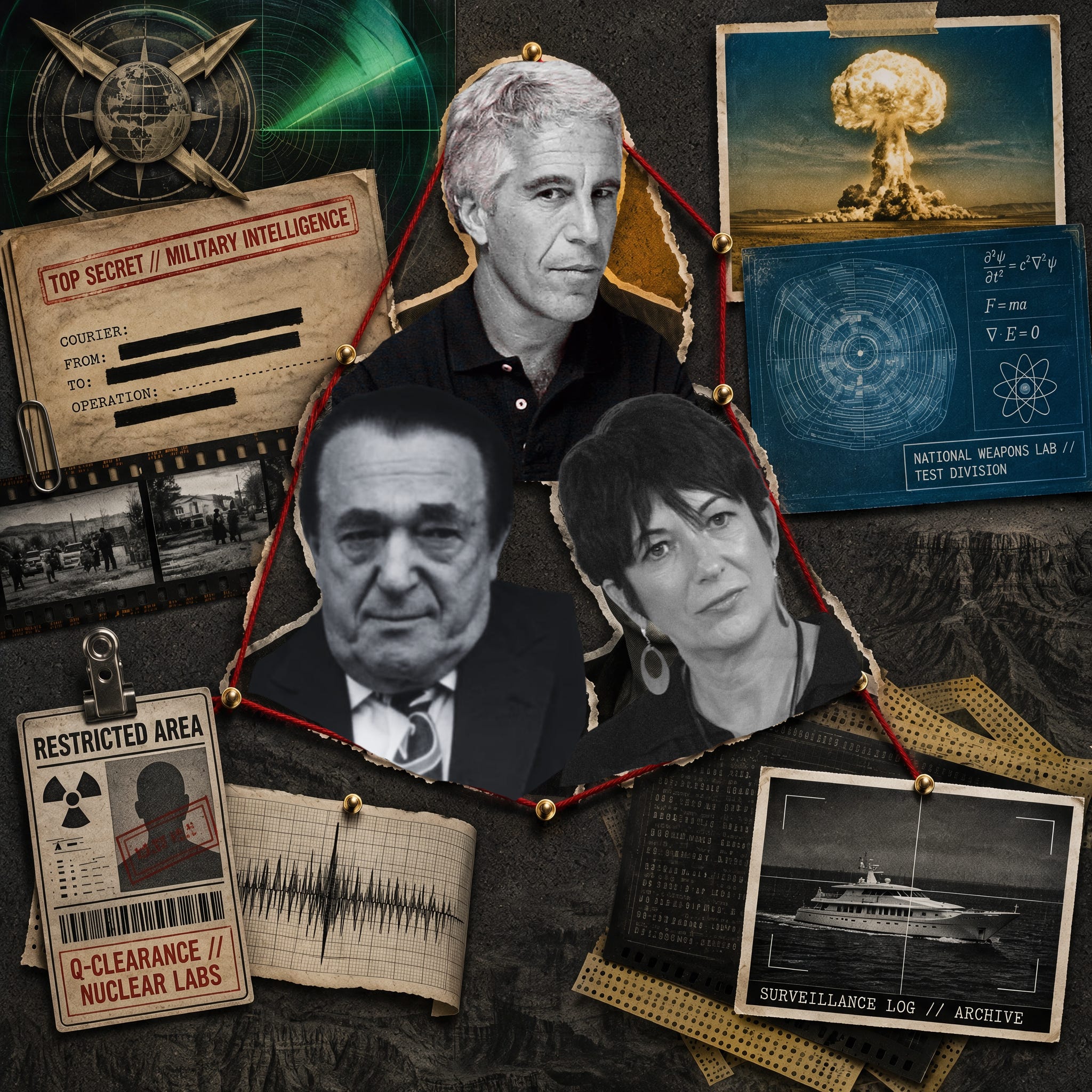
If you’ve managed to avoid the name Jeffrey Epstein until now, I envy you, and I’m sorry to be the one to end your streak.
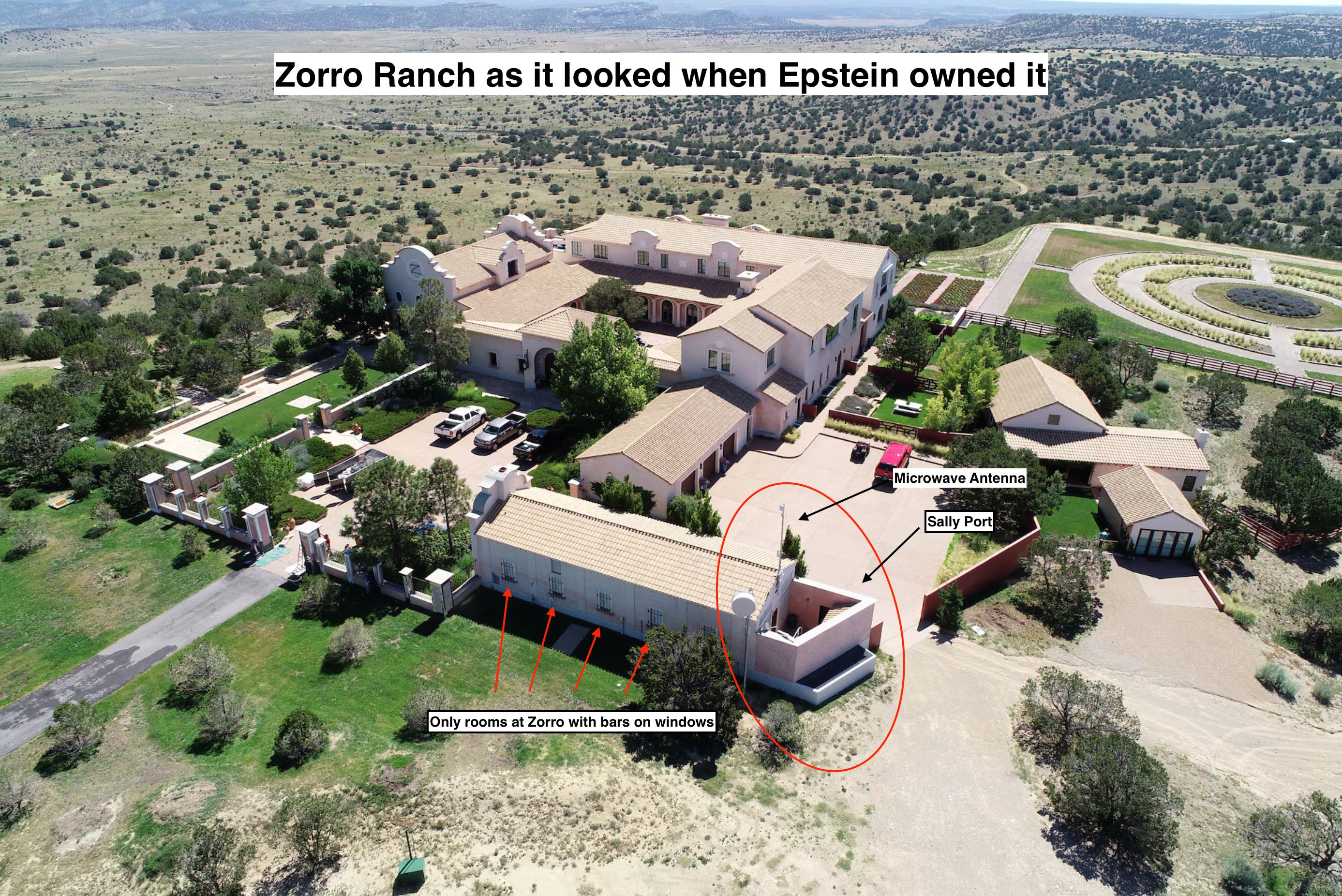
Epstein is widely described in corporate news stories as a “disgraced New York financier” who called himself a money manager for billionaires, though nobody has ever fully explained where his own fortune came from. He was superficially charming, good-looking in an evil Barney Rubble kind of way, spectacularly well connected, famously NOT well hung, and seemingly everywhere a scumbag rapist working for foreign and domestic military intelligence operations might benefit from being: on private jets with former presidents, at dinners with princes, at the elbows of Nobel laureates. He owned a Manhattan townhouse said to be the largest private home in the city, a mansion in Palm Beach that Donald Trump competed with him to buy, an apartment in Paris, a 10,000-acre rape-ranch in New Mexico that he bought from the then sitting governor, and two — count ‘em, two — private islands in the U.S. Virgin Islands.
He also groomed, trapped, raped and otherwise sexually abused girls and young women, many of them minors, for decades. Survivors describe being recruited with promises of money, modeling work or help with college, then abused in his homes and passed to others, including former New Mexico governor and Jaba the Hut lookalike, Bill Richardson, and fellow Jaba the Hut lookalike, Alan Dershowitz. Well over a hundred survivors have since come forward. I believe them.
In 2008, after Palm Beach police built a case involving dozens of girls, federal prosecutors in Florida gave Epstein one of the most lenient deals in modern American criminal history. He pleaded guilty to two state prostitution charges, one involving a minor, served about 13 months in a county jail, and was allowed to leave six days a week on “work release.” In July 2019, federal prosecutors in New York finally arrested him on sex trafficking charges. A month later he was found dead in his cell in a Manhattan federal jail. The medical examiner ruled it a suicide. A great many people have their doubts.
His longtime partner, the British socialite Ghislaine Maxwell, was convicted in 2021 of helping recruit and groom girls for him and is serving 20 years in federal prison.
Here in New Mexico, Epstein never even got to the point of needing a “sweetheart deal” from the U.S. Attorney for the District of New Mexico, as he had gotten from Alex Acosta, the U.S. Attorney for the Southern District of Florida. That’s because what happened in New Mexico was worse than what happened in Florida, and the U.S. Attorney appointed to New Mexico the year Epstein bought his ranch here was also Epstein’s personal power of attorney for the purchase of that ranch. I’ve been screaming this into a void for nearly a year now, and zero national media outlets have bothered to give a fuck.
What, and why
Most of the reporting on Jeffrey Epstein, much of it brave and essential, has focused on what he did and to whom. Good. That’s important. But I want to know why he did it the way he did.
Consider how a man whose only goal was sexually abusing and trafficking children might behave. He’d keep his head down, like most such monsters do. He’d buy unassuming property quietly, through strangers. He’d hire anonymous contractors, and keep his distance from anyone with a badge, a vote or a security clearance. He would do his best not to be noticed.
Epstein did the opposite, every single time.
He bought his New Mexico ranch from a sitting governor, Bruce King. The ranch shared a fence line with Henry Singleton, co-founder of the defense giant Teledyne and a veteran of America’s O.S.S. wartime spy agency, and the two properties were tied together by private communications lines. The private home phone numbers of both King and Singleton were in Epstein’s little black book. To build his mansion, Epstein hired Bradbury Stamm, an industrial contractor here in New Mexico, whose specialty is building top-secret facilities for the nuclear weapons labs. Epstein filled his homes with Nobel laureates and other nuclear weapons scientists, cabinet secretaries, a future Israeli defense minister and a former president. He sought out the people who make foreign policy that impacts the Middle East, and the scientists who invent and build weapons of mass destruction, and he made sure they owed him, by any means necessary.
A man who wants to hide, which is what most pedophiles are, does the reverse. Epstein was building access to the richest and most powerful people on earth. Most analysis of this I’ve seen has said prestige was the camouflage: the more powerful his friends, the less anyone looked closely at his guests. But I think that’s a stupid read of what Epstein was doing. I don’t think camouflage is why he cultivated the particular Rolodex he had. I think access to military intelligence secrets and power over those who rule the world was.
His interests were consistent. Money. Politicians who could shape foreign policy. And, above almost everything, the science of the American weapons complex, from the nuclear labs he moved next to in New Mexico the 1990s to the artificial intelligence and quantum computing he funded later.
The question my work now asks is simple: We know what he did; we are starting to see why.
But who was all that access for? Surely not for Epstein himself.
He worked for someone else.
The hypothesis
Here at THE PUGILIST, we have a working theory, and I want to lay it out plainly so you know exactly what I’m testing.
We believe Epstein’s crimes served at least one foreign intelligence operation, possible more than one, with the passive and perhaps active assistance of United States military intelligence. We believe the sexual blackmail and helpful funding of research etc (bribery) his operation made possible had a purpose beyond pleasure or protection: access, at least at the start, to America’s most advanced weapons technology.
And we believe Epstein didn’t invent this machine. He appears to have stepped into one that was already running and had been for a while, a ring for gathering compromising material and intelligence of which Ghislaine’s father was a part, and which his three daughters all continued to carry forward after his death.
To understand why, you need to meet him.
The father
Robert Maxwell was a Czech-born British media baron who owned newspapers, publishing houses and a yacht named for his youngest daughter, Ghislaine. He is said to have made his first fortune with Pergamon Press, a scientific publisher that built its empire by publishing Soviet science in the West, which gave him entry to laboratories and governments on both sides of the Iron Curtain. He was suspected, at various times, of working for British intelligence, the Soviet KGB and Israel’s military intelligence agency, the Mossad. It’s very likely his main loyalty was to Israel, and his European, Soviet and United States connections were in ultimate service to the Mossad.
Ari Ben-Menashe, a former officer in Israel’s military intelligence, has said publicly that Robert Maxwell was a longtime Mossad agent, and that Maxwell brought both his daughter Ghislaine and Epstein into Israeli intelligence work. The investigative journalist Seymour Hersh, in his 1991 book The Samson Option, reported Maxwell’s ties to Israeli intelligence and his role in the affair of Mordechai Vanunu, the technician who exposed Israel’s secret nuclear weapons program. Maxwell denied all of it, calling Ben-Menashe’s claims “a total invention.” Which is exactly what a spy would say.
In earlier installments, I’ve covered a lot of this already. I’ve reported how Maxwell sold PROMIS software into Los Alamos and Sandia, America’s two most powerful and influential nuclear weapons laboratories, both in New Mexico, where the nuclear bomb was invented. PROMIS was a powerful case-tracking program built by a small Washington company called Inslaw for the U.S. Justice Department. Inslaw’s owners accused the government of stealing it, and witnesses later claimed copies had been fitted with a secret back door and sold to intelligence services around the world, Israel’s among them. Ben-Menashe swore in a 1991 affidavit that Israeli spymaster Rafi Eitan had obtained the software and that Maxwell helped market the doctored version.
One reporter was chasing that story harder than anyone. Danny Casolaro, a freelance journalist in Virginia, was tracing the stolen software and the web of spies, arms dealers and officials he called “the Octopus.” In August 1991 he traveled to Martinsburg, West Virginia, telling friends he was about to meet a source who would break the case open. On August 10, 1991, he was found dead in the bathtub of his hotel room, his wrists slashed. His notes were never found. Police ruled it a suicide. His family never believed it.
Twenty-eight years later, to the day, on August 10, 2019, Jeffrey Epstein was found dead in his jail cell. Also ruled a suicide.
August 10 is not without significance for Israel. It is the date in A.D. 70 when Roman troops destroyed the Second Temple, a tragedy that ended ancient Jewish sovereignty and often coincides with the national fast day of Tisha B’Av. Today, Israel commemorates this loss through a 25-hour fast, solemn gatherings at the Western Wall, and the mandatory closure of public entertainment venues across the country. In 1920, The Treaty of Sèvres that paved the way for the establishment of the British Mandate for Palestine, which was eventually used to create the nation of Israel, was signed on August 10. And in 2005, just days after resigning from his post as Finance Minister to protest the upcoming Gaza Disengagement Plan, Benjamin Netanyahu delivered a major speech to the Knesset on August 10; that speech led to the political schism that reshaped modern Israeli politics and enabled the current genocide in Gaza.
Three months after Casolaro died, Robert Maxwell went off the side of his yacht near the Canary Islands. He fell, jumped or was pushed; the question has never been settled. He died. He was buried on the Mount of Olives in Jerusalem. Israel’s prime minister, its president and at least six current and former heads of Israeli intelligence came to see him off. That’s quite a turnout for a mere newspaperman.
Two years after that, in 1993, Maxwell’s daughter Ghislaine led Epstein to New Mexico, where, with her guidance, he bought a 8,000-acre ranch south of Santa Fe, about 50 miles as the crow flies from Los Alamos National Laboratory to the north and about 35 from Sandia to the southwest: the very labs her father’s software had reached.
Ghislaine has told the United States Justice Department that her father’s scientific contacts led her to introduce Epstein to the Santa Fe Institute, a think tank founded by Los Alamos labs veterans, including physicist Murray Gel-Mann, whose main research partner was Yuval Ne’eman, the scientist who served in Israel’s Knesset and oversaw the exodus of Jewish Soviet nuclear weapons scientists (the “refusniks”) to Israel during the 1980s and 1990s. Epstein went on to fund Gel-Mann’s work in New Mexico, and won his loyalty.
Ghislaine’s dad made it possible for Israel to spy on New Mexico’s weapons labs during the Cold War.
His daughter and her supposed romantic partner—a man who in truth did not like adult women—moved in next door as it ended.
The asset question
Epstein has been identified as an asset or operative of Israeli intelligence by people in a position to know, or to have heard. The United States news media, both corporate and independent, largely ignore this. I’m not sure why.
Ben-Menashe has said Epstein was Mossad. Former CIA officer John Kiriakou, an Abu Grahb whistleblower who served time for exposing the U.S. government for torturing prisoners in violation of international law, has also said he believes Epstein was working for the Mossad, and has called Epstein “a construct,” a creation of intelligence rather than a self-made man. And according to reporting by Vicky Ward, Alexander Acosta, the federal prosecutor who signed off on Epstein’s 2008 sweetheart deal, told Trump transition officials he’d been told to back off because Epstein “belonged to intelligence.” Acosta has never confirmed saying it. Israeli officials, including former Prime Minister Naftali Bennett, have flatly denied that Epstein ever worked for the Mossad. But that’s exactly what a spy agency would say.
Once I began to see the pattern in New Mexico, a question followed me around like a stray dog: if the ranch was about the labs, what were the other houses about? This installment is about the islands.
A note on method, because you deserve one. A hypothesis is a question with its sleeves rolled up. Some of what follows is documented in primary records. Some is reported by others, and I’ll say so. Some is simply geography, the kind of proximity that starts an investigation rather than ending one. I’m a novelist by trade as well as a reporter, and I know a good plot when I see one. I also know that real life rarely ties its bows so neatly, which is why I’m going to the archives.
Paradise, with a military map underneath
The U.S. Virgin Islands are an American territory in the Caribbean, east of Puerto Rico: three main islands, St. Thomas, St. John and St. Croix, plus dozens of smaller ones scattered in water so blue it looks retouched. The United States bought them from Denmark in 1917, mostly to keep Germany from getting them. Strategic military and commercial value, it turns out, is the oldest real estate tradition in the islands.
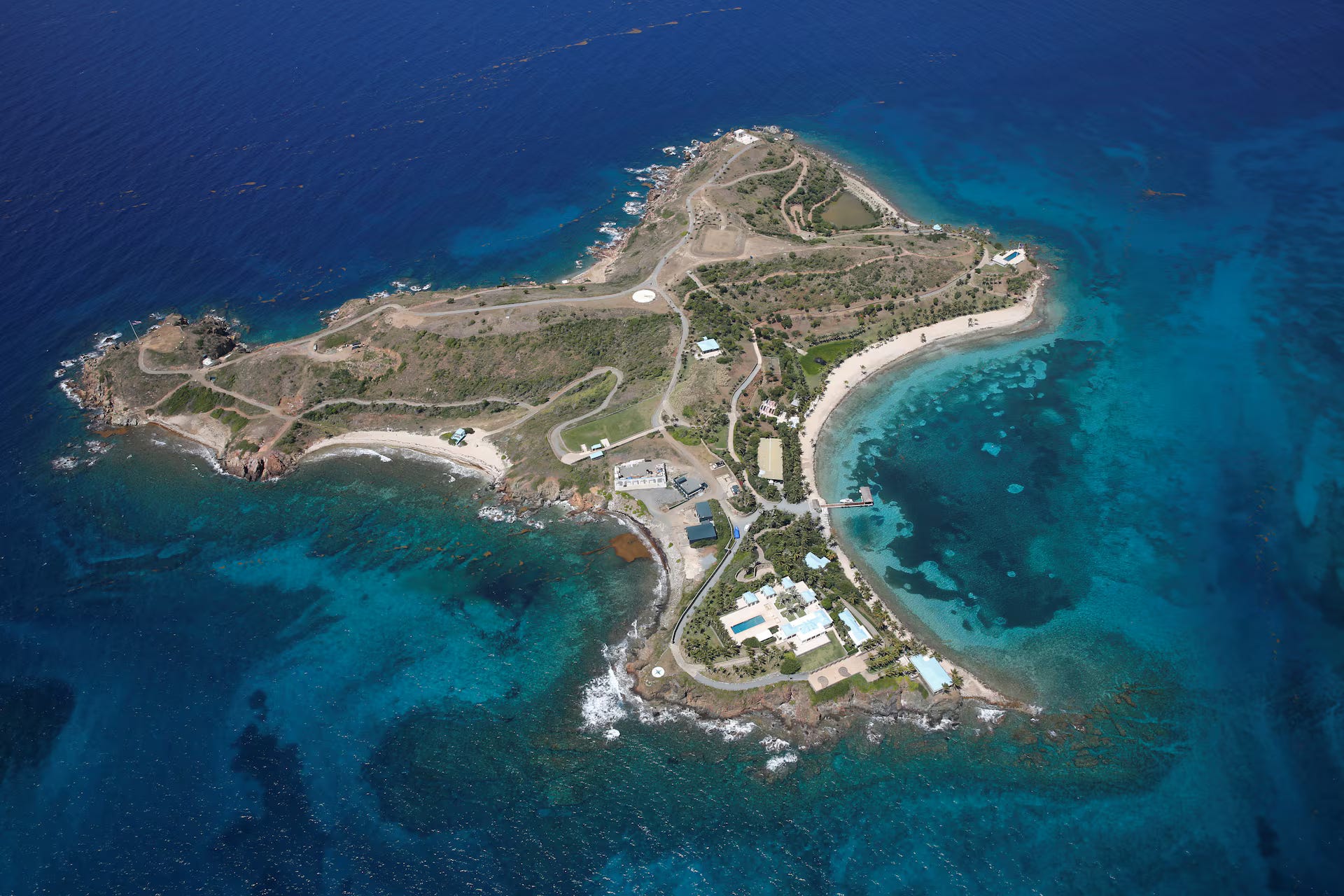
Epstein’s island, Little St. James, is a 70-acre knob of green just off the east end of St. Thomas. In news coverage it’s usually called a playground for the rich. For the girls and young women who survivors say were flown there and abused, it was something much darker, and that should always come first. It was a rape island. A place where children were taken, trapped and raped by some of the most powerful men in the world.
But spread out a military map of the region and the island takes on another identity.
For most of the Cold War, the waters around Puerto Rico and the Virgin Islands were one of the Navy’s most important training and testing grounds in the hemisphere. A declassified Pentagon history of where America kept its nuclear weapons, analyzed in the Bulletin of the Atomic Scientists in 1999, lists Puerto Rico, which lies 86 miles from Little St. James, among the storage sites, beginning in June 1956. In the mid-1980s, a commission of the Puerto Rico Bar Association concluded that Naval Station Roosevelt Roads, on Puerto Rico’s east coast, had been prepared as a nuclear command center, with facilities for anti-submarine nuclear weapons, and that nuclear-armed ships and submarines routinely called at the island’s bases.
Off St. Croix, 56 miles from Little St. James, the Navy built an underwater tracking range covering about 400 square nautical miles, wired with listening devices that let it follow submarines and torpedoes in three dimensions. Its purpose was anti-submarine warfare: the art of finding the enemy’s nuclear submarines before they could fire. The Navy also kept installations on Crown Mountain, the highest point on St. Thomas; it is 10.5 miles from Little St. James.
In 1997, a Navy photographer snapped a picture of the USS Maryland, an Ohio-class submarine carrying Trident nuclear missiles, at Roosevelt Roads, 45 miles from Little St. James.
The following year, Jeffrey Epstein bought that island.
Roosevelt Roads closed in 2004. Last November, the Pentagon quietly reopened it, and thousands of troops have trained there this year. The neighborhood, it seems, never stopped mattering. It just stopped making the news. And it has never, until today and this publication, made the news in association with Jeffrey Epstein.
The man who built the bomb
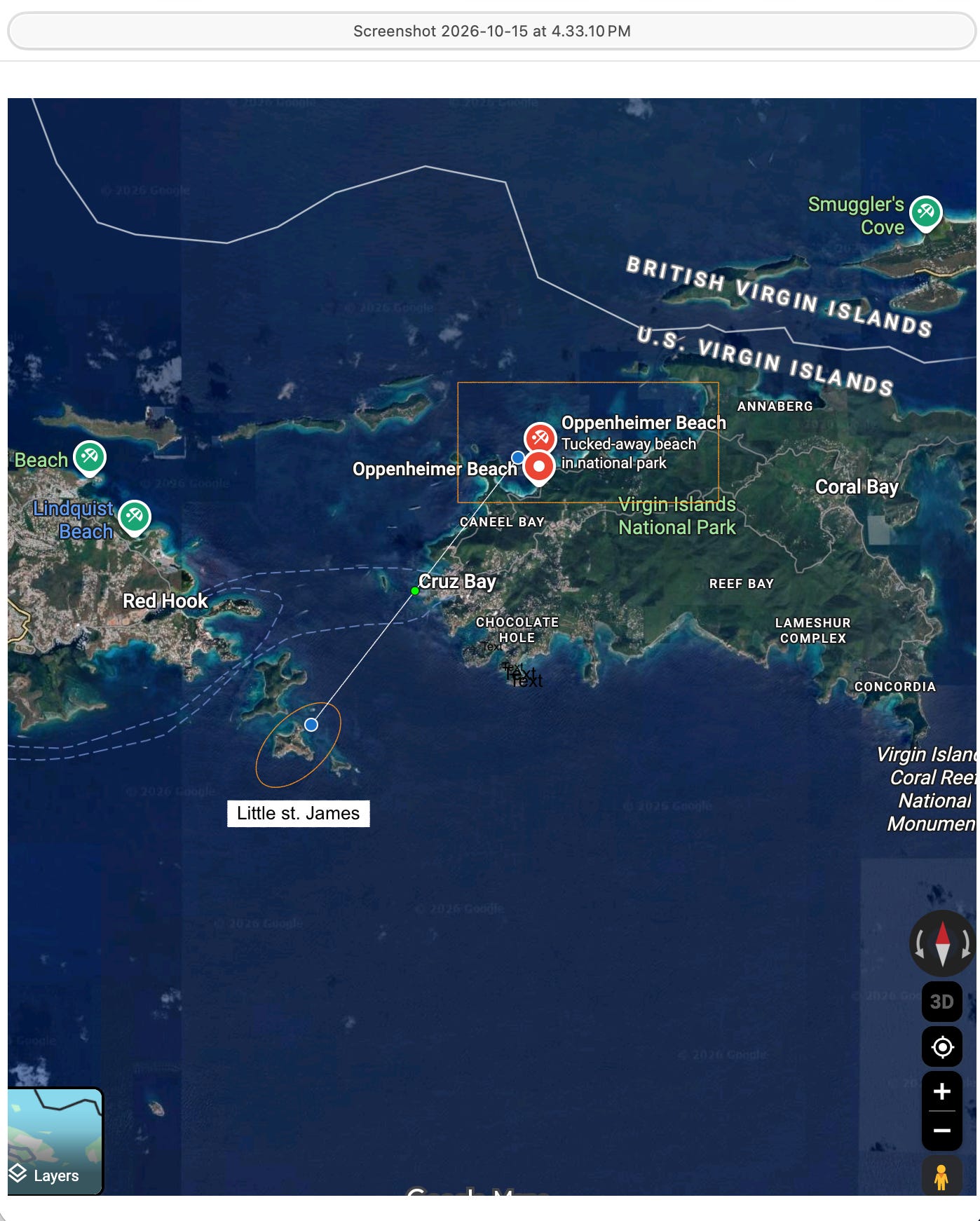
A short 6-mile boat ride across the channel from Little St. James lies St. John, the smallest and wildest of the three big islands. And on St. John, on a crescent of sand called Hawksnest Bay, the most famous scientist of the 20th century went to recover after his own country broke him.
J. Robert Oppenheimer led the Manhattan Project, the secret wartime effort at Los Alamos, New Mexico, that built the first atomic bombs. After the war he became a celebrity and a skeptic, warning against a race to build the far more powerful hydrogen bomb. That made him powerful enemies in the United States government. In 1954, after a closed hearing in which his left-wing friends, his marriage and his old evasions were dragged into the light, the Atomic Energy Commission revoked his security clearance. The man who had held America’s deepest secrets was barred from them. If someone were hoping to access those secrets, this news might have made forging a neighborly friendship with Oppenheimer a rather attractive proposition.
That same year, Oppenheimer, his wife Kitty and their children began spending months at a time on St. John. They bought a corner of land at Hawksnest from the Gibney family, built a modest cottage on the beach, and spent their days sailing. Old friends from Los Alamos came to visit, among them Dr. Louis Hempelmann, who had run health and radiation medicine for the bomb project. Years later, Hempelmann recalled in an oral history that Oppenheimer still feared he was being followed and recorded.
He was right to think more than one government was interested in him. In June 1954, the very week the New York Times reported that Oppenheimer had been declared a security risk, Meyer Weisgal of Israel’s Weizmann Institute of Science showed up at Princeton to recruit him and invite him to Israel. In 1958, Oppenheimer went, to help dedicate Weizmann’s new institute for nuclear science. He met with Israel’s founding prime minister, David Ben-Gurion, at his own request. Ben-Gurion told his cabinet afterward that he sensed in the American “some sort of Jewish spark.” Oppenheimer returned again to Israel in 1965.
Those were exactly the years Israel was secretly building its own atomic weapons at a desert site called Dimona, with a reactor bought from France in a deal negotiated in Paris.
Oppenheimer died in 1967. Kitty scattered his ashes in the water off Hawksnest. When their daughter Toni died in 1977, she left the beach property to “the people of St. John.” For three years it sat under the control of her executor, a former New Jersey governor named Robert Meyner, while the Gibneys fought the gift and vandals worked over the house. The territorial government finally took title in February 1980.
What was in that house when Toni died, and what the government received, are among the questions taking me to the islands. The other question is What did the neighbors know—and who were they?
Interestingly, when I first took a screenshot of the Google Maps search I did for Oppenheimer’s Beach less than a month ago, on October 15, 2026, I posted it as a note on Substack and Facebook. Today, as I was preparing this piece you’re reading now, I did the same Google Maps search and found that Oppenheimer Beach no longer appears anywhere on the map. It has been replaced by “Gibney Beach” instead. When I checked Apple Maps to see if they had also replaced Oppenheimer Beach with Gibney Beach in the three weeks since I posted the image of Oppenheimer Beach, I found the same thing. Oppenheimer Beach had been erased from public online maps. That both Google and Apple had done this indicates an order coming from the United States government to change the map. Here is the October 15, 2026 screenshot, followed by how it looks today. I ask you, if I am just a “crazy” person, why would the United States government make changes to the map in the three weeks since I first posted about the proximity of Oppenheimer Beach to Little St. James? So far, I’m the only reporter who has made this connection. And, no, none of this is comforting. In fact, it’s terrifying.
The neighbor who bought an island
Oppenheimer’s most powerful neighbor was Laurance Rockefeller: Navy veteran, investor in aviation, adviser to five presidents, and grandson of John D. Rockefeller, the man who built Standard Oil into the most powerful company on Earth.
Laurance first saw St. John in 1952 and fell in love, the way rich men fall in love with irreplaceable beautiful things they can buy. He quickly learned that the name Rockefeller doubled the asking price, so he worked through agents and intermediaries, quietly buying up most of the island. Among his purchases was Caneel Bay, right next door to Hawksnest, which he bought from a complany called Textron, a conglomerate that would soon go into the military helicopter business. In 1956, his foundation handed more than 5,000 acres to the federal government to create Virgin Islands National Park. Even a friendly local historian concedes that “there were issues” with how some of that land was obtained from island families.
If you’ve been reading my New Mexico work, that sentence probably made the hair on your arms stand up. Powerful outsiders, quiet buyers, titans of industry in oil and defense contracting moving in, local families losing land. The Caribbean has its own version of that story.
Rockefeller kept land on St. John until he died in July 2004. For six years, he and Jeffrey Epstein were landowners in the same small cluster of islands.
The man who sold Epstein the island, and his father
In April 1997, the Wall Street Journal ran a small real estate notice: Little St. James, for sale, $10.5 million. The owner was a venture capitalist named Arch Cummin. The island already had its main house, guest cottages, a caretaker’s cottage, a desalination plant, a helipad, a dock and the oval swimming pool that would later appear in so many grim photographs.
In April 1998, a company called L.S.J. LLC bought it for $7.95 million, about $2.5 million below the asking price. The company had one member: Jeffrey Epstein.
Now for something that, as far as I can tell, has never been reported anywhere.
Through primary sources, I’ve established that Arch Cummin’s father, Pearson Church Cummin Jr., was an officer with the Ritchie Boys. If that name is new to you, it was to me too, not so long ago. The Ritchie Boys were trained at Camp Ritchie, a secret Army school in the Maryland mountains during World War II, in the dark arts of military intelligence: interrogating prisoners, mapping enemy forces, waging psychological warfare. About 20,000 men passed through. Roughly 2,000 were German-speaking Jewish refugees who had fled Hitler and went back to fight him. Several Ritchie Boys went on to careers in the CIA.
Camp Ritchie’s neighbor in the Catoctin Mountains was the OSS’s own secret training camp, where America taught its first generation of spies and saboteurs. Today that ground is better known as Camp David.
Henry Singleton, Epstein’s next-door neighbor at the New Mexico ranch, served in the Office of Strategic Services, America’s wartime spy agency and the forerunner of the CIA. So did Donald Barr, the headmaster of Manhattan’s elite Dalton School, who in 1974 hired a 21-year-old college dropout named Jeffrey Epstein to teach math to the children of the powerful.
The man who gave Epstein his first job, the man who lived next to his ranch, and the father of the man who sold him his island all came out of America’s wartime intelligence services.
How Cummin came to own Little St. James, and who brokered its sale to Epstein, are next on my list. Those documents are nowhere to be found online, and will necessitate a trip to the Virgin Islands, if I can raise funds for it.
Bring on the geniuses
Once he had the island, Epstein began filling it with brilliant people.
In April 2002, he paid for the St. Thomas Common Sense Symposium, a gathering of about 20 pioneers of artificial intelligence. Among them were MIT’s Marvin Minsky, one of the founding fathers of the field, and the team behind Cyc, an ambitious, decades-long attempt to teach computers common sense, long backed by Pentagon research money. Epstein sent a boat to carry the guests out to Little St. James. One attendee later recalled that Epstein was convinced AI would become enormously important. He was right about that, at least.
In 2005, he paid the Virgin Islands Water and Power Authority to lay a power and fiber-optic cable from St. Thomas to his island, giving it a dedicated line for data.
In March 2006, he paid for a physics conference on St. Thomas called “Confronting Gravity,” organized by the physicist Lawrence Krauss. The guests included Stephen Hawking, whom Epstein took for a ride in a specially modified submarine.
Artificial intelligence. Cosmology. And later, back in Massachusetts, quantum computing. Over the years, Epstein’s science money tracked the frontier of the technologies the Pentagon cared most about, as the focus shifted from nuclear weapons to directed energy weapons and AI. That might be coincidence. It might be a sleazy pedophile who simply liked smart company and entertained it in the strategic epicenters of U.S. weapons research. Or it might be something bigger. I’d like to find out which.
The second island
In January 2016, Epstein bought the island next door, Great St. James, which is more than twice the size of his first. Its main owners, the family of a Danish politician, had refused to sell to him years earlier. This time, according to the Miami Herald, Epstein bought through a company called Great St. Jim LLC and listed as its owner Sultan Ahmed bin Sulayem, the Emirati chairman of the global ports giant DP World, against the sultan’s will. Epstein paid $17.5 million for the Danish family’s land and $5 million for the rest.
His building permits for the new island called for a barge dock, a marine electrical cable, a solar array, a machine shop, a security building and something described as an “underwater office.”
An underwater office. Hold that thought. He died before most of it was built.
Friends in high places
A private island surrounded by military history needs friends on shore, and the record suggests Epstein had them.
Cecile de Jongh, the wife of John de Jongh, governor of the Virgin Islands from 2007 to 2015, worked for years for Epstein’s company in St. Thomas, according to filings in the territory’s own lawsuit against JPMorgan Chase. Epstein’s businesses enjoyed generous tax breaks from the territory’s Economic Development Commission. When an attorney general finally came after his money, she didn’t last long. Denise George sued Epstein’s estate in 2020, sued JPMorgan in late December 2022 for enabling him, and was fired by Gov. Albert Bryan days later.
I’ll have much more on the de Jongh years, and on what changed after they ended, in a future installment.
What I still need
Proximity is where an investigation begins. To turn this map into proof, I need paper, and most of it has never been scanned. It sits in courthouses in Charlotte Amalie, in archives in Washington and Princeton, and in filing cabinets nobody has opened in decades. Here’s what I’m after:
The deed history of Little St. James before Arch Cummin, and the broker’s file on the 1998 sale.
Toni Oppenheimer’s probate file, and an inventory of what the territory received in 1980.
Navy records on the St. Croix range and the Crown Mountain installations from 1998 to 2004, the years Epstein’s island and the nuclear-era Navy overlapped.
Oppenheimer’s papers at the Library of Congress, for any visitor to St. John we don’t yet know about.
Epstein’s flight logs and emails, cross-checked against Navy personnel, defense contractors and foreign officials.
How you can help
THE PUGILIST is reader-funded, full stop. Flights to St. Thomas, court copy fees, archive hours and island coffee add up. If this work matters to you, please consider becoming a paid subscriber or leaving a tip. Every dollar goes straight into the reporting.
And if you know something, whether you served at Roosevelt Roads or on the St. Croix range, grew up on St. John, worked on Little St. James, or remember who was selling islands in the late 1990s, my inbox is open. Sources are protected.
The map is on the table. Let’s go find out who drew it.
 reply