
1169 stories
·
0 followers

Deus Ex

1 Share


This article tells part of the story of Warren Spector.

A slight shift of focus, and the future could still turn out like Deus Ex after all…

— Deus Ex lead writer Sheldon Pacotti, speaking in 2014

The reviews that greeted Ion Storm’s Deus Ex upon its release in June of 2000 ranged along a continuum from cautiously to wildly positive. Computer Gaming World, the Gray Lady of the hobby, came with one of the most nuanced takes. Reviewer Thierry Nguyen spoke of “loving” the game in the abstract, but lamented “deep flaws that sometimes frustrated me, as they detracted from its ambitious design”; these included performance issues, poor artificial intelligence on the part of the enemies, and a sense of contrivance that clung to some of the environments and plot points. The excitable lads at Australia’s PC Powerplay, on the other hand, placed no such qualifiers on their declaration of love for Deus Ex. In a special feature published when the game was not yet three months old, they declared it to be quite simply The Best Game Ever: “Every action within Deus Ex’s expansive environments has far-reaching consequences, making it seem like the player is ensconced within a living, breathing world.”

For better or for worse, the critical consensus over the quarter-century since Deus Ex was a brand-new game has hewed more to PC Powerplay than Computer Gaming World. As the years have passed, it has been praised more and more fulsomely, not only for its gameplay but for being a full-blown work of interactive speculative fiction, full of uncanny insights into the ways the world has changed since it was released just as the Dot-com Bubble was bursting. YouTube in this Year of Our Lord 2026 is overflowing with videos that declare it to be “The Most Important Videogame Ever Made,” the game that “predicted the future,” the proud home of “some of the most insightful philosophy that you will ever witness in the gaming medium.” It’s become fodder for a certain species of painfully earnest commentator who desperately wants games to be culturally relevant true-blue art, whilst also continuing to allow him to run around and blow shit up in the manner to which he’s become accustomed. All too often, this causes such folks to make claims for Deus Ex that have only a tangential relationship with its reality, lacking the necessary grounding in the cultural circumstances that produced it. Which is no surprise really; some of these folks weren’t even born yet when Deus Ex was new on store shelves.

My favorite anecdote in this vein involves the name of the protagonist: J.C. Denton. It was theorized for years that the “J.C.” stood for “Jesus Christ,” pointing to the literal deus ex machina (“God in the machine”) of one of the game’s three possible endings, in which Denton merges with an artificial intelligence — in the Singularity sense, not that of the algorithms controlling the enemies who run through the game’s corridors shooting at you — to take over the world. At a Game Developers Conference postmortem in 2017, Deus Ex’s mastermind Warren Spector, who had always stayed mum on the subject prior to this event, brought forth a revelation that caused jaws to drop almost audibly throughout the room: the initials really did stand for “Jesus Christ.” But then came the deflating coda. Rather than having any deeper thematic or philosophical implications, the name of the protagonist came from a friend of Spector’s with the first name of Denton, who was so nice and helpful that it could become downright “irritating,” as Spector put it. “Jesus Christ, Denton!” he would say at these junctures. When production on Deus Ex began, Spector thought that the phrase had a nice ring to it. So much for philosophy.

Like Planescape: Torment and to some extent even Alpha Centauri, Deus Ex has become as much an aspirational ideal as a concrete artifact. And that’s fine; we all need things to which to aspire, after all. Still, in this article I’m going to do my best to drill down on the less hyperbolic reality of Deus Ex. If this means pushing back at times against its popular reputation as a sui generis masterpiece, know that that doesn’t mean it isn’t a fine and groundbreaking game, a game which dares to attempt to do a lot of difficult things and manages to succeed at a remarkable number of them.
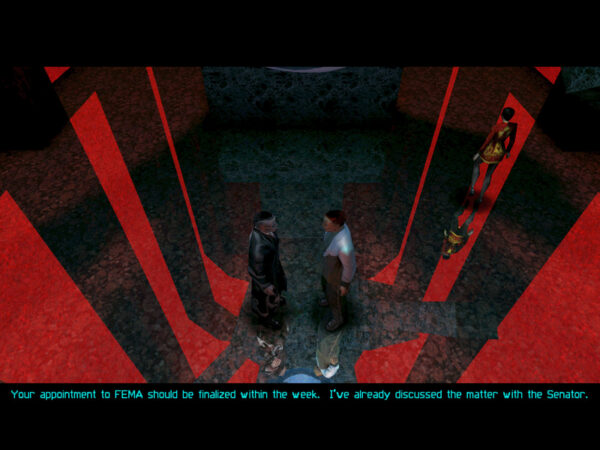

One of the nefarious actors in Deus Ex is the Federal Emergency Management Agency. How’s that for a deep state?

As I’ve already implied, discussions of Deus Ex tend to break down along two axes: the innovations of its gameplay and the statements it makes — or seems to make — about the very future in which we are now privileged or condemned to be living. The gameplay is both the easier subject to get a handle on and the one where the more grandiose claims require less qualification, so let’s start there.

Whatever else it happens to be, Deus Ex is the greatest game that Looking Glass Studios never made, steeped in that creative collective’s ethic of the “immersive sim.” As longtime readers of this site know, Looking Glass’s very first game, Ultima Underworld, appeared in 1992, right about the same time that id Software released Wolfenstein 3D, their dry run for DOOM. For the balance of the decade, Looking Glass was the yin to id’s yang. Both studios worked with first-person 3D, but, while id emphasized straightforward shooter gameplay, Looking Glass stubbornly stuck to a much more complex, multi-variant gameplay model that strove to drop the player right into a believable 3D world. It was a far more difficult path to walk, with far fewer commercial rewards to be found along the way, yet it resulted in a catalog of games that are still well remembered and widely recognized as formative to what gaming has become in the decades since. It might not be going too far astray to call Looking Glass the Velvet Underground of gaming.

In my opinion, the greatest, most quintessential Looking Glass game of all is System Shock, which was released in 1994, still fairly early in the studio’s run. It casts you as the sole surviving human aboard a space station where an evil central computer, the chillingly iconic SHODAN, has killed everyone else and turned their corpses into bloodthirsty zombies. You have to shoot, sneak, hack, and engineer your way to victory against her, in combinations that can and will vary from player to player. The game is less a fixed story than an emergent playground of problems and possibilities that yields a story, if the player is doing it right. System Shock so impressed Warren Spector, who was serving as Looking Glass’s producer and liaison at the publisher Origin Systems at the time it went into development, that it caused him to quit his job there and join Looking Glass full-time.

System Shock. One of its design principles was a thoroughgoing commitment to diegesis; you aren’t privy to any information which the character you play isn’t also privy to. What you see onscreen is exactly what the protagonist sees through his neural implant. (Valve’s Half-Life would famously employ the same approach four years later.)

All told, System Shock was the most uncompromising implementation of an immersive sim that Looking Glass ever created — for that matter, one of the most uncompromising that anyone has ever created, right up to the present day. Confronted by feedback from players who found the scope of possibility which System Shock allowed them less bracing than confusing, Looking Glass shrank it just slightly in their later games. Their 1998 game Thief, for example, made it clear to the player that stealth was the only real route to success. Yet Spector found the early builds of that game, which is at least as critically lauded as System Shock today, to be more frustrating than freeing. What happened if you were discovered in one of the dark corners of the game, despite all of your best efforts to stay hidden? It usually just led to a swift game-over screen, so inept was your character in a straight-up sword fight. Spector wondered why he couldn’t be allowed to take a different approach to the game’s problem space than that of pure stealth, if he so chose. After having worked on System Shock, Thief felt too constrictive.

This was the direction his thoughts were traveling when John Romero called him up to offer him $3 million to make “any game you want to make.” Deus Ex was a return to the ethic that had produced System Shock, and thus cannot be fully understood without reference to that earlier game. Like System Shock, it gives you a goal and sets you loose to try to achieve it in any way you can conceive and pull off. The core of Spector’s mission statement to his team was just three words long: “Problems, not puzzles.” Instead of insisting that you work your way to solutions that have already been thought up by the designers — the definition of puzzle-based gameplay — it’s content to offer up a selection of challenges and affordances and then trust in the multi-variant simulation to do the rest. This gives emergent possibilities for problem-solving — as opposed to puzzle-solving — that even the designers may never have imagined. If this approach wasn’t quite as breathtakingly new in 2000 as some of the YouTube commentariat seem to think it was — again, see System Shock — it was most definitely the road less traveled in 3D gaming at the time.

That said, Deus Ex is more willing than System Shock to compromise on the ideology of the immersive sim in order to satisfy other goals. It’s slightly less committed to diegesis, being willing to foreground information that System Shock prefers to keep hidden. The changes which the protagonist of System Shock undergoes all happen organically, as a result of his actions in the world. In Deus Ex, while you will always play an agent with the code name of J.C. Denton, your identity is less intimately bound up with his. You’re free to make your own version of him by explicitly choosing which skills to invest in initially and which ones to improve as the game goes on, from a modest menu of same that includes Computers, Electronics, Environmental Training, Lockpicking, Medicine, Swimming, and an array of Weapons competencies. (Interestingly, a 1999 direct sequel to the original System Shock that was developed by Irrational Games rather than Looking Glass themselves made the same choice to crack open the black box, as it were, and expose the CRPG elements.)

Deus Ex’s character-creation screen.

Instead of taking place in one contiguous space like System Shock — albeit a space with plenty of locked doors and balky elevators to be sorted out — Deus Ex embraces a more typical first-person-shooter campaign structure, giving you a set of twelve missions that are played out one after the other. Each mission is, we might say, a kind of mini-System Shock, a self-contained simulation space that must be “solved” in one way or another in order to proceed to the next one. In terms of its overarching narrative, then, Deus Ex is really a quite traditionalist game.

The campaign structure does allow Deus Ex to present a far broader array of environments than it otherwise could, the polar opposite of the relentlessly uniform, suffocating corridors of System Shock. You hopscotch from New York City to Hong Kong to Paris among many other destinations, ending up — inevitably, given the nature of the story — at good old Area 51. But what is gained in cosmopolitan diversity is lost in the ability of players to make their own story. While each mission can be solved in a huge number of ways, it will always lead to the same mission afterward; the game will always dance to the tune of the same set of fixed plot beats. The “living, breathing world” that so delighted PC Powerplay back in the day is an illusion outside of the granular frame of how you complete each individual mission. Whether you choose to make your J.C. Denton a hyper-violent super-soldier who assassinates moral niceties along with everyone else he meets or a tormented soul engaged in what he suspects more and more to be a bad business, he will always arrive there at Area 51 via the same basic series of steps. Yes, one might argue that System Shock as well has a somewhat linear, deck-by-deck instead of mission-by-mission progression, but the ability — indeed, the necessity — to periodically go back to decks you might have thought you had “cleared” gives it a verisimilitude that Deus Ex can’t quite match.

So, for all its reputation for innovation, well-deserved in many respects, Deus Ex’s wide-frame approach to storytelling is almost as old as digital games themselves. At the climax of the linear campaign, you are given a choice between three pre-crafted endings. Other than by dying and failing to reach the climax at all, you have no more control than this over the final outcome of the story. This could be construed as a weakness, given the stakes of the plot, which is vastly more complicated than System Shock’s personal zero-sum game between yourself and SHODAN. Still, I do understand why it was done this way, and don’t really blame anyone for it: because truly interactive storytelling, especially on a scale like this one, is hard, as decades of experience have taught us all too well. As I’ve written many times, game design is an art of the possible; having made their bed by choosing to tackle such an ambitious story, the designers of Deus Ex had to lie in it as best they could.

Try to pick the lock or blow it open? The choice is yours… or maybe you can do something else, perhaps something totally unexpected, instead.

At the level of the individual missions, however, the game does do an admirable job of living up to its goal of letting you figure things out for yourself. If you want to go for maximum lethality, you can do that, although the limited quantity of ammunition to hand will make it a daunting task. (Just why does the organization you work for spend a fortune to turn you into an augmented super-soldier and then scrimp on bullets like a corporate Karen in charge of an office-supply cabinet?) If you want to rely on stealth and technological trickery, reserving your kill shots for the people who really deserve them, you can do that too. The best way to know if an immersive sim is successful at what it has set out to do is to imagine that you — the real you, that is — are actually in the situation it depicts, ask yourself how your real-world self would react, and then find out if the game allows you to do that. If the answer is yes, then the game is probably onto something. And by this standard, Deus Ex acquits itself pretty darn well, all things considered.

Indeed, for many years after the game’s release, the designers were regaled with tales of players who had devised solutions to the missions’ problems that they had never even thought of — another sign of a successful immersive sim. One of the most famous examples emerged when the game was still in testing. It involves magnetic explosive charges that can be attached to doors and windows for the purpose of blowing them open, or to make booby-traps for enemies. The testers discovered that they could use these in a whole different way: to make a kind of staircase for climbing a wall by attaching them one after another at increasing heights, hopping from one rung to the next. It was a clever and totally unanticipated way to reach high balconies and rooftops. Informed of this exploit, many a design team would have contrived some way to block it and moved on to the next bug on the list. But Warren Spector’s team took it as a challenge to make their virtual realities that much more airtight, such that even climbing to someplace you “shouldn’t” be couldn’t break them.

An improvised ladder made from magnetic explosive charges.

The worst thing you can say about this aspect of Deus Ex is that the simulation of the real world sometimes leads to situations where behaviors are entirely emergent, but a long way off from believable. Deus Ex goes so far in simulating a logically functioning environment in comparison to most games of its era that it occasionally falls into a kind of uncanny valley of realism, amenable to “cheap” solutions on the player’s part that remind her all too clearly that she’s merely playing a game. The most notorious examples of this phenomenon tend to revolve around the behavior of the various guards, terrorists, and other enemies in the spaces, who act more like confused herd animals than trained operatives. There are lots of ways to lead these clowns astray in order to avoid and/or kill them, ways that would never fly in the real world. But they stand out only because so much else has raised our expectations so high…

One of the many choices which Deus Ex largely leaves up to its player is how much to engage with its convoluted, much-discussed story line. You can treat the game as nothing more than a series of tactical scenarios to overcome, if you’re so inclined. Or you can really dig into the lore by exhausting every possible line of interrogation with the people you meet and carefully reading through the many documents you stumble across. It’s to this side of the game, which is increasingly described as prescient if not downright prophetic by people looking back from these dystopic-feeling current times of ours, that I’d like to turn now.


The most infamous and chilling “proof” of Deus Ex’s alleged facility for predicting the future is a view of the New York City skyline that you can see in the very first mission. This game that was released fifteen months before the terrorist attacks of September 11, 2001, nonetheless shows only empty sky where the twin towers of the World Trade Center ought to be. As the people who made the game have always been quick to explain, this was not intended as a conscious statement of any sort, much less a prophecy. The towers were left out due to a shortage of texture memory. But still… what a coincidence! It’s almost enough to make you believe that the ghost of the Oracle of Delphi really does haunt Deus Ex.

The game that follows that disconcerting skyline view is littered with quotes that seem almost as unnervingly prescient, especially when pulled out of context. They seem to apply all too well to our present age of ever greater disparities of wealth, all but unchecked corporate power, solipsistic social media, and widespread surveillance in both digital and physical spaces. Add to all of that the claim that our computers are on the verge of waking up to sentience and taking over the world…

For 100 years, there’s been a conspiracy of plutocrats against ordinary people. In 1945, corporations paid 50 percent of federal taxes. Now they pay about 5 percent. In 1900, 90 percent of Americans were self-employed. Now it’s about 2 percent. It’s called consolidation. Strengthen governments and corporations, weaken people. With taxes, this can be done imperceptibly over time.


This is real freedom: freedom to own property, make a profit, make your life. The West, so afraid of strong government, now has no government. Only financial power. All taxes are social engineering. That’s always been their real purpose. What happens is that politicians get money from big companies, so all the social engineering is for making big companies.


The need to be observed and understood was once satisfied by God. Now we can implement the same functionality with data-mining algorithms. The human organism always worships. First it was the gods, then it was fame (the observation and judgment of others), next it will be the self-aware systems you have built to realize truly omnipresent observation and judgment.

But before we get too hot and bothered over this 26-year-old game that seems to have so accurately captured the world we live in today, we should perhaps take a step back to ask ourselves where its ideas actually came from and what its makers were actually trying to do with them.

This supposed engine of prophecy is in reality one of the last enduring artifacts of 1990s conspiracy culture, that virulent Petri dish of vanished civilizations, crash-landed aliens, hidden historical overlords, secret societies, and more government coverups than an army of Boy Scouts could shake their sticks at. While the guiding ethic of Deus Ex’s gameplay was “problems, not puzzles,” that of its story was almost as simple: “What would the world be like if every conspiracy theory — every single one of them — was true?” It’s the trashcan cocktail of conspiracy culture, with some of just about everything thrown in. This was done not because its makers earnestly believed in most of what they wrote into their game, but for the most typical reason that any group of game developers do anything: because they thought it would be fun in a game that was to be, as Warren Spector described it, “James Bond meets The X-Files by way of Neuromancer.” To that list of influences can be added Blade Runner, The Terminator, and Snow Crash, along with a small library’s worth of dodgy books about aliens and pseudo-history. As anyone who has been reading these histories of mine for a while will readily recognize, this is not a strikingly original collection of gaming source material. Deus Ex stands out more for its maximalist approach and utter commitment to its subject matter than for the subject matter itself.

What follows may be a fool’s errand, but I’m going to try to summarize — in extremely abbreviated fashion, mind you — the conspiracy-addled backstory of Deus Ex as I understand it. (Credit where it’s due: the script of Deus Ex is primarily the work of Sheldon Pacotti and Austin Grossman, with much input from Warren Spector and the rest of his 30-person team.)

It all goes back at least as far as the Knights Templar — it’s always the Knights Templar, isn’t it? — who during the Crusades set up a banking system that would help them to rule the world, money being power and all. They morphed via several intermediate steps into the Illuminati, the hidden hand behind the last three or four centuries of human history, who numbered among their ranks the Founding Fathers of the United States. (Their symbol is right there on the American dollar bill!)

In 1947, this strand of conspiracy theory collided violently with another one, when a UFO crash-landed in Roswell, New Mexico. The Illuminati suppressed news of the close encounter, setting up a new and ultra-secret arm of the American government, known as Majestic 12, to study the alien artifacts that were recovered. All was more or less well in the national-security state for the better part of a century thereafter; some of the information gleaned from Roswell was strategically leaked to the scientific establishment, other parts held back as instruments of social engineering and mind control.

Some decades into the 21st century, however, the Illuminati fell victim to infighting within their own ranks. Bob Page, a filthy-rich industrialist who was one of the Illuminati’s ruling Council of Five, decided to assassinate his colleagues and take over the organization all by himself. This plan only partially came off, resulting in two dueling would-be Earth-dominating secret societies.

Page, who was quite a piece of work even by Illuminati standards, tried to consolidate his power by unleashing a massive pandemic to kill off billions of people and destabilize the world’s governments. (Have I mentioned that this game really can feel unnervingly prophetic?) Then he deployed an artificial intelligence by the name of Icarus to  invade and subsume the entire Internet. (Have I mentioned… oh, yes, I have, haven’t I?) While he was about all of this, Page genetically engineered himself and a small team of agents into supermen. Among these agents was one J.C. Denton, the player’s avatar in the game proper.

There’s much, much more to it, including a second rogue AI that sets about fighting the first one on the highways and byways of the Internet, but that will have to do for our purposes. The game itself kicks off in 2052 on Liberty Island in New York Harbor, which has been occupied by a gang of “terrorists” — freedom fighters by other people’s definition — as part of an operation to steal a shipment of a vaccine against Page’s genetically engineered disease. J.C. Denton is called in to stop them. He does so, but while he’s about it he’s given cause to wonder whether he’s been told the whole truth about the organization he works for, which he had heretofore believed to be completely benevolent. The plot takes many twists and turns thereafter, with J.C. Denton bouncing from team to team — including not only the two feuding dominant secret cabals, but others who oppose them both.
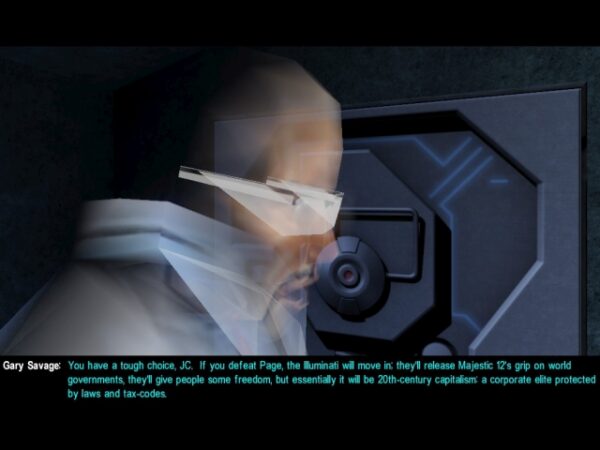
As I wrote earlier, it all comes to an end at Area 51, where J.C. Denton is confronted with a choice of three solutions to the chaos. One is to blow up the Internet and all other global communications systems and throw humanity into a new “Dark Ages” for at least the next few hundred years, in the hope that his descendants will make less of a mess of things when they get around to reinventing the technology that he is about to destroy; one is to join with the original Illuminati who have been fighting Bob Page all along and help to rule the world as one of them; and one is to join with the AI to form a true superintelligence combining the best parts of humans and computers, and rule the world alone that way. Warren Spector has often said that he wanted the choices the player makes in Deus Ex to say less about J.C. Denton than they did about the person behind the monitor; this choice of endings is surely the ultimate expression of that impulse. (For the record, I’d have to go for the Dark Ages as the least bad choice in this situation. There’s even a part of me — possibly the most morbid one, granted — that thinks this might not be such a bad thing. Maybe we could use a few centuries to rediscover our humanity: to learn to breathe real air, eat real food, do real work, and talk to one another face to face again.)

So, it’s not as if the story of Deus Ex gives no food for thought. Yet it’s better understood as an exercise in pastiche than philosophy, much less prophecy. The relationship of past, present, and future is actually a quantum one: the act of predicting or warning us about the future can itself produce the very outcomes it depicts. Novelist Thomas M. Disch cottoned onto this inverse relationship in the pages of his Hugo-winning nonfiction book The Dreams Our Stuff is Made Of already a couple of years before Deus Ex was released, in chapters with titles like “The Future as a Lifestyle,” “Science Fiction as Religion,” and “Republicans on Mars.” Not long afterward, the ubiquitous “flip phones” of the aughts, modeled on the communicators found in the original Star Trek television series of the 1960s, provided an indubitable example to everyone of what can happen when engineers who have been raised on vintage science fiction are placed in charge of product design.

More recently, manifestations of the same phenomenon have begun to feel more and more sinister. We live in a world today in which Mark Zuckerberg — admittedly, not one of the brighter bulbs in the Silicon Valley firmament — renamed one of the largest and most profitable companies on the planet after the virtual-reality network found in Neal Stephenson’s Snow Crash, having apparently failed to understand that the novel in question was intended as satire. We live in a world in which Sam Altman and Dario Amodei are constantly arguing over which one’s statistical pattern-matching and probabilistic text-generating machine will spontaneously wake up to consciousness and enslave us all first, all because the novelist Vernor Vinge has told us this is inevitable. We live in a world in which seeing is no longer believing, because any photograph or even video clip we see may be AI-generated. In short, we are all struggling to discern reality through an ever thicker fog of what Jean Baudrillard dubbed “hyperreality” back in the 1980s. Large-language models have become the perfect symbols of the age, what with their congenital inability to separate fact from fiction. Small wonder that some people have convinced themselves that life itself is probably just a giant videogame.

The conspiratorial view of history fits so neatly into this milieu because it actively encourages us to substitute what might be true — or what we would like to be true — for what we can know to be true. Once upon a time, it was easy to see it as just good fun. Certainly most of the makers of Deus Ex never thought they were making a grand statement about the way the world really was or would become as they piled trope upon trope to create their grand conspiratorial edifice, any more than did the makers of The X-Files, the television show from which they drew so much inspiration. But, as literary theorists have long told us, you are still saying something about our world even when you insist that you’re saying nothing at all.

Betwixt and between the quotations that have come to seem so prescient, Deus Ex also bangs away on tired old anarcho-libertarian drums about the evils of the United Nations and the so-called “deep state.” These quotations have aged rather less well than the ones I included above, coming across more like prescriptions for than descriptions of our current problems, revealing Deus Ex to be a game that is as much of its time as timeless. One can all too easily imagine these sentences coming straight from the mouth of Alex Jones, back in the days when he could still be dismissed as just another reactionary nutcase crackling through the ether on the further reaches of the AM-radio dial.

The whole project of world government — going back to the League of Nations — has been funded and manipulated, mainly by wealthy bankers. Remember that the U.N. itself was built on land donated by John D. Rockefeller. The U.N. was founded, not to end war, but to gradually replace national governments with a globalist meritocracy.


The entire executive branch is hand-picked. Nineteen of the last 23 U.S. presidents have been members of the Trilateral Commission. The Trilateral Commission is financed by the Rockefellers and the Rothschilds.

I find the way that Deus Ex turns honest attempts to improve our world — for instance, on the part of the founders of the United Nations and at least some American presidents — into yet more nefarious conspiracies to be as personally aggravating as it is unhelpful to our modern political discourse. Lurking in the accusations against “wealthy bankers” is the oldest, ugliest conspiratorial trope of all, the idea — stemming from the 1903 forgery “The Protocol of the Elders of Zion” — that a cabal of Jews secretly run the world. “Famous conspiracy theories always turn out to be just antisemitism,” this website’s regular commenter Ross theorized after reading a piece I wrote about the thoroughly unpleasant Pierre Plantard, the man behind some of the most outlandish tales surrounding the French village of Rennes-le-Château. The more conspiracy theories I examine in depth, the more true this proposition seems.

The writers of Deus Ex might respond, reasonably enough on the surface, that all of the most controversial statements come from its various feuding characters; it would be as unfair as it would be schizophrenic to claim that the writers are in agreement with every word these characters say. In case I haven’t made myself clear, know that I don’t accuse anyone who worked on this game of being personally antisemitic. The thing is, though, that even explicitly fictional conspiracy theories — heck, even explicitly satirical ones — have a way of overflowing the vessels that are meant to contain them. Take, for instance, all of this business about the Illuminati, a staple of decades of conspiracy culture that naturally made its way into Deus Ex. The original wellspring of it all, in a modern context at least, is the Illuminatus! trilogy of novels, published in 1975 by Robert Shea and Robert Anton Wilson. They are convoluted, endlessly discursive, and filled with unexpected and eye-opening connections… and also a giant joke in the same style as Umberto Eco’s later novel Foucault’s Pendulum, being an intellectual shell game and a parody of the fever dreams of the hippie generation. And yet there were people who decided it was all real, worked it into their worldview, and refused to be dissuaded from belief even by the very authors who had made it all up.

It seems to me that there are two principal dangers here. One is the way that, as our friend Ross so cogently noted, all or almost all conspiracy theories tend to wind up in dark places by the time they reach maturity, no matter how harmless they start out. The other one is still more insidious: by teaching us to look for all of the world’s ills in secret cabals of consciously evil people, conspiracy theories mislead us as to how history fundamentally works, thereby leading us to seek simple solutions to complicated problems. Way too often, the result is demagoguery. Again, we can see this all around us today; I trust that I don’t need to belabor the point further.

Suffice to say then that the story of Deus Ex does make me a little uncomfortable, for all of the reasons I’ve just listed. Even if we acknowledge that it puts its fingers on many of the ailments besetting us today with improbable accuracy, the reasons it posits for those ailments, and thus the ways of combating them that it might lead us to adopt, are deeply misguided.

But that’s just me, viewing it with the benefit of a quarter-century of hindsight. Setting aside sociopolitical concerns, I still wouldn’t call Deus Ex’s story a great one; the best drama does not arise from merely piling backstory complication upon complication, as television shows like The X-Files and Lost proved when their unwieldy conspiratorial edifices finally collapsed into weary incoherence. Thankfully, though, a videogame seldom needs a great story in the way that so much linear media does; in some cases, it may even be an unnecessary distraction. The story of Deus Ex is effective enough within the frame of this particular videogame, lending it a memorable atmosphere and gravitas while only modestly compromising its bona fides as an immersive sim. I just wish we could all agree not to force it to punch above its weight by assigning it a profundity it hasn’t earned and doesn’t even really aspire to. This fiction is pulp, not prophecy.


Having chewed my way through all of the above, I’m left with just one more question on my docket: what do I think of Deus Ex? You know, just as a computer game?

I must admit that I approach this question with some trepidation. I know that some of you think highly of it indeed; more than one of you have told me that it’s your favorite game of all time. Many years ago now, during one of those occasional discussions we have around here about where these histories of mine ought to end, one or two of you suggested that Deus Ex might be a good place, an argument predicated on the assertion that it brings together all of the strands of narrative and interactivity that I’ve spent so many years running down and wraps them up in a neat little bow. (For the record: I don’t actually plan on stopping. I can already hear the sighs of relief raining down on me from the galleries, along with perchance a few disgruntled grumbles from the Statler and Waldorf types.)

Personally, I wouldn’t go so far in praising Deus Ex. However, let me state very clearly that Deus Ex is a landmark game that is in most ways brilliantly conceived and executed. There is good reason that it struck many folks as a revelation upon its release all those years ago, what with its rich breadth of player possibility and its compelling atmosphere of tension and betrayal. This was the immersive sim’s breakthrough moment, the one that Looking Glass, the inventor of the approach, ironically never got to enjoy. Deus Ex sold over 1 million copies, spawned a series of equally commercially successful if never quite as critically lauded sequels, and influenced the design conversation in games for two and a half decades. Deus Ex knows exactly what it wants to be, and realizes most of its ambitious goals smoothly while avoiding a Kenyan motorway worth of potential potholes.

So, when I tell you that it left me somewhat less thrilled than it did many of you, know that it wasn’t really the game but the player who was at fault. My central stumbling block with a game like this is that it asks a little bit more from me than I’m prepared to give it at this point in my life. My sweet spot of an evening these days is sitting on the sofa next to my wife, bantering about the game I — usually “I,” but sometimes “we” — play on the television screen. This is not the way that Deus Ex wants to be played; it wants me to put on headphones and burrow my way deep down into its hermetic virtual world, where I can start at every shadow and react to every passing footfall. The experience it wants to give me just isn’t the one I’m looking for these days. (In light of that reality, I do wonder how I would respond today to System Shock, a game I still want to rate above this one…)

It’s awful to say, I know, but when I play Deus Ex I can’t escape a certain sense of ennui, not only with all of the tactical energy it demands of me, but with its all too typically “gamerdark” aesthetics and laundry list of influences that I’ve become just a bit too familiar with by this point. On the whole, I prefer some more light to accompany my shade. I’m afraid my favorite Warren Spector joint remains The Worlds of Ultima: Martian Dreams, that delightfully quirky and totally original journey to Edwardian Mars.

But that’s just, like, my opinion, man. You should absolutely try Deus Ex for yourself to form your own. At best, you might discover your new favorite game. And even if you’re a sourpuss like me, you’ll walk away with a better understanding of why it holds that status for so many other people.


Did you enjoy this article? If so, please think about pitching in to help me make many more like it. You can pledge any amount you like.


Sources: The book Deus Ex: Prima’s Official Guide by Chris McCubbin; Computer Gaming World of March 2000 and October 2000; PC Powerplay of September 2000.

Online sources include Warren Spector’s postmortem at the 2017 Game Developers Conference and “How Deus Ex Predicted the Future” by Richard Wordsworth for Kotaku.

Where to Get It: Deus Ex: Game of the Year Edition is available as a digital purchase at GOG.com.

Read the whole story
mikemariano
5 hours ago
reply
Share this story
Delete

Why Did Jeffrey Epstein Buy an Island in the Nuclear Navy’s Backyard?

1 Share

Friends, I offer all news, analysis and opinion pieces for free. But it is paid subscribers who make this work possible. This is an actual job for me. One that places me in some scary crosshairs. Please support my work with a paid subscription. Paid subscribers get access to exclusive chats, live broadcasts, book giveaways and more. If you can’t afford $7 a month, you can still support me by sharing, liking and commenting. Not up for a long-term commitment, or want to give a little extra? Leave a one-time or recurring tip in any amount. Thanks!

Buy Me a Coffee

Share

Subscribe now

If you’ve managed to avoid the name Jeffrey Epstein until now, I envy you, and I’m sorry to be the one to end your streak.

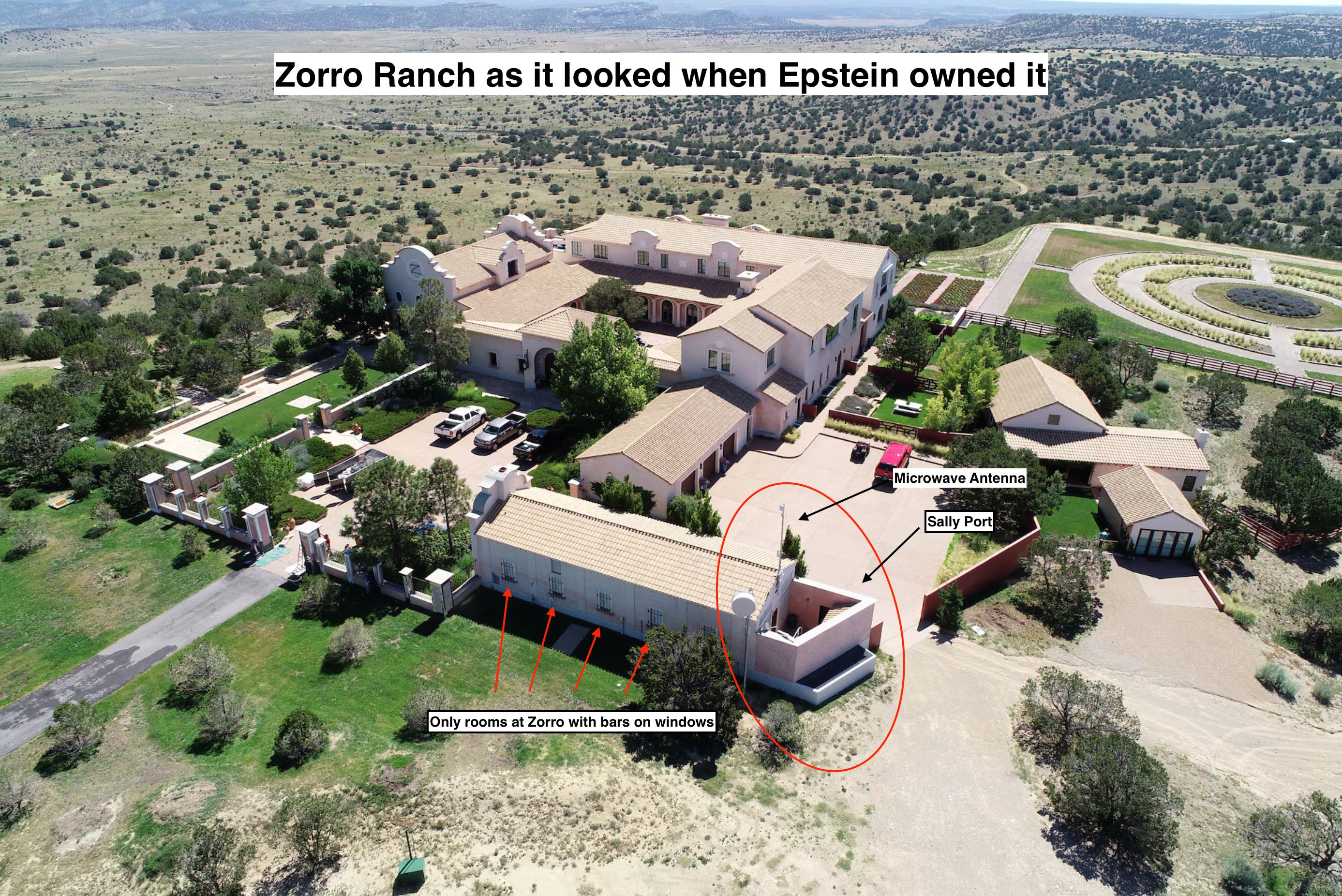
Epstein is widely described in corporate news stories as a “disgraced New York financier” who called himself a money manager for billionaires, though nobody has ever fully explained where his own fortune came from. He was superficially charming, good-looking in an evil Barney Rubble kind of way, spectacularly well connected, famously NOT well hung, and seemingly everywhere a scumbag rapist working for foreign and domestic military intelligence operations might benefit from being: on private jets with former presidents, at dinners with princes, at the elbows of Nobel laureates. He owned a Manhattan townhouse said to be the largest private home in the city, a mansion in Palm Beach that Donald Trump competed with him to buy, an apartment in Paris, a 10,000-acre rape-ranch in New Mexico that he bought from the then sitting governor, and two — count ‘em, two — private islands in the U.S. Virgin Islands.

He also groomed, trapped, raped and otherwise sexually abused girls and young women, many of them minors, for decades. Survivors describe being recruited with promises of money, modeling work or help with college, then abused in his homes and passed to others, including former New Mexico governor and Jaba the Hut lookalike, Bill Richardson, and fellow Jaba the Hut lookalike, Alan Dershowitz. Well over a hundred survivors have since come forward. I believe them.

In 2008, after Palm Beach police built a case involving dozens of girls, federal prosecutors in Florida gave Epstein one of the most lenient deals in modern American criminal history. He pleaded guilty to two state prostitution charges, one involving a minor, served about 13 months in a county jail, and was allowed to leave six days a week on “work release.” In July 2019, federal prosecutors in New York finally arrested him on sex trafficking charges. A month later he was found dead in his cell in a Manhattan federal jail. The medical examiner ruled it a suicide. A great many people have their doubts.

His longtime partner, the British socialite Ghislaine Maxwell, was convicted in 2021 of helping recruit and groom girls for him and is serving 20 years in federal prison.

Here in New Mexico, Epstein never even got to the point of needing a “sweetheart deal” from the U.S. Attorney for the District of New Mexico, as he had gotten from Alex Acosta, the U.S. Attorney for the Southern District of Florida. That’s because what happened in New Mexico was worse than what happened in Florida, and the U.S. Attorney appointed to New Mexico the year Epstein bought his ranch here was also Epstein’s personal power of attorney for the purchase of that ranch. I’ve been screaming this into a void for nearly a year now, and zero national media outlets have bothered to give a fuck.

What, and why

Most of the reporting on Jeffrey Epstein, much of it brave and essential, has focused on what he did and to whom. Good. That’s important. But I want to know why he did it the way he did.

Consider how a man whose only goal was sexually abusing and trafficking children might behave. He’d keep his head down, like most such monsters do. He’d buy unassuming property quietly, through strangers. He’d hire anonymous contractors, and keep his distance from anyone with a badge, a vote or a security clearance. He would do his best not to be noticed.

Epstein did the opposite, every single time.

He bought his New Mexico ranch from a sitting governor, Bruce King. The ranch shared a fence line with Henry Singleton, co-founder of the defense giant Teledyne and a veteran of America’s O.S.S. wartime spy agency, and the two properties were tied together by private communications lines. The private home phone numbers of both King and Singleton were in Epstein’s little black book. To build his mansion, Epstein hired Bradbury Stamm, an industrial contractor here in New Mexico, whose specialty is building top-secret facilities for the nuclear weapons labs. Epstein filled his homes with Nobel laureates and other nuclear weapons scientists, cabinet secretaries, a future Israeli defense minister and a former president. He sought out the people who make foreign policy that impacts the Middle East, and the scientists who invent and build weapons of mass destruction, and he made sure they owed him, by any means necessary.

A man who wants to hide, which is what most pedophiles are, does the reverse. Epstein was building access to the richest and most powerful people on earth. Most analysis of this I’ve seen has said prestige was the camouflage: the more powerful his friends, the less anyone looked closely at his guests. But I think that’s a stupid read of what Epstein was doing. I don’t think camouflage is why he cultivated the particular Rolodex he had. I think access to military intelligence secrets and power over those who rule the world was.

His interests were consistent. Money. Politicians who could shape foreign policy. And, above almost everything, the science of the American weapons complex, from the nuclear labs he moved next to in New Mexico the 1990s to the artificial intelligence and quantum computing he funded later.

The question my work now asks is simple: We know what he did; we are starting to see why.

But who was all that access for? Surely not for Epstein himself.

He worked for someone else.

The hypothesis

Here at THE PUGILIST, we have a working theory, and I want to lay it out plainly so you know exactly what I’m testing.

We believe Epstein’s crimes served at least one foreign intelligence operation, possible more than one, with the passive and perhaps active assistance of United States military intelligence. We believe the sexual blackmail and helpful funding of research etc (bribery) his operation made possible had a purpose beyond pleasure or protection: access, at least at the start, to America’s most advanced weapons technology.

And we believe Epstein didn’t invent this machine. He appears to have stepped into one that was already running and had been for a while, a ring for gathering compromising material and intelligence of which Ghislaine’s father was a part, and which his three daughters all continued to carry forward after his death.

To understand why, you need to meet him.

The father

Robert Maxwell was a Czech-born British media baron who owned newspapers, publishing houses and a yacht named for his youngest daughter, Ghislaine. He is said to have made his first fortune with Pergamon Press, a scientific publisher that built its empire by publishing Soviet science in the West, which gave him entry to laboratories and governments on both sides of the Iron Curtain. He was suspected, at various times, of working for British intelligence, the Soviet KGB and Israel’s military intelligence agency, the Mossad. It’s very likely his main loyalty was to Israel, and his European, Soviet and United States connections were in ultimate service to the Mossad.

Ari Ben-Menashe, a former officer in Israel’s military intelligence, has said publicly that Robert Maxwell was a longtime Mossad agent, and that Maxwell brought both his daughter Ghislaine and Epstein into Israeli intelligence work. The investigative journalist Seymour Hersh, in his 1991 book The Samson Option, reported Maxwell’s ties to Israeli intelligence and his role in the affair of Mordechai Vanunu, the technician who exposed Israel’s secret nuclear weapons program. Maxwell denied all of it, calling Ben-Menashe’s claims “a total invention.” Which is exactly what a spy would say.

In earlier installments, I’ve covered a lot of this already. I’ve reported how Maxwell sold PROMIS software into Los Alamos and Sandia, America’s two most powerful and influential nuclear weapons laboratories, both in New Mexico, where the nuclear bomb was invented. PROMIS was a powerful case-tracking program built by a small Washington company called Inslaw for the U.S. Justice Department. Inslaw’s owners accused the government of stealing it, and witnesses later claimed copies had been fitted with a secret back door and sold to intelligence services around the world, Israel’s among them. Ben-Menashe swore in a 1991 affidavit that Israeli spymaster Rafi Eitan had obtained the software and that Maxwell helped market the doctored version.

One reporter was chasing that story harder than anyone. Danny Casolaro, a freelance journalist in Virginia, was tracing the stolen software and the web of spies, arms dealers and officials he called “the Octopus.” In August 1991 he traveled to Martinsburg, West Virginia, telling friends he was about to meet a source who would break the case open. On August 10, 1991, he was found dead in the bathtub of his hotel room, his wrists slashed. His notes were never found. Police ruled it a suicide. His family never believed it.

Twenty-eight years later, to the day, on August 10, 2019, Jeffrey Epstein was found dead in his jail cell. Also ruled a suicide.

August 10 is not without significance for Israel. It is the date in A.D. 70 when Roman troops destroyed the Second Temple, a tragedy that ended ancient Jewish sovereignty and often coincides with the national fast day of Tisha B’Av. Today, Israel commemorates this loss through a 25-hour fast, solemn gatherings at the Western Wall, and the mandatory closure of public entertainment venues across the country. In 1920, The Treaty of Sèvres that paved the way for the establishment of the British Mandate for Palestine, which was eventually used to create the nation of Israel, was signed on August 10. And in 2005, just days after resigning from his post as Finance Minister to protest the upcoming Gaza Disengagement Plan, Benjamin Netanyahu delivered a major speech to the Knesset on August 10; that speech led to the political schism that reshaped modern Israeli politics and enabled the current genocide in Gaza.

Three months after Casolaro died, Robert Maxwell went off the side of his yacht near the Canary Islands. He fell, jumped or was pushed; the question has never been settled. He died. He was buried on the Mount of Olives in Jerusalem. Israel’s prime minister, its president and at least six current and former heads of Israeli intelligence came to see him off. That’s quite a turnout for a mere newspaperman.

Two years after that, in 1993, Maxwell’s daughter Ghislaine led Epstein to New Mexico, where, with her guidance, he bought a 8,000-acre ranch south of Santa Fe, about 50 miles as the crow flies from Los Alamos National Laboratory to the north and about 35 from Sandia to the southwest: the very labs her father’s software had reached.

Ghislaine has told the United States Justice Department that her father’s scientific contacts led her to introduce Epstein to the Santa Fe Institute, a think tank founded by Los Alamos labs veterans, including physicist Murray Gel-Mann, whose main research partner was Yuval Ne’eman, the scientist who served in Israel’s Knesset and oversaw the exodus of Jewish Soviet nuclear weapons scientists (the “refusniks”) to Israel during the 1980s and 1990s. Epstein went on to fund Gel-Mann’s work in New Mexico, and won his loyalty.

Ghislaine’s dad made it possible for Israel to spy on New Mexico’s weapons labs during the Cold War.

His daughter and her supposed romantic partner—a man who in truth did not like adult women—moved in next door as it ended.

The asset question

Epstein has been identified as an asset or operative of Israeli intelligence by people in a position to know, or to have heard. The United States news media, both corporate and independent, largely ignore this. I’m not sure why.

Ben-Menashe has said Epstein was Mossad. Former CIA officer John Kiriakou, an Abu Grahb whistleblower who served time for exposing the U.S. government for torturing prisoners in violation of international law, has also said he believes Epstein was working for the Mossad, and has called Epstein “a construct,” a creation of intelligence rather than a self-made man. And according to reporting by Vicky Ward, Alexander Acosta, the federal prosecutor who signed off on Epstein’s 2008 sweetheart deal, told Trump transition officials he’d been told to back off because Epstein “belonged to intelligence.” Acosta has never confirmed saying it. Israeli officials, including former Prime Minister Naftali Bennett, have flatly denied that Epstein ever worked for the Mossad. But that’s exactly what a spy agency would say.

Once I began to see the pattern in New Mexico, a question followed me around like a stray dog: if the ranch was about the labs, what were the other houses about? This installment is about the islands.

A note on method, because you deserve one. A hypothesis is a question with its sleeves rolled up. Some of what follows is documented in primary records. Some is reported by others, and I’ll say so. Some is simply geography, the kind of proximity that starts an investigation rather than ending one. I’m a novelist by trade as well as a reporter, and I know a good plot when I see one. I also know that real life rarely ties its bows so neatly, which is why I’m going to the archives.

Paradise, with a military map underneath

The U.S. Virgin Islands are an American territory in the Caribbean, east of Puerto Rico: three main islands, St. Thomas, St. John and St. Croix, plus dozens of smaller ones scattered in water so blue it looks retouched. The United States bought them from Denmark in 1917, mostly to keep Germany from getting them. Strategic military and commercial value, it turns out, is the oldest real estate tradition in the islands.

Epstein’s island, Little St. James, is a 70-acre knob of green just off the east end of St. Thomas. In news coverage it’s usually called a playground for the rich. For the girls and young women who survivors say were flown there and abused, it was something much darker, and that should always come first. It was a rape island. A place where children were taken, trapped and raped by some of the most powerful men in the world.

But spread out a military map of the region and the island takes on another identity.

For most of the Cold War, the waters around Puerto Rico and the Virgin Islands were one of the Navy’s most important training and testing grounds in the hemisphere. A declassified Pentagon history of where America kept its nuclear weapons, analyzed in the Bulletin of the Atomic Scientists in 1999, lists Puerto Rico, which lies 86 miles from Little St. James, among the storage sites, beginning in June 1956. In the mid-1980s, a commission of the Puerto Rico Bar Association concluded that Naval Station Roosevelt Roads, on Puerto Rico’s east coast, had been prepared as a nuclear command center, with facilities for anti-submarine nuclear weapons, and that nuclear-armed ships and submarines routinely called at the island’s bases.

Off St. Croix, 56 miles from Little St. James, the Navy built an underwater tracking range covering about 400 square nautical miles, wired with listening devices that let it follow submarines and torpedoes in three dimensions. Its purpose was anti-submarine warfare: the art of finding the enemy’s nuclear submarines before they could fire. The Navy also kept installations on Crown Mountain, the highest point on St. Thomas; it is 10.5 miles from Little St. James.

In 1997, a Navy photographer snapped a picture of the USS Maryland, an Ohio-class submarine carrying Trident nuclear missiles, at Roosevelt Roads, 45 miles from Little St. James.

The following year, Jeffrey Epstein bought that island.

Roosevelt Roads closed in 2004. Last November, the Pentagon quietly reopened it, and thousands of troops have trained there this year. The neighborhood, it seems, never stopped mattering. It just stopped making the news. And it has never, until today and this publication, made the news in association with Jeffrey Epstein.

The man who built the bomb

A short 6-mile boat ride across the channel from Little St. James lies St. John, the smallest and wildest of the three big islands. And on St. John, on a crescent of sand called Hawksnest Bay, the most famous scientist of the 20th century went to recover after his own country broke him.

J. Robert Oppenheimer led the Manhattan Project, the secret wartime effort at Los Alamos, New Mexico, that built the first atomic bombs. After the war he became a celebrity and a skeptic, warning against a race to build the far more powerful hydrogen bomb. That made him powerful enemies in the United States government. In 1954, after a closed hearing in which his left-wing friends, his marriage and his old evasions were dragged into the light, the Atomic Energy Commission revoked his security clearance. The man who had held America’s deepest secrets was barred from them. If someone were hoping to access those secrets, this news might have made forging a neighborly friendship with Oppenheimer a rather attractive proposition.

That same year, Oppenheimer, his wife Kitty and their children began spending months at a time on St. John. They bought a corner of land at Hawksnest from the Gibney family, built a modest cottage on the beach, and spent their days sailing. Old friends from Los Alamos came to visit, among them Dr. Louis Hempelmann, who had run health and radiation medicine for the bomb project. Years later, Hempelmann recalled in an oral history that Oppenheimer still feared he was being followed and recorded.

He was right to think more than one government was interested in him. In June 1954, the very week the New York Times reported that Oppenheimer had been declared a security risk, Meyer Weisgal of Israel’s Weizmann Institute of Science showed up at Princeton to recruit him and invite him to Israel. In 1958, Oppenheimer went, to help dedicate Weizmann’s new institute for nuclear science. He met with Israel’s founding prime minister, David Ben-Gurion, at his own request. Ben-Gurion told his cabinet afterward that he sensed in the American “some sort of Jewish spark.” Oppenheimer returned again to Israel in 1965.

Those were exactly the years Israel was secretly building its own atomic weapons at a desert site called Dimona, with a reactor bought from France in a deal negotiated in Paris.

Oppenheimer died in 1967. Kitty scattered his ashes in the water off Hawksnest. When their daughter Toni died in 1977, she left the beach property to “the people of St. John.” For three years it sat under the control of her executor, a former New Jersey governor named Robert Meyner, while the Gibneys fought the gift and vandals worked over the house. The territorial government finally took title in February 1980.

What was in that house when Toni died, and what the government received, are among the questions taking me to the islands. The other question is What did the neighbors know—and who were they?

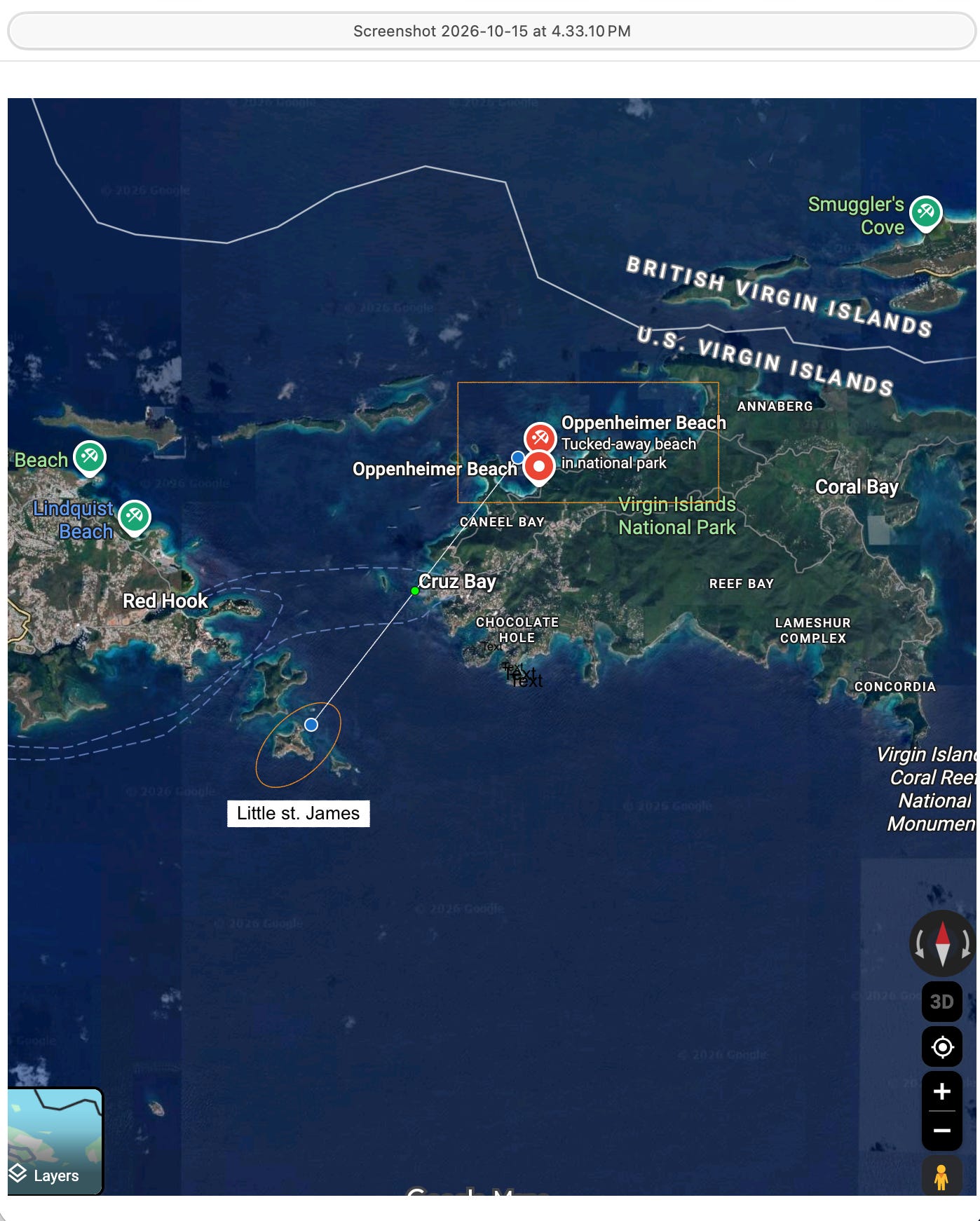
Interestingly, when I first took a screenshot of the Google Maps search I did for Oppenheimer’s Beach less than a month ago, on October 15, 2026, I posted it as a note on Substack and Facebook. Today, as I was preparing this piece you’re reading now, I did the same Google Maps search and found that Oppenheimer Beach no longer appears anywhere on the map. It has been replaced by “Gibney Beach” instead. When I checked Apple Maps to see if they had also replaced Oppenheimer Beach with Gibney Beach in the three weeks since I posted the image of Oppenheimer Beach, I found the same thing. Oppenheimer Beach had been erased from public online maps. That both Google and Apple had done this indicates an order coming from the United States government to change the map. Here is the October 15, 2026 screenshot, followed by how it looks today. I ask you, if I am just a “crazy” person, why would the United States government make changes to the map in the three weeks since I first posted about the proximity of Oppenheimer Beach to Little St. James? So far, I’m the only reporter who has made this connection. And, no, none of this is comforting. In fact, it’s terrifying.

The neighbor who bought an island

Oppenheimer’s most powerful neighbor was Laurance Rockefeller: Navy veteran, investor in aviation, adviser to five presidents, and grandson of John D. Rockefeller, the man who built Standard Oil into the most powerful company on Earth.

Laurance first saw St. John in 1952 and fell in love, the way rich men fall in love with irreplaceable beautiful things they can buy. He quickly learned that the name Rockefeller doubled the asking price, so he worked through agents and intermediaries, quietly buying up most of the island. Among his purchases was Caneel Bay, right next door to Hawksnest, which he bought from a complany called Textron, a conglomerate that would soon go into the military helicopter business. In 1956, his foundation handed more than 5,000 acres to the federal government to create Virgin Islands National Park. Even a friendly local historian concedes that “there were issues” with how some of that land was obtained from island families.

If you’ve been reading my New Mexico work, that sentence probably made the hair on your arms stand up. Powerful outsiders, quiet buyers, titans of industry in oil and defense contracting moving in, local families losing land. The Caribbean has its own version of that story.

Rockefeller kept land on St. John until he died in July 2004. For six years, he and Jeffrey Epstein were landowners in the same small cluster of islands.

The man who sold Epstein the island, and his father

In April 1997, the Wall Street Journal ran a small real estate notice: Little St. James, for sale, $10.5 million. The owner was a venture capitalist named Arch Cummin. The island already had its main house, guest cottages, a caretaker’s cottage, a desalination plant, a helipad, a dock and the oval swimming pool that would later appear in so many grim photographs.

In April 1998, a company called L.S.J. LLC bought it for $7.95 million, about $2.5 million below the asking price. The company had one member: Jeffrey Epstein.

Now for something that, as far as I can tell, has never been reported anywhere.

Through primary sources, I’ve established that Arch Cummin’s father, Pearson Church Cummin Jr., was an officer with the Ritchie Boys. If that name is new to you, it was to me too, not so long ago. The Ritchie Boys were trained at Camp Ritchie, a secret Army school in the Maryland mountains during World War II, in the dark arts of military intelligence: interrogating prisoners, mapping enemy forces, waging psychological warfare. About 20,000 men passed through. Roughly 2,000 were German-speaking Jewish refugees who had fled Hitler and went back to fight him. Several Ritchie Boys went on to careers in the CIA.

Camp Ritchie’s neighbor in the Catoctin Mountains was the OSS’s own secret training camp, where America taught its first generation of spies and saboteurs. Today that ground is better known as Camp David.

Henry Singleton, Epstein’s next-door neighbor at the New Mexico ranch, served in the Office of Strategic Services, America’s wartime spy agency and the forerunner of the CIA. So did Donald Barr, the headmaster of Manhattan’s elite Dalton School, who in 1974 hired a 21-year-old college dropout named Jeffrey Epstein to teach math to the children of the powerful.

The man who gave Epstein his first job, the man who lived next to his ranch, and the father of the man who sold him his island all came out of America’s wartime intelligence services.

How Cummin came to own Little St. James, and who brokered its sale to Epstein, are next on my list. Those documents are nowhere to be found online, and will necessitate a trip to the Virgin Islands, if I can raise funds for it.

Bring on the geniuses

Once he had the island, Epstein began filling it with brilliant people.

In April 2002, he paid for the St. Thomas Common Sense Symposium, a gathering of about 20 pioneers of artificial intelligence. Among them were MIT’s Marvin Minsky, one of the founding fathers of the field, and the team behind Cyc, an ambitious, decades-long attempt to teach computers common sense, long backed by Pentagon research money. Epstein sent a boat to carry the guests out to Little St. James. One attendee later recalled that Epstein was convinced AI would become enormously important. He was right about that, at least.

In 2005, he paid the Virgin Islands Water and Power Authority to lay a power and fiber-optic cable from St. Thomas to his island, giving it a dedicated line for data.

In March 2006, he paid for a physics conference on St. Thomas called “Confronting Gravity,” organized by the physicist Lawrence Krauss. The guests included Stephen Hawking, whom Epstein took for a ride in a specially modified submarine.

Artificial intelligence. Cosmology. And later, back in Massachusetts, quantum computing. Over the years, Epstein’s science money tracked the frontier of the technologies the Pentagon cared most about, as the focus shifted from nuclear weapons to directed energy weapons and AI. That might be coincidence. It might be a sleazy pedophile who simply liked smart company and entertained it in the strategic epicenters of U.S. weapons research. Or it might be something bigger. I’d like to find out which.

The second island

In January 2016, Epstein bought the island next door, Great St. James, which is more than twice the size of his first. Its main owners, the family of a Danish politician, had refused to sell to him years earlier. This time, according to the Miami Herald, Epstein bought through a company called Great St. Jim LLC and listed as its owner Sultan Ahmed bin Sulayem, the Emirati chairman of the global ports giant DP World, against the sultan’s will. Epstein paid $17.5 million for the Danish family’s land and $5 million for the rest.

His building permits for the new island called for a barge dock, a marine electrical cable, a solar array, a machine shop, a security building and something described as an “underwater office.”

An underwater office. Hold that thought. He died before most of it was built.

Friends in high places

A private island surrounded by military history needs friends on shore, and the record suggests Epstein had them.

Cecile de Jongh, the wife of John de Jongh, governor of the Virgin Islands from 2007 to 2015, worked for years for Epstein’s company in St. Thomas, according to filings in the territory’s own lawsuit against JPMorgan Chase. Epstein’s businesses enjoyed generous tax breaks from the territory’s Economic Development Commission. When an attorney general finally came after his money, she didn’t last long. Denise George sued Epstein’s estate in 2020, sued JPMorgan in late December 2022 for enabling him, and was fired by Gov. Albert Bryan days later.

I’ll have much more on the de Jongh years, and on what changed after they ended, in a future installment.

What I still need

Proximity is where an investigation begins. To turn this map into proof, I need paper, and most of it has never been scanned. It sits in courthouses in Charlotte Amalie, in archives in Washington and Princeton, and in filing cabinets nobody has opened in decades. Here’s what I’m after:

  • The deed history of Little St. James before Arch Cummin, and the broker’s file on the 1998 sale.

  • Toni Oppenheimer’s probate file, and an inventory of what the territory received in 1980.

  • Navy records on the St. Croix range and the Crown Mountain installations from 1998 to 2004, the years Epstein’s island and the nuclear-era Navy overlapped.

  • Oppenheimer’s papers at the Library of Congress, for any visitor to St. John we don’t yet know about.

  • Epstein’s flight logs and emails, cross-checked against Navy personnel, defense contractors and foreign officials.

How you can help

THE PUGILIST is reader-funded, full stop. Flights to St. Thomas, court copy fees, archive hours and island coffee add up. If this work matters to you, please consider becoming a paid subscriber or leaving a tip. Every dollar goes straight into the reporting.

And if you know something, whether you served at Roosevelt Roads or on the St. Croix range, grew up on St. John, worked on Little St. James, or remember who was selling islands in the late 1990s, my inbox is open. Sources are protected.

The map is on the table. Let’s go find out who drew it.


Subscribe now

Share

Buy Me a Coffee

Read the whole story
mikemariano
3 days ago
reply
Share this story
Delete

Reflections on Being Kidnapped by Border Patrol

1 Share

Laura Rethmann CounterPunch

Last Wednesday, Border Patrol detained me for nearly twenty hours.

I have never felt my citizenship more acutely than I did in detention. Not when I first held my passport, not when I cast my first ballot, not in any of the moments when citizenship is ceremonially affirmed. I felt it there, where my freedom was uncertain but my privilege was not.

I won’t go into what happened before I was placed in handcuffs, but I do want to talk about the hours that followed.

A comrade and I arrived at the Border Patrol station after an hour and a half of being jolted around in the back of a hot, bumpy truck. After cuffing us, officers had driven us to three different locations, each time attempting to transfer us to a transport vehicle, only to find no one available, or willing, to take responsibility for us. Eventually, they drove us themselves, lurching over uneven dirt roads as the heat and motion left us increasingly carsick. Plastic water bottles rolled just out of reach at our feet. When we protested the reckless driving and told the officers we were feeling sick, one officer assured us, “I am actually one of the chill guys.” He offered this as reassurance, as though he was doing us a favor, as though we should feel fortunate to be in his custody rather than that of officers who might treat us worse. We were relieved when the truck finally stopped and we were led through the station’s metal gates where our cuffs would finally come off before the first search and the seizure of our possessions.

With four other officers looking on, an officer instructed us to stand, one by one, as they patted down our bodies, made us shake out our bras, and ordered us to remove the laces from our shoes. They took any extra layers of clothing we had on and packaged up our belongings, placing them on a shelf along the wall. That was when I noticed the baby seats lined up among the confiscated possessions. To my right, strollers jammed beneath the stairs.

It took me a moment to understand what I was seeing. These were the remnants of children’s lives, ordinary objects that had somehow been absorbed into the machinery of detention. The children themselves were nowhere in sight. I did not encounter the human bodies that filled those car seats, but their absence was made tangible by the items left behind. I imagined the chain of events that was required to bring each object here. The journeys, the apprehensions, the separations, the moment a stroller and car seat ceased to be an ordinary necessity of caring for a child and became another instrument entangled in the machinery of separation. I could not know where those children were now, whether they were nearby or far away, whether they were still with their parents or had been taken somewhere else.

Everything in that room had been reduced to almost nothing: bodies to be searched, clothing to be removed, possessions to be packaged and put away. And yet, among that nothingness, these objects insisted on the fullness of the lives they belonged to. A pink car seat. A toddler’s purple polka dotted booster seat. Ordinary things made unbearable by the people they silently testified to, and by the uncertainty of where those people had gone. I stood there in the strange in-between of presence and absence, surrounded by evidence of lives that had passed through this place, traces of people who were no longer visible. Humanity, reduced to its traces. I stood among the ghosts of children whose stories I would never know, left to wonder how many lives had passed through this room and where, beyond these walls, they had gone.

The devastation came in pieces, each detail making the last harder to stomach. “Avelino,” “Mercado,” “Checo”- names scratched into the cell benches as proof of people who sat there long enough to need to leave some evidence that they had existed. Outside the interrogation room sat a child’s bead maze, the kind found in doctors’ offices. Outside a cell labeled “unaccompanied juveniles” hung children’s artwork of superheroes and flowers. Across the detention center, large cartoon posters announced “You have a right not to be assaulted.”

What kind of place needs to remind people that they have a right not to be assaulted?

The first holding station was as uncomfortable as one might imagine. Everything was concrete. The cold benches were too narrow to lie down on, too hard to rest against, offering no position in which the body could settle. A short concrete dividing wall provided the slight suggestion of privacy around a communal combination metal toilet-sink. Above it, signs read NO AGUA POTABLE. A posted warning explained that the station violated water testing requirements and that the water contained dangerously high levels of nitrates, associated with “blue baby syndrome,” a condition where infants’ blood cannot carry enough oxygen, turning their skin blue.

The fluorescent lights blazed overhead, day and night. Eventually, we were given mattress pads and emergency blankets made of thin, reflective foil. Every movement made them crackle. We tried to lie as still as possible, minimizing even the small sounds of shifting bodies, listening to the blankets rustle whenever someone moved. Even rest required a kind of collective stillness.

And yet, despite the handcuffs, the concrete, and the hours of confinement, my comrades and I were treated relatively well. The officers seemed unsure how to behave around us. They had detained us, but we were citizens, and that appeared to complicate their understanding of how they were supposed to act. “We aren’t used to dealing with people like you,” “this is all new for us,” they would say while struggling to fill out our paperwork or attempting to guess what would happen to us next. We seemed to present a contradiction they couldn’t resolve. We were people they had detained, but people they understood they were supposed to treat differently.

Occasionally, an officer would barge into the cell shouting orders and threatening us if we did not comply. My comrades and I would joke that they’d briefly forgotten we were the kind of people they recognized as human. Soon enough, the aggression would recede, and the officer would return to a more accommodating demeanor.

When time had lost all meaning and the next morning’s sun finally rose, my comrades and I were transferred to the Tucson Sector Station. This time, we were marched onto a large prison bus. Inside, rows of detained migrants sat waiting.

I slid into the first row, in front of a woman whose face was swollen and black-and-blue, her wrists still cuffed. Yet as I stepped on the bus, I caught her wide, beautiful smile and the cheeky, playful spark in her eyes. Throughout the drive, she would say something amusing in Spanish to the person beside her, then erupt into a deep, full-bodied laugh. Otherwise, the bus was heavy with exhaustion, fear, and anguish. In the row beside the beat up woman radiating joy, a mother sat silently holding her daughter, the child’s head resting against her shoulder. Toward the back of the bus, beyond the metal gate separating the men from the women, men sat with tears in their eyes, looking terrified.

The relief I’d been holding onto all night that I’d soon return home curdled as I took them in.

The woman behind me, the mother beside her, the men in the back – their futures were in the hands of a state that had already reduced them to fingerprints, paperwork, cells, bus routes, and decisions made by people they would probably never know. I could imagine my life resuming but, at that moment, it just made me feel sick.

I leaned my head against the metal bars covering the bus window and watched the sun rise over the Sonoran Desert. The mountains glowed in the early light, their exposed ridgelines cutting into the vast, open sky. Still green from the rains, the desert bloomed among the saguaros and creosote. It is one of the most beautiful ecosystems I have ever seen. I turned to the comrade beside me and asked about their ecological restoration work in the region and about the watersheds they worked to restore. I wondered what the people sitting behind us thought as they looked out over the same landscape.

For people crossing this same desert on foot, it could mean something entirely different. Thirst. Exposure. Death. I could sit behind bars and marvel at its beauty. Others had to cross it at the risk of their lives. We shared the same landscape, but not our relationship to it.

In that moment, and in every moment since the confused, ambivalent agents threw us against their trucks, citizenship revealed itself not as an abstract legal status, but as a mark inscribed on our bodies. A mark that set us apart from the others. It moved us to the front of the intake line while others waited behind another chain link fence. It sent us to a different holding block, earned us an extra Suncup, and granted officers the absurd privilege of looking us in the eyes. Nothing about our bodies had changed. Yet a line had been drawn between us and the people standing just beyond it. A line that reorganized the world around us. Citizenship was not simply something we possessed. It was something that acted upon us, sorting our bodies, redistributing dignity. It was a border that traveled with us, a border reproduced inside the trucks, the holding cells, and intake lines- wherever the state decided who counted, who waited, and who could be seen. Citizenship was a line drawn through a bus full of people.

The line was not drawn based on who was kind or dangerous, who was a parent, who was afraid, who had suffered, or who deserved to go home. It did not measure our humanity. It sorted us. And I knew which side of that line I was likely to end up on. For the first time, I felt its violence not as an abstraction but as a force acting on the bodies around me, determining what could happen to them.

Hours later, after more “for institutional use only” meals in another cold, cement-walled cell, we were finally processed out. Officers checked paperwork and retrieved our possessions, still sealed in Department of Homeland Security plastic. Then a second-generation Mexican American Border Patrol officer stopped her checklist to ask, again, whether my comrades and I were citizens.

When my Indigenous comrade answered, “Unfortunately,” the officer stopped checking her paperwork. Looking my comrade dead in the eyes, she began screaming at us about how grateful we should be to be United States citizens.

“Look around you,” she said pointing at the two dozen migrants just being marched off of the latest bus. “All these people risked their lives to cross the border. You should be fucking grateful!”

I keep returning to the cruelty of that demand.

Be grateful. Be grateful that you are a citizen of the state that colonizes and murders your people. Be grateful that you are included. Look at their suffering. Look at what could happen to you. Look at how much worse it could be.

Be grateful that the state has given you reason to believe it will let you go.

Yet the officer did not see that the only reason crossing a border is such a risk to people’s lives is because of the very system she helps enforce. The desert is not dangerous by accident. Migration is not inherently deadly. The risk to life is produced by the walls, checkpoints, armed patrols, surveillance, detention, deportation, and policies designed to push people into more remote and deadly terrain.

The state creates the conditions that make people suffer, then points to their suffering as proof that we should be grateful to stand on the safer side of the line. The state creates the danger, then presents surviving it as a gift.

This is why the fight against the border wall is connected to ICE in our towns, to police surveillance, to detention centers, to the destruction of Indigenous land, and to every system that decides which people are disposable. These systems are not identical, but they share a logic. They sort people into categories of worth, distribute safety unequally, and make the resulting violence appear natural, necessary, or deserved.

They also recruit people to enforce that violence.

They offer a uniform, a badge, a paycheck, a measure of authority, and the promise of belonging. They invite people to turn that authority against others who look like them, come from where they come from, or carry histories that overlap with their own. They offer a place inside the machinery in exchange for helping keep it running.

I believe one of the cruelest things empire does is offer belonging on the condition that we accept someone else’s exclusion. It tells us we can be safe by helping make others unsafe, worthy by agreeing that someone else is not. It teaches us to mistake proximity to power for liberation, and survival within a violent system for proof that the system is just.

Perhaps the officer believed she was defending something valuable. Perhaps she thought she was reminding my comrade of a privilege she should appreciate. But what she was defending, in that moment, was a hierarchy in which citizenship became a reason to demand gratitude rather than a reason to question why some people were caged while others were permitted to leave.

I do not need to know what she believed about herself to recognize the function of what she was doing. And I cannot pretend that this machinery only implicates people like her. It implicates me too.

I knew I was likely going home. My citizenship had not kept the state from putting me in handcuffs, but it gave me reason to expect that my detention would end. I could imagine my life continuing beyond those walls because I had reason to believe the state would let me leave. Whatever else I experienced there, I had a relationship to citizenship that many of the people around me did not share. I could be frightened by the machinery without having to fear that it would permanently absorb me.

I do not want to turn this experience into a story about how much I learned, how deeply I felt, or how morally transformed I became. The people on that bus were not there to teach me a lesson. Their suffering was not an instrument for my political awakening. They were people caught in a system that had the power to decide what happened to them, and I was a person who could recognize, in that moment, that the same system was likely to let me go.

Instead, I hope this reflection can be a call to action.

Compassion can coexist quite comfortably with domination. We can feel terrible about detention centers and still accept the premise that some people must be detained. We can donate to mutual aid, volunteer with immigrant organizations, and express outrage over deportations while treating the citizenship that protects us as an unquestioned entitlement. We can become very good at tending to the wounds of a system we have no intention of dismantling. We can care about people and remain loyal to the arrangements that hurt them.

This is not an argument against care. Mutual aid, solidarity, and the work of keeping one another alive matter greatly, especially in a world organized around abandonment. But care is not inherently oppositional. It can relieve suffering without challenging the conditions that produce it. When we care for those harmed by a system without questioning the privileges that system extends to us, our compassion can become a way of reconciling ourselves to the very arrangements we claim to oppose.

The question, then, is not whether we care, but what our care asks of us.

We have to become traitors.

Not because we are morally pure. Not because we have never participated in harm. Not because we have figured out how to live without contradiction. But because the opposite is true. We have participated. We have benefited. We have been taught to call that benefit normal, deserved, or inevitable. To be a traitor is not to claim moral purity from outside the system. There is no clean outside from which to condemn the world and declare ourselves free of its violence. We have to begin by recognizing that we are implicated, that the arrangements we inherit are reproduced through our everyday choices, and that refusing them requires more than good intentions. We will not unlearn it all at once. There will always be another complicity to recognize, another loyalty to question, another way we have mistaken our comfort for justice. We do not have to be good at being traitors. We just have to be willing to become them.

To become a traitor is to betray the person you were yesterday, to betray the loyalties that have taught us to accept violence and call silence solidarity. It is to recognize that the things you failed to question yesterday can be questioned today, and that yesterday’s failure is not today’s absolution. We can be wrong, be confronted, change course, and try again. The point is not to emerge innocent on the other side of our politics. The point is to stop making our innocence the condition of our participation.

We have to betray the values that make borders seem natural, detention necessary, and legality synonymous with morality. We have to betray the comfort that depends on someone else’s confinement. We have to betray the story that our safety is proof of our goodness. We have to betray the institutions that ask us to accept cruelty as the price of order. We have to betray the people we love if loving them requires protecting their participation in harm. We have to betray the version of ourselves that needs to believe we are innocent.

And we have to betray whiteness—not as an identity we can simply disavow, or a stain we can wash away through the right politics, but as a system of power that distributes protection, legitimacy, and belonging through a racial hierarchy. The same is true of citizenship. To refuse its hierarchy is not to pretend that legal status has no material consequences. The people on that bus knew better. It is to reject the idea that those consequences reflect a natural difference in human worth, or that the protection afforded to some of us obligates us to defend the machinery that denies it to others.

I think of the officer who demanded gratitude for our citizenship. Her demand highlighted the bargain at the heart of whiteness, where belonging was offered in exchange for loyalty to the system that withholds it from others. Her proximity to that belonging did not depend on the color of her skin alone, but on her willingness to defend the boundaries of who deserved it. The state offered her a place within its machinery, and in that moment, she used that place to insist that we recognize its hierarchy as a gift. Refusing that bargain means acting against the arrangements from which we benefit, including, and especially, when doing so costs us something.

Betrayal requires being willing to lose something: comfort, approval, access, the easy belonging that comes from knowing the rules and staying on the right side of them. It means accepting that people may call us disloyal when we refuse to protect what they want protected. The cost of defection is real, but so is the cost of remaining faithful.

And we can not do this work alone or only inside ourselves. Our loyalties are sustained in relationships, in the groups that reward our silence, in the habits that make certain people easier to ignore, in the decisions we learn not to question. If complicity is reproduced collectively, defection must also become collective. We have to become capable of interrupting those habits together, of building the trust and collective courage to let that recognition change what we do next.

Defection is a practice that has to shape how we organize, what we build, and how we respond when our own institutions reproduce the violence we oppose. Sometimes, defection looks like naming the harm a strategy may reproduce even when the group is exhausted, the deadline is approaching, and everyone wants to believe we have finally found a way forward. It means being willing to risk your standing by saying that our urgency does not absolve us of the responsibility to ask whom we are acting for, whose knowledge we have ignored, and who will bear the consequences if we get it wrong. It also means building organizations in which that interruption can do more than expose someone’s courage, but also create one where the group is willing to pause, reconsider, and change course.

We need places where we can practice this together. Where we can tell the truth about our mistakes, interrupt one another without abandoning one another, and make different decisions based on what we learn. Collective accountability is neither unconditional affirmation or individual punishment. It is the difficult work of remaining in relation while changing what the group is doing. None of this guarantees that we will get it right. It just gives us a way to notice when we are getting it wrong, and to do something about it together.

There will be days when we retreat into old loyalties, when fear makes us defensive, when the cost of defecting feels too high. On those days, we must begin again. We can not wait until we are free of complicity to challenge the systems that implicate us. We can not mistake the impossibility of perfection for the impossibility of change. The call is not to be good traitors. It is to become traitors, and to keep becoming them. Repeatedly, deliberately, in the choices we make, the harms we confront, and the loyalties we refuse to protect.

As the backdoors of our final transport vehicle opened and we were released behind a McDonald’s parking lot, I understood that the border is not somewhere far away. It is in our towns, our institutions, our relationships, and the choices we make about who deserves protection and who can be sacrificed. The border is the difference between being released and being left to wait, between being allowed to return to your life and having your future held in someone else’s hands. It is the machinery that makes one person’s freedom feel deserved and another’s a privilege to be withheld.

My citizenship did not prevent the state from detaining me. It gave me reason to believe the state would let me go. I cannot make that difference disappear by refusing to acknowledge it. But I can refuse the demand that I be grateful for it. I can refuse to mistake my relative safety for being free.

We have to defect.

Laura Rethmann is a scholar-activist committed to challenging systems of oppression and advancing movements for collective liberation. She can be reached at laura.etc@proton.me. For more on the struggle against the border wall, follow @tierralibre_noborders. 

Independent media needs voices that challenge power—and CounterPunch delivers, with sharp reporting, uncompromising commentary and perspectives pushed to the margins of corporate news. Explore CounterPunch for free articles and podcasts, and donate to help keep its reader-supported journalism alive.

Please share this story and help us grow our network!

Photo: Police arrest immigration reform advocates during a peaceful sit-in outside the White House on May 1, 2010, following Arizona’s passage of SB 1070. Photo by Arasmus Photo via Wikimedia Commons (CC BY 2.0).

Read the whole story
mikemariano
5 days ago
reply
Share this story
Delete

When The U.S. Virgin Islands Stopped Ignoring His Crimes In 2015, Epstein Moved His Main Operations To The Safety of New Mexico

1 Share

I offer all my news, investigations and analysis for free. But your support is necessary and appreciated. Please like, share, comment and subscribe, paid if you’re able. You may also leave a one-time or recurring tip in any amount. Just four $25 tips per day keep me writing full time. Thank you!

Buy Me a Coffee

Share

Subscribe now


In emails contained within the 3+ million publicly available documents in the Dept. of Justice Epstein files, we see that in 2014, notorious child sex trafficker, child rapist and likely intelligence operative Jeffrey Epstein started asking about upgrading the modest communications network at Zorro Ranch to something far more substantial.

Then he waited.

By 2016, he had stopped waiting.

Over those two years, the project drew in his inner circle: his ranch manager Brice Gordon, his accountant Richard Kahn in New York, his lawyer Darren Indyke, his New York IT consultant and “personal genius” James Ce, and Jermaine Ruan, the man he called “the lsj guy,” his communications contact in the U.S. Virgin Islands. They emailed one another and called others too. Local contractors like Richard Boltz of Advanced Communications an Technology in Albuquerque. The list also included a man described only as “Vito,” the manager of the San Cristobal Ranch next door to Zorro, owned by the family of former OSS officer Henry Singleton, who founded Teledyne, one of the most successful defense contractors in the world.

But why? Why was Epstein suddenly and anxiously demanding a new and extremely robust private network at the ranch? And why did Epstein want a communications network that a local contractor would later describe as military and industrial grade, at a place Epstein treated as a vacation property, and where, by the state’s own recent (and likely wrong) estimate, he supposedly spent only two to five weeks a year? (NM Truth Commission interim report)

The answer is hidden in plain sight.

Epstein commands his team to simply recreate at his New Mexico ranch the same private communications system had at Little St. James, his private island.

Little St. James was the first Epstein property to have a powerful microwave communications setup, far more than a remote vacation compound would need, be it an island or a massive ranch.

People have long speculated that Epstein used that Little St. James system to send secret communications in his various unsavory dealings there and in his other properties. Survivors have repeatedly said their rapes were video recorded and used by Epstein and Maxwell to blackmail powerful people, claims backed up by photo evidence in the DOJ files that show hidden spy cameras in clocks and other items in rooms owned by Epstein.

One can safely assume that if kompromat were being collected by them, Epstein and Maxwell would need a powerful closed private communications network for the transmission of such materials to whomever they worked for who needed powerful men blackmailed for them.

So, who were Epstein and Maxwell working for? That’s still a subject of debate and speculation. While there seems to be a concerted effort by certain “independent” journalists, such as Zev Shalev, to point the finger at Russia as the likely recipient of such blackmail materials from Epstein and Maxwell, this appears to possibly be deliberate misdirection, likely paid for by what The Pugilist considers to be the most likely true power behind the operation: Israel.

Ghislaine Maxwell’s father was an Israeli spy, as documented in the book Robert Maxwell, Israel’s Superspy by Gordon Thomas and Martin Dillon. Ari Ben-Menashe, a former Israeli intelligence operative and the author of the book Profits of War: Inside the Secret U.S.-Israeli Arms Network, has said he was tasked with “running” Epstein, and was the man to introduce him to the Maxwells. Perhaps most damning of all is that the voting, legislative and financial records of those men in Epstein’s potential blackmail orbit always ended up shifting after their association with him, to become strongly supportive, in one way or another, of the goals of the Zionist Israeli government. In New Mexico, those goals appear to have been connected to a task begun by Robert Maxwell in the 1980s, when he infiltrated the state’s nuclear weapons labs with software that had been bugged by Israeli military intelligence.

For many years, Epstein’s operation seemed to run smoothly and without interference out of the U.S. Virgin Islands. But by 2014, something there was making Epstein nervous about keeping the nexus of that massive private communications system at Little St. James.

For a while, he waited it out. Maybe hoping things would not get as bad as they could.

Then something happened, and he, seemingly spooked, stopped waiting. He started demanding. The new system in New Mexico, at Zorro Ranch, had to be built, and quickly.

There’s a reason for that. And the reason is this: As the walls started closing in around Epstein in the U.S. Virgin Islands, Florida and New York City, there was only one place left where he held a vast property, where had complete privacy, and where its leadership had been so easy to blackmail, bribe, or otherwise buy off that Epstein trusted no one in power there would ever betray him.

And that place, dear readers, was New Mexico.

The island, and the people who once covered for him

Little St. James was Epstein’s primary residence and, according to the Virgin Islands’ own attorney general, the center of his child (and adult) sex trafficking operation. She alleged that he lured girls and young women to the island, kept a computerized database to track those he could traffic there, and later bought neighboring Great St. James in part to keep anyone from watching. When sex-offender registry officials came to verify his address, they could go no farther than the dock unless Epstein or his staff invited them.

Epstein had been wiring the island for years. Steve Scully, who owned a telecommunications business on St. Thomas, told ABC News in 2019 that Epstein hired him in 1999 to build a communications network on Little St. James, and that over six years he visited the island more than 100 times. Epstein wanted phone or internet service almost everywhere on the 72-acre island, Scully said, including a secluded cove he called “the grotto.” He “never wanted a call to drop.” Scully said he walked away over what he saw there: groups of girls who appeared to be unsupervised and who “couldn’t have been more than 15 or 16 years old.”

Former U.S. Virgin Islands governor John DeJongh and his wife, Cecile, who collected $200,000 as a secretary year on Epstein’s payroll.

Epstein could operate that way because the territory’s government let him. From 2007 to January 2015, the Virgin Islands was governed by John de Jongh Jr. For that entire stretch, according to JPMorgan Chase, the governor’s wife, Cecile de Jongh, worked for Epstein as office manager of his St. Thomas companies. JPMorgan alleged she was paid as much as $200,000 a year, that Epstein paid the couple’s children’s tuition, and that in 2009 she certified Epstein was a “bona fide resident” while he was serving his Florida sentence. In 2011, according to the bank, she sent Epstein draft language for the territory’s sex-offender monitoring law and asked whether it would work for him. The de Jonghs have contested the claims against them in court.

In 2014, Epstein was about to lose that protection. De Jongh was finishing his second term and could not run again. Epstein courted his successor, Kenneth Mapp, from the start: Mapp later acknowledged a $10,000 Epstein contribution to his inaugural committee, and he had lunch on the island, probably in 2016. But Mapp was a different kind of governor. In text messages released by the Justice Department, he repeatedly scolded Epstein for building on his islands without permits and told him environmental matters could not be settled informally. By 2018, Epstein’s own lawyer is seen in the DOJ files strategizing about how to unseat Mapp.

The pressure was building outside the islands too. On December 30, 2014, Virginia Roberts asked to join a federal lawsuit in Florida that challenged Epstein’s 2008 plea deal, and her filing named Prince Andrew and Alan Dershowitz, both of whom denied her allegations. In 2015, now Virginia Giuffre, she sued Ghislaine Maxwell in federal court in New York. These were civil cases brought by victims, not criminal investigations; those would come later. But their discovery reached into Epstein’s and Maxwell’s records, and the Florida case threatened to tear up the deal that had kept him out of federal prison.

The Virgin Islands, long his safe haven, was suddenly not looking so safe. But another of his properties was. Florida had prosecuted him. New York would. The Virgin Islands would sue his estate and collect more than $105 million. New Mexico, where he owned 10,000 acres, never charged him, never made him register as a sex offender, and never searched his ranch until 2026, seven years after his death. More than any other place Epstein kept a home, New Mexico had done the least to hold him accountable, and he could wagered he could count on that continuing. (Spoiler alert: He was right.)

I believe that whatever Epstein was sending and receiving through his network at Little St. James, he began moving to New Mexico in those years. He started planning the twin in 2014 and then hesitated. He pushed it through in 2016, after his protector had left office and his name was back in headlines beside Prince Andrew’s. It was finished in September 2016.

When the reckoning finally came, it proved him right about New Mexico. The Miami Herald’s 2018 series “Perversion of Justice” blew open the Florida case, and the Virgin Islands sued his estate after his death.

Zorro Ranch went unsearched until this year, seven years after his death. It is only now, too, that the state’s attorney general is finally investigating Epstein’s crimes here. Both of these things might never have happened if the release of the DOJ files earlier this year had not been so deeply, pathetically embarrassing for the state and its leaders, and many of them named in the files as taking money from Epstein are still in positions of power today. There is some indication that the state’s sudden creation of a “truth commission” made of four state legislators, one of whom has since resigned from office after a conflict of interest was made public, and another of whom has a similar conflict but is refusing to resign, was created mostly as damage control and public relations.

Without the world finally having known about the New Mexico power structure’s deep ties to Epstein, I rather suspect no one here would have done a goddamned thing at all.

The build, document by document

Until 2014, Zorro ran on two leased T-1 lines and an unlicensed radio hop to Sandia Crest, about a megabit and a half of data. (EFTA01124584) The emails released under the Epstein Files Transparency Act show what happened next.

  • June 2014. Epstein approves a bid from Richard Boltz of Advanced Communications for a licensed microwave link, and a $30,000 deposit goes out on a $48,984 job. (EFTA00991033, EFTA01206652) That month, Richard Kahn reports that the ranch’s data lines keep getting hammered with traffic “even when no one is using any computer equipment.” (EFTA00706953)

  • 2014. Epstein asks for the Zorro system to duplicate what he has at Little St. James.

  • October 6, 2014. The FCC grants Zorro Development Corp. its first two microwave licenses, WQUT488 and WQUT489.

  • December 1, 2014. The project stalls; Kahn tells the vendor they will wait for Epstein’s next visit before deciding whether to cancel. (EFTA01206652) The 2014 licenses lapse unbuilt in April 2016.

  • March 22, 2016. Ranch manager Brice Gordon forwards Epstein a memo laying out three options. The cheapest is to share a fiber site on the neighboring San Cristobal Ranch; the most expensive is a 27-mile shot to Sandia Crest that the memo says would require industrial or military grade equipment. Epstein picks Sandia Crest. (THE PUGILIST)

  • March 23, 2016. Epstein refuses a gigabit link and points to the DragonWave radios he already uses: “we shoot dragon wave further.” (EFTA00830845)

  • March 25, 2016. Epstein tells Gordon that if problems come up, they should bring in “the lsj guy.” (THE PUGILIST)

  • April 15, 2016. The contractor runs the engineering numbers: 27.53 miles from Sandia Crest straight to the main residence. (EFTA00702637)

  • May 2016. A crew confirms line of sight by flashing a signal mirror toward the peak. (EFTA01738251)

  • July 12, 2016. The FCC grants WQXY316 and WQXY300, a two-way link between the ranch house and Sandia Crest.

  • September 26, 2016. Gordon confirms the link is finished. (EFTA02450493)

  • November 2016. Gordon writes that he and his wife are returning to their “new home” on Little St. James. They keep managing Zorro until Epstein’s death.

The people on the emails

The documents name the people Epstein relied on to build and run the network. Each played a documented role. Kahn, as co-executor of Epstein’s estate, has been sued by government plaintiffs over the estate; the others have not been accused of any wrongdoing.

The pattern matters more than any one name. The vendor who built the islands’ microwave backbone designed Zorro’s. The island’s communications man was on call for the ranch. And the couple who had managed Little St. James since at least 2011 built the New Mexico link, then went back to the island while still running Zorro. The same small team ran both ends of a twin system.

The documents show what the network was built to do and who built it. They do not show what it carried. That is the question only these people, or a subpoena, can answer.

The case against everything I’ve written about the communications system at Zorro Ranch, answered point by point

The most detailed rebuttal to my reporting on this comes from self-described researcher on Substack, named Rye Howard-Stone. He went through the same emails and concluded that the Zorro network was nothing but a troubled rural broadband project. His argument, published in his own newsletter, deserves a full hearing, and an answer, point by point. But before we get to that, we should also make it clear that Howard-Stone is associated with another group of “journalists” in Zionist Cliff Schechter’s “Blue Amp Media” universe. This cabal, which serves the Zionist wing of the United States Democratic Party (and has a strong interest in hiding the truth about Zorro Ranch and the powerful NM Democrats in Epstein’s orbit) includes people like Ellie Leonard (on Blue Amp’s payroll), mega-grifter Lev Parnas and a few other less significant “influencers” who joined forces in an attempted smear campaign against me in the wake of my having published articles that pointed towards Israel’s possible involvement with Epstein’s child sex trafficking ring.

Ahem. Here we go:

The license. Howard-Stone notes that the license Epstein used, Microwave Industrial/Business Pool, is one of the most common the FCC issues: more than 55,000 are active, about 1,500 of them held by Union Pacific Railroad alone. That’s true, and it’s the wrong comparison. These licenses belong to railroads, electric utilities, pipelines, internet providers and governments. So I downloaded the FCC’s complete license file, dated October 18, 2026, and went through it. Of 55,487 active licenses, about two dozen connect to a private house, cabin, lodge or ranch, roughly one in 2,400. That means only 0.04% of these “common” licenses were issued to private homes. It also means that among private homes in the USA with internet service, the chance that the service is provided by the kind of operation Epstein had at both LSJ and Zorro is 0.000022429906542056075%. In other words: For a private home, this type of license is close to unheard of. Howard-Stone has a fucked-up view of what the word “common” means.

The hardware. He’s right that the DragonWave radios are standard equipment rural internet providers use every day. I’ll grant it. The question this piece asks was never whether the radios were exotic. It’s why a man with a vacation ranch built a private, point-to-point link he owned end to end, with the same brand of radio, designed by the company that built the Virgin Islands’ microwave backbone, with his island’s communications man on call. Ordinary parts can build an extraordinary system.

The speed. Howard-Stone reads Epstein’s refusal of a gigabit connection as proof that this was only about getting decent internet. The March 2016 options memo points the other way. Plan A was to tap fiber at the neighboring San Cristobal Ranch, where gigabit service was available, and talks with the ranch’s manager were already under way. Plan B was the memo writer’s recommended fallback: lease any nearby property with gigabit fiber and build a short microwave hop, as he had done on his own ranch. Plan C, the 27-mile shot to Sandia Crest, was his least favorite: hard to reach, expensive, and expected to carry about 30 percent of the bandwidth. Within 48 hours of receiving the memo, with the neighbor’s fiber still in negotiation and Plan B untried, Epstein chose Plan C. A man shopping for internet takes the fast, cheap option down the road. A man who wants a path that runs through nobody else’s equipment pays more for less. Epstein was never after speed. He was after privacy.

The antenna. Howard-Stone cites Epstein’s objection to seeing the antenna as the fussiness of a rich homeowner. Maybe. It’s also what you would expect from someone who didn’t want the link noticed, and the emails show the contractor flagging for “Jeffrey’s attention” whether the dish would be visible from the back parking area.

The heating and cooling. When the link failed in a March 2017 storm, the ranch manager shut down the main house’s climate system. Howard-Stone ties that to a 2015 Honeywell contract that made the climate controls depend on an internet connection. That may be right, and it proves only that the link carried ordinary traffic too, which this piece never disputes. A thermostat’s data and any other data travel the same path. And as Howard-Stone himself acknowledges, Gordon’s email never says why he shut the system down.

The route. He suggests the completion email, which describes a link “from Sandia to Ranch and MH to Lodge,” may mean the 27-mile path was never built as a single jump. The FCC’s own record settles it: license WQXY316 runs directly from a site labeled “MAIN RESIDENCE” to one labeled “SANDIA CREST TOWER.”

The licenses. He reports that WQXY316 and WQXY300 expired on July 12, 2026. FCC records confirm it. The licenses were active when THE PUGILIST first reported on them in March; they lapsed four months later, at the end of their ten-year term. The more telling fact is how long they lasted: the licenses stayed active in the name of Epstein’s company, Zorro Development Corp., for three years after the ranch was sold in 2023.

The silence in the files. Finally, Howard-Stone notes that the released documents never mention Sandia Labs, Los Alamos or any intelligence agency in connection with this network. No shit. He says this as if all the truth of Epstein is only contained in the files. As if reporting were limited only to things a robot can find on the internet (Howard-Stone’s specialty.)

First off, we do not know what the full Epstein files contain. Most of them have never been released, and the ones that have been are heavily redacted.

Secondly, the only reason a man with associations such as Howard-Stone’s would stand up, point a scrawny finger at my work and say, “That’s not true” without evidence is because someone paid (or merely flattered and misled?) him to do that. I think we all know who that might be.

The questions New Mexico hasn’t asked

I cannot tell you what traveled over that 27-mile path between 2016 and 2019. As far as I can find in the public record, nobody with subpoena power has tried to find out.

New Mexico has two bodies that could. The Department of Justice reopened its criminal investigation in February. The Truth Commission has subpoena power and a list of witnesses. I am putting these questions to both, and will report their answers:

  1. Do you plan to subpoena or interview the people who built and ran these networks — Brice and Karen Gordon, Richard Kahn, James Ce, Hector Cintron, Chris Cappiello and Future Technologies, Richard Boltz, and the operator of the Sandia Crest tower — about what the Zorro and Little St. James systems carried?

  2. Have you subpoenaed the companies’ records: invoices, network configurations, access logs, and any record of who could reach the system remotely?

  3. During the March 2026 search, did investigators examine the ranch’s communications equipment, or ask the current owners for its logs, configurations or storage devices?

  4. Have you asked the U.S. Virgin Islands, or Choice Communications, for records of the Little St. James network Zorro was modeled on?

  5. The Truth Commission’s counsel said the Gordons are on its list to depose. When?

Epstein spent two years and tens of thousands of dollars making sure his ranch could talk privately with his island and the rest of the world. Seven years after his death, New Mexico still hasn’t asked what it said.

Looking beyond New Mexico

My coverage of the Epstein saga has so far been provincial by design, focused almost exclusively on what happened here in my home state of New Mexico, and on what did not happen but should have. Now I have started looking beyond our borders, at the ways Epstein’s other properties and connections shaped what he did, and did not do, here.

In 2014, as the rest of Epstein’s secretive world was slowly being uncovered at his other estates, he figured that here in New Mexico no one would bother him.

And he was right.


I offer all my news, investigations and analysis for free. But your support is necessary and appreciated. Please like, share, comment and subscribe, paid if you’re able. You may also leave a one-time or recurring tip in any amount. Just four $25 tips per day keep me writing full time. Thank you!

Buy Me a Coffee

Share

Subscribe now

Read the whole story
mikemariano
23 days ago
reply
Share this story
Delete

How Paris Is Hamas

1 Share
How Paris Is Hamas

Paris is burning, which is always a good thing, and the revolution that Sinwar started is turning, though they deny him. I'm sure French and Albanians can see their problems, but few see al-Sinwar as their spiritual leader, though he is. Al-Sinwar started a great rebellion across West Asia, which is where Europe really is. 'Europe' is just a racist line on a map which the flood is simply ignoring. As Hemingway said, ask not for whom the bell tolls. It tolls for you.

I have gone through one 'grey' revolution myself in Sri Lanka and I know if the people do not have power they will take power. All of us are just a few powercuts away from overthrowing our governments. Energy is the economy and it's the economy, stupid. I also know that revolutions don't just turn themselves, if you don't have revolutionary leadership you'll end up with bloodless bureaucrats still bleeding you to death (see Sri Lanka, Nepal, etc). But none of this is to offer advice or hope to Europe. Europe as a concept should be destroyed. Good riddance.

My enemy is not the European government, it is the European people. Europeans are, by definition, awful. Europe is a just a racist line across Asia, it's not a real continent. Europe is the idea that tribes which have been fighting for centuries should put aside their difference to wage war on everybody that doesn't look like them. It's not racist to point this out, it's racist to do it. Whiteness, which includes their colonies, is these savages putting aside their differences to gang up on the rest of us, and this is very dangerous. So it's not just that the White Empire needs to fall, or that borders in West Asia should be withdrawn. Europe needs to be wiped off the map entirely.

We need to take Europe apart until we figure out what's going wrong. Europe should be run by a Dictatorship of the Immigrant for 100 years at least, to reeducate Whites until they don't exist as a category, and learn basic hygiene. So Mr. Macron, tear down the wall. Make Europe Asia again. Macron is, of course, no more material than a macaron. The White Empire is run by America and they have used Fortress Europe to attack both Russia and Iran, have lost both battles, and now there's havoc inside the White camp. This is not historically unusual. You lose some, you lose some more.

This unrest in European capitals is like the unrest in any empire when they lose a major war. An Empire is like a shark, it dies if it doesn't move forward. Just because the Empire doesn't acknowledge its losses in the news doesn't make them any less historically untrue. I repeat what goes unrepeated. The strongest European Army has lost (as they always do) to Russia. The White Navy lost a major naval battle to Yemen, major aerial battles to both Iran and Yemen, and a ground war to Palestine. Palestine is now a more viable proposition than Europe, or the White Empire itself. One is on the way up and the other is on the way down. That's the nature of revolution. The revolution will not be televised, as Gil Scott Heron said, but yet it happens.

The spark that the Al-Aqsa Flood is what is burning Paris and Albania and Italy now. There is no European unrest, the natives are restless across West Asia. The same flood of fire than engulfed the Gulf Apostates has enveloped Europe, and it will reach the 'Gulf of America' by December. Les Jews sont faits, to modify a French saying. This dice was cast long ago, the iceberg has been hit, and it's last call on the White Star Line as they lay more steam on the Titanic.

Europeans think they're immune because they've drawn the world's deadliest border around themselves to keep the Slavs and colored out as Hitler, the last honest European, intended. But oil does not care about these borders and the oil is burning. Why wouldn't Europe burn too? Indeed, why shouldn't they? Unlike Billy Joel they did start the fire, and they're not trying to fight it at all.

Europe is in Asia and this idea that you can burn people alive all over the world and not have it touch your lives is over. And Americans are not immune either. My condolences to our people trapped inside, but 'Israeli', European, American, and White identities are all cooked. Any revolution trying to save these cursed people and nations will get turned over in the world revolution that contains them, inshallah. I don't care what Europeans want. As long as they're Europeans, it's not enough.

White people have to understand that it's a wide world and they don't get to suck the energy out of it. That's what the Empire is fighting for, across West Asia, blowing up diesel in Russia and crude in West Asia. It's not trying to restore energy flows, they could do that by just leaving. No, if they can't have the energy they'll burn it on the way out. They would rather rule over a ruin that deal with non-Whites equally. But, thankfully, the non-Whites are dealing with them.

The only thing that unites Russia and Iran and China is sovereignity. They're not authoritarian, they just claim their own authority, which is the only sin against an Empire. Not bending the knee. All these countries are asking for is reciprocity, and Iran more than anyone is enforcing this demand. Iran has said it's all one ocean it's one oil supply it's one internet it's one life. And either all can sail or none can sail, all can trade or none can trade. As Yemen has said, a siege for a siege, a blockade for a blockade. The Axis of Resistance has said this clearly and that is the axis this revolution turns on, not the petty grievances of the petty bourgeoise. The protests in Europe are well and good, but they're fundamentally downstream of the flood. And as long as Paris isn't Hamas, they've lost the plot. Europeans are no longer driving history. They are, in fact, being driven out of it.

Read the whole story
mikemariano
24 days ago
reply
Share this story
Delete

Wayne Mellinger: There Are 2 Kinds of People in Santa Barbara

1 Share

There are two kinds of people in Santa Barbara: the people who think we have a housing crisis, and the people who own homes.

The first group talks about it constantly. The second group talks about it, too, but only to mention what the place down the street just sold for.

I love both groups. Some of my best friends are homeowners.

After a second glass of Santa Ynez pinot, a few will confess they couldn’t afford their own house today. Then they get in the Volvo and drive home to it.

This isn’t really a disagreement about facts. It’s about which side of the deed you’re standing on.

For renters, rising prices are a crisis. For owners, they’re a 401(k) with a lemon tree.

Math Doesn’t Care About Your Feelings

Let’s do the numbers, since feelings are free and housing is not.

Santa Barbara home prices have hovered around $1.8 million. In May, WalletHub ranked Santa Barbara last among 300 American cities for home-buying affordability.

Not near the bottom. Last.

Somewhere in Ohio, a real estate agent just spilled his reasonably priced coffee laughing.

Put 20% down on a $1.8 million home — that’s $360,000, which most of us keep in our other jacket — and finance the rest at an illustrative 6.4% interest rate.

You’re paying roughly $9,000 monthly in principal and interest. Add estimated property taxes and you’re above $10,000, before insurance and maintenance.

To keep those costs near 30% of income, a household would need to earn more than $425,000 annually.

The area’s 2026 median family income benchmark for four people is $118,600.

That’s not an affordability gap. That’s a canyon with an ocean view, and the canyon is also for sale.

Renting is the consolation prize. Average asking rents in the Santa Barbara multifamily market were about $2,900 in the first half of 2026, and roughly 59% of occupied city housing units are renter-occupied.

The people experiencing this crisis aren’t a marginal constituency. They just can’t make the afternoon planning meeting.

Why the Other Half Sleeps Soundly

Homeowners aren’t villains. They’re ordinary people responding rationally to incentives California created decades ago.

Consider Proposition 13, passed in 1978, when the Bee Gees were singing “Stayin’ Alive” and Californians were making long-term financial arrangements to do precisely that.

Under Prop. 13, a property’s assessed value generally cannot increase more than 2% annually, except when reassessment rules apply.

The couple who bought on the Riviera in 1991 may pay substantially less in property taxes than the family purchasing an equivalent house next door.

Their house is worth millions of dollars. Their tax assessment still remembers the first Bush administration.

One person’s housing crisis is another person’s appreciating asset.

The interesting question isn’t why homeowners protect their interests. It’s how a community can organize itself around those interests while proclaiming its commitment to affordable housing.

Everyone supports affordable housing in principle. The difficulties begin when somebody proposes building it.

Suddenly, neighborhood character, architectural compatibility, traffic, parking and historic preservation become matters of existential importance.

Nobody needs to announce an intention to exclude working families. Exclusion emerges from the accumulated consequences of individually reasonable objections.

No conspiracy is necessary. The machinery works perfectly well on its own.

Somebody Pays the Bill

The housing crisis doesn’t disappear because some residents can’t see it from their patios. It just gets on Highway 101.

Thousands of workers commute into Santa Barbara from Ventura County and elsewhere. They clean hotel rooms, prepare restaurant meals, teach children, care for older residents, and perform countless tasks that make paradise possible.

We welcome their labor with open arms. Their housing is another matter.

Apparently, our commitment to reducing carbon emissions ends somewhere near the property line.

And at the bottom of the housing ladder, the joke stops being funny.

During my years working with people experiencing homelessness, I encountered individuals whose lives had unraveled through unaffordable rents, illness, lost employment, addiction and family conflict.

Their circumstances differed, but affordable routes back into housing were scarce.

Santa Barbara County figures show people living in vehicles increasing from 675 in 2022 to 962 in 2025.

In a small county-commissioned survey of 90 vehicle residents not engaged with services, more than half reported working.

The survey cannot represent everyone living in vehicles, but it punctures the assumption that employment guarantees housing.

Behold the new Santa Barbara dream: a job and a Corolla with a view.

A Third Kind of Person

Santa Barbara’s state-assigned housing-planning target is 8,001 units for 2023-2031. Through 2025, the city had permitted 863, approximately 11% of that target.

Permits aren’t completed homes, and the target isn’t a construction quota. Still, much of the permitted housing remains beyond lower-income households’ reach.

The solutions require more than slogans: infill near jobs and transit, tenant protections, preservation of existing affordable units, and public investment in homes for people the private market fails to serve.

So I propose a third kind of Santa Barbaran: the homeowner who remembers what it took to get in the door and is willing to hold it open.

Perhaps you bought in 1991. Your house has appreciated beyond anything you imagined. Your children now live in Ventura, or in your guest room, because they cannot afford a place of their own.

Come to the next planning meeting. Support a well-designed apartment building in your neighborhood. Welcome more neighbors.

Bring a renter. Offer to split the parking.

Santa Barbara has spent generations preserving its exceptional beauty. Now we face a different challenge: preserving the possibility of belonging here.

A beautiful city that increasingly excludes the people who make it function may remain beautiful for a very long time.

But we should be careful about calling it a community.

The post Wayne Mellinger: There Are 2 Kinds of People in Santa Barbara appeared first on Noozhawk.

Read the whole story
mikemariano
24 days ago
reply
Share this story
Delete
Next Page of Stories