There are two kinds of people in Santa Barbara: the people who think we have a housing crisis, and the people who own homes.
The first group talks about it constantly. The second group talks about it, too, but only to mention what the place down the street just sold for.
I love both groups. Some of my best friends are homeowners.
After a second glass of Santa Ynez pinot, a few will confess they couldn’t afford their own house today. Then they get in the Volvo and drive home to it.
This isn’t really a disagreement about facts. It’s about which side of the deed you’re standing on.
For renters, rising prices are a crisis. For owners, they’re a 401(k) with a lemon tree.
Math Doesn’t Care About Your Feelings
Let’s do the numbers, since feelings are free and housing is not.
Santa Barbara home prices have hovered around $1.8 million. In May, WalletHub ranked Santa Barbara last among 300 American cities for home-buying affordability.
Not near the bottom. Last.
Somewhere in Ohio, a real estate agent just spilled his reasonably priced coffee laughing.
Put 20% down on a $1.8 million home — that’s $360,000, which most of us keep in our other jacket — and finance the rest at an illustrative 6.4% interest rate.
You’re paying roughly $9,000 monthly in principal and interest. Add estimated property taxes and you’re above $10,000, before insurance and maintenance.
To keep those costs near 30% of income, a household would need to earn more than $425,000 annually.
The area’s 2026 median family income benchmark for four people is $118,600.
That’s not an affordability gap. That’s a canyon with an ocean view, and the canyon is also for sale.
Renting is the consolation prize. Average asking rents in the Santa Barbara multifamily market were about $2,900 in the first half of 2026, and roughly 59% of occupied city housing units are renter-occupied.
The people experiencing this crisis aren’t a marginal constituency. They just can’t make the afternoon planning meeting.
Why the Other Half Sleeps Soundly
Homeowners aren’t villains. They’re ordinary people responding rationally to incentives California created decades ago.
Consider Proposition 13, passed in 1978, when the Bee Gees were singing “Stayin’ Alive” and Californians were making long-term financial arrangements to do precisely that.
Under Prop. 13, a property’s assessed value generally cannot increase more than 2% annually, except when reassessment rules apply.
The couple who bought on the Riviera in 1991 may pay substantially less in property taxes than the family purchasing an equivalent house next door.
Their house is worth millions of dollars. Their tax assessment still remembers the first Bush administration.
One person’s housing crisis is another person’s appreciating asset.
The interesting question isn’t why homeowners protect their interests. It’s how a community can organize itself around those interests while proclaiming its commitment to affordable housing.
Everyone supports affordable housing in principle. The difficulties begin when somebody proposes building it.
Suddenly, neighborhood character, architectural compatibility, traffic, parking and historic preservation become matters of existential importance.
Nobody needs to announce an intention to exclude working families. Exclusion emerges from the accumulated consequences of individually reasonable objections.
No conspiracy is necessary. The machinery works perfectly well on its own.
Somebody Pays the Bill
The housing crisis doesn’t disappear because some residents can’t see it from their patios. It just gets on Highway 101.
Thousands of workers commute into Santa Barbara from Ventura County and elsewhere. They clean hotel rooms, prepare restaurant meals, teach children, care for older residents, and perform countless tasks that make paradise possible.
We welcome their labor with open arms. Their housing is another matter.
Apparently, our commitment to reducing carbon emissions ends somewhere near the property line.
And at the bottom of the housing ladder, the joke stops being funny.
During my years working with people experiencing homelessness, I encountered individuals whose lives had unraveled through unaffordable rents, illness, lost employment, addiction and family conflict.
Their circumstances differed, but affordable routes back into housing were scarce.
Santa Barbara County figures show people living in vehicles increasing from 675 in 2022 to 962 in 2025.
In a small county-commissioned survey of 90 vehicle residents not engaged with services, more than half reported working.
The survey cannot represent everyone living in vehicles, but it punctures the assumption that employment guarantees housing.
Behold the new Santa Barbara dream: a job and a Corolla with a view.
A Third Kind of Person
Santa Barbara’s state-assigned housing-planning target is 8,001 units for 2023-2031. Through 2025, the city had permitted 863, approximately 11% of that target.
Permits aren’t completed homes, and the target isn’t a construction quota. Still, much of the permitted housing remains beyond lower-income households’ reach.
The solutions require more than slogans: infill near jobs and transit, tenant protections, preservation of existing affordable units, and public investment in homes for people the private market fails to serve.
So I propose a third kind of Santa Barbaran: the homeowner who remembers what it took to get in the door and is willing to hold it open.
Perhaps you bought in 1991. Your house has appreciated beyond anything you imagined. Your children now live in Ventura, or in your guest room, because they cannot afford a place of their own.
Come to the next planning meeting. Support a well-designed apartment building in your neighborhood. Welcome more neighbors.
Bring a renter. Offer to split the parking.
Santa Barbara has spent generations preserving its exceptional beauty. Now we face a different challenge: preserving the possibility of belonging here.
A beautiful city that increasingly excludes the people who make it function may remain beautiful for a very long time.
But we should be careful about calling it a community.
Infinite Jaz exists because I believe reporting on Israel-Palestine, and the systems of power that shape it, should not be filtered through the priorities of billionaires and politically biased, risk-averse institutions.
But all of my reporting is self-funded, and it cannot continue without your support. If you believe in the importance of independent journalism, please consider becoming a paid subscriber—you’ll gain access to the full archive of subscriber-only reporting and help cover my upcoming reporting trips to the West Bank.
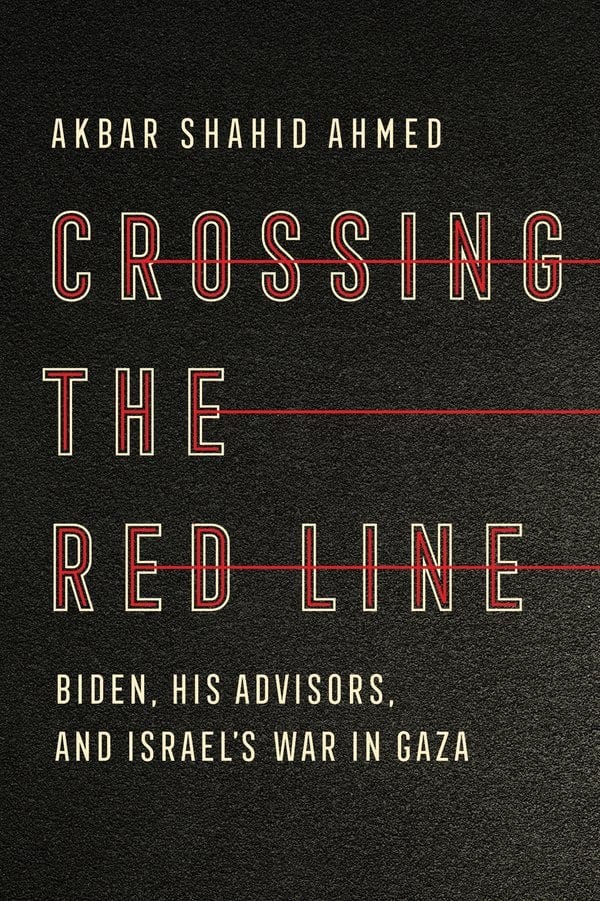
I sat down with Akbar Shahid Ahmed to discuss his new book, Crossing the Red Line: Biden, His Advisors, and Israel’s War in Gaza, an extraordinary feat of reporting based on interviews with more than 150 people inside the Biden administration. Even as someone who follows nearly every story from the region, I was genuinely shocked by several of the revelations Akbar shared.
As usual, we went longer—and more in-depth—than the typical podcast interview. But I think you’ll find our discussion engaging and illuminating all the way through. The conversation transformed my understanding of the Biden administration’s role in Israel’s genocide in Gaza, and I suspect you’ll have a similar experience.
Among the subjects we cover:
The suppression of damning reports and legal findings about Israel’s conduct in Gaza within the Biden administration
What a much-diminished Biden actually knew about the suffering in Gaza, and how his closest advisors controlled the information reaching him
Biden misleading Senator Bernie Sanders into holding back a Senate vote challenging weapons sales to Israel
Kamala Harris listening to a recording of Hind Rajab’s murder—and choosing not to act on what she heard
Secretary of State Antony Blinken’s refusal to sanction an Israeli military unit implicated in torture and sexual assault, despite concrete evidence and a recommendation from his own officials
Gaza as a testing ground for the tactics and legal justifications of future American wars
Hamas leaders’ surprise at just how much humiliation Biden was willing to tolerate from Israel
The Biden administration’s private acknowledgment of ethnic cleansing in the West Bank—and its decision to let it continue virtually unchecked
The key officials who facilitated Israel’s war in Gaza, their concerns about potential personal liability for aiding and abetting war crimes, and the prestigious new jobs many have since landed
The continuity between Biden and Trump, and how the former’s decisions laid the groundwork for the latter’s policies in Gaza and beyond
Akbar’s book is an invaluable contribution to the historical record of the Biden administration’s active role in the destruction of Gaza. Please consider picking up a copy here.
Lastly, to my Jewish subscribers, G’mar chatima tovah. May this Yom Kippur be an occasion not only for reflection and atonement, but for reckoning with what’s being done in our name.
Iran in their underground Fort. These commanders fell in battle, but the war goes on
“The West won the world not by the superiority of its ideas or values or religion […] but rather by its superiority in applying organized violence. Westerners often forget this fact; non-Westerners never do.” – Samuel P. Huntington
The White Empire took Asia by taking and remaking its forts, using superior cannon and siege weaponry. The Portuguese took the Strait of Hormuz in 1515 and the British took Perim in Bab el Mandeb in 1799 and they are only now being wrested free. How? The same way they were tooken. With superior forts, cannon, and siege weaponry.
Iran and the Axis of Resistance have redefined forts as being underground. Under entire mountains, as in Iran and Yemen, or even under a concentration camp as in Palestine, these have proven to be superior. We had forts before, but the colonizer always wrested them. Now the modern underground fort has been tested in war, and bested them.
The Axis of Resistance has also redefined cannon. While the Empire drifted away from land-based cannon, because they were always bombing people far from home, the people of the land innovated on them. Now Iran and Yemen have 'cannon' that can be fired from its mountain fortresses and quickly withdrawn, and the 'cannonball' can find their targets from across continents. It's a brave new day and the cowardly colonizers have little or nothing to do with it.
As Samuel P. Huntington said, the White Empire won the world by its superiority in applying organized violence and it loses it the same way. To superior, well-organized violence. A 21st century shift in weapons and tactics that they're on the wrong side of. The Empire occupied and monopolized trade around the world using fortresses and cannon and they lose their occupation bases and monopolies to superior cannon and fortress. As the Axis of Resistance has proven.
Historical Background
I will speak somewhat from memory here because Sri Lanka is dotted with forts (Galle, Matara, Jaffna, Mannar, Colombo), still with their cannon. I have a lived memory of them, and know how they changed hands over and over. First the Portugeuse, the Dutch, then the British. The cannon always pointed outwards, because they fought amongst each other, but the fortress was always there for our plundering. Now the Americans do it from a giant embassy, but it's the same thing. These forts have been here so long that it's easy to think that this is the only way to trade. Like that new Jewish saying, 'if I don't steal it, someone else will.' But this tyrannical sort of trade is, in fact, profoundly unnatural.
People traded fine around the Indian Ocean before the White Empire fortressified everything. We had Tamil sailors manning Chinese boats, coins from the Roman Empire, goods from the Muslim World. I'm not saying that people didn't fight, but there wasn't a monopoly of violence across the entire ocean. It's not some natural law that you need to trade this way, it is, in fact, a historical anomaly.
Speaking from Sri Lanka, the entire Indian Ocean has a longer history of trade that was just, trade. Zheng He (a Chinese Muslim) came here in the 1420s and gave us stuff. Ibn Battuta came even earlier in the 1300s, marking our connection to the Muslim World. We have had trade with India since time immemorial. None of these traders set up forts to violently extort us because they were traders. They had stuff and exchanged it, quite often more stuffthan us. Zheng He really just left gifts and bounced. Unlike broke-ass Europeans (not coincidentally turned white because they had so little solar energy), people in what's now called the Global South had plentiful energy (recorded on our coincidentally colored skin) and could trade amongs ourselves without depending on coercion. Always remember this, we didn't come looking for them, they came looking for us.
When the energy poor Europeans came here they actually didn't have much to trade with. All the violent tribes of Europe had to offer us was superior violence, so they took. Beginning with the Portugeuse they locked down trade using violence, such extraordinary violence that it required extraordinary cannon and forts. Then they monopolized our trade amongst each other (White people don't even use spices) and started sucking the profits (ie, energy) north. The Whites fought amongst each other for this monopoly trade so long that we think this it the only way to trade, but it's not. Such unnatural trade was only held in place by artificial violence. But nature is healing, inshallah.
What Iran is establishing is trade outside of this monopoly of violence. All Yemen wants is the same, the right to move around and exist on their own terms. Same for China, same for Russia, North Korea, Cuba, et cetera. This is what unites all of the White Empire's enemies, not their political systems, not their religion, not freedom or human rights or any other such marketing phrases used by inveterate slavers and inhuman corporations. The White Empire is run by Corporate AI, not humans, and it's never been personal, it's strictly business. They want a monopoly on trade and they attack any independent nation that threatens this.
When they first arrived, we hadn't evolved the organized violence to fight them because for centuries we hadn't needed it. Why would China need to violently impose trade with Sri Lanka when they had more stuffthan us? They could just come here and trade stuff normally, which they mostly didn't because they simply weren't interested. Why would the Muslim World pepper us with forts? We were happy to trade pepper for their fancy system. It's only when broke-ass Europeans came that they broke the system, and quite effectively played us against each other. There was a huge amount of energy released by them networking the continents (in their desparation) and for a brief period (500 years) they were able to profit from being middlemen with superior violence. Other people had, of course, evolved mostly land-based violence, but no one else was this aggressively amphibious (and later, avariciously avian).
At the beginning Whites (their energy poverty reflected on their skin) had little to trade but organized violence and weapons, which is to say they didn't trade they're terrorized and took shit. Remember, they came looking for us, we didn't come looking for them! Much of the trade that enriched Europe wasn't between us and them, but between ourselves, with them monopolizing the profits. For example, the Whites grew opium in India to violently force on China. Warmer peoples never resorted to such lows as inter-continental drug dealing because we were not that broke. We were really not prepared for the violence that came out of the Asian ghetto called Europe.
I can still see that violence dotted around my island as forts, and the historical lesson I learned over and over was that they fought over these forts, and whoever held the fort won. That's how Sri Lanka passed from the Portugeuse to the Dutch to the British to now the Americans (their Embassy is horrifyingly large). They violently controlled trade not just with them (which was negligible at first) but with each other (which was a lot, literally the world). The controlled trade with sieges then, now with sanctions, but it's the same phenomenon. Coming to its natural denounement. After many millions dead and the climate burning, unfortunately. Shout-out the whales, also, they got it the worst.
That's why what Iran, Yemen and the Axis of Resistance is doing is so important, led by the heroes of Palestine of course. They are taking the Empire's forts, one by one. They very physical occupation they girded us with. And they are outshooting the Empire's cannon, silencing the guns they used to extort the world. What Russia and China are doing is also important, one in hot war and the other trade war, a revenge best served cold. They are showing us that trade and development is possible with or without the Empire, and even against its worst intentions. It's taken long centuries but the natives are relentless and nature is healing, inshallah.
Present Foreground
That's the historical background, I guess, did I digress? Let's connect it back to the present, the rise of Bab el Mandeb to the Yemeni and the Strait of Hormuz to the Iranians, long centuries since losing them. Previously, I've spoken about how the Axis of Resistance is winning the missile and tunnel wars, ushering in a new paradigm of warfare. But is it really so new? What is a missile but a cannonball and what is a tunnel but a deeper fort? Yes, it's still just cannon and forts, the age-old battle betwixt shield and sword. The Persian Gulf is lost the same way the Portugeuse took it, through cannon and fort. This was how they held power and how they lose it. This is the only language colonizers understand, superior violence.
The great innovation of 21st century warfare has been tunnel forts and smart missiles (and drones). Palestine first showed it, in their daring escape from and resistance from under the concentration camp the Whites made of Gaza. Then Yemen showed the same model when they defeated the US Navy in the Red Sea. And Iran demonstrated the same thing when they not only held Iran but destroyed all the US bases surrounding them. The Portuguese conquered Hormuz in 1515 and it's taken over 500 years to get it back! But we got it, homies, we got it. And these guys have changed history.
Can you believe it? I see the same damned Portugeuse Fort in my own country, built by slave labor, passed among Whites so they can rape us, and I have to pinch myself. It's really happening. We're finally beating them. In West Asia, sure, but I'll take it as an Asian.
The White Empire today is still dependent on 20th century weapons which are, in many cases, worse than 15th century ones. Modern American forts are exposed containers and just regular buildings out in the sun. Their old forts were stone while the new ones are basically cardboard. And they do not have much modern cannon at all, they got so used to strafing the poor from air cavalry that their missile technology has barely evolved.
For many years the Empire has ruled by fiat, not forts, sanctions, not sieges. I usually say it's the same thing because it has the same effects, but these are not the same causes. The White Empire has ruled for decades not by the consent of the government but by the lack of concerted opposition. Iran accepted American bases across the Persian Gulf and other countries accepted American sanctions. People, more than we should have, forgave and were content to live under the White Empire. Iran wanted to lift sanctions through negotiation, Russia broached joining NATO, China preaches win-win at ever occassion. Despite them being degenerate thieves and rapists, we gave the White Empire every chance to preside as elder statesman, but they can't do it. White supremacy is the only content to White Empire and they have to go out the way they came in, violently. They know no other language.
Since the White Empire monopolized global trade it was held by force, literally by forts. And if you didn't like it you didn't get missives, you got missiles down the throat. This was the deal and they held it even after they lost the power to enforce it, by sheer inertia. I think there remained that foolish idea that Whites could become human and just trade like normal people if we gave them long enough but they can't and they won't and they forced the point themselves, by starting multiple land wars in Asia. The force was implied, but the minute they made it explicit, everyone could see that they were a spent farce.
Now they're losing fortress Ukraine in North West Asia and every base in South West Asia and can't even start in East Asia, though I don't put anything past them, who knows. They monopolized global trade using superior violence, made real through unassailable forts and assault weapons, and they lose their monopoly the same way, to superior tunnel forts and missiles and drones. But lose to what?
What Comes Next
The common thinking among even avowed anti-imperialists is still basically imperialist. They think some empire has to replace this one, like the succession of Portugeuse, Dutch, British, inscribed in Sri Lanka's historical forts and collective trauma. If I don't steal it, someone else will, as the new Jewish saying goes, or 'the dark forest theory' of Liu Cixin's Three Body Problem books. But this thinking is a historical anomaly we need to think beyond now. You can't be an anti-imperialist imperialist, but you can try and be yourself, in your own land, without hegemony imposed by air and sea.
Land-based empires, forts, trade wars, fine, that sort of fighting goes on all the time. But networks of naval bases to monopolize global trade? That's an anomaly that's seen its time. No one monopolized trade in the Indian Ocean the way the Whites did. Violent trade monopolies are not a necessary evil, they're just evil. I'm not saying there weren't trade disputes and that there wasn't violence and conquest, I'm saying that there wasn't a monopoly of violence sold as peace and a monopoly of conquest sold as freedom. There wasn't one energy flow with most surplus going north (the unipolar world), there was lots of trade going across, in a multipolar world. And that is what we can and inshallah are returning to.
Iran is not replacing the Persian Gulf bases (though I think those borders certainly need to be redrawn, make UAE Oman again and, hell, make Saudi Yemeni). If you look at the way the Axis of Resistance is structured, it's not proxies and buffer states like the Empire does (and accuses everybody else of). Iran is not trying to dominate Yemen, on the other side of the horn. And if you look at the way China operates, they're not monopolistic with its Belt and Road. And Russia isn't owning the new Arctic route. Everyone is trying to just do their own thing, and what the vanguard in Yemen is saying is either everyone can trade or no one can trade. This is kinda the way it was before. And this is possible.
This is what is at stake in World War III. The White Empire is fighting to hold on to the world by force, and the world is struggling to be free many different ways at once. There is no particular alliance between everyone fighting America, but they are all fighting for the same thing. Freedom. Freedom from what? Freedom from a monopoly of trade, that says everything has to go through them. And how is that freedom won? The same way it was lost, through cannon and fort.
This is similar to what I was surprised to have uncovered in my reporting on the coverup and protection of Jeffrey Epstein in my home state of New Mexico by powerful local law enforcement and political figures, many of whom are still in power.
Unlike Hersh’s conclusions, however, my conclusions indicate Epstein was also an asset of the CIA. The extreme harassment and physical attacks against me only began after I published a headline that said exactly that, which, if you’re trying to convince me I was WRONG about that, is a lousy strategy.
Regardless, I am glad to finally see someone of Hersh’s caliber reporting — albeit behind a paywall — that Epstein’s child sex trafficking ring and financial favors were not just the oddities of one depraved pedophile “financier” and his sparkly, quirky heiress girlfriend, but rather the modus operandi of United States and Israeli joint intelligence agencies conspiring to control powerful people in our own and foreign governments, royalty, banking and business, by using illegal sex acts and bribes to blackmail them into compliance, with compliance likely including sneaking nuclear weapons secrets to Israel out of New Mexico’s weapons labs. Full. Stop.
The entire United States government does not want its citizens to know any of this, because it would not be something most Americans would or could tolerate.
While the American public seems to have an insanely high tolerance for violence against migrants and criminalized Others, there does seem to be some sort of a line for most of them, drawn at “trafficking defenseless white American girls to rich men to blackmail them, and using our tax dollars to do it.” This is why no president has released the complete files or ever will. This is why the New Mexico Epstein “Truth” Commission is actually the opposite of truth. This is why I got hit with a directed energy weapon and run out of my own country, and then had that experience gaslit by Democrat-funding fake-news outlets on Substack. Neither party wants the files released, because, let’s face it: Neither party is really in charge of anything. Intelligence agencies are in charge. Ours, and Israel’s. With the help of Palantir.
A couple of weeks ago, I started getting a bunch of ranting, borderline-unhinged-sounding emails from a person who said they were an old guy in Santa Fe. They started with him asking me, repeatedly, for the details of my Paypal account so that he could send me $500. I did not respond.
I don’t use Paypal because years ago, when I owned a small scone bakery that supplied pastries to Albuquerque-area coffeeshops, that Paypal was hacked and used to clean out my entire bank account.
I ignored the emails, because I unfortunately get a lot of loony emails from a lot of people. I wish I didn’t. I wish I could have made enough money with the bakery to just spend my days making scones.
The same man continued to email me, despite my lack of response, this time to say he loved my work and had reached out to Seymour Hersh on my behalf, to ask him to work with me. He then sent me what he said was the reply from Hersh, saying something about how he would love to meet me and would be happy to fly out to wherever I was now to meet me, that I seemed to have the information he was lacking to put together all the pieces of an Epstein puzzle he was working on, that if I agreed to meet Hersh I would be rewarded by Hersh introducing me to “the most powerful literary agents in New York.”
I read it all, and felt a deep and dreadful unease.
First of all, I am not about to give any strangers my exact address right now — and this request to come meet me came at the same time several other entities, including my former literary agency in New York, the one that had connected me to a Zionist Hollywood go-agent who ghosted me the second I defending Palestinians, was suddenly trying to get my new address in Spain from me to send me two boxes of book that had been returned to them from one of my old addresses two years ago. Yeah, no.
Second, the idea that I would WANT to be introduced to the most powerful literary agents in New York was laughable. Been there, done that, never again, thanks. They’re almost all Zionists. They work with Zionist producers and executives in Hollywood, to catch and kill the kinds of books and stories I write, to control and destroy people like me. I am blacklisted in the New York publishing world and in Hollywood because of my outspoken stance on genocide always being wrong, even when Israel commits it.
So, naturally, I did not answer the old man in Santa Fe, even when he dangled Seymour Hersh and New York literary agents in front of me like some clueless carrot. (I created my own publishing company and digital news magazine in the past couple of years precisely because I do NOT want to work with the establishment in New York anymore.)
A few days passed, and the same guy then sent me an email that sounded like every email every woman who rejected an entitled narcissistic man of any kind has ever gotten — telling me things like “oh, you think you’re too good to answer me, huh?” and “I gave you $500, that should grant me access to you” and “at least an acknowledgement you got these emails,” the “bitch” was implied. Dear reader, this man never sent me money. But if he had, that would have been his choice and certainly not a ticket to enter my life nor find out where I live.
I mention all of this because the timing of … All Of This … seems off.
Why does Hersh, in this new article, go out of his way to say in his headline that Epstein was Mossad and FBI but not CIA? When paired with the strange emails from the supposed guy in Santa Fe, and his forwarded emails from the supposed Seymour Hersh, teamed up with the multiple attempts from multiple angles to figure out exactly where I am right now, after moving to another continent for safety … it all feels a bit … no se que.
That said, I am glad a famous and respected reporter like Hersh, a man with the accolades and institutional backing to be taken seriously by the rest of the corporate news media world, is finally saying what has been glaringly obvious to anyone who bothered to look.
Jeffrey Epstein was one of “ours.” And his child sex trafficking ring was OUR child sex trafficking ring.
That’s why you’re never getting the files. Because the horrors therin were the product of you own tax dollars, your own government, your own intelligence agencies. Because they are proof that the nation that for decades has done obscenities and atrocities to countless Others around the world was also fully capable of doing the same thing to its own people. The Epstein Files are the smoking gun that points to the moment the United States stopped belonging to its own people are began belonging to Israel and global oligarchs.
The files are not being withheld, as the DNC would like you to believe, just to protect Trump. It’s to protect the entire United States intelligence and defense community. It’s to protect the entire IDEA of what the United States even is.
In other words, Jeffrey Epstein and Ghislaine Maxwell operated a child-and-adult sex trafficking ring and Other Means of Bribery for decades, with the knowledge and support of the intelligence agencies of the United States of America and Israel. Even Seymour Hersh says so.
Maybe now, I won’t be the only voice out there willing to say it plainly.
Maybe now, your favorite “independent” journalists who have only been focusing on WHAT Epstein did will finally have the guts to talk about the terrifying WHY he did it at all: Because Uncle Sam and Israel wanted him to.
The last act of death is not mortality but the erasure of memory.
Chris Hedges ScheerPost
The tombstone for my grandparents, Ethel and Philip Prince, and my uncle, Maurice Prince.
MECHANIC FALLS, Maine — I am standing in Maple Grove Cemetery in Mechanic Falls, Maine. In front of me, within a radius of a few feet, are three rectangular granite headstones that read “HEDGES,” “BLAIR” and “PRINCE.”
Before me lie the remains of my parents, grandparents, two uncles and my aunt. The grass is parched and yellowed. There are small American flags placed in round metal holders, slightly askew, next to each gravestone.
All of the men were World War II veterans. My father was an Army sergeant in North Africa and the Middle East. Uncle Ellsworth was in the Merchant Marine and went back and forth in the North Atlantic convoys. Uncle Morris fought on Guadalcanal in the Solomon Islands and Luzon in the Philippines, where he was wounded. My grandfather, Philip Prince, an Army master sergeant, trained troops in Texas.
Besides being identified as veterans, there is little information available from these plots, although my father is named as the Rev. Thomas Hedges. The women, including my mother, who was an English professor, have almost nothing to identify them. Their names. Their dates of birth and death.
Patriarchy rules, even in death.
Service to the war machine of the state confers the ultimate status, especially in small, rural towns, although my father and Uncle Morris loathed war and the military. Uncle Morris returned from the South Pacific and drank himself to death as he struggled with physical and emotional wounds. My father, unlike my other relatives, refused to have a gun in the house. He became a pacifist after the war and an anti-war activist during the war on Vietnam. He told me as a boy that if the Vietnam War was still being fought when I was 18, and if I was drafted, he would go to prison with me.
I carry that image, my father and I, in a cell.
I feel grief and loss. But I also feel something else. These individuals loom large in my consciousness. They visit me in dreams. They carry the gargantuan imprint our immediate family makes on us, for good or ill.
I can summon up their faces and voices.
Small, insignificant moments in our lives, like old-time movie reels, play in my head. Fishing in trout streams with my grandfather. Duck hunting in icy waters on the Maine coast with Uncle Ellsworth. Sitting in a hard wooden pew during my father’s sermons. Arguing with my mother — which I did frequently — about William Faulkner, who I loved and who she did not. My slight and wickedly funny grandmother in her apron, cooking French toast on the white porcelain stove. Uncle Morris, disheveled and seated at my grandparents’ small kitchen table, his breath smelling of alcohol, which no one else in our family drank. Aunt Miriam, who we called Auntie Mim, who had no children and who doted on my sister, brother and me.
I always wanted to be a writer.
My mother, even before I could read, would type up my stories and staple them together in little pamphlets. When I arrived at my grandparents’ house, which burned down shortly after my grandmother died, I would climb upstairs to find yellow legal pads and neat rows of sharpened pencils laid out on a birdseye maple sewing table.
Lunch in rural communities is the big meal. Not dinner. My grandmother, when it was time to eat, would shout up the narrow stairs, “Christafa,” in the thick Maine accent that colored the speech of my relatives.
The red wooden barn, where swings hung from the thick beams for us as children and where I hand-tied fishing flies with my grandfather, is a pile of broken timber.
My grandfather, who smoked a pack of unfiltered Camel cigarettes a day and died at 85, unsurprisingly, of emphysema, would mix batches of Prince’s Insect Repellent in the barn. He poured it into small amber-colored glass bottles to sell to gun and tackle shops.
One afternoon, he took me out to the barn and made me put my hand on a Bible.
“Swear you will never tell this formula to anyone,” he intoned.
I promised.
He then made me doubly swear not to divulge it to my mother, his daughter. They had a fraught relationship, given his domineering personality and my mother’s formidable resistance.
Love is imperfect.
I am alone in the Maple Grove Cemetery. There is nothing to stop me from speaking to the empty space. I tell them I love them. I tell them I miss them.
I carry memories of a few dramatic intervals in our lives. Mostly, I carry mundane interactions of daily existence, which death makes sacred.
Thornton Wilder’s play Our Town is set in the fictional town of Grover’s Corners, New Hampshire between 1901 and 1913. In the play Emily Gibbs dies at 26 giving birth to her second child. She joins the dead in the town cemetery. She defies the advice of the departed townspeople around her and returns to earth to relive one happy day.
She goes back to the day of her 12th birthday. It is dawn.
No one from her past can see or hear her as she speaks to them.
“I can’t bear it,” Emily says as she watches her birthday celebration. “They’re so young and beautiful. Why did they ever have to get old?”
“Oh, Mama,” she implores, “just look at me one minute as though you really saw me. Mama, fourteen years have gone by. I’m dead. You’re a grandmother, Mama. I married George Gibbs, Mama. Wally’s dead, too. Mama, his appendix burst on a camping trip to North Conway. We felt just terrible about it — don’t you remember? But, just for a moment now we’re all together. Mama, just for a moment we’re happy. Let’s look at one another.”
“I can’t,” she goes on. “I can’t go on. It goes so fast. We don’t have time to look at one another.”
Emily breaks down sobbing.
“Take me back — up the hill — to my grave,” Emily says. “But first: Wait! One more look.”
She looks left, out past the audience and then to the right.
“Good-by, Good-by, world,” she says. “Good-by, Grover’s Corners…Mama and Papa. Good-by to clocks ticking…and Mama’s sunflowers. And food and coffee. And new-ironed dresses and hot baths…and sleeping and waking up. Oh, earth, you’re too wonderful for anybody to realize you.”
Emily and the other spirits watch the stars come out over Grover’s Corners. She admits she should have listened to them.
It was a mistake to return.
“Yes, now you know,” Simon Stimson, the bitter, alcoholic choirmaster, tells Emily. “Now you know! That’s what it was to be alive. To move about in a cloud of ignorance; to go up and down trampling on the feelings of those…of those about you. To spend and waste time as though you had a million years. To be always at the mercy of one self-centered passion, or another. Now you know — that’s the happy existence you wanted to go back to. Ignorance and blindness.”
“Simon Stimson,” Emily’s mother-in-law Mrs. Gibbs says, “that ain’t the whole truth and you know it.”
Emily’s husband George comes to the cemetery. He throws himself on her grave. He does not speak.
It is dusk in Maple Grove Cemetery. It is time to leave.
My generation will follow the generation before me. This is the ancient rhythm of existence.
Death comes faster than we imagine. It robs us of all that is most precious. I carry these dead with me. I will carry them until I, too, depart. They remind me of my obligation to the living. They remind me, as the poets and sages tell us, that life is sacred, that love must always be honored, that our existence is brief, that human beings are fragile, that one day the memories we carry will vanish, that we are made from dust, and to dust we will return.
Live, the dead whisper, while you can.
NOTE TO SCHEERPOST READERS FROM CHRIS HEDGES: There is now no way left for me to continue to write a weekly column for ScheerPost and produce my weekly television show without your help. The walls are closing in, with startling rapidity, on independent journalism, with the elites, including the Democratic Party elites, clamoring for more and more censorship. Bob Scheer, who runs ScheerPost on a shoestring budget, and I will not waver in our commitment to independent and honest journalism, and we will never put ScheerPost behind a paywall, charge a subscription for it, sell your data or accept advertising. Please, if you can, sign up at chrishedges.substack.com so I can continue to post my now weekly Monday column on ScheerPost and produce my weekly television show, The Chris Hedges Report.
Chris Hedges is a Pulitzer-prize winning journalist, best-selling author & activist
Editor’s Note:At a moment when the once vaunted model of responsible journalism is overwhelmingly the play thing of self-serving billionaires and their corporate scribes, alternatives of integrity are desperately needed, and ScheerPost is one of them. Please support our independent journalism by contributing to our online donation platform, Network for Good, or send a check to our new PO Box. We can’t thank you enough, and promise to keep bringing you this kind of vital news.
Once considered the standard bearer for the good life, for competent governance and a strong social state, Finland is unravelling at warp speed. What has gone wrong so quickly?
In three words, NATO, austerity and Russophobia.
All are linked. Finland is slashing its social state to the bone to meet NATO’s 5% GDP military spending target, a target which became necessary after the country abandoned neutrality and swapped the welfare state for the warfare state after Russia’s invasion of Ukraine.
The speed of the collapse has been stunning.
In 2019, the at-risk of poverty rate was 11% and by 2022 the country was on course to hit record low unemployment.
Everything changed after Russia’s invasion of Ukraine and the country’s hysterical over-reaction to an imagined threat. This is not just my judgement. A number of Finnish academics, including Heikki Patomäki, professor of world politics at the University of Helsinki, have said that the conditions simply did not warrant Finland joining NATO, cutting off its economically valuable links to Russia and militarising its border.
The facts support this.
At the time of its invasion of Ukraine, Russia had just a couple of thousand troops spread out across various bases on its 1,340 km border with Finland. The bases were home to handful of missile defence batteries and a few dozen tanks. Many of the troops and much of the equipment was subsequently deployed to Ukraine, leaving the bases empty. There was obviously no invasion threat, and Putin in May 2022 emphasised this in a phone call to Finland’s then-president Sauli Niinistö.
But by this point, the Russophobia and hysteria for NATO membership had begun to take on a life of its own. Sanna Marin, Finland’s young female prime minister at the time, and a liberal media darling, was a particularly effective saleswoman. Despite claiming in the days following Russia’s invasion that there was no threat, her tone became decidedly more hawkish in the months that followed. She said Russia “poses a threat to all of us” and began talking like a war-time leader, saying in September 2022 that “Russia may challenge Finland, blackmail us and threaten us, but we will not give in.” Bear in mind, Russia at this point had practically zero troops and equipment on its western border with Finland. The Russian threat she was invoking was entirely imagined, an hallucination.
Nevertheless, in April 2023, Finland joined NATO, just days after Marin was defeated by the right and far-right in an election where the policy choice on Russia was one of uniformity, with the conservatives, the ethno-nationalists and Marin’s social democrats all singing the same tune.
After her defeat, Marin scuttled off to work for Tony Blair, while the new conservative-nationalist government set about decimating Finland’s welfare state to pay for the privilege of NATO membership.
The Finnish government is now a substantial way through its programme to cut €9 billion of public spending by 2027, including large reductions to social security (including housing, child, and unemployment benefits) healthcare, education, and municipal funding budgets, while it also increasing taxes on average earners. Cuts to healthcare provision have been particularly brutal, including a large reduction in hospital staff numbers, elderly care and disability services while redefining “minimum service obligations” to justify providing patients with lower quality care. The government has also slashed funding for organisations working on peace and initiatives which would address the new cold war-style relations with Russia.
In addition, the new government fully closed all the border crossings with Russia that Marin’s Social Democrats had partially closed, and began building large sections of a border fence, securitised with troops, night vision cameras and motion detectors.
And while the entire country is now suffering as a result of the pro-war paranoia that has gripped Finland’s leaders, its border towns have taken a particular beating.
Before the war, Russians routinely crossed to shop, eat, stay in hotels and visit holiday properties they owned in the towns and villages along the border. That has all gone away. One estimate cited in a recent Finnish study puts the loss of Russian tourism in the border region of South Karelia at as much as €1 million per day. Unemployment in some border regions is now approaching 20%.
The border also used to be an important commercial gateway between the EU and Russia, but its closure eliminated much of the road freight and transit business. The OECD says eastern Finland has gone from being an “economic gateway” to a “security barrier,” a transformation which of course it praises rather than mourns, claiming that confronting Russia is important not only for Finland but for Europe as a whole.
Then there are the commodities like gas and timber.
As for timber, in 2021, 70% of Finland’s wood imports came from Russia, and this wood supplied approximately 10% of all the raw wood used by Finnish industry. Pulp mills in Finland subsequently went bust and the industry faced shortages which persist to this day after the EU, with Finland’s support, banned countries from buying wood from Russia.
Finland’s decisions, both independently and collectively through the EU, have immiserated many millions of Finnish citizens. Yet at the same time as the country is slashing the social state, it is spending more money than ever, around $8.1 billion in 2025, on weapons of war to fight a threat that previously didn’t exist. A threat that Finland has made real by its new-found anti-Russia NATO militancy, with Putin promising to respond to Finland’s border build-up.
And among the beneficiaries of a new tooled-up and aggressive Finland are the arms dealers of the Israeli apartheid-genocide complex, which in 2024 sold Finland its questionably functional “David’s Sling” air defence system for €316 million. Finland has also bought tank and ship missiles from the Israeli company Rafael which supplied most of the weapons and equipment used to commit the genocide of Gaza. The Finnish government said Israel’s genocide of Gaza would not stop it buying weapons from the country, a position which is par for the course among the morally bankrupt leaders of Europe.
It’s all utterly deranged, but completely unsurprising given the Russophobia which pervades all European halls of power and has become embedded on the continent.
Finland has effectively taken a scythe to all the things that made it, in the eyes of many, the envy of the world. The country has trashed the model which delivered such a high standard of living, a model which included neutrality and good relations with Russia.
Instead the country has enacted a self-imposed structural adjustment programme to pay for membership of a military alliance it didn’t need, with that membership creating an enemy that didn’t exist, an enemy which happens to be a nuclear superpower with which it shares a huge border.
The price has been, and will continue to be a steep one, and it is a price ordinary Finns will be paying for a long time.
But it is not just in Finland.
We are watching, across Europe, the shameful replacement of the welfare state with the warfare state while the merchants of genocide and death laugh all the way to the bank.
(All my work is free to read but takes time and effort to put together, so if you appreciate it please consider upgrading or making a donation here.)
 Log in


 reply
reply